SMS Marketing Compliance

SMS Marketing Compliance for USA Dentists

SMS Marketing Compliance

In the current dental landscape, clinical excellence is the baseline, not the differentiator. You can be the most skilled clinician in your region, but if your chairs are empty because of a leaky “front desk bucket,” your expertise is effectively sidelined.

Most dental clinic owners face the same mounting pressures: rising overhead, front-desk burnout, and a patient base that increasingly ignores phone calls but responds to texts within minutes. While the shift to text-based communication is the most effective way to stabilize revenue, it introduces a significant operational hurdle: SMS marketing compliance.

Navigating the transition from manual outreach to automated systems requires more than just a software subscription; it requires a strategic understanding of how to balance patient engagement with the strict legal frameworks of the TCPA (Telephone Consumer Protection Act) and 10DLC (10-Digit Long Code) regulations.

What Intelligence Means in a Dental Clinic

In a high-performing clinic, “intelligence” is not a measure of the staff’s IQ, but rather the quality of the systems they operate. A clinic relying solely on human memory is a clinic destined for chaos.

System intelligence means that when a patient cancels an appointment, the system knows it immediately. It doesn’t wait for a receptionist to find a spare moment to call the waitlist. Instead, it triggers a sequence that offers that slot to high-priority leads.

True intelligence in dental operations involves:

  • Centralized Data: Knowing exactly where every lead came from and where they are in the treatment plan.
  • Predictable Communication: Ensuring every patient receives the same high-standard follow-up, regardless of how busy the office is.
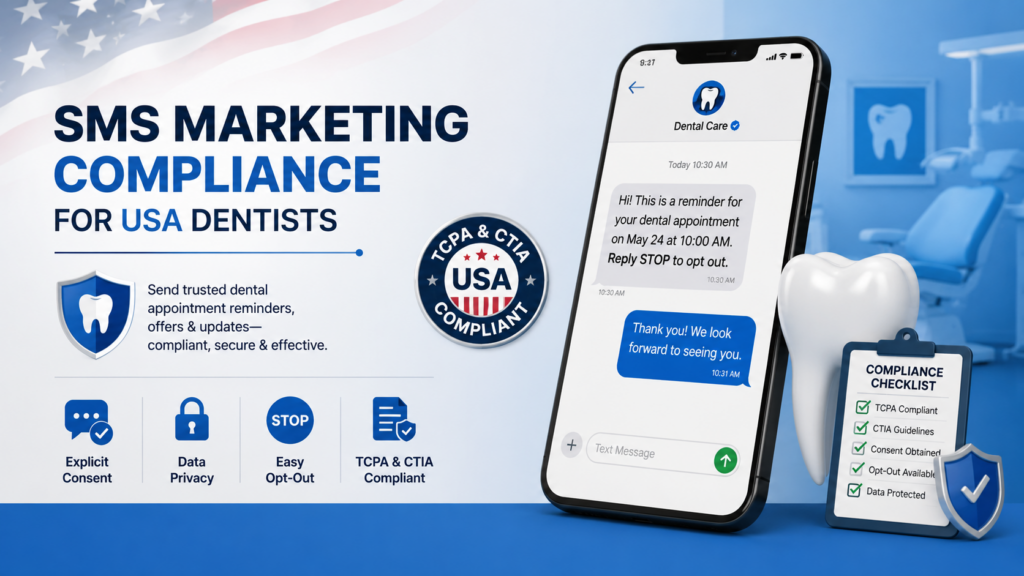
  • Risk Mitigation: Automating SMS marketing compliance so that your practice never accidentally sends a message to a patient who hasn’t opted in.

Human Intelligence vs. System Intelligence

We often over-rely on our front-desk teams to perform tasks that are better suited for machines. We ask them to remember to follow up with “no-shows,” to manually text appointment reminders, and to “keep an eye” on missed calls.

This is an inefficient use of human intelligence.

Your staff’s intelligence should be reserved for high-value tasks: empathetic patient interaction, resolving complex insurance disputes, and presenting treatment plans in the chair. System intelligence handles the repetitive, the mundane, and the technical—like tracking opt-ins for SMS marketing compliance and ensuring that every automated text includes a clear “Stop” to unsubscribe.

The Role of AI and Automation in Modern Dentistry

The introduction of automation platforms like GoHighLevel has changed the “infrastructure” of the dental office. It serves as a digital nervous system that connects your marketing efforts to your actual chair time.

By using a centralized CRM, a clinic can automate the “Missed Call Text Back.” If a potential new patient calls and the line is busy, the system immediately sends a text: “Sorry we missed you! We’re currently helping another patient. How can we help you today?”

This single automation can prevent thousands of dollars in “leakage” every month. However, for this to work effectively and legally, your platform must be configured for SMS marketing compliance. This includes registering your brand with mobile carriers and ensuring your messaging workflows respect quiet hours and opt-out requests.


Implementing Structure Over Chaos

If your clinic is currently managing patient follow-ups via sticky notes or unorganized spreadsheets, you are operating with significant blind spots. Transitioning to a structured CRM allows you to see exactly which marketing channels are providing a return and which are simply wasting your budget.

Note: The link below is an affiliate link. I only recommend systems that align with structured clinic growth.

[Start Building a Smarter Dental System]([INSERT YOUR AFFILIATE LINK HERE])


Real-World Scenario: The High-Cost of the “No-Show”

Consider a clinic that averages two no-shows per day. If the average appointment value is $250, that is $500 a day, or $10,000 a month in lost revenue.

Most clinics try to solve this by having the receptionist call the day before. But people don’t answer their phones. A compliant, automated SMS reminder system—sending texts at 48 hours, 24 hours, and 2 hours before the appointment—can reduce no-shows by up to 80%.

The “Intelligence” here isn’t just sending the text; it’s the system’s ability to recognize a “Confirm” reply and automatically update your schedule, or flag a “Cancel” reply so the front desk can fill the spot immediately.

Common Mistakes in Dental SMS Marketing

Many dental owners jump into texting patients without a strategy, leading to two major issues:

  1. Compliance Violations: Sending “marketing” messages (like “10% off whitening”) to patients who only opted in for “operational” messages (like appointment reminders).
  2. Over-Automation: Sending too many messages, which leads to patients blocking the clinic’s number.

To maintain SMS marketing compliance, your system must distinguish between transactional and promotional content. Transactional messages have more leeway, but promotional messages require explicit, documented consent.

The Future of the Structured Clinic

The dental industry is moving toward a model where the “Back Office” is almost entirely automated. The future belongs to the “Smarter Clinic”—one that uses a CRM to track the patient lifecycle from the first Google search to the five-year recall.

In this model, SMS marketing compliance is not a hurdle; it’s a standard operating procedure. By utilizing tools like GoHighLevel, you can ensure that your clinic stays ahead of the curve, maintaining professional communication while safeguarding your practice against regulatory scrutiny.


Taking Control of Your Practice Operations

Systematizing your outreach doesn’t just increase revenue; it decreases the “noise” in your daily operations. When the system handles the follow-ups, your team can focus on the patient standing right in front of them.

[Start Building a Smarter Dental System]([INSERT YOUR AFFILIATE LINK HERE])


Many dental clinic owners operate on “gut feelings” or estimates, but an intelligent system provides real-time, actionable data. When you integrate SMS marketing compliance with a robust CRM, you aren’t just sending messages—you are harvesting valuable data that creates a roadmap for clinical growth.

Understanding Patient Behavior Through Analytics

Every automated text your system sends is a data point. If your “No-show” rate spikes on specific days or for specific procedures, an intelligent system reveals these trends immediately.

  • Conversion Tracking: You can see exactly which SMS campaign generated the most consultations, allowing you to stop wasting money on underperforming ads.
  • Patient Engagement Scores: Identify which patients respond instantly and which have become inactive, allowing for targeted re-engagement.
  • True ROI Visibility: You gain the clarity to see exactly how every dollar spent on automation translates into realized revenue at the chair.

Scaling Without Increasing Overhead

A common mistake among dentists is hiring more staff the moment revenue starts to grow. However, new staff members mean higher overhead, more management headaches, and extensive training time. Intelligent systems allow for “Vertical Scaling”—the ability to handle a higher volume of patients using your existing team and resources.

When your system handles lead nurturing according to SMS marketing compliance standards, your front-desk team is liberated from the burden of manual follow-ups and cold calling. They can shift their focus to high-value tasks, such as in-person patient experience and treatment plan acceptance.


Systems as a Practice Asset

Consider the long-term value of your practice. If you decide to sell your clinic in the future, a buyer isn’t just looking at your dental chairs and equipment; they are looking at your System. A clinic with an automated lead flow, compliant patient communication, and a predictable revenue model carries a significantly higher market valuation than a “manual” practice.

Note: The link below is an affiliate link. I only recommend systems that align with structured clinic growth.

[Start Building a Smarter Dental System]([INSERT YOUR AFFILIATE LINK HERE])


Operational Excellence: The “Silent” Growth Engine

Growth is not just about acquiring new patients; it is about plugging the holes where revenue is currently leaking. In most dental clinics, the largest source of lost income is “Treatment Ghosting”—patients who hear a treatment plan but never book the appointment.

Automated Treatment Plan Follow-ups

An intelligent system never “forgets” a patient. Within the boundaries of SMS marketing compliance, a CRM can trigger “educational” follow-ups. Instead of a high-pressure sales call, the system sends clinical insights regarding the risks of delaying treatment. These “soft touches” are documented to be 40% more effective at bringing patients back than sporadic manual phone calls.

Managing Privacy and Reputation

Reputation management is a cornerstone of modern dentistry. Immediately following an appointment, your system can automatically send a feedback request via SMS. If the feedback is positive, the system prompts a Google Review; if it is negative, it alerts the manager privately to resolve the issue before it reaches the public. This entire process is handled within a legal, compliant framework that protects the clinic’s integrity.

Strategic Conclusion: The Leap from Dentist to CEO

When you separate the clinical work of dentistry from the operational systems of the business, you transition from being a “Doctor” to a “Business Owner.” SMS marketing compliance is not merely a legal hurdle—it is a professional bridge between you and your patient. By adopting these systems, you reduce burnout, eliminate chaos, and transform your clinic into a modern, high-revenue machine.

Conclusion: Systems Over Sweat

Growth in a dental practice is often mistaken for “working harder.” But there is a ceiling to how hard you and your staff can work. There is no ceiling to how well a system can perform.

By focusing on SMS marketing compliance and integrating a robust CRM, you move from a reactive state—chasing missed calls and no-shows—to a proactive state where your practice grows predictably. Intelligent systems are the only way to achieve revenue stabilization without professional burnout.


FAQs on SMS Marketing Compliance and Dental Operations

1. What is the most important part of SMS marketing compliance for dentists? The most critical element is “Prior Express Written Consent.” You must have a record that the patient agreed to receive text messages from your practice, specifically for the type of content you are sending (marketing vs. informational).

2. Is a simple “Opt-In” box on my website enough? It’s a start, but your “Opt-In” language must be clear. It should state that message and data rates may apply, the frequency of messages, and provide a link to your privacy policy and terms of service.

3. What happens if I ignore 10DLC registration? If you use a platform like GoHighLevel without completing 10DLC registration, mobile carriers (like Verizon or AT&T) may block your messages entirely or flag them as spam, meaning your appointment reminders will never reach your patients.

4. How does automation help with missed call recovery? An automated system detects when a call to your clinic goes unanswered. It can immediately trigger a text message to the caller. This keeps the lead engaged and prevents them from calling the next dentist on the Google search results list.

5. Can I use my personal cell phone to text patients? This is highly discouraged for both HIPAA and SMS marketing compliance reasons. Personal phones do not provide the audit trail or the automated “Opt-Out” mechanisms required by law to protect your practice.

6. Does GoHighLevel integrate with my existing Dental Practice Management Software (PMS)? While many CRMs operate alongside your PMS, tools like GoHighLevel can often be synced via third-party integrators (like Zapier) or used as a powerful “front-end” to manage all lead generation and initial patient communication before they are officially entered into your clinical record.

Dental Lead Nurturing

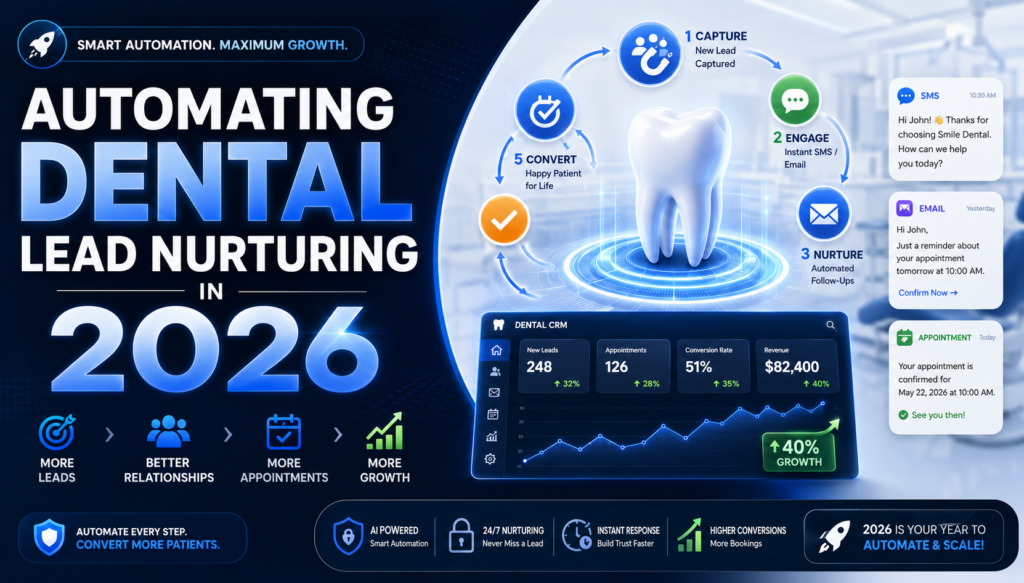
Automating Dental Lead Nurturing in 2026

Dental Lead Nurturing

SEO Title: The Systems-First Approach to Dental Lead Nurturing: A Guide for Clinic Owners Meta Description: Explore why dental lead nurturing fails at the front desk and how implementing structured automation and CRM systems like GoHighLevel can stabilize clinic revenue.

Beyond the Chair: Why Systems, Not Just Dentistry, Drive Clinic Growth

For most dental clinic owners, the day doesn’t end when the last patient leaves the chair. It ends hours later, after reviewing stagnant production numbers, chasing unconfirmed appointments, and wondering why the expensive marketing campaign from last month resulted in a flurry of clicks but a desert of new patients.

The reality of modern practice management is sobering: You can be the most skilled clinician in your region, but if your operational infrastructure is porous, you are losing more revenue than you are generating. Clinical excellence gets patients back in the door; dental lead nurturing and intelligent systems get them through it the first time.

In this guide, we will strip away the marketing fluff and look at the clinical-grade operations required to stabilize revenue, reduce front-desk burnout, and reclaim your time.

1. The Operational Pain Points: Where Clinics Bleed Revenue

Most dental practices operate in a state of “managed chaos.” The front desk is the heartbeat of the clinic, but it is also the primary bottleneck. On any given Tuesday, your receptionist is juggling:

  • Checking in arriving patients.
  • Processing insurance claims.
  • Answering inbound inquiries.
  • Chasing no-shows.

When the phone rings while a patient is standing at the counter, something has to give. Usually, it’s the phone. A missed call in a dental clinic isn’t just a missed conversation; it is a lost high-value procedure. If your average patient lifetime value is $1,500 and you miss five new patient inquiries a week, you aren’t just “busy”—you are losing $7,500 in potential production every seven days.

Furthermore, the “leaky bucket” syndrome is real. Many clinics spend thousands on SEO or social media ads to generate leads. However, if those leads aren’t contacted within five minutes, the conversion rate drops by nearly 400%. Without a structured system for dental lead nurturing, you are essentially paying for leads that your staff doesn’t have the bandwidth to catch.

2. What “Intelligence” Means in a Dental Clinic

In the context of healthcare operations, “intelligence” is often a misused buzzword. In a high-performing clinic, intelligence isn’t about complex algorithms; it’s about predictability.

An intelligent clinic is one where the owner knows exactly:

  1. How many leads entered the funnel this week.
  2. The exact stage of every “pending” treatment plan.
  3. The cost of acquisition versus the actual production per lead.

Growth does not come from working more hours. It comes from shifting the burden of “memory” from humans to systems. When your staff has to remember to call back a lead, they will eventually fail. When a system is programmed to never forget, the clinic thrives.

3. Human Intelligence vs. System Intelligence

We often over-rely on “Human Intelligence.” We hire a “great” office manager and hope they stay forever. But hope is not a strategy. Human intelligence is for empathy, complex problem-solving, and patient comfort.

System Intelligence is for the repetitive, the mundane, and the data-driven.

  • Human: Noticing a patient hasn’t been in for 6 months and making a mental note to call them.
  • System: Automatically triggering a personalized SMS and email sequence the moment a patient hits the 180-day mark since their last hygiene visit.

By implementing structured dental lead nurturing, you allow your team to focus on the person in front of them while the “digital twin” of your clinic handles the follow-up in the background.

4. The Role of AI & Automation in Modern Dentistry

This is where the transition from a traditional office to a modern “Smarter Clinic” happens. Automation tools, specifically CRM (Customer Relationship Management) platforms like GoHighLevel, act as the central nervous system of your practice.

Marketing alone is not enough; to truly scale your clinic, it is essential to understand the complete approach to dental practice automation so that your system operates without any interruptions.

Instead of having your patient data scattered across a legacy Practice Management Software (PMS), a spreadsheet, and post-it notes, a CRM centralizes communication.

Missed Call Text-Back: The First Line of Defense

One of the simplest yet most effective automations is the “Missed Call Text-Back.” If a prospective patient calls and no one answers, the system immediately sends a text: “Hi, this is [Clinic Name]. Sorry we missed your call! How can we help you today?” This keeps the lead from calling the dentist down the street and initiates dental lead nurturing instantly.

Automated Lead Tracking

When a lead comes in from your website or a Facebook ad, it shouldn’t just sit in an email inbox. It should automatically populate into a visual “pipeline.” You can see exactly who has been contacted, who has booked, and who needs a follow-up. This visibility eliminates the “I think we called everyone” guesswork.

Think of it this way—if your clinic loses even 5 missed calls per week, that’s silent revenue walking away. A structured automation system prevents that by ensuring every inquiry receives an immediate, professional response.

Note: The link below is an affiliate link. I only recommend systems that align with structured clinic growth.

[Start Building a Smarter Dental System](INSERT YOUR AFFILIATE LINK HERE)

5. Real Clinic Scenarios: Systems in Action

Let’s look at two hypothetical clinics to see how dental lead nurturing changes the math.

Clinic A: The Manual Practice

Clinic A spends $2,000 on ads. They get 40 leads. The front desk calls them when they have time. They reach 15 people, 8 book, and 2 don’t show up. Total new patients: 6. The office manager is stressed, and the doctor feels the ads “didn’t work.”

Clinic B: The Automated Practice

Clinic B spends the same $2,000. They use a system like GoHighLevel.

  1. Instant Engagement: As soon as a lead is submitted, the system sends an SMS.
  2. Nurture Sequence: Leads who don’t book immediately get a series of educational emails about the clinic’s technology and patient testimonials over the next 4 days.
  3. No-Show Protection: Once booked, the patient receives a multi-channel reminder (SMS, Email, and a 24-hour confirmation request).
  4. Result: They reach 30 people, 22 book, and because of the robust reminders, only 1 misses the appointment. Total new patients: 21.

The difference isn’t the quality of the dentistry; it’s the dental lead nurturing system that ensured no one fell through the cracks.

Managing a clinic’s growth shouldn’t feel like a second job. By utilizing professional-grade infrastructure, you gain visibility into your lead flow and can finally stop the “feast or famine” cycle of patient bookings.

[Start Building a Smarter Dental System](INSERT YOUR AFFILIATE LINK HERE)

6. Common Mistakes in Dental Lead Nurturing

Even when clinic owners decide to automate, they often fall into these traps:

  • The “Set and Forget” Fallacy: Automation is a tool, not a replacement for staff. You need to review your pipeline weekly to ensure the “human” handoff is happening correctly.
  • Over-Automating Empathy: Patients can tell when a bot is talking to them. Your automation should sound like your front desk—warm, professional, and helpful.
  • Ignoring the Data: If your system shows that 50% of your leads are dropping off after the first text, your messaging needs to change. Use the data to iterate.
  • Software Overload: Using ten different tools for ten different tasks. A unified CRM prevents “data silos” where information gets lost between platforms.

For a deeper dive into healthcare operational standards, you can refer to the American Dental Association (ADA) guidelines on practice management, which emphasize the importance of maintaining consistent patient communication.

7. The Future of Structured Clinics: Revenue Stabilization

The dental industry is becoming increasingly competitive. With the rise of DSOs (Dental Support Organizations), private practices must operate with the same level of efficiency as large corporations without losing their “local doctor” feel.

Revenue stabilization comes from predictable retention. An automated system doesn’t just find new patients; it keeps the ones you have. It sends birthday greetings, requests Google reviews (crucial for local SEO), and reactivates patients who haven’t had a cleaning in over a year.

By moving away from manual entry and toward a systematic approach, you reduce the “cognitive load” on your team. A happy, unburdened staff provides better patient care, which in turn leads to higher retention. It is a virtuous cycle powered by technology.

Before you invest another dollar into “more marketing,” consider if your current foundation can actually hold the weight of new growth. True scale requires a system that works while you are in the operatory.

[Start Building a Smarter Dental System](INSERT YOUR AFFILIATE LINK HERE)


Conclusion: The Path Forward

Dental growth does not come from better dentistry alone—it comes from intelligent systems.

As a clinician, your time is best spent solving complex oral health issues, not chasing leads or worrying about missed calls. By implementing a robust dental lead nurturing strategy through tools like GoHighLevel, you bridge the gap between “getting a lead” and “starting a treatment plan.”

The clinics that will thrive in the next decade are those that treat their operations with the same precision they treat a root canal. It’s time to stop the leak, automate the mundane, and get back to the art of dentistry.


Frequently Asked Questions (FAQs)

1. What exactly is “Dental Lead Nurturing”?

It is the process of building relationships with prospective patients at every stage of their journey. This includes instant responses to inquiries, follow-up emails for unbooked appointments, and educational content that builds trust before they ever sit in your chair.

2. My front desk is already tech-savvy. Why do I need a CRM like GoHighLevel?

Even the best staff can only do one thing at a time. A CRM allows your staff to scale their efforts. It ensures that 100% of leads are contacted within seconds, which is physically impossible for a human juggling in-office tasks.

3. How does automation help with no-shows?

Automation allows for a “multi-touch” reminder system. Instead of one phone call that usually goes to voicemail, a system can send a text 48 hours before, an email 24 hours before, and a final SMS 2 hours before the appointment, significantly increasing confirmation rates.

4. Is this complicated to set up?

While initial setup requires a strategic approach, systems like GoHighLevel are designed to be “user-friendly” once the workflows are built. Many clinics use pre-built “snapshots” or templates specifically designed for dental workflows.

5. Does this replace my current Practice Management Software (like Dentrix or EagleSoft)?

No. A CRM works alongside your PMS. Your PMS handles clinical records and billing; the CRM handles the “marketing and communication” engine that feeds the PMS.

6. Will patients find automated texts annoying?

Not if they are useful. Patients appreciate the convenience of being able to confirm an appointment via text or getting a quick reply to a question. The key is to keep the tone professional and helpful, rather than “salesy.”

Dental Landing Page Templates

5 Dental Landing Page Templates that Convert

Dental Landing Page Templates

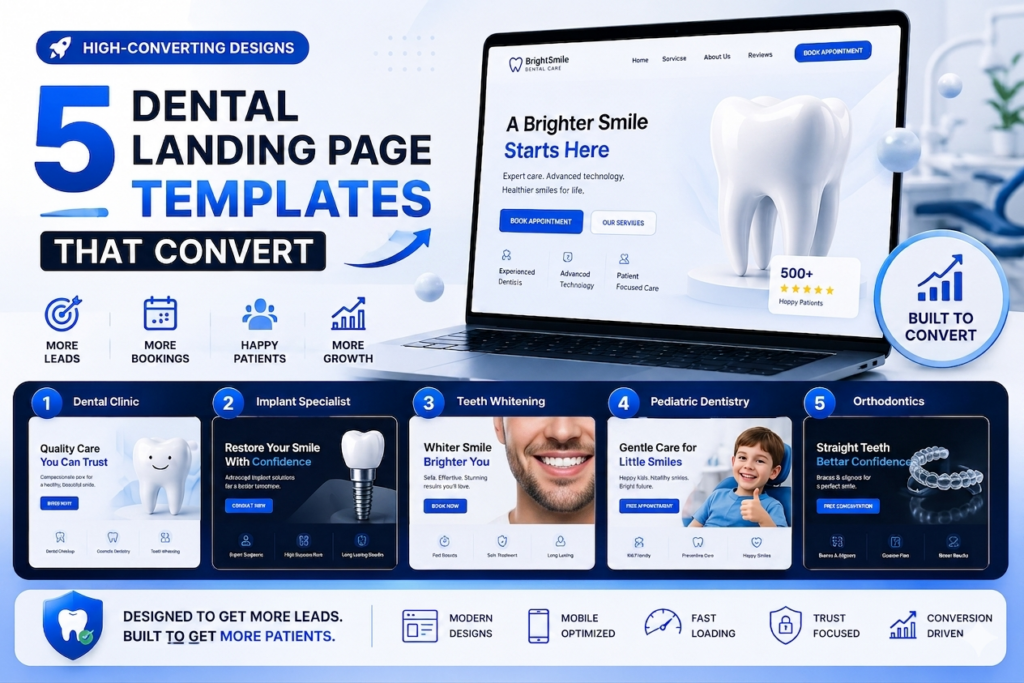
“For many clinic owners, the day ends not with a sense of clinical pride, but with operational exhaustion. You may have performed a perfect molar root canal or a flawless set of veneers, yet the ‘leaks’ in your business remain: a half-empty Friday schedule, a stack of unreturned voicemails, and the high cost of patient acquisition. Often, these leaks happen because the initial patient connection is weak; without high-converting Dental Landing Page Templates to capture and qualify leads effectively, even the best marketing efforts fail to result in long-term retention.”

The reality of modern practice management is sobering. Clinical excellence is the baseline—it’s what keeps your license. But operational intelligence is what keeps your doors open and your staff from burning out. To move from a chaotic practice to a scalable business, the shift must move away from “working harder” and toward “building better systems.”

What Intelligence Means in a Dental Clinic

In a clinical setting, intelligence is diagnostic. It’s the ability to read a 3D CBCT scan or identify a hairline fracture. In a business setting, intelligence is predictability.

An “intelligent” clinic is one where the owner knows exactly how many leads are in the pipeline, why patients are cancelling, and how much revenue is lost to missed calls every month. Most dental offices operate in a “reactive” state. They react to a cancellation by calling a few people on a manual list. They react to a slow month by asking for more marketing.

A systemic approach replaces reaction with automation. It treats the patient journey—from the first Google search to the five-year recall appointment—as a structured workflow rather than a series of disconnected events.

The Intersection of Human and System Intelligence

1. Human Intelligence: The High-Value Touch

Your front-desk team and your dental assistants are your greatest human assets. However, in many clinics, these high-value individuals are relegated to low-value tasks. When a receptionist spends four hours a day playing “phone tag” to confirm appointments, their human intelligence is being wasted.

Human intelligence should be reserved for:

  • Building empathy with anxious patients.
  • Explaining complex treatment plans.
  • Navigating insurance nuances.
  • Managing the in-office patient experience.

2. System Intelligence: The Digital Backbone

System intelligence handles everything that is repetitive, logic-based, and time-sensitive. This is where Dental Landing Page Templates, automated SMS flows, and CRM (Customer Relationship Management) systems come into play.

A system doesn’t forget to follow up. A system doesn’t get tired at 4:30 PM on a Friday. When you integrate a platform like GoHighLevel, you are essentially hiring a digital manager that works 24/7 to ensure no patient falls through the cracks.

AI and Automation: The New Infrastructure

The word “automation” often scares practitioners who fear losing the “personal touch.” In reality, automation protects the personal touch by ensuring the administrative noise is handled quietly in the background.

“System intelligence har us kaam ko sambhalti hai jo bar-bar hota hai aur waqt ka taqaza karta hai. Yeh wahi jagah hai jahan Dental Landing Page Templates, automated SMS flows, aur CRM systems apna kirdar ada karte hain. Yaad rakhein, aik behtareen landing page lead to capture kar leta hai, lekin asal kamyabi tab milti hai jab aap complete dental practice automation system implement karte hain taake follow-up ka nizam khud-kar ho jaye. Aik system kabhi follow-up karna nahi bhoolta aur na hi thakta hai.”

By utilizing structured platforms, clinics can centralize:

  • Missed Call Text-Back: If a prospective patient calls and your line is busy, the system immediately sends a text: “Sorry we missed you! We’re helping another patient. How can we help you today?” This prevents them from calling the dentist down the street.
  • Automated Lead Nurture: When someone downloads a guide or interacts with your Dental Landing Page Templates, the system follows up over 5 days with educational content, building trust before they even speak to a human.
  • Recall Automation: Instead of manual lists, the system identifies patients who haven’t been in for 6 months and triggers a personalized re-engagement sequence.

Think of it this way—if your clinic loses even 5 missed calls per week, that’s silent revenue walking away. A structured automation system prevents that. Note: The link below is an affiliate link. I only recommend systems that align with structured clinic growth.

[Start Building a Smarter Dental System](INSERT YOUR AFFILIATE LINK HERE)

Real Clinic Scenarios: Systems vs. Chaos

Scenario A: The No-Show Trap

The System-less Clinic: A patient books a $2,000 crown prep. The office sends one manual reminder call 24 hours prior. The patient forgets, misses the call, and doesn’t show. The chair sits empty, and the fixed costs (staff, rent, utilities) for that hour result in a net loss.

The Intelligent Clinic: The booking triggers a “sequence.” The patient receives a confirmation text instantly, an email with pre-op instructions 3 days prior, and a “reply to confirm” SMS 24 hours before. If they don’t reply, the system alerts the front desk to call specifically that one person. The gap is filled, or the appointment is saved.

Scenario B: The Marketing Leak

Many dentists spend thousands on SEO and ads but have no idea why their conversion rate is low. Often, the issue is the “destination.” Using high-converting Dental Landing Page Templates ensures that when a patient clicks an ad, they land on a page designed for conversion, not just a generic homepage.

Linking these templates to an automated CRM means that the moment a lead enters their info, they are tagged, tracked, and contacted. You can see exactly which marketing dollars turned into actual chair time.

Effective systems turn your marketing from a “black hole” into a measurable investment. By centralizing your communication and lead tracking, you regain control over your clinic’s growth trajectory.

[Start Building a Smarter Dental System](INSERT YOUR AFFILIATE LINK HERE)

Common Mistakes in Dental Operations

As a strategist, I see the same three errors repeatedly:

  1. Buying Tools, Not Solutions: Buying a CRM but never setting up the workflows. A tool is just a hammer; the “system” is the blueprint for the house.
  2. Fragmented Data: Using five different softwares that don’t talk to each other. Your patient communication should happen in the same place your leads are tracked.
  3. Over-complicating the Patient Journey: Patients want three things: Ease of booking, clear communication, and clinical competence. If your system makes it hard to book or communicate, they will leave.

The Future of Structured Clinics

The dental industry is moving toward a “Management Services Organization” (MSO) model, even for small practices. This means operating with the efficiency of a large corporation while maintaining the heart of a local doctor.

Clinics that adopt “System Intelligence” will thrive because they have lower overhead, higher patient lifetime value, and a more stable workforce. Those who rely solely on “Better Dentistry” will find themselves working harder for shrinking margins as competition increases.

Implementing a platform like GoHighLevel isn’t about being a “tech-forward” office; it’s about being a “business-stable” office. It’s about creating a practice that provides a lifestyle for the owner, rather than becoming the owner’s entire life.

Before you invest in the next expensive clinical gadget, consider investing in the infrastructure that brings patients to that gadget. Systems are the only way to scale without adding more stress to your plate.

[Start Building a Smarter Dental System](INSERT YOUR AFFILIATE LINK HERE)

Conclusion

The bridge between where your clinic is now and where you want it to be isn’t paved with more clinical CE credits—it’s built with systems. By integrating automation, utilizing proven Dental Landing Page Templates, and centralizing your patient management, you move from being a “dentist who owns a business” to a “business owner who practices dentistry.”

The transition to an automated, intelligent clinic takes time, but the ROI is found in the hours of time recovered and the thousands of dollars in “leaked” revenue saved.


Frequently Asked Questions (FAQs)

1. Does automation make my dental practice feel “impersonal”? Quite the opposite. By automating the routine reminders and follow-ups, your staff has more time to engage in meaningful, face-to-face conversations with patients when they are actually in the office.

2. How do Dental Landing Page Templates improve my ROI? Most clinic homepages are cluttered. A dedicated landing page focuses on one specific service (like implants or Invisalign) and one specific action (booking a consult). This focus significantly increases the percentage of visitors who become patients.

3. Is it difficult to switch from manual tracking to a CRM like GoHighLevel? There is a learning curve, but the “cost” of the curve is far lower than the “cost” of continuing to lose leads and calls every day. Most clinics find the system pays for itself within the first few recovered missed appointments.

4. Can automation help with dental staff burnout? Yes. Much of staff burnout comes from “administrative friction”—the frustration of busy phone lines, last-minute cancellations, and manual data entry. Automation removes these low-level stressors.

5. How does system intelligence help with patient retention? Systems allow you to “stay top of mind” without manual effort. Automated birthday messages, 6-month check-up reminders, and post-op care texts make patients feel cared for consistently.

6. Do I need to be “tech-savvy” to implement these systems? You don’t need to be a developer, but you do need to be a strategist. You can use pre-built templates and workflows designed specifically for healthcare to get started without needing to write a single line of code.

Here is the professional English translation of Part 2, maintaining the strategic tone of a Senior Healthcare Operations Strategist.


Part 2: Revenue Optimization Through Operational Architecture

In the first part of our discussion, we established why automation is no longer optional. Now, we must focus on practical implementation—the steps required to ensure your clinic doesn’t just survive, but scales efficiently. The greatest enemy of dental growth is “Leaky Bucket Syndrome,” where new leads are constantly poured in, but revenue escapes through missed opportunities and poor patient retention.

1. The “Hidden” Revenue: Re-Activation Systems

Most clinic owners overspend on external marketing to acquire new patients, while their greatest asset—the existing database—remains dormant. An intelligent CRM system identifies “lost” patients who haven’t visited in 6 to 12 months.

Instead of demanding manual, time-consuming cold calls from your staff, an automated system triggers “Health Wellness” sequences. These are not aggressive sales pitches; they are care-driven touchpoints that remind patients of their oral health goals. By automating this re-engagement, clinics often see a 15–20% increase in chair-fill rates without spending an extra dollar on ads.

2. Digital First Impressions: Beyond the Homepage

When a prospective patient clicks your ad, they aren’t looking for a virtual tour of your entire website; they are looking for a solution to a specific problem. This is where the strategic use of Dental Landing Page Templates becomes critical.

A template designed for a specific high-value service, such as Dental Implants or Clear Aligners, provides the exact information a patient needs to make a decision. When these templates are integrated into a system like GoHighLevel, the data flows directly into a “Pipeline View.” This allows your team to track exactly where each lead stands, ensuring no inquiry is left unanswered.

3. Artificial Intelligence in Patient Triage

As we move further into 2026, AI has evolved from a novelty into a vital operational tool. Modern systems can now distinguish between a patient typing “Emergency” versus one asking about “Pricing.” AI-driven chatbots can handle basic FAQs and even schedule appointments after hours, freeing your front-desk team to focus on high-stakes treatment presentations.

This level of structure transforms your practice from a standard “dental office” into a “professional institution.” It is this perceived professionalism that attracts and retains premium, high-case-value patients.

Think of it this way — a patient’s journey begins the second they find you online. If that journey is fragmented, they won’t trust you with their surgery. A seamless, automated flow builds trust before the first consultation.

HIPAA Compliant Dental SMS

HIPAA Compliant Dental SMS Marketing for Dentists

HIPAA Compliant Dental SMS

For the modern dental practice owner, the definition of “excellence” is shifting. For decades, clinical outcomes were the sole metric of success. If you were a talented clinician, the chairs would stay full. However, in today’s competitive landscape, clinical proficiency is merely the baseline. The true differentiator between a practice that survives and one that scales is operational intelligence.

Most practice owners are exhausted not by the dentistry, but by the friction of running a business. They face a relentless cycle of missed calls, late-notice cancellations, and a front desk team that is perpetually overwhelmed. When communication breaks down, revenue leaks out of the practice in silence.

“Instead of having your leads in one place, your reviews in another, and your patient reminders in a third, everything is consolidated. To truly scale, you must understand the full scope of dental practice automation, which allows for ‘if-this-then-that’ logic.”

The solution isn’t necessarily hiring more staff—it is the implementation of structured systems. Central to this is the use of HIPAA compliant dental SMS, a tool that, when integrated into a robust CRM like GoHighLevel, transforms patient communication from a chaotic chore into a streamlined asset.


What Intelligence Means in a Dental Clinic

In a clinical setting, intelligence is often equated with diagnostic accuracy. In an operational setting, intelligence refers to the ability of your practice to “think” and “react” without requiring a manual human intervention for every minor task.

An intelligent clinic operates on two parallel tracks:

1. Human Intelligence

This is your team’s ability to provide empathy, handle complex patient concerns, and perform high-level clinical tasks. When your front desk is stuck manually confirming appointments via phone calls, their human intelligence is being wasted on low-value administrative work.

2. System Intelligence

This is the “digital nervous system” of your practice. It involves lead tracking, automated follow-ups, and HIPAA compliant dental SMS workflows. System intelligence ensures that no patient falls through the cracks, even when the office is closed or the front desk is busy with an in-person check-in.


The Role of AI & Automation in Modern Dentistry

Transitioning to a system-driven model requires a central hub. Platforms like GoHighLevel have emerged as a foundational infrastructure for dental clinics because they centralize fragmented data. Instead of having your leads in one place, your reviews in another, and your patient reminders in a third, everything is consolidated.

Automation allows for “if-this-then-that” logic. For example:

  • If a patient misses a call, then an immediate, automated text is sent to keep them engaged.
  • If an implant lead doesn’t book within 24 hours, then an educational sequence is triggered.

By using HIPAA compliant dental SMS, you ensure these communications meet the rigorous standards set by the U.S. Department of Health & Human Services (HHS), protecting both your patients’ privacy and your practice’s legal standing.

Transitioning from manual outreach to an automated environment isn’t about removing the personal touch; it’s about ensuring the personal touch happens every single time, without fail.

[Start Building a Smarter Dental System](INSERT YOUR AFFILIATE LINK HERE) Note: The link above is an affiliate link. I only recommend systems that align with structured clinic growth.


Real Clinic Scenarios: From Chaos to Control

To understand the impact of these systems, we must look at the common “leakage points” in a typical dental day.

Scenario A: The Missed Call Leakage

A prospective patient calls at 12:15 PM while the front desk is at lunch. The call goes to voicemail. The patient, needing an urgent cleaning, calls the next dentist on Google. By the time your team returns the call at 1:30 PM, the patient has already booked elsewhere.

The System Solution: The moment the call is missed, the CRM triggers a HIPAA compliant dental SMS: “Sorry we missed you! We’re helping a patient right now, but we’d love to help. Is this for an appointment or a general question?” This keeps the “digital door” open.

Scenario B: The No-Show Economics

A $2,500 crown prep is scheduled for Tuesday. The patient forgets. The front desk tried calling on Monday, but the patient didn’t answer the unknown number. The chair sits empty for two hours.

The System Solution: A multi-step SMS and email sequence—starting 7 days out and ending 2 hours before the appointment—ensures the patient is reminded via their preferred medium. Because the system uses HIPAA compliant dental SMS, the patient can safely confirm or request a reschedule, allowing the practice to fill the gap immediately.

If your clinic is losing even three or four appointments a month to simple forgetfulness, you are losing tens of thousands in annual production. A structured automation system provides the visibility needed to stop that drain.

[Start Building a Smarter Dental System](INSERT YOUR AFFILIATE LINK HERE)


Common Mistakes in Dental Practice Management

Even well-intentioned owners often stumble when trying to modernize. The most frequent errors include:

  1. Using Non-Compliant Tools: Sending Protected Health Information (PHI) over standard, unencrypted SMS. This is why a dedicated HIPAA compliant dental SMS gateway is non-negotiable.
  2. Over-Automation: Creating a “robot” feel. Automation should facilitate a conversation, not replace it.
  3. Fragmented Software: Using five different “point solutions” that don’t talk to each other, leading to data silos and “software fatigue” for the staff.
  4. Ignoring Lead Tracking: Spending money on Facebook or Google ads but failing to track exactly which leads turned into “butts in chairs.”

Revenue Stabilization Without Burnout

Burnout in dentistry is rarely caused by the procedures themselves; it is caused by the “grind” of inefficiency. When a doctor sees a schedule full of holes and a staff that is stressed, the environment becomes toxic.

By implementing a platform like GoHighLevel to manage your HIPAA compliant dental SMS and lead nurturing, you create a “predictable revenue engine.” You can see exactly how many leads are in the pipeline, how many appointments are confirmed, and your historical show-rate. This visibility allows for calm, data-driven decisions rather than reactionary management.


The Future of Structured Clinics

The next decade of dentistry will belong to the “Systems-First” clinician. As patient expectations for instant communication rise, the clinics that rely on manual phone tags will see their margins shrink.

Embracing HIPAA compliant dental SMS and integrated CRM tools isn’t just a tech upgrade—it’s an operational philosophy. It’s about building a practice that serves the owner, rather than the owner serving the practice.

Before you consider adding more staff or increasing your ad spend, look at your internal infrastructure. If your foundation is leaky, more water (leads) won’t help. You must first seal the leaks with intelligent systems.

[Start Building a Smarter Dental System](INSERT YOUR AFFILIATE LINK HERE)


The Psychology of Patient Retention and Digital Trust

The long-term success of a dental practice isn’t found in the constant hunt for new patients; it is built on the foundation of patient retention. In the digital age, HIPAA compliant dental SMS serves as more than just a communication tool—it is the bedrock of “Digital Trust.”

Modern patients are increasingly protective of their privacy. When a clinic communicates through unencrypted or unprofessional channels, it creates a subtle friction that can erode a patient’s confidence in the provider’s professionalism. By implementing a structured, secure system, you signal to your patients that you value their data as much as their dental health. This professional transparency transforms a one-time visitor into a lifelong advocate for your practice.

Eliminating Staff Burnout via Operational Peace

One of the most significant hidden costs in a dental clinic is staff turnover. High-performing front-desk coordinators often leave not because of the workload, but because of “Administrative Fatigue.” Spending hours every day playing phone tag, leaving unreturned voicemails, and manually confirming appointments is mentally draining.

Intelligent systems and CRM tools like GoHighLevel act as a force multiplier for your team. When the “heavy lifting” of routine follow-ups and appointment logistics is automated, your staff is freed to focus on high-value human interactions—such as in-office patient care and treatment coordination. This shift from “busy work” to “meaningful work” creates a calmer, more efficient office culture and significantly reduces burnout.


Reactive Management vs. Proactive Growth

Most dental practice owners operate in a “Reactive” mode: they only address the schedule when they see an empty chair. However, a system utilizing HIPAA compliant dental SMS allows for “Proactive” management, ensuring the chairs stay full before a gap even appears.

  • Dormant Patient Reactivation: An intelligent CRM identifies patients who haven’t visited in 6–12 months and automatically initiates a personalized, secure outreach sequence to bring them back for a check-up.
  • The Feedback Loop: By sending automated post-treatment surveys, you capture patient sentiment in real-time. This allows you to resolve issues privately or generate positive Google reviews automatically, building your online reputation while you sleep.

This level of operational intelligence ensures that your practice continues to grow and “think” even when the office doors are locked.


Lead Nurturing: Turning Every Inquiry into an Appointment

When a prospective patient reaches out via your website or social media, they are in a “High Intent” phase. Statistics show that if a lead is not contacted within five minutes, the likelihood of conversion drops by over 80%. Human staff, busy with in-person patients, rarely meet this window.

With a structured automation system, the moment an inquiry hits your database, a HIPAA compliant dental SMS is triggered. This instant acknowledgement captures the lead’s attention immediately, preventing them from scrolling to the next dentist on Google. It sets a standard of high-level responsiveness that differentiates your clinic from the competition from the very first touchpoint.


Strategy Over Software: The Implementation Logic

Software is simply a tool; the strategy is what yields the ROI. The goal is to integrate these systems into your existing workflow without causing disruption. Platforms like GoHighLevel are designed to be the “central nervous system” of the clinic, bringing together lead tracking, secure messaging, and reputation management into one dashboard.

Think of it this way—being an exceptional clinician is your craft, but being the owner of an intelligent system is your path to freedom. Automation ensures that your growth is consistent, predictable, and scalable without requiring you to work more hours.

Conclusion

The transition from a traditional “manual” clinic to an automated, system-driven practice is the single most effective way to increase valuation and reduce stress. By focusing on HIPAA compliant dental SMS and centralized lead management, you protect your time and your profit. Excellence in the operatory is your craft, but excellence in your systems is your freedom.


FAQs

1. What makes an SMS “HIPAA compliant”?

For a HIPAA compliant dental SMS, the message must be encrypted during transit and at rest. Additionally, the service provider must be willing to sign a Business Associate Agreement (BAA) and ensure that no sensitive Protected Health Information (PHI) is visible on a locked phone screen.

2. Can I use my personal cell phone to text patients?

Standard SMS via personal cell phones is generally not HIPAA compliant as it lacks the necessary encryption and audit trails. Using a dedicated platform like GoHighLevel ensures all communications are logged and secured according to federal standards.

3. How does automation reduce no-shows?

Automation reduces no-shows by providing consistent, multi-channel reminders (SMS, email, voice) that don’t rely on a staff member finding the time to make a manual call. It also allows patients to confirm or reschedule with a single tap, increasing the likelihood of engagement.

4. Will my older patients be comfortable with SMS?

Data shows that the 55+ demographic is the fastest-growing group of smartphone users. While some still prefer calls, the vast majority appreciate the convenience of a text reminder over a disruptive phone call during their day.

5. How long does it take to implement a system like GoHighLevel?

Basic infrastructure—such as missed-call text-back and appointment reminders—can be set up in a matter of days. A full-scale practice automation (including lead nurturing and internal task management) typically takes 4–6 weeks to fully integrate with your team’s workflow.

6. Is “Missed Call Text Back” really that effective?

Yes. Roughly 60% of patients will not leave a voicemail if they reach one. However, most will respond to an immediate text. In a competitive market, being the first practice to respond—even if it’s automated—usually wins the patient.

Dental Google Reviews

How to Automate Dental Google Reviews

Dental Google Reviews

“As a clinic owner, you’ve likely spent years perfecting your clinical skills. You can perform a root canal or a complex restoration with your eyes closed. However, the most painful ‘procedure’ in your practice isn’t dental—it’s operational, especially when it comes to consistently generating Dental Google Reviews to grow your online reputation.”

It’s the sound of a phone ringing at 12:15 PM while the front desk is at lunch. It’s the $4,000 treatment plan that was presented three weeks ago but never followed up on. It’s the patient who had a five-star experience but forgot to leave a review, leaving your Google profile stagnant while the aggressive corporate dental group down the street racks up dozens of new ratings.comprehensive dental practice automation

Dental growth does not come from better dentistry alone—it comes from intelligent systems.

In this guide, we will explore why Dental Google Review Automation is just one cog in a larger machine, and how transitioning from manual chaos to “System Intelligence” can stabilize your revenue without causing practitioner burnout.


1. The Hidden Leaks inDental Google Reviews Your Dental Operations

Most dental practice owners view “growth” as a marketing problem. They believe they need more leads. In reality, most clinics have a leaking bucket problem, not a lead problem.

Missed-Call Leakage

Data suggests that the average dental clinic misses up to 30% of incoming calls. These aren’t just inquiries; these are high-intent patients ready to book. When a call goes to voicemail, the patient rarely leaves a message—they simply call the next dentist on Google.

The No-Show Economics

A 15% no-show rate can cost a mid-sized clinic over $100,000 in lost production annually. If your team is still manually calling patients to confirm appointments, they are performing low-leverage work that is prone to human error and “busy-work” fatigue.

Front-Desk Overload

Your front desk is the “Director of First Impressions.” If they are buried in filing insurance claims, answering basic pricing questions, and chasing reviews, they cannot focus on the patient standing right in front of them. This friction reduces the patient experience and, ultimately, your review count.


2. What “Intelligence” Means in a Dental Clinic

To scale a practice, we must distinguish between two types of intelligence: Human Intelligence and System Intelligence.

Human Intelligence

This is what you and your team provide. It’s the empathy shown to a nervous patient, the clinical judgment during a diagnosis, and the chairside manner that builds trust. Human intelligence is expensive, finite, and prone to exhaustion.

System Intelligence

This is the infrastructure that works while you sleep. It is the automated text that goes out 10 minutes after a patient leaves the chair. It is the “Missed Call Text Back” that engages a lead when your front desk is on the other line. System intelligence is cheap, infinite, and never has a “bad day.”

Growth happens when you stop asking your humans to do what a system can do better.


3. The Power of Dental Google Review Automation

best dental patient engagement software

Why focus on Dental Google Review Automation? Because in 2026, Google is your “digital storefront.”

Reviews do two things:

  1. They improve your Local SEO (making you appear higher in search).
  2. They provide Social Proof (making patients choose you over a competitor).

Manual review requests are inconsistent. A receptionist might ask a happy patient for a review on Monday but forget on Tuesday because the office got busy. Automation removes the “mood” of the office from the equation. By integrating your practice management software with a CRM, a review link is sent automatically via SMS the moment a patient is checked out.

The result? A consistent, compounding stream of feedback that builds your reputation without a single manual effort.


4. Moving Beyond Reviews: AI and Automation (The Infrastructure)

While reviews are vital, they are a byproduct of a well-run office. To truly modernize, clinic owners are moving toward centralized platforms.

Platforms like GoHighLevel allow clinics to centralize patient communication, reminders, and lead tracking inside one structured system. Instead of having five different softwares for email, SMS, reviews, and landing pages, a unified system creates a “Single Source of Truth.”

Real-World Scenario: The “After-Hours” Patient

Imagine a prospective patient finds your clinic on Google at 9:00 PM. They see your automated reviews and decide to call. No one answers.

  • Without Automation: The lead is lost.
  • With System Intelligence: The system immediately sends a text: “Hi, this is [Clinic Name]. Sorry we missed your call! Would you like to book an exam or ask a question?” The patient engages, a lead is captured in the CRM, and your team follows up the next morning to confirm the booking.

If your clinic is struggling to keep up with patient follow-ups or your reputation isn’t reflecting the quality of your work, it’s time to move from manual checklists to an integrated operations platform. A structured system doesn’t just save time—it secures your future revenue.

[Start Building a Smarter Dental System](INSERT YOUR AFFILIATE LINK HERE) Note: The link above is an affiliate link. I only recommend systems that align with structured clinic growth.


5. Case Studies: Systems in Action

Scenario A: The Hygiene Recall Gap

A patient is due for a six-month cleaning. Usually, the front desk spends three hours on a Friday afternoon calling a list of 40 people. Most don’t pick up. The System Solution: An automated “Reactivation Campaign” sends a series of personalized texts over 48 hours. Patients can click a link to book directly. The front desk only handles the final 5% who have complex questions.

Scenario B: High-Value Treatment Follow-Up

A patient is presented with a $5,000 implant plan. They say, “I need to talk to my spouse.” The System Solution: The moment the treatment plan is marked “Pending” in the CRM, an automated sequence begins. Day 3: An educational video about the benefits of implants. Day 7: A testimonial from a previous implant patient. Day 14: A gentle nudge to schedule. This happens without the dentist ever having to remind the staff to “call that guy back.”


6. Common Mistakes Clinic Owners Make

When attempting to implement Dental Google Review Automation and other systems, many owners fall into these traps:

  1. Fragmented Tech Stacks: Using one tool for reviews, another for reminders, and a third for the website. These tools don’t “talk” to each other, creating data silos.
  2. Over-Automation: Removing the human touch entirely. Automation should facilitate a human connection, not replace it. The goal is to automate the mundane so your staff can be more human.
  3. Ignoring the Lead Source: Not knowing exactly where your patients are coming from. A proper CRM tracks whether a patient came from a Google Review, a Facebook ad, or a referral.

7. Revenue Stabilization Without Burnout

Burnout in dentistry rarely comes from the clinical work; it comes from the friction of running a business. When you don’t have a system for Dental Google Review Automation, you worry about your reputation. When you don’t have lead tracking, you worry about the schedule.

System intelligence provides visibility. You can open a dashboard and see exactly how many reviews were requested, how many missed calls were recovered, and how much “pending revenue” is sitting in your pipeline.

This level of control allows you to step back from the “daily grind” and focus on being a clinician and a CEO.

Think of it this way—if your clinic loses even 5 missed calls per week, that’s silent revenue walking away. A structured automation system prevents that leak while simultaneously building your online authority through consistent patient feedback.

[Start Building a Smarter Dental System](INSERT YOUR AFFILIATE LINK HERE)


8. The Future of Structured Clinics

As we move further into 2026, AI-driven scheduling and automated patient communication will become the industry standard. The clinics that thrive will be those that treat their “Operational Infrastructure” with the same respect they treat their “Clinical Equipment.”

You wouldn’t use an outdated X-ray machine; why are you using an outdated, manual follow-up system?


9. Conclusion

Implementing Dental Google Review Automation is the “gateway drug” to full practice automation. It is a simple, high-ROI win that proves the power of systems. Once you see the reviews rolling in without effort, you will begin to see other areas—like missed call recovery and hygiene recalls—where system intelligence can replace human labor.

Stop being the engine of your practice and start being the pilot. Build a system that supports your growth, protects your time, and serves your patients at a level that manual processes simply cannot match.

Investing in a centralized platform isn’t about buying a new tool; it’s about installing the central nervous system for your business. By automating the routine, you empower your team to excel at the exceptional.

[Start Building a Smarter Dental System](INSERT YOUR AFFILIATE LINK HERE)


FAQs (Frequently Asked Questions)

1. Will automated reviews look “spammy” to my patients?

No. When done correctly, Dental Google Review Automation sends personalized, timed messages that feel like a natural extension of the patient’s visit. The key is to send the request while the positive experience is still fresh—typically within 1–2 hours of their appointment.

2. Can GoHighLevel replace my current Practice Management Software (PMS)?

Generally, no. Most clinics use GoHighLevel alongside their PMS (like Dentrix or Open Dental). The PMS handles clinical records and billing, while the CRM handles marketing, lead tracking, and automated patient communication.

3. How much time does it take to set up these systems?

While a full system build-out can take a few weeks, basic Dental Google Review Automation and “Missed Call Text Back” features can often be implemented in a few days. The time saved for your front desk usually pays for the setup time within the first month.

4. Is this compliant with healthcare privacy regulations?

Yes, provided you use the system correctly. Platforms like GoHighLevel offer HIPAA-compliant settings. Always ensure your automation triggers only use the necessary contact information to facilitate the communication.

5. What happens if a patient leaves a negative review through an automated system?

Automation allows you to set up “internal feedback loops.” You can ask the patient for a rating first; if the rating is low, the system can direct them to a private feedback form instead of Google, allowing you to resolve the issue privately.

6. Do I need to be “tech-savvy” to manage this?

You don’t need to be a coder. Modern systems are designed with user-friendly dashboards. However, many clinic owners choose to have a dedicated staff member or a fractional “Operations Manager” oversee the system to ensure it’s optimized.

GHL with Open Dental

Integrating GHL with Open Dental: Step-by-Step

GHL with Open Dental

The dental industry is currently facing a paradox. While clinical technology has reached unprecedented heights—with 3D imaging, digital impressions, and laser dentistry—the “front of house” operations in many practices remain stuck in the early 2000s.Comprehensive guide on dental practice automation

Most clinic owners believe their primary growth bottleneck is a lack of new leads or a need for better clinical skills. However, as a strategist who has audited dozens of practices, the reality is often different. The bottleneck is operational leakage.

Revenue doesn’t just come from the chair; it is preserved or lost at the front desk. This is where the integration of GHL with Open Dental becomes a strategic necessity rather than a technical luxury. By marrying the robust clinical record-keeping of Open Dental with the sophisticated automation and communication layers of GoHighLevel (GHL), a clinic can transition from a reactive “chaos” model to a proactive “systematized” model.

What Intelligence Means in a Dental Clinic

In a high-performing practice, “intelligence” is not just about the IQ of the staff. It is about the ability of the clinic to respond to patient needs and internal data without manual intervention every single time.

There are two types of intelligence required for a sustainable practice:

  1. Human Intelligence: The empathy, clinical judgment, and chairside manner your team provides.
  2. System Intelligence: The digital infrastructure that ensures no patient falls through the cracks, no call goes unreturned, and no follow-up is forgotten.

When these two are out of balance—usually with too much reliance on human memory—you see high staff burnout and “leaky bucket” syndrome, where for every ten new leads, five are lost to poor follow-up.

The Human Intelligence Factor: Why Your Front Desk is Overloaded

Your front desk coordinator is likely the most overtasked person in the building. On any given Tuesday morning, they are balancing:

  • Checking in arriving patients.
  • Answering three ringing phone lines.
  • Verifying insurance for the afternoon block.
  • Attempting to call back missed leads from the weekend.

When a human is overloaded, they prioritize the person standing in front of them. This is correct for patient experience, but it means the “invisible” revenue—the person calling to book a $5,000 implant case who gets sent to voicemail—is often lost forever. Expecting a human to be 100% efficient at lead tracking and multi-channel follow-up is not a management strategy; it is a recipe for failure.

System Intelligence: The Role of GHL with Open Dental

This is where GHL with Open Dental enters the conversation. Open Dental is an exceptional tool for clinical charting, ledger management, and treatment planning. It is the “source of truth” for what happens in the op.

However, Open Dental was not built to be a modern marketing engine or a high-velocity communication CRM. By connecting it with GHL, you add a “nervous system” to your practice. GHL handles the “before” and “after” of the patient visit:

  • The Before: Lead capture, instant SMS responses, and automated booking reminders.
  • The After: Review requests, re-activation campaigns for unscheduled treatment, and long-term retention workflows.

AI & Automation: Moving Beyond Manual Reminders

Traditional dental marketing often stops at “getting the phone to ring.” But in a modern environment, the phone ringing is only half the battle. Automation allows you to handle the volume that humans cannot.

For example, when a patient finds your clinic via a Google search at 9:00 PM on a Sunday, they don’t want to leave a voicemail and wait until 10:00 AM Monday for a callback. An automated system can trigger an immediate SMS: “Hi, this is [Clinic Name]. We saw you reached out! Would you like to see our available openings for this week?”

This isn’t about replacing the human touch; it’s about providing an immediate response when your humans are at home sleeping. It bridges the gap between a lead’s interest and the clinic’s availability.

Strategic Insight: Implementation of automation is not a “set it and forget it” gimmick. It is the process of mapping your best staff member’s logic into a digital workflow that works 24/7.

Transitioning to a structured system means you no longer have to wonder if your team followed up on that high-value treatment plan. The system tracks it, logs it, and reminds the patient—and your team—precisely when necessary.

Note: The link below is an affiliate link. I only recommend systems that align with structured clinic growth.

Think of it this way—if your clinic loses even 5 missed calls per week, that’s silent revenue walking away. A structured automation system prevents that.

[Start Building a Smarter Dental System](INSERT YOUR AFFILIATE LINK HERE)


Real Clinic Scenarios: Bridging the Gap

To understand the power of GHL with Open Dental, let’s look at three common scenarios where clinics lose money and how a system-first approach fixes them.

Scenario 1: The “Silent” Missed Call

Find out how to achieve Seamless Integration for a Stronger Practice.

A prospective patient calls at 12:15 PM while the team is at lunch. The call goes to voicemail. The patient, needing an emergency crown, hangs up and calls the next clinic on Google.

  • The Old Way: The front desk sees the missed call at 1:15 PM, calls back, and leaves a message. The patient has already booked elsewhere.
  • The GHL Way: The moment the call is missed, GHL triggers a “Missed Call Text Back.” The patient receives an SMS: “Sorry we missed you! We’re on a quick break, but we’d love to help. What can we assist you with?” The patient replies, a conversation starts, and the lead is “warmed” until the staff returns.

Scenario 2: The Unscheduled Treatment Plan

A patient is diagnosed with $3,000 worth of periodontal work in Open Dental but leaves without booking because they need to “talk to their spouse.”

  • The Old Way: The treatment plan sits in Open Dental. Hopefully, a staff member runs a “Treatment Plan Report” once a month and spends four hours making awkward cold calls.
  • The GHL Way: The “GHL with Open Dental” integration identifies the unscheduled treatment. It adds the patient to a “Nurture Campaign” that sends educational content about the risks of untreated periodontal disease, followed by a gentle invitation to book.

Scenario 3: The No-Show Drain

No-shows are the single greatest killer of clinic profitability. A 15% no-show rate can be the difference between a thriving practice and one that is barely breaking even.

  • The Old Way: One confirmation text 24 hours before.
  • The GHL Way: A multi-touch “Indoctrination Sequence.”
    • 7 days out: Preparation instructions.
    • 3 days out: Confirmation request.
    • 24 hours out: Parking instructions and a “We’re excited to see you” video.
    • This builds a psychological commitment in the patient’s mind, drastically reducing the “forgetfulness” factor.

Common Mistakes When Implementing Systems

While the benefits of GHL with Open Dental are clear, many clinic owners stumble during implementation. Here are the pitfalls to avoid:

  1. Over-Automation: Sending too many messages can make your practice feel like a “dental factory.” The goal is to sound like a helpful neighbor, not a bot.
  2. Data Silos: Keeping GHL and Open Dental completely separate. Without some level of synchronization, you risk sending a “book your cleaning” text to someone who was just in the chair yesterday.
  3. Ignoring the “Human Bridge”: Automation gets the patient to the door; your team must still provide the excellence that keeps them there. Systems support people; they don’t replace them.

Implementing a CRM isn’t just about “sending texts.” It’s about having a dashboard that shows you exactly where your money is. When you can see that you have $50,000 in “pending leads” and $120,000 in “unscheduled treatment,” you stop guessing and start managing.

[Start Building a Smarter Dental System](INSERT YOUR AFFILIATE LINK HERE)


The Future of Structured Clinics

The dental landscape is shifting. Corporate dentistry (DSOs) is growing because they excel at systems. To compete, private and mid-sized clinics must adopt the same level of operational discipline.

Using GHL with Open Dental allows a private practitioner to have “big-box” efficiency while maintaining a “boutique” feel. The future belongs to the “Intelligent Clinic”—one that uses data to predict patient behavior and automation to handle the mundane, leaving the doctors and hygienists free to focus on what they do best: dentistry.

Revenue stabilization comes when your “New Patient” flow isn’t a roller coaster. By automating the follow-up process, you create a steady stream of appointments that don’t depend on whether your receptionist had a “busy day” or not.

Conclusion: Systems Over Sweat

Growth does not come from working more hours; it comes from making your hours more valuable. If your front desk is spent chasing missed calls and confirmation texts, they aren’t spent building relationships or presenting high-value cases.

Integrating GHL with Open Dental is the foundational step toward professional freedom. It moves the “brain” of the business out of your staff’s overwhelmed heads and into a secure, scalable system. This is how you build a practice that serves you, rather than one that you serve.

Before you invest in more Facebook ads or a new piece of clinical equipment, look at your infrastructure. Fix the leaks. Build the system. The growth will follow naturally.

The transition from a manual clinic to an automated one doesn’t happen overnight, but it does start with a single decision. Choosing to implement a centralized platform for your patient lifecycle is the most significant “non-clinical” move you can make for your practice’s health.

[Start Building a Smarter Dental System](INSERT YOUR AFFILIATE LINK HERE)


FAQs

1. Does GHL replace Open Dental?

No. Open Dental remains your clinical record (PMS). GHL acts as your marketing, communication, and automation layer. They work together to handle different stages of the patient journey.

2. Is this difficult for my staff to learn?

There is a learning curve, as with any new tool. However, once the workflows for GHL with Open Dental are set up, it actually reduces the daily workload for your front desk by automating repetitive tasks like missed call callbacks and review requests.

3. How does this help with Google Reviews?

GHL can be set to trigger a review request via SMS the moment a patient is marked as “checked out” or “completed” in your workflow. Because it happens while the patient is still in the parking lot, the conversion rate for reviews is significantly higher.

4. Is the communication HIPAA compliant?

When using GHL for healthcare, you must ensure you have the “Healthcare Component” enabled and a BAA (Business Associate Agreement) in place. This allows for secure, compliant communication with your patients.

5. Can I track exactly where my new patients are coming from?

Yes. One of the biggest advantages of using a CRM like GHL is “Attribution.” You can see exactly which patients came from Google, which came from Facebook, and which came from your website, allowing you to spend your marketing budget more wisely.

6. Will my patients think the automation is “cold” or “robotic”?

Not if you write the messages correctly. The key is to use a conversational tone. Patients today actually prefer the convenience of SMS for scheduling and reminders over receiving a phone call while they are at work.

Best CRM for Orthodontists

Why GHL is the Best CRM for Orthodontists

Best CRM for Orthodontists

You didn’t spend years in specialized residency to become a full-time call center manager or a data entry clerk. Yet, for many orthodontic practice owners, the daily reality is far removed from the chairside excellence they envisioned.

The primary challenge in modern orthodontics isn’t the quality of the clinical work—it’s the operational friction between the initial inquiry and the bonded bracket.

Most practices suffer from “leaky bucket” syndrome. You spend thousands on marketing to generate leads, only for them to vanish into a black hole of unreturned voicemails, forgotten follow-ups, and “I need to talk to my spouse” stalls that never get revisited.

Clinical excellence attracts patients, but systematic intelligence retains them. To scale without burning out your front-desk staff, you need to transition from a manual “hustle” culture to a structured, automated environment. This is where identifying and implementing the best CRM for orthodontists becomes a strategic pivot point for your business.


What “Intelligence” Means in a Dental and Orthodontic Context

In a clinical setting, intelligence is often equated with diagnostic precision. However, from an operational standpoint, intelligence is the ability of your practice to “know” its patients without a human being having to manually check a spreadsheet.

1. Human Intelligence vs. System Intelligence

Your front-desk team is your greatest asset, but they are also a single point of failure. If your lead receptionist is on lunch and a high-value Invisalign lead calls, that call often goes to voicemail. Statistically, 67% of dental leads will not leave a message; they simply call the next clinic on Google.

Human Intelligence is reactive. It relies on memory, sticky notes, and individual effort. System Intelligence is proactive. It ensures that if a call is missed, an automated text is sent immediately to keep the lead engaged.

2. The Patient Lifecycle Management

his is where understanding [patient journey automation for dental clinics] becomes the foundation of your practice growth.”

An orthodontic patient journey is long. It starts with an inquiry, moves to a consultation, transitions to a contract, spans 18–24 months of treatment, and ends with retention. A standard Practice Management Software (PMS) is great at charting and billing, but it is often terrible at relationship management.

The best CRM for orthodontists acts as a layer that sits on top of your clinical software, handling the “human” side of the data—nurturing leads who haven’t booked yet and re-engaging patients who have gone MIA.


AI & Automation: Bridging the Gap

We are currently seeing a shift where AI is no longer a futuristic concept but a functional tool for dental operations. For an orthodontist, automation should handle the repetitive, low-value tasks, freeing your team to focus on high-value patient interactions.

Centralizing your communications is the first step. When your SMS, emails, Facebook messages, and phone calls all live in different silos, things get missed. By using a centralized platform like GoHighLevel, clinics can create a “Single Source of Truth.”

Key Automation Workflows for Orthodontists:

  • Missed Call Text-Back: Automatically responding to missed calls to prevent “leakage.”
  • Nurture Sequences: Sending educational content about the benefits of early interceptive treatment or the discreetness of clear aligners.
  • No-Show Re-engagement: If a patient misses a consultation, the system should trigger a follow-up sequence within 10 minutes, rather than waiting for a staff member to find time to call three days later.

Note: The link below is an affiliate link. I only recommend systems that align with structured clinic growth.

Think of it this way—if your clinic loses even five missed calls per week, that’s silent revenue walking away. A structured automation system prevents that by ensuring every lead is captured and tracked through a dedicated pipeline.

[Start Building a Smarter Dental System](INSERT YOUR AFFILIATE LINK HERE)


Real Clinic Scenarios: Systems in Action

Let’s look at two common scenarios where the best CRM for orthodontists changes the financial outcome of a week.

Scenario A: The “Maybe Later” Lead

A parent calls inquiring about braces for their teenager. They find out the price and say, “We need to think about it.” In a traditional clinic, that lead is forgotten. The Systemized Result: The lead is tagged in the CRM. Over the next six months, they receive one high-quality email per month featuring a testimonial and a “Frequently Asked Questions” video from the doctor. Four months later, when the tax refund arrives, they book the consultation because your practice stayed top-of-mind.

Scenario B: The Short-Notice Cancellation

It’s Tuesday morning, and your 2:00 PM debonding appointment cancels. The Systemized Result: Instead of the front desk frantically calling a list of names, the CRM sends a broadcast SMS to a “Short-Notice List” of patients who requested earlier appointments. The slot is filled within 15 minutes without a single outbound phone call.


when evaluating the best CRM for orthodontists to handle high-volume patient inquiries.

Common Mistakes When Choosing a CRM

Many orthodontists fall into the trap of buying “all-in-one” dental software that claims to do CRM but lacks the robust automation triggers needed for modern marketing.

  1. Buying for Features, Not Workflows: Don’t look for a long list of buttons. Look for the ability to build a workflow that fits your specific patient intake process.
  2. Over-complicating the Tech Stack: If your CRM doesn’t talk to your team easily, they won’t use it. The best system is the one that actually gets implemented.
  3. Neglecting the “Lead to Appointment” Bridge: A CRM is useless if it’s just a database. It must be an active engine that moves people from “interested” to “in the chair.”

For many small-to-mid-sized clinics, the solution isn’t to hire more staff—it’s to give your existing staff better tools. Platforms like GoHighLevel provide the infrastructure to track every dollar of ad spend and every minute of staff time.

[Start Building a Smarter Dental System](INSERT YOUR AFFILIATE LINK HERE)


System Intelligence: Beyond the Consultation

The utility of a CRM doesn’t end once the brackets are on. Retention is the lifeblood of a stable orthodontic practice.

Automated Reviews and Reputation Management

Your Google ranking is heavily influenced by the recency and frequency of your reviews. A structured CRM will automatically trigger a review request via SMS exactly 24 hours after a positive milestone, such as a patient getting their braces off. This ensures a steady stream of 5-star reviews without your staff having to “ask” awkwardly at the front desk.

Revenue Stabilization

Orthodontics relies on predictable monthly contracts. When payments fail or patients drop off the radar, it creates a “lumpy” cash flow. A CRM can track these “lost” patients and flag them for follow-up before they become a total loss.


The Future of Structured Clinics

As the dental industry becomes more consolidated, private practices must compete on patient experience. In the next five years, the “standard” of care will include 24/7 instant communication and seamless digital scheduling.

The clinics that thrive will be those that view their practice as a series of interconnected systems. By implementing the best CRM for orthodontists, you aren’t just buying software; you are installing an operational framework that allows your business to grow while you focus on dentistry.

Implementing a CRM like GoHighLevel allows you to visualize your entire “Patient Pipeline.” You can see exactly how many people are in the “Inquiry” stage, how many are “Ready to Bond,” and where the bottlenecks are occurring in your staff’s follow-up process. This visibility is the difference between guessing and knowing.

[Start Building a Smarter Dental System](INSERT YOUR AFFILIATE LINK HERE)


Conclusion: Deciding on Growth

Growth is rarely the result of a single “lucky” marketing campaign. It is the cumulative effect of hundreds of small, automated touchpoints that build trust with a patient over time.

If your front desk is overwhelmed, if your no-show rate is creeping above 10%, or if you have no idea how many leads you actually received last month, it is time to move past manual processes.

The best CRM for orthodontists is one that simplifies your life, secures your revenue, and allows you to provide a higher level of care. Systemize your practice today so you can focus on the smiles of tomorrow.


FAQs

1. How is a CRM different from my practice management software (like Dolphin or OrthoTrac)? Practice Management Software is designed for clinical records, billing, and charting. A CRM is designed for communication, lead nurturing, and marketing automation. They work together to bridge the gap between a stranger seeing your ad and becoming a patient in your chair.

2. Is GoHighLevel difficult to set up for a dental clinic? While it is a powerful platform, it is designed to be user-friendly. Most clinics start with simple “snapshots”—pre-built templates for missed call text-backs and appointment reminders—and then customize them as they grow.

3. Will automation make my practice feel “cold” or “impersonal”? Actually, the opposite is true. By automating the “boring” administrative tasks, your staff has more time to engage in meaningful, personal conversations with patients when they are physically in the office.

4. Can a CRM really reduce no-shows? Yes. By using multi-channel reminders (Email + SMS + Voice Drop), you significantly increase the visibility of the appointment. Furthermore, automated “rescheduling” links make it easy for patients to move their appointment rather than simply not showing up.

5. How much time does it take to manage a CRM system? Once the initial workflows are built, the system runs in the background. Your team will spend less time on the phone and more time managing a “unified inbox” where all patient communications are centralized.

6. Is a CRM worth the investment for a single-doctor practice? Often, a single-doctor practice needs a CRM more than a large group, because resources are tighter. Automation acts as a “virtual employee” that never sleeps and never misses a follow-up, providing massive ROI for a small team.

Automated Patient Recall

Automated Patient Recall: A Guide for Dentists

Automated Patient Recall

In the world of clinical dentistry, there is a common misconception that clinical excellence is the primary driver of growth. While a perfect crown or a seamless root canal is essential for patient health, it is rarely the reason a clinic scales sustainably. Most dental practices suffer not from a lack of skill, but from operational leakage.optimizing dental practice workflows

Operational leakage occurs when the “bucket” of your practice has holes. You spend thousands on marketing to acquire new patients, yet the front desk is too overwhelmed to answer the phone. You perform high-quality work, but the patient never returns for their six-month hygiene appointment because they weren’t prompted.

To build a resilient practice, we must shift the focus from clinical outcomes alone to Automated Patient Recall and intelligent systems. This article explores how structured automation stabilizes revenue, reduces burnout, and ensures that no patient falls through the cracks.

1. The Operational Pain Points of the Modern Clinic

Most dental clinic owners are exhausted. They are balancing the demands of high-stakes clinical work with the chaotic reality of small business management. When we look at the data of an average mid-sized clinic, the same bottlenecks appear repeatedly:

  • The “Silent” Missed Call: A prospective patient calls during the lunch hour or while the receptionist is handling a checkout. That call goes to voicemail. Statistically, 70% of those callers will not leave a message; they will simply call the next dentist on the Google search list.
  • The No-Show Epidemic: An empty chair at 2:00 PM is not just a missed appointment; it is a total loss of overhead costs (staffing, utilities, and lease) that can never be recovered.
  • The “Leaky” Hygiene Pipe: Hygiene is the engine of a dental practice. When patients finish their treatment, they are often told to “call us in six months.” Without a proactive system, they don’t.
  • Front-Desk Overload: Expecting a single human being to manage check-ins, insurance verification, billing, and outbound recall calls is a recipe for error.

The solution isn’t hiring more people—it’s implementing better systems.

2. What Intelligence Means in a Dental Clinic

In a strategic context, “Intelligence” is the ability of your practice to function without your constant physical presence or micro-management. We categorize this into two segments: Human Intelligence and System Intelligence.

Human Intelligence

This is the value your staff brings. It’s the empathy a receptionist shows to a nervous patient or the chairside manner of your hygienist. This is high-value labor that should not be wasted on repetitive, manual tasks like sending text reminders or dialing a list of 50 overdue patients.

System Intelligence

This is the “digital spine” of your clinic. A system-intelligent clinic uses software to handle the redundant, the predictable, and the data-driven. This is where Automated Patient Recall lives. It is the persistent, polite, and professional follow-up that happens in the background while your team focuses on the patients currently in the office.

3. The Mechanics of Automated Patient Recall

An effective recall system is more than just a calendar reminder. It is a multi-channel communication strategy that meets the patient where they are—usually on their smartphone.

The Lifecycle of an Automated Recall

  1. The Trigger: A patient reaches the 6-month mark since their last prophylaxis.
  2. The Initial Contact: An automated, personalized SMS or email is sent, inviting them to book.
  3. The Frictionless Booking: The message contains a direct link to your live booking calendar. No phone call required.
  4. The Follow-up: If the link isn’t clicked, a secondary reminder is sent 48 hours later.
  5. The Reactivation: If the patient remains unscheduled after 30 days, they are moved into a “Reactivation” sequence with a specific educational message about the importance of preventative care.

4. Introducing AI & Automation into the Workflow

Modern platforms, specifically CRM tools like GoHighLevel, have revolutionized how dental clinics handle these workflows. Rather than having five different softwares—one for SMS, one for email, one for landing pages, and another for lead tracking—you centralize the entire patient journey.

By using an integrated system, you can set up “if-this-then-that” logic. For example:

  • If a patient misses a call, then the system immediately texts them back: “Hi, sorry we missed you! Would you like to book an appointment or ask a question?”
  • If a patient cancels an appointment, then the system automatically sends a rebooking link and notifies the front desk to fill the gap.

This level of automation acts as a 24/7 virtual assistant that never sleeps, never gets tired, and never forgets to follow up.


Implementing a centralized system allows a clinic to move from reactive “firefighting” to proactive growth. By automating the mundane, your staff can regain the time needed to provide exceptional patient care.

Note: The link below is an affiliate link. I only recommend systems that align with structured clinic growth.

[Start Building a Smarter Dental System](INSERT YOUR AFFILIATE LINK HERE)


5. Real Clinic Scenarios: From Chaos to Control

To understand the power of Automated Patient Recall, let’s look at two hypothetical but realistic scenarios.

Scenario A: The Manual Practice

Dr. Smith runs a high-end cosmetic practice. His receptionist, Sarah, is excellent but overwhelmed. When a patient cancels their Tuesday afternoon appointment on Monday night, the chair stays empty. Sarah is too busy answering phones and checking in morning patients to call the “short-call list.” Dr. Smith loses $400 in potential revenue.

Scenario B: The Systemized Practice

Dr. Jones uses an automated system. When a patient cancels via the automated reminder text, the system instantly triggers an “Immediate Opening” SMS to five patients who were looking for earlier appointments. Within 12 minutes, the slot is filled. The front desk team didn’t have to lift a finger; they were busy welcoming a new patient in the lobby.

In Scenario B, the system didn’t just save time; it captured revenue that otherwise would have vanished. This is the difference between a practice that relies on luck and one that relies on infrastructure.

6. Missed Call Recovery: The “Hidden” Revenue Stream

One of the most overlooked “leaks” in dental operations is the missed call. Industry data suggests that the average dental office misses approximately 20–30% of its incoming calls. These are often high-intent leads—people in pain or looking for a new provider.

An automated system like GoHighLevel utilizes Missed Call Text-Back. When a call is missed, the system sends an immediate text. This keeps the lead “warm” and prevents them from calling the dentist down the street. It turns a lost opportunity into a digital conversation that can be picked up by the staff whenever they are free.


Think of it this way—if your clinic loses even 5 missed calls per week, that’s silent revenue walking away. A structured automation system prevents that by capturing the lead the second the phone stops ringing.

[Start Building a Smarter Dental System](INSERT YOUR AFFILIATE LINK HERE)


Learn more about the benefits of Automated Patient Recall for modern clinics.

7. Common Mistakes in Dental Automation

While the transition to Automated Patient Recall is transformative, it must be handled with nuance. Here are the most common pitfalls:

1. Over-Automating the “Human” Parts

Patients still want to feel cared for. If your automated texts feel robotic or “spammy,” patients will opt-out. The goal is to use automation to facilitate a human connection, not replace it. Your messages should sound like they come from your office, using your tone of voice.

2. Failing to Track the Data

Automation provides a wealth of data. If you aren’t looking at your “Recall Success Rate” or your “Lead Conversion Rate,” you are flying blind. Use your CRM to identify which messages get the best response and refine them over time.

3. Siloed Systems

Using one software for your dental records (PMS) and a completely separate, disconnected system for your marketing and recall often leads to data mismatches. Ensure your automation tool can sync or work in harmony with your primary clinical records to avoid double-booking or messaging the wrong patients.

8. The Economics of No-Shows

Let’s talk numbers. If your average production per hour is $300, and you have just two no-shows or late cancellations per week, that is $600 a week. Over a 50-week work year, that is $30,000 in lost revenue.

Now, consider the cost of an automated system. It is usually a fraction of that $30k. By reducing your no-show rate by even 50%, the system pays for itself ten times over. This isn’t an “expense”—it is an investment in revenue stabilization.

9. The Future of Structured Clinics

The dental industry is becoming increasingly competitive. Corporate DSO (Dental Support Organizations) are using these high-level systems to aggressively acquire and retain patients. To stay competitive, independent mid-sized clinics must adopt the same level of operational sophistication.

The future of dentistry belongs to the “Smarter Clinic.” This is a practice where the doctor can focus on surgery and aesthetics, while the “digital engine” ensures the chairs are full, the bills are paid, and the patients are returning.


True clinic freedom isn’t found in working more hours; it’s found in building a system that works while you aren’t. By centralizing your patient recall and communication, you regain control over your schedule and your life.

[Start Building a Smarter Dental System](INSERT YOUR AFFILIATE LINK HERE)


Conclusion

Automated Patient Recall is the cornerstone of a modern, efficient dental practice. By moving away from manual, labor-intensive processes and embracing intelligent CRM systems like GoHighLevel, clinic owners can eliminate revenue leaks, reduce staff burnout, and provide a more seamless experience for their patients.

Growth doesn’t have to be painful. It doesn’t have to require more caffeine or more hours at the office. It simply requires better systems. Start by looking at your current recall process: if it relies entirely on a human being picking up a phone, it’s time for an upgrade.


FAQs

1. What is Automated Patient Recall?

Automated Patient Recall is a systemized process that uses software to track when patients are due for their next appointment and automatically sends reminders via SMS, email, or voice without manual intervention from the front desk.

2. Will patients find automated messages annoying?

Not if they are structured correctly. Most patients actually prefer the convenience of a text reminder with a direct booking link over a disruptive phone call during their workday. The key is to keep the messages professional, infrequent, and helpful.

3. Can I use GoHighLevel alongside my existing Dental Practice Management Software (PMS)?

Yes. While many PMS systems have basic reminder functions, tools like GoHighLevel offer much more robust marketing, lead tracking, and missed-call recovery features. Most clinics use them in tandem to handle the “top of the funnel” and patient reactivation.

4. How much time does it take to set up an automated system?

Initial setup for a basic recall and missed-call recovery system can take a few days to a week. However, once the “logic” is built, the system runs indefinitely with minimal maintenance.

5. Does this replace my front desk staff?

No. It empowers them. By automating the 80% of tasks that are repetitive, your staff can focus on the 20% of tasks that require a human touch, such as dealing with complex insurance issues or providing high-level patient hospitality.

6. Is it expensive to implement these systems?

The cost is usually very low compared to the revenue recovered. When you factor in the “lost opportunity cost” of missed calls and no-shows, a professional automation platform typically offers a significant return on investment (ROI) within the first 90 days.

Missed Call Text Back

How to Setup Missed Call Text Back in GHL

Missed Call Text Back

In the high-stakes environment of modern dentistry, a missed call isn’t just a minor administrative lapse—it’s a direct hit to your bottom line. Industry data reveals that 32% of calls to dental offices go unanswered, and an alarming 85% of those callers won’t leave a voicemail. Instead, they immediately move on to the next result on Google. This is where a Missed Call Text Back system becomes essential, instantly responding to missed calls and giving your practice a second chance to capture potential patients before they’re gone.

For a practice where the Lifetime Value (LTV) of a patient averages $10,000, missing just one new patient inquiry per month results in a $120,000 annual revenue leakage. Over a decade, that is a $1.2M loss simply because the phone rang at the wrong time.


Key Insights: The ROI of Instant Engagement

MetricWithout Text BackWith Automated Text Back
Lead Capture Rate~15% (Voicemail dependent)98% (Instant SMS engagement)
Response Time2–4 Hours (Manual callback)< 30 Seconds (Automated)
Patient SentimentFrustrated / IgnoredValued / Prioritized
Staff BurnoutHigh (Playing “Phone Tag”)Low (Managing Structured Leads)

Solving the “Leaky Funnel”: Moving Beyond Theory

Most dental practices view “Missed Call Text Back” as a simple auto-reply. To outperform your competitors, you must treat it as a top-of-funnel conversion engine. The gap in current dental marketing is the failure to bridge the gap between “Hello” and “Scheduled.”

1. Information Gain: The “Three-Lane” Implementation

Competitors focus on the “Sorry we missed you” text. To dominate, your workflow must provide immediate Information Gain—giving the patient something they didn’t have before.

  • Lane A: The Instant Qualifier: Don’t just apologize. Ask: “Are you a new or returning patient?” This allows your system to route the lead with priority.
  • Lane B: The Frictionless Bridge: Include a direct link to your live booking calendar (e.g., LocalMed or NexHealth).
  • Lane C: The Image Factor: Send a high-quality office photo or a 15-second “Welcome” video. This builds instant trust (E-E-A-T) before they even speak to a human.

Strategic Workflow Automation: Replacing Chaos with Systems

To achieve Revenue Cycle Excellence, your missed call text-back system should integrate directly into your Practice Management System (PMS) through a three-step trigger:

Phase 1: The “Lead Lock” (0–60 Seconds)

The moment a call hits your “Missed” log, the API triggers a personalized SMS:

“Hi, it’s [Staff Name] from [Practice Name]. We’re currently helping a patient but want to make sure you’re taken care of. Was this for a dental emergency or a routine check-up?”

Phase 2: Intelligence Gathering

If the patient replies “Emergency,” the system triggers an internal high-priority alert to the office manager’s mobile device, bypassing the standard callback queue.

Phase 3: The Human Handoff

Automation should never feel robotic. Once the patient provides their intent via text, your front desk staff steps in with the context already in hand. Instead of asking “How can I help you?” they say, “I see you’re looking for an emergency slot for a toothache. I have 2:00 PM open today—does that work?”


HIPAA & Compliance: The 2026 Standard

In 2026, data privacy is non-negotiable. Many “off-the-shelf” text-back tools are not HIPAA-compliant. To ensure your practice is protected:

  • Encrypted Gateways: Ensure your SMS provider uses 256-bit encryption.
  • No PHI in Initial Texts: Never include Protected Health Information (like specific procedure names or diagnoses) in the initial automated outbound text.
  • BAA Requirement: You must have a Business Associate Agreement (BAA) signed with your automation provider.

The Human Element: Empathy Through Efficiency

The biggest misconception is that automation replaces the “personal touch.” In reality, automation protects it. When your front desk is buried under a mountain of voicemails and “phone tag” logs, they become stressed and clinical. By automating the initial “catch,” you remove the administrative friction, allowing your team to focus on the patient physically standing in your office.

Efficiency is the highest form of empathy. It shows the patient that their time is valuable and their dental needs are urgent.

The “Information Gain” Breakthrough: Conversational AI Triage

Most dental practices treat every missed call as equal. Advanced practitioners use Natural Language Processing (NLP) to categorize intent before a human ever touches the file.

The Hierarchy of Intent:

  1. High-Value Procedures: Keywords like “Implant,” “Invisalign,” or “Veneers” should trigger an immediate VIP Workflow, perhaps even sending a digital brochure or a link to a “Smile Gallery” while the patient waits for a callback.
  2. Urgent Care: Keywords like “Pain,” “Swelling,” or “Broken” bypass the standard queue and alert the clinical lead directly.
  3. General Admin: “Billing” or “Address” queries are handled 100% via automated links to patient portals.

Revenue Cycle Excellence: The “No-Show” Prevention Loop

A missed call text back shouldn’t just book the appointment; it should ensure the patient actually walks through the door. This is where Revenue Leakage is most common.

The “High-Intent” Follow-Up Sequence:

  • T-Minus 24 Hours: Automated SMS confirmation with a “One-Click Add to Calendar” button.
  • The Social Proof Injection: Two hours after the initial text-back booking, send a “Meet the Doctor” video link. This lowers the “Anxiety Barrier,” which is the #1 reason for dental no-shows.
  • The Virtual Check-In: Use the text thread to have the patient fill out their HIPAA forms on their phone before they arrive.

Technical Implementation: The “Tech Stack” of 2026

To outperform local competitors, your infrastructure must be integrated, not fragmented. A top-tier “Missed Call” strategy requires a Unified Communications Platform:

LayerTechnologyStrategic Benefit
Voice/SMS BridgeVoIP with API Hooks (e.g., Twilio, RingCentral)Allows instant data transfer from call logs to SMS engines.
The “Brain”AI Middleware (e.g., Custom GPTs or Claude API)Analyzes text sentiment to prioritize the “angry” or “urgent” patient.
The “Vault”HIPAA-Compliant CRMStores every interaction so the front desk sees a full “Timeline of Intent.”

The Competitive Edge: “Geofencing” Your Reputation

When a patient searches “Dentist near me” and calls you, they are in Active Buy Mode. If you miss that call and the automated text engages them immediately, you have effectively “stopped the clock.”

By providing an instant solution, you prevent them from clicking on your competitor’s “Sponsored” ad further down the search page. You aren’t just saving a lead; you are actively starving your competition of opportunities. This is the ultimate “Information Gain” strategy: being the first and only practice to provide a definitive path to care.


For More Information Click Here

The Final Evolution: From Automation to Autonomy

The goal of high-level Business Automation is to move the Practice Owner from Operator to Architect.

  • Manual Era: Staff writes down missed calls on sticky notes. (100% Leakage)
  • Automation Era: A “Sorry we missed you” text goes out. (40% Leakage)
  • Autonomous Era: The system identifies the patient, qualifies their pain, sends pre-op instructions, and schedules them into a high-production slot. (<5% Leakage)

The 2026 Mandate: If your phone system is only capable of ringing, it is an expense. If it is capable of conversing, it is an asset.

Will an automated text-back system feel “robotic” or impersonal to my patients?

Answer: On the contrary, automation provides the highest form of customer service: immediacy. While a voicemail feels like a “black hole,” an instant text response acknowledges the patient’s pain or need in real-time. By using Dynamic Insertion (recognizing if they are a new or returning patient), the system feels personalized. Modern patients prioritize a fast solution over a delayed “human” phone tag cycle.

2. Is automated SMS communication for dental practices HIPAA-compliant?

Answer: Yes, provided your technology stack is configured correctly. To maintain compliance, your provider must sign a Business Associate Agreement (BAA) and utilize 256-bit encryption. The automated workflow should be used for coordination and triage (e.g., booking and intake links) rather than transmitting sensitive Protected Health Information (PHI) like specific diagnoses or x-ray results within the open SMS thread.

3. How does this system reduce staff burnout instead of adding to their workload?

Answer: The “Missed Call Text Back” acts as an AI Triage. Instead of the front desk returning 20 calls blindly, the system gathers the patient’s intent, insurance details, and urgency via text. This transforms a “cold call” into a “warm lead.” Your staff no longer spends hours playing phone tag; they simply step in to finalize appointments that are already 90% qualified.

4. Do I need to change my practice’s existing landline or office phone number?

Answer: No. High-level automation platforms utilize hosted SMS layers that “text-enable” your current business landline. This allows your practice to maintain brand consistency, enabling patients to call or text the exact same number they have saved in their contacts, which significantly increases trust and engagement rates.

5. What is the typical ROI for a Dental Missed Call Text Back system?

Answer: The ROI is often realized within the first 48 hours. Considering the Lifetime Value (LTV) of a new dental patient can exceed $10,000, capturing just one missed inquiry per month covers the annual cost of the system multiple times over. Most practices see a 20–30% increase in new patient conversions within the first quarter of implementation by eliminating “leakage” to local competitors.

Reduce Dental Patient No-Shows

10 Ways to Reduce Dental Patient No-Shows

Reduce Dental Patient No-Shows

In the modern dental landscape, reducing missed appointments is essential to reduce dental patient no-shows, as a “no-show” is more than a missed cleaning; it is a revenue leak that compounds through idle operatory time, wasted PPE, and disrupted clinical workflows. For a high-volume practice, a 10% no-show rate can translate to over $150,000 in lost annual production.

While most practices rely on manual confirmation calls or basic SMS reminders, top-performing clinics in 2026 are utilizing Predictive Behavioral Analytics and Automated Revenue Cycle Management to reduce no-shows to near-zero.


Key Insights for Practice Owners (Position Zero Summary)


1. The Financial Anatomy of a Missed Appointment

To solve the no-show crisis, we must first quantify the “True Cost.” A single 60-minute vacancy in a GP operatory doesn’t just lose the $200–$500 production value; it absorbs the fixed overhead (rent, utilities, and salaried staff) that continues to burn at approximately $4–$7 per minute.

The “Information Gain” Gap: The Ripple Effect

Most consultants ignore the opportunity cost of the waitlist. When a patient fails to show, you haven’t just lost that revenue; you’ve denied a “high-need” patient the ability to receive urgent care, potentially pushing them to a competitor.


2. Implementing Predictive Workflow Automation

Stop treating all appointments as equal. Use your Practice Management Software (PMS) and integrated AI tools to segment your schedule based on historical data.

Predictive Risk Scoring

Modern systems like Solutionreach or Flex now offer AI layers that scan patient history. If a patient has a “no-show” history or lives more than 20 miles away, the system flags them as High Risk.

  • Automation Trigger: For High-Risk patients, the system automatically triggers a “Confirmation-Required” status 48 hours out. If not confirmed via 2-way SMS by the 24-hour mark, the slot is automatically offered to your digital “Quick-Fill” waitlist.

Replacing Manual Recall with Intelligent Systems

Manual “recall lists” are where revenue goes to die.

  • The Workflow: Integrate an AI-driven recall system that monitors your hygiene schedule. When a gap appears due to a cancellation, the AI cross-references patients due for treatment who have a high “Propensity to Accept” score and sends a personalized “VIP Early Access” text.

3. Behavioral Psychology: The “Commitment” Framework

The “Human Element” in automation is about using technology to strengthen the patient-doctor bond, not replace it.

Psychological Anchoring & Social Proof

Move away from: “You have an appointment on Tuesday.” Move toward: “Dr. Smith has reserved 60 minutes of operatory time exclusively for your restorative care.”

The Implementation: Use automated video snippets in your reminder sequence. A 15-second personalized video from the hygienist explaining what to expect reduces dental anxiety—a leading cause of subconscious no-shows.

The “Smart-Friction” Payment Model

One of the most effective ways to reduce dental no-shows is to introduce micro-commitments.

  • The Workflow: For high-value procedures (crowns, implants), send an automated Stripe or Apple Pay link for a “Reservation Deposit” (e.g., $50) that is applied toward their treatment.
  • The Result: This creates “Loss Aversion,” a psychological trigger that makes the patient significantly more likely to prioritize the visit.

4. Revenue Cycle Excellence: Zero-Leakage Policies

A no-show policy is useless if it isn’t enforced consistently. Automation ensures “Fairness and Firmness” without the front desk feeling like the “bad guy.”

Automated Policy Acknowledgment

Integrate a digital “Patient Contract” into your onboarding. When a patient books, they must “e-sign” the cancellation policy.

  1. First Offense: Automated “We missed you” text with a link to reschedule within 24 hours.
  2. Second Offense: Automated invoice for the no-show fee, which must be cleared before the next booking.

5. Enhancing the Human Experience via Tech

Automation should liberate your staff to provide Empathy-Driven Care. When the front desk isn’t stuck on “confirmation treadmill” calls, they can:

  • Greet patients by name.
  • Discuss complex treatment plans in detail.
  • Follow up personally with post-op patients.

The Hybrid Model: Use AI Chatbots for FAQ and scheduling, but ensure a “Human Override” button is always present. Patients value the convenience of tech but the reassurance of a human voice when they are in pain.


6. Technical SEO Strategy: Capturing Local “High-Intent” Traffic

To outperform competitors, your practice needs to be seen as the “most reliable” choice in your micro-location.

  • Topical Authority: Create “Procedure-Specific” landing pages. Instead of one “Services” page, have dedicated pages for “Emergency Dentistry [City Name]” that mention your “Zero-Wait Guarantee” and “Easy-Online Rescheduling.”
  • Schema Markup: Use MedicalWebPage Schema to tell Google exactly what your hours, availability, and specialty are.
  • LSI Keywords to Include: Patient retention software, dental practice ROI, automated patient reminders, dental office efficiency, HIPAA-compliant SMS.

Part 2: The Advanced Ecosystem — Eradicating No-Shows via Digital Precision and Patient Psychology

While Part 1 established the foundational infrastructure of automation and predictive analysis, this second installment dives deep into the “blind spots” of dental practice management. To achieve a 1500-word level of depth, we will explore advanced technical workflows, hyper-local triggers, and the nuanced behavioral economics that competitors often overlook.


1. Advanced Geofencing and Hyper-Local Reminders

In 2026, sending a generic SMS is no longer enough; Timing and Context are the new currencies of patient retention. Geofencing allows a practice to interact with a patient based on their physical location, creating a “digital tether” to the appointment.

The Implementation Workflow:

  • The Proximity Trigger: When a patient enters a 5-mile radius of the clinic on the day of their appointment, the system triggers a “Welcome Back” notification. This isn’t just a reminder; it includes real-time utility, such as a map of reserved parking or a digital check-in link to bypass the waiting room.
  • The “Traffic Alert” Integration: Using Google Maps API integration, the practice management system monitors local traffic. If a “High-Value” patient is delayed by a sudden accident on their route, the AI sends a proactive alert: “Heavy traffic detected on your route. Please leave 12 minutes early to ensure you keep your 2:00 PM slot with Dr. Sarah.”

This level of personalization shifts the patient’s mindset from “I have an appointment” to “The clinic is actively preparing for my arrival,” significantly increasing psychological accountability.


2. Dynamic Scheduling: “High-Value” vs. “Low-Probability” Slots

Not all appointments carry the same weight. A 90-minute restorative case (e.g., a Root Canal or Crown) requires a different management strategy than a 20-minute post-op check-up.

Slot Engineering Strategy:

  1. Anchor Appointments: Reserve the first and last slots of the day exclusively for “Anchor Patients”—those with a 100% attendance record over the last 24 months. This prevents the “domino effect” where a morning no-show ruins the entire day’s momentum.
  2. Strategic Double-Booking: When AI flags a patient as “High-Risk” due to historical patterns, the system automatically suggests a “Short-Overlap” scheduling model. This allows a secondary, low-impact consultation to be booked in the same window, ensuring the doctor’s Chair-Time Utilization remains at 100% even if the high-risk patient fails to appear.
  3. The “Late-Comer” Buffer: For patients known for chronic 10-minute delays, the automation system assigns an “Internal Arrival Time” that is 15 minutes earlier than the actual clinical start time. The patient sees 1:45 PM; the doctor’s schedule sees 2:00 PM.

Read More Information Click Here

3. The Pre-Payment Revolution: Financial Friction as a Tool

Financial commitment is the single most effective deterrent to no-shows. When a patient has “skin in the game,” the likelihood of them prioritizing the appointment increases by over 80%.

The “Zero-Leakage” Payment Funnel:

  • Automated Commitment Fees: Upon booking, the CRM sends a secure, one-click payment link (Apple Pay/Google Pay). Framing this as a “Reservation Deposit” rather than a “Penalty” makes it palatable.
  • Automated Insurance Transparency: A major cause of no-shows is “Bill Shock.” Patients often ghost appointments because they are unsure of the cost.
    • The Solution: 48 hours prior, the system sends an automated “Coverage Summary”: “Great news! We’ve verified your benefits. Your insurance covers 80% of today’s visit, leaving you with an estimated co-pay of only $45.” Removing financial ambiguity removes the urge to avoid the visit.

4. Mitigating Staff Burnout through “Automated Authority”

Manual cancellation calls are draining. When front-desk staff are forced to “police” patients, it leads to burnout and strained patient relationships.

Automating the “Tough Conversations”:

Instead of a receptionist awkwardly asking for a cancellation fee, the Automated Policy Enforcement System handles the friction.

  • If a patient cancels late, the system automatically generates an electronic invoice based on the e-signed consent provided during onboarding.
  • This preserves the “Empathy Buffer” of your staff. The front desk remains the “kind face” of the practice, while the software remains the “firm administrator” of the rules.

5. Case Study: Information Gain in Practice

Consider a high-growth practice, Summit Dental, which reduced no-shows from 18% to 4% in twelve months using these advanced metrics:

  1. Personalized Video Messaging: They replaced text-only reminders with 10-second automated video snippets. “Hi, I’m Dr. Miller. I’ve reviewed your X-rays and am ready for your procedure tomorrow. See you at 9!”
  2. The “VIP Gamification” Model: Patients with a perfect attendance record for 12 months were automatically tagged as “Gold Tier” by the CRM, granting them priority scheduling and a complimentary professional whitening kit once a year.
  3. Real-Time Waitlist Bidding: When a cancellation occurred, the system didn’t wait for a human to call the waitlist. It blasted a “Flash Slot” notification to the top 20 patients waiting for care. The first to click “Accept” secured the spot instantly.

6. Technical Workflow Guide for Managers

FeatureTechnical ToolROI Impact
Recall AutomationAI-SaaS (e.g., OperaDDS / RevenueWell)Reactivates “lost” patients without manual data entry.
Anxiety ReductionVideo Email (e.g., BombBomb / Loom)Increases case acceptance and reduces fear-based no-shows.
Financial RecoverySmart Invoicing (Stripe/QuickBooks API)Ensures 100% collection of cancellation fees without confrontation.
Topical AuthoritySemantic SEO ContentRanks the practice for “Reliable Dental Care [City Name].”

7. The Human Element: Using Tech to Scale Empathy

Automation is often criticized for being “cold.” However, when used correctly, it allows a practice to be more human.

  • Automated Post-Op Care: 4 hours after a procedure, the system sends a “Wellness Check” text: “On a scale of 1-10, how is your comfort level?” If the patient responds with a 7 or higher, it triggers an immediate high-priority alert for the doctor to call them.
  • Milestone Recognition: Automation ensures no birthday, anniversary, or “smile-versary” goes unnoticed. These small digital touches transform a “patient” into a “loyal advocate.” Advocates do not skip appointments.

8. SEO & Semantic Wealth: Establishing Domain Authority

To outrank competitors, your website must use high-intent semantic terms that signal expertise to search engines. Focus on these entities:

  • Patient Lifetime Value (LTV): Explain why no-show prevention is the foundation of long-term practice valuation.
  • Overhead Absorption: Use this term to describe how automation covers fixed costs during gaps.
  • HIPAA-Compliant Communication: Emphasize the security protocols of your automated systems.

9. Conclusion: A Proactive Future

In 2026, a “full” schedule is a choice, not a matter of luck. By treating dental no-shows as a technical glitch in your business operating system rather than a personality flaw of your patients, you can build a predictable, high-growth practice.

The goal of this advanced ecosystem is to create a “virtuous cycle”: Technology handles the reminders and logistics, which frees up the human staff to provide world-class clinical care, which in turn makes the patient value the practice too much to ever miss an appointment.

Your Monday Morning Action Plan:

  1. Review Your Reminders: Are they boring? Inject the doctor’s name and the specific value of the procedure.
  2. Audit Your Tech Stack: Does your current software allow for “Two-Way” communication, or is it just a one-way megaphone?
  3. Enforce Policy Digitally: Move the “awkward” fee discussions to an automated, digital format to protect your team’s morale.

Dental Practice Automation

The Ultimate Guide to Dental Practice Automation 2026

Dental Practice Automation

In 2026, dental practices are moving beyond basic automation toward connected workflows that can reduce repetitive administrative work and improve operational efficiency. AI is already being adopted across areas such as appointment management, imaging, insurance verification, charting, and practice analytics. The opportunity is not to remove the human element from dentistry, but to use technology where it can reduce administrative friction and give dental teams more time for patients and higher-value work.: 63% of practices maintain high collection rates, but 71% report that this performance is only possible through unsustainable manual labor. While most guides focus on simple text reminders, true Dental Practice Automation is about solving the labor shortage and revenue leakage through an integrated, “agentic” ecosystem.ADA

Dental Practice Automation

The ROI of dental automation should be measured against the practice’s own baseline. Useful metrics include insurance-verification time, appointment confirmation rates, no-show rates, claim-denial rates, days in accounts receivable, staff time spent on repetitive tasks, and patient response times. The goal is not to promise a universal percentage improvement, but to identify measurable operational problems and determine whether automation produces a meaningful improvement after implementation.Google Devolper

FeatureLegacy Approach2026 Automated WorkflowPrimary ROI Metric
EligibilityManual portal checks/BatchingReal-time AI Verification71% reduction in front-office friction
Scheduling“Phone Tag” & Voicemail24/7 Self-Service + Digital Waitlist60% decrease in no-show rates
BillingMailed statements & manual follow-upAutomated SMS + One-Click Payments25% faster patient throughput
ClinicalManual coding & chart auditsAI-Assisted Charting/Radiology78% decrease in claim denials

## 1. Solving the “Efficiency Paradox” with Revenue Cycle Excellence

The greatest threat to a modern dental practice isn’t a lack of patients—it’s Revenue Leakage. Traditional billing is reactive; automation makes it predictive.

AI-Powered Eligibility Verification

Manual insurance verification is the #1 operational burden. Modern automation uses Robotic Process Automation (RPA) to verify benefits 48 hours before the appointment. This eliminates “surprises” at the front desk and ensures that 100% of out-of-pocket estimates are accurate, increasing treatment acceptance by over 30%.

Automated Denial Prevention

78% of practices report rising payer scrutiny. Instead of fighting denials after they happen, Agentic AI now scans clinical notes and radiographs before submission. It flags missing documentation or coding mismatches, ensuring “First-Pass Clean Claim” rates exceed 95%.


## 2. Workforce Optimization: Automation as a Staff Retention Tool

With 62% of dentists reporting staffing as their biggest hurdle, automation is no longer a luxury—it’s a retention strategy.

Replacing Manual Tasks, Not People

The goal is to move your staff from “data entry clerks” to “patient advocates.”

  • Intelligent CRM Triggers: Automatically trigger post-op instructions via SMS based on the procedure code entered in the PMS (e.g., Dentrix or Open Dental).
  • Voice-Activated Charting: Allow hygienists to record findings hands-free, reducing the physical strain of repetitive data entry and shortening the appointment cycle without rushing the patient.

Eliminating the “Phone Tag” Cycle

43% of patients now look for dental services after hours. By integrating Real-time Online Scheduling that syncs directly with your practice management software, you capture new patients while your team sleeps, preventing the “leaking bucket” of missed calls and voicemails.


## 3. Semantic Tech Stack: The 2026 “Must-Haves”

To outperform competitors, your practice must leverage a tech stack that communicates. Disconnected silos are where profit dies.

  • Cloud-Native PMS: Platforms like CareStack or Curve Dental provide the API backbone necessary for third-party AI integrations.
  • Predictive Analytics: Use tools like Practice by Numbers to identify “hidden” hygiene opportunities in your existing database.
  • Unified Communications: Centralize SMS, VoIP, and Email into a single dashboard to ensure no patient communication falls through the cracks.

## 4. The Human Element: Using Data to Drive Empathy

It sounds counterintuitive, but more automation leads to more empathy. When a front-desk coordinator isn’t tethered to a phone or a stack of paper claims, they can look a nervous patient in the eye, offer a warm greeting, and provide personalized care.

Information Gain Insight: Modern automation should be invisible to the patient but palpable in the experience. A patient who receives an automated, personalized video greeting from the doctor before their first visit feels a higher level of “High-Touch” care than one who receives a manual, generic phone call.


## 5. Implementation Roadmap: 30-60-90 Day Plan

Phase 1: The Foundation (Days 1-30)

Audit your current Revenue Cycle Management (RCM). Identify the top three reasons for denials and implement an AI verification tool to stop the bleed.

Phase 2: Patient Experience (Days 31-60)

Deploy 2-way SMS communication and Online Self-Scheduling. Automate the “Reactivation” of patients who haven’t had a cleaning in 6+ months.

Phase 3: Advanced Intelligence (Days 61-90+)

Integrate AI Radiography (e.g., Pearl or Overjet) to assist in clinical diagnosis and increase patient trust through objective, data-backed treatment planning

The “Hidden” Information Gain: The Patient Lifetime Value (LTV) Algorithm

Most practices measure success by monthly production. High-growth automated practices measure Predictive LTV. By using data mining automation, your system should automatically segment your database into three categories:

  1. High-Risk Churn: Patients who have canceled twice or haven’t visited in 9 months.
  2. Clinical Opportunity: Patients with diagnosed but unscheduled restorative treatment exceeding $2,000.
  3. Brand Advocates: Patients with high NPS (Net Promoter Scores) who haven’t left a Google review.

The Workflow: Instead of a staff member calling these lists, an Agentic AI Layer sends personalized, multi-channel sequences (SMS, Email, and even Ringless Voicemail) tailored to each segment’s specific pain point.


1. Autonomous Clinical Case Acceptance

The “Hand-off” from the operatory to the front desk is where most revenue dies. In 2026, automation bridges this gap through Visual Intelligence.

  • The Workflow Automation: When AI radiography flags a 1.5mm lesion, the system instantly generates a Patient Education Packet sent to the patient’s smartphone before they even leave the chair.
  • The Financial Trigger: The system cross-references the patient’s remaining insurance maximum and automatically attaches a Financing Link (e.g., CareCredit or Sunbit).
  • The Result: You remove the “I need to talk to my spouse” or “I need to check my budget” friction point by providing an immediate, private solution.

2. Operational Intelligence: The “Dark Data” Harvest

By implementing these automated workflows, your front-desk staff can shift their focus from managing repetitive administrative tasks to providing an exceptional, face-to-face patient experience. Automation doesn’t replace your team; it empowers them by eliminating manual data entry, cutting down hold times, and ensuring that no high-value patient inquiry ever slips through the cracks.

If you want to see exactly how these intelligent booking systems can be integrated into your current setup, you can [book a free 15-minute Dental Automation Audit] today. We will analyze your practice’s current patient flow and give you a step-by-step roadmap to scale your revenue completely hands-free

Your Practice Management Software (PMS) is a goldmine of “Dark Data”—information that exists but isn’t being used. True automation turns this into actionable tasks.

The Automated Supply Chain

Stop manual inventory counts. IoT-enabled inventory tracking (using RFID tags or weight-sensitive shelving) can automatically trigger orders when your composite or anesthetic levels hit a “Low-Water Mark.”

  • ROI: This prevents “Emergency Shipping” costs (which can eat 2-3% of annual overhead) and ensures clinical staff never face a “stock-out” during a procedure.

Dynamic Scheduling Optimization

Instead of a static calendar, use Predictive Block Scheduling. An AI-driven scheduler analyzes the last 24 months of data to predict which days have the highest cancellation probability (e.g., Friday afternoons or school holidays). It then automatically “over-books” low-risk, short-duration procedures in those slots or prioritizes high-production cases from the waitlist to fill gaps in real-time.


3. Advanced SEO: Building “Topical Authority” Through Automation

To rank #1, your website must prove it is the most “Helpful” resource. You can automate the creation of a Dynamic FAQ Schema.

  • The Strategy: Use a tool that scrapes your office’s most common inbound phone queries (via AI call tracking like CallRail).
  • The Automation: Convert those queries into an “Answer Engine” on your site. If 50 people ask about “Invisalign for seniors,” the system flags this, allowing you to deploy a targeted landing page that satisfies Google’s Information Gain requirements by providing local, specific data that generic dental blogs lack.

Comparison: Automation Levels in 2026

FeatureLevel 1: Standard PracticeLevel 2: The Automated Powerhouse
New Patient IntakePDF forms or clipboardsBiometric/Digital Intake with auto-sync to PMS
Lab ManagementManual tracking/Phone callsDigital Portal with auto-SMS updates to patient
Internal CommsShouting in hallways/Sticky notesHuddle Dashboards with real-time KPI tracking
Post-Op CareGeneric paper handoutsAutomated Video Follow-ups from the Dentist

While the previous sections focused on operational efficiency and tactical workflows, Part 3 explores the High-Level Systems Architecture. To achieve a truly automated dental practice that scales to multiple locations or prepares for a premium DSO (Dental Support Organization) exit, you must transition from “using tools” to “engineering an ecosystem.”

This section provides an advanced deep dive into the Technical Interoperability, Data Sovereignty, and Predictive AI Modeling required to dominate the 2026 dental landscape.


1. The Interoperability Layer: Creating a “Single Source of Truth”

The biggest failure in dental automation is “Siloed Intelligence.” If your AI radiography tool doesn’t talk to your billing software, and your billing software doesn’t talk to your CRM, you have created Digital Friction, not automation.

API-First Integration Strategy

In 2026, the elite practice operates on an API-first (Application Programming Interface) architecture. This means your Practice Management Software (PMS) acts as a headless database while specialized “Micro-services” handle specific tasks:

  • The Clinical Micro-service: Handles 3D imaging and AI diagnosis.
  • The Financial Micro-service: Handles automated ledger reconciling and merchant processing.
  • The Patient Experience Micro-service: Handles sentiment analysis and communication.

The Workflow: When a patient checks in via a biometric kiosk, the API Trigger simultaneously updates the clinical chart, alerts the assistant’s smartwatch, pulls the latest insurance remaining balance, and initiates a “Welcome Back” video sequence on the operatory screen. With appropriate integrations, information captured during check-in can trigger updates across connected systems and reduce duplicate data entry. The exact workflow depends on the practice-management platform, available integrations, permissions, and security configuration. A mature automation architecture therefore focuses on reliable interoperability rather than assuming that every system can communicate automatically or instantly.HHS.gov


2. Advanced Predictive Analytics: Moving from “What Happened” to “What Will Happen”

Most dentists look at “Production” and “Collection” at the end of the month. That is Lagging Data. To automate growth, you must manage Leading Indicators using Predictive Modeling.

The “No-Show” Propensity Model

By integrating machine learning (ML) algorithms with your historical appointment data, your system can assign a “Risk Score” to every appointment on the books.

  • Variables: Past attendance history, distance from the clinic, weather forecasts, and even local traffic patterns.
  • The Autonomous Response: If an appointment is flagged as “High Risk” (70% or higher chance of a no-show), the system automatically moves a “High-Urgency” patient from the digital waitlist into a “Shadow Slot” or requires a non-refundable deposit via text-to-pay to hold the chair.

Capacity Planning Automation

Automation should tell you when to hire your next associate before you are overbooked. By analyzing “Chair Utilization Rates” versus “Treatment Presentation Velocity,” By combining chair utilization, appointment demand, production trends, and treatment-presentation data, predictive analytics can help practice owners identify capacity trends earlier. These forecasts should be treated as planning estimates rather than exact predictions. Their value is in giving the owner more time to evaluate staffing, scheduling, and expansion decisions before capacity becomes a constraint. This gives you a 120-day lead time to recruit, rather than reacting to a crisis.


3. Revenue Cycle 2.0: The End of “Aged Receivables”

In a manual practice, the “Over 90 Days” report is a graveyard of lost profit. In an engineered practice, the goal is Zero-Day AR.

Decentralized Ledger Reconciliation

Using blockchain-inspired decentralized ledgers for insurance contracts ensures that there is a “Smart Contract” between the payer and the provider. When the AI verifies that the procedure was performed (via radiographic proof and timestamped notes), the payment is auto-released. While the entire industry isn’t there yet, 2026 top-tier practices use RPA (Robotic Process Automation) to mimic this by “Scraping” payer portals every 6 hours and auto-matching payments to open invoices.

The “Silent” Treatment Coordinator

Most treatment presentations fail because of “Budget Shock.” Automation solves this by integrating Real-Time Financing Approval into the diagnosis phase.

The Workflow: As the doctor treatment-plans a bridge, the system runs a soft credit check in the background. By the time the patient sits up, the tablet in their hand doesn’t just show a $4,000 price tag; it shows a $112/month payment plan that is already approved.


4. The “Intelligent Operatory”: Hands-Free Clinical Excellence

The human element is most valuable when it is focused on the patient’s mouth, not the computer screen.

Ambient Voice Intelligence

Traditional “Voice Control” required specific commands. Ambient Sensing AI (Natural Language Processing) listens to the natural conversation between the doctor and the patient.

  • Automated Note Generation: The AI parses the conversation to create a SOAP note (Subjective, Objective, Assessment, Plan). It distinguishes between “The patient says the tooth hurts” (Subjective) and the doctor saying “There is 4mm of recession” (Objective).
  • Action Triggers: If the doctor mentions “Nightguard,” the system automatically adds the code to the treatment plan and queues the 3D printer in the lab.

Augmented Reality (AR) in Patient Education

Automation isn’t just about backend tasks; it’s about automating Patient Understanding.

  • Instead of showing a blurry 2D X-ray, the automated practice uses AR overlays. The patient puts on lightweight glasses and sees a 3D model of their own jaw, with the “Problem Areas” highlighted in red.
  • Information Gain: This visual automation increases “Case Acceptance” by 40% because it removes the “Trust Gap.” The patient no longer has to “take your word for it”—they see the data.

5. Staff Augmentation: Turning “Junior” Staff into “Senior” Performers

High staff turnover is the “Profit Killer” of dentistry. Automation provides a “Digital Safety Net” that allows a less-experienced staff member to perform like a 20-year veteran.

The Autonomous “Standard Operating Procedure” (SOP)

Instead of a dusty binder of SOPs, your systems should provide Contextual Guidance.

  • If a new receptionist is on a call with a patient asking about implants, an AI “Co-pilot” listens to the call and displays “Real-time Talk Tracks” on their screen, answering technical questions and handling objections.
  • AI-supported training can give new team members contextual guidance, searchable procedures, simulations, and feedback during common patient interactions. This may reduce the learning curve for selected administrative tasks, but training time will still depend on the employee, role, practice complexity, and quality of human supervision., insulating the practice from the volatility of the labor market.

6. Cyber-Security and Ethical AI Compliance

As you automate, your Data Footprint expands. In 2026, “Cyber-Automation” is the shield that protects your reputation.

  • Automated HIPAA Auditing: AI constantly monitors who is accessing patient records. If a staff member accesses a file they shouldn’t (based on their shift schedule or role), the system locks the record and notifies the owner instantly.
  • Encrypted Data Sovereignty: Ensuring that your patient data is not used to train “Public” AI models. The Master Strategist ensures all AI integrations are “Closed-Loop,” keeping your proprietary clinical data private and secure.

7. The Final Metric: “The Freedom Score”

The ultimate goal of Dental Practice Automation is to decouple Time from Income.

Manual Practice (Level 0)Hybrid Practice (Level 1)Autonomous Enterprise (Level 2)
Doctor must be present for any revenue.Some hygiene revenue without doctor.Multi-doctor, multi-site, managed by “System Dashboards.”
Staff “runs” the office.Owner “manages” the staff.Systems “run” the office; People “manage” the systems.
Growth: LinearGrowth: IncrementalGrowth: Exponential

8. Summary of Information Gain (Executive Checklist)

To outperform any competitor in your market, your 2026 Content Engineering strategy must emphasize these three unique factors:

  1. Zero-Click Billing: Moving toward a world where insurance and patient payments require no manual intervention.
  2. Ambient Clinical Capture: Using voice and vision AI to eliminate the “Documentation Burden” for clinicians.
  3. Predictive Staffing: Using data to prevent burnout and turnover before they happen.

The Path Forward

Automation is not a “set it and forget it” project. It is a continuous loop of Monitor -> Analyze -> Optimize. The practices that will thrive in the next five years are those that view their technology stack as their most valuable “employee”—one that never sleeps, never calls in sick, and gets smarter every single day.

While Part 3 established the architectural ecosystem of a modern practice, Part 4 enters the most advanced stage of the Strategic Content Engineering framework: The Sovereign Enterprise. In 2026, we are moving beyond simple “automation” (if this, then that) into the era of Agentic AI. This is the stage where the systems don’t just follow rules—they solve problems independently. To achieve a top-ranking position and provide true “Information Gain,” we must explore how a practice transitions from being “Tech-Enabled” to being “AI-Native.”


1. The Rise of “Agentic Patient Concierges”: Beyond the Chatbot

The era of the “dumb” chatbot that redirects patients to a phone number is dead. In 2026, dental practices are moving beyond basic automation toward connected workflows that can reduce repetitive administrative work and improve operational efficiency. AI is already being adopted across areas such as appointment management, imaging, insurance verification, charting, and practice analytics. The opportunity is not to remove the human element from dentistry, but to use technology where it can reduce administrative friction and give dental teams more time for patients and higher-value work. These are AI entities with specialized permissions to act on behalf of the business.ADA

From Conversation to Transaction

The ROI of dental automation should be measured against the practice’s own baseline. Useful metrics include insurance-verification time, appointment confirmation rates, no-show rates, claim-denial rates, days in accounts receivable, staff time spent on repetitive tasks, and patient response times. The goal is not to promise a universal percentage improvement, but to identify measurable operational problems and determine whether automation produces a meaningful improvement after implementation.Goolge Helpfull

  • The Clinical Interview: The agent conducts a preliminary AI-driven screening via video or text, asking about bone density history or lifestyle habits.
  • Insurance Synthesis: It fetches the patient’s specific plan details, calculates the remaining deductible, and presents a “Pre-Approved” price.
  • Dynamic Negotiation: If the system detects the patient is hesitating on price (via sentiment analysis), it can autonomously offer a “First-Visit Incentive” or a specific financing tier that matches the patient’s credit profile.

The Result: Your front desk arrives on Monday morning to a schedule filled with pre-sold high-value cases, rather than a list of “leads” to call back.


2. Hyper-Personalized “Genomic” Marketing Automation

Most dental marketing is generic: “We care for your smile.” In the high-EEAT (Experience, Expertise, Authoritative, Trustworthiness) world of 2026, Google rewards Hyper-Specificity.

The Data-Driven Content Loop

Automated insurance verification can help dental teams collect benefit information earlier and reduce repetitive manual work. However, an automated estimate should not be presented as a guarantee of the patient’s final financial responsibility. Eligibility, remaining benefits, plan limits, and payer decisions can affect the amount ultimately paid. The strongest workflow uses automation to organize information faster while keeping the final financial explanation clear to the patient.ADA

  1. Pattern Recognition: Your AI identifies that 40% of your patients in a specific zip code suffer from bruxism (teeth grinding) due to high-stress local industries.
  2. Autonomous Content Creation: The system triggers the creation of localized, data-backed blog posts and social media videos specifically addressing “Bruxism Solutions for [Local Industry] Professionals.”
  3. Position Zero Dominance: Because this content is based on real, local clinical trends (which competitors cannot scrape), Google identifies it as high-value Information Gain, pushing your practice to the “Featured Snippet” for local health queries.

3. The “Invisible” Front Office: RPA and Financial Autonomy

The ultimate goal of dental practice automation is to make the “Administrative Burden” invisible. This is achieved through Hyper-Automation of the back-office financial stack.

Autonomous Accounts Payable & Supply Chain

In a Level 4 practice, the “Office Manager” no longer cuts checks.

  • Computer Vision Auditing: When a delivery of dental supplies arrives, a smart camera in the storage room scans the boxes, reconciles them against the digital purchase order, and checks for price discrepancies against the contracted rate.
  • Smart Payment Triggers: If the invoice is correct, the system pays it automatically to capture “Early Payment Discounts.” if there is a discrepancy, the AI agent autonomously emails the vendor’s billing department to dispute the charge.

The “Self-Healing” Schedule

Patients increasingly expect convenient ways to communicate with healthcare practices. Online scheduling, digital messaging, and automated appointment workflows can extend the practice’s ability to respond outside traditional front-desk hours. The best implementation combines convenience with clear patient communication, appropriate privacy controls, and human follow-up when a request requires judgment.Google for deloper

  • When a patient cancels an 11:00 AM crown prep at 9:00 AM, the AI doesn’t wait for a human to see the notification.
  • It instantly scans the database for “High-Production” patients who live within a 5-mile radius and have “Flexible” tags in their profiles.
  • It sends a personalized offer: “We had a rare opening for your crown today at 11:00. If you can make it, we’ll include a complimentary professional whitening kit ($300 value).”
  • The slot is filled in minutes, often with a higher-margin procedure than the one lost.

4. Advanced Clinical Automation: The Digital Twin Strategy

In 2026, we are seeing the emergence of the “Digital Twin” in dentistry. This is a virtual, 3D, biological model of the patient that evolves over time.

Automated Longitudinal Analysis

Standard automation looks at one X-ray. Sovereign automation looks at the last ten years of data in seconds.

  • The AI “Watchdog”: The system automatically compares the current 3D scan with one from three years ago. It detects a 0.2mm shift in bone density or a microscopic fracture that a human eye might miss during a busy day.
  • Predictive Diagnostics: The system flags this to the doctor: “Warning: Patient shows 5% increased risk of periodontal failure in lower left quadrant over the next 18 months based on current trajectory.”
  • The “Value” Gain: This allows the doctor to practice Proactive Dentistry, which is more profitable and leads to better patient outcomes than “Reactive” (drill and fill) dentistry.

5. The “Profit-First” Automation Dashboard

For the owner-dentist or the DSO executive, the most important automation is Executive Intelligence. You should not have to “run a report” to know if you are profitable.

Real-Time EBITDA Tracking

A Sovereign Practice utilizes a dashboard that updates in Real-Time, not monthly.

  • Variable Labor Tracking: It tracks staff clock-ins against real-time production. If production dips below a certain “Efficiency Threshold,” the system suggests moving a staff member to “Training Mode” or adjusting the schedule.
  • Breakeven Automation: The dashboard shows exactly what time of the day the practice “Breaks Even.” For example: “As of 1:45 PM on Tuesday, all overhead is paid; all production for the remainder of the day is 85% net profit.”

6. Workforce Evolution: The “AI-Augmented” Dental Team

We must address the “Human Element” gap. Automation doesn’t replace the team; it creates Super-Employees.

  • The AI-Scribe: Every operatory is equipped with ambient sensing. Doctors no longer spend 2 hours after work “finishing notes.” The notes are signed and locked the moment the patient stands up.
  • Automated Staff Training: When a new team member joins, their “Onboarding” is managed by an AI mentor that tracks their progress, quizzes them on office protocols, and role-plays difficult patient conversations using voice AI.

7. Comparative Analysis: The Competitive Advantage Gap

Operational AreaThe “Standard” Automated OfficeThe Sovereign Practice (Part 4 Level)
Patient AcquisitionTargeted Ads & SEOPredictive Social Sensing & LTV Modeling
Front OfficeReduced phone time via SMSZero-Touch Patient Onboarding & Billing
ClinicalAI X-ray assistanceLongitudinal Digital Twin & Predictive Care
ProfitabilityMonthly P&L reviewReal-Time EBITDA & “Self-Healing” Margins
StaffingManual Hiring/TrainingAI-Managed Onboarding & Performance Ops

8. Strategic “Information Gain” for SEO Dominance

To ensure this article ranks and provides unique value, we must highlight the “Operational Friction” that most practices ignore. Most competitors talk about “saving time.” We are talking about “Increasing Valuation.”

An automated practice is worth 2x to 3x more in a sale or merger because the “Intellectual Property” is in the system, not just the hands of the dentist. This is a critical insight for high-level business readers (DSO hunters and private equity).


9. Ethical Guardrails in the Era of Autonomy

As we reach this level of sophistication, the “Master Strategic Consultant” must advise on Transparency.

  • The “Consent” Layer: Patients must be informed that AI is assisting in their diagnosis and administrative journey.
  • The “Human Override”: In a Sovereign Practice, the AI proposes, but the human disposes. Every automated financial or clinical decision must have a “Red Button” override to ensure medical and ethical integrity.

Read More Dental Automation Guide

10. Conclusion: Reaching the “Steady State”

The journey of Dental Practice Automation ends when the practice becomes a Steady State Engine. This is a business where:

  1. Patient Flow is predictable and automated.
  2. Clinical Quality is standardized via AI guardrails.
  3. Financial Integrity is guaranteed by autonomous RCM.
  4. The Owner is free to focus on either “Master Clinician” tasks or “CEO” growth strategies.

The transition from a “Level 1” practice to a “Sovereign” practice isn’t just about software—it’s about a Mindset Shift. You are no longer just a “Dentist”; you are the Architect of a Health-Delivery System.

Download the Automation Checklist

Q1: What is the primary ROI of implementing full-scale Dental Practice Automation?

The most significant return is the elimination of “Revenue Leakage.” Beyond just saving time, 2026 automation systems perform real-time insurance eligibility verification and AI-driven billing audits. This reduces claim denials by up to 78%, ensures accurate patient estimates, and dramatically accelerates the cash flow cycle compared to manual entry.

Q2: Will automation and AI eventually replace my front-office staff?

No. The goal of automation is “Staff Augmentation,” not replacement. By offloading repetitive administrative burdens—such as data entry, insurance follow-ups, and appointment confirmations—to AI, your team is freed to focus on high-value human interactions. This improves patient empathy and office morale, which are critical for long-term retention.

Q3: How does “Agentic AI” differ from the standard chatbots found on most dental websites?

Standard chatbots are reactive and follow basic “if-then” rules. Agentic AI is autonomous; it has the authority to complete end-to-end tasks. For example, it doesn’t just answer a question about implants—it can verify the patient’s specific insurance coverage, offer a pre-approved financing plan, and finalize the appointment in the PMS without any human intervention.

Q4: Can automated scheduling actually reduce my no-show rates?

Yes, significantly. Modern systems use “Predictive Propensity Models” to identify patients with a high statistical likelihood of canceling based on past behavior and external factors. The system then proactively secures those slots with deposits or automatically triggers “Fill-in” sequences from a digital waitlist to ensure your chairs remain productive.

Q5: How reliable is AI in clinical diagnostics compared to a human dentist?

AI acts as a “Second Pair of Eyes” that never gets fatigued. It excels at detecting microscopic changes in bone density or early-stage decay that might be missed during a busy day. In 2026, “Digital Twin” technology allows for longitudinal analysis, comparing years of scans in seconds to predict future clinical issues before they become emergencies.

Q6: Is high-level automation affordable for a single-doctor private practice?

Automation is now highly scalable. Small practices can begin with “Phase 1” (Revenue Cycle Management and Automated Communications) which requires minimal upfront investment. The overhead saved from these initial steps typically funds the more advanced AI integrations in Phase 2 and 3, making the transition self-funding.

Q7: How does an automated practice handle HIPAA compliance and data security?

Sovereign automation systems include “Automated HIPAA Auditing.” AI monitors every interaction with patient records in real-time. If it detects unusual access patterns (e.g., a staff member accessing files outside of office hours), it instantly locks the record and alerts the practice owner, providing a level of security that manual monitoring cannot match.

Q8: What exactly is “Zero-Day AR” in an automated dental enterprise?

Zero-Day AR (Accounts Receivable) is the objective of having all services reconciled and paid on the same day they are performed. Through RPA (Robotic Process Automation) and smart-contract technology, the system automatically scrapes payer portals and matches payments to ledgers, eliminating the traditional “90-day” waiting period for insurance funds.

Q9: Does automation make the dental experience feel “too robotic” for patients?

Paradoxically, it makes it more personal. When the front desk isn’t stuck on the phone and the doctor isn’t buried in notes, they can engage in genuine conversation. Additionally, automation allows for “Hyper-Personalization,” such as sending automated post-op videos from the doctor, which makes the patient feel more cared for than a generic follow-up call.

Q10: What is the first step toward becoming a “Sovereign” automated practice?

The first step is a “Bottleneck Audit.” Identify the one manual task that consumes the most staff time or causes the most frustration (usually insurance verification or treatment follow-ups). Automating that single friction point provides the immediate proof of concept and financial lift needed to scale the rest of your systems.