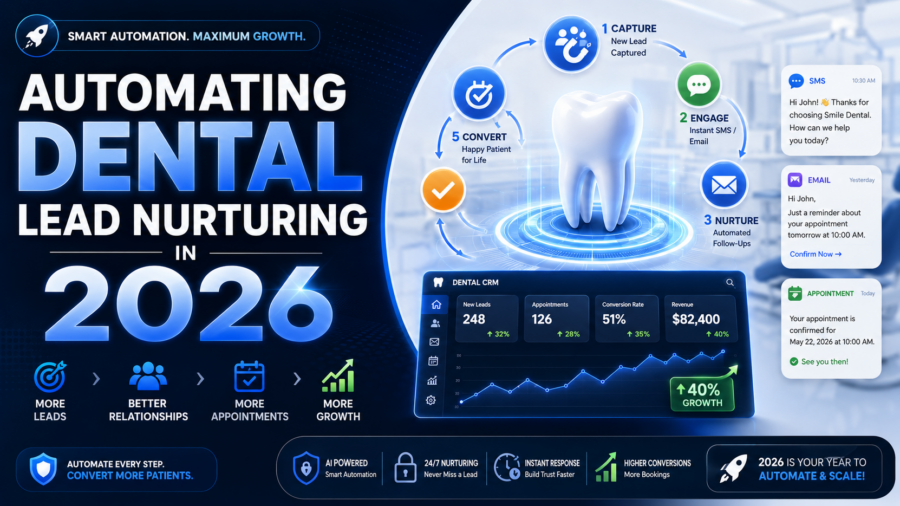
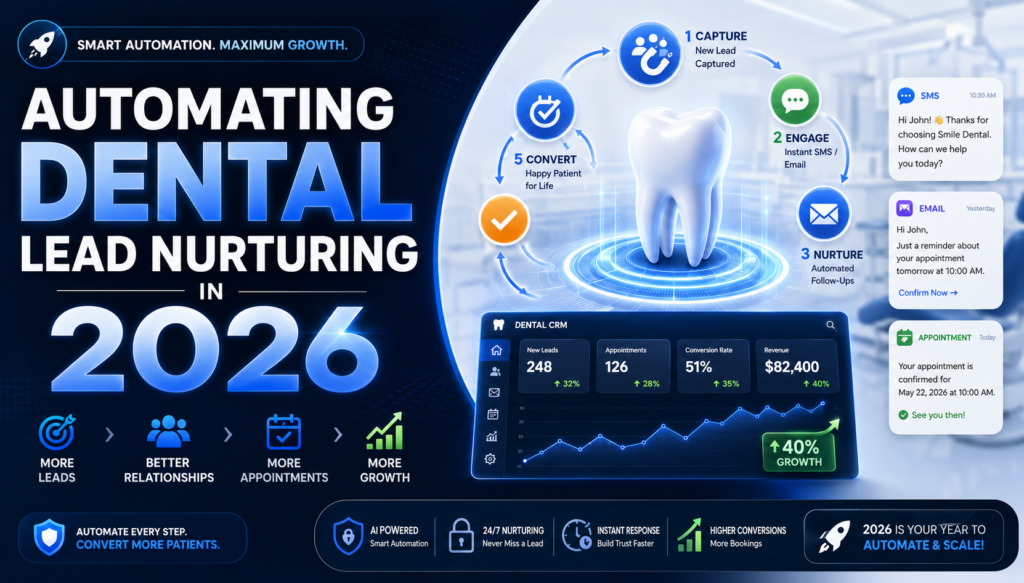
SEO Title: The Systems-First Approach to Dental Lead Nurturing: A Guide for Clinic Owners Meta Description: Explore why dental lead nurturing fails at the front desk and how implementing structured automation and CRM systems like GoHighLevel can stabilize clinic revenue.
Beyond the Chair: Why Systems, Not Just Dentistry, Drive Clinic Growth
For most dental clinic owners, the day doesn’t end when the last patient leaves the chair. It ends hours later, after reviewing stagnant production numbers, chasing unconfirmed appointments, and wondering why the expensive marketing campaign from last month resulted in a flurry of clicks but a desert of new patients.
The reality of modern practice management is sobering: You can be the most skilled clinician in your region, but if your operational infrastructure is porous, you are losing more revenue than you are generating. Clinical excellence gets patients back in the door; dental lead nurturing and intelligent systems get them through it the first time.
In this guide, we will strip away the marketing fluff and look at the clinical-grade operations required to stabilize revenue, reduce front-desk burnout, and reclaim your time.
1. The Operational Pain Points: Where Clinics Bleed Revenue
Most dental practices operate in a state of “managed chaos.” The front desk is the heartbeat of the clinic, but it is also the primary bottleneck. On any given Tuesday, your receptionist is juggling:
- Checking in arriving patients.
- Processing insurance claims.
- Answering inbound inquiries.
- Chasing no-shows.
When the phone rings while a patient is standing at the counter, something has to give. Usually, it’s the phone. A missed call in a dental clinic isn’t just a missed conversation; it is a lost high-value procedure. If your average patient lifetime value is $1,500 and you miss five new patient inquiries a week, you aren’t just “busy”—you are losing $7,500 in potential production every seven days.
Furthermore, the “leaky bucket” syndrome is real. Many clinics spend thousands on SEO or social media ads to generate leads. However, if those leads aren’t contacted within five minutes, the conversion rate drops by nearly 400%. Without a structured system for dental lead nurturing, you are essentially paying for leads that your staff doesn’t have the bandwidth to catch.
2. What “Intelligence” Means in a Dental Clinic
In the context of healthcare operations, “intelligence” is often a misused buzzword. In a high-performing clinic, intelligence isn’t about complex algorithms; it’s about predictability.
An intelligent clinic is one where the owner knows exactly:
- How many leads entered the funnel this week.
- The exact stage of every “pending” treatment plan.
- The cost of acquisition versus the actual production per lead.
Growth does not come from working more hours. It comes from shifting the burden of “memory” from humans to systems. When your staff has to remember to call back a lead, they will eventually fail. When a system is programmed to never forget, the clinic thrives.
3. Human Intelligence vs. System Intelligence
We often over-rely on “Human Intelligence.” We hire a “great” office manager and hope they stay forever. But hope is not a strategy. Human intelligence is for empathy, complex problem-solving, and patient comfort.
System Intelligence is for the repetitive, the mundane, and the data-driven.
- Human: Noticing a patient hasn’t been in for 6 months and making a mental note to call them.
- System: Automatically triggering a personalized SMS and email sequence the moment a patient hits the 180-day mark since their last hygiene visit.
By implementing structured dental lead nurturing, you allow your team to focus on the person in front of them while the “digital twin” of your clinic handles the follow-up in the background.
4. The Role of AI & Automation in Modern Dentistry
This is where the transition from a traditional office to a modern “Smarter Clinic” happens. Automation tools, specifically CRM (Customer Relationship Management) platforms like GoHighLevel, act as the central nervous system of your practice.
Marketing alone is not enough; to truly scale your clinic, it is essential to understand the complete approach to dental practice automation so that your system operates without any interruptions.
Instead of having your patient data scattered across a legacy Practice Management Software (PMS), a spreadsheet, and post-it notes, a CRM centralizes communication.
Missed Call Text-Back: The First Line of Defense
One of the simplest yet most effective automations is the “Missed Call Text-Back.” If a prospective patient calls and no one answers, the system immediately sends a text: “Hi, this is [Clinic Name]. Sorry we missed your call! How can we help you today?” This keeps the lead from calling the dentist down the street and initiates dental lead nurturing instantly.
Automated Lead Tracking
When a lead comes in from your website or a Facebook ad, it shouldn’t just sit in an email inbox. It should automatically populate into a visual “pipeline.” You can see exactly who has been contacted, who has booked, and who needs a follow-up. This visibility eliminates the “I think we called everyone” guesswork.
Think of it this way—if your clinic loses even 5 missed calls per week, that’s silent revenue walking away. A structured automation system prevents that by ensuring every inquiry receives an immediate, professional response.
Note: The link below is an affiliate link. I only recommend systems that align with structured clinic growth.
[Start Building a Smarter Dental System](INSERT YOUR AFFILIATE LINK HERE)
5. Real Clinic Scenarios: Systems in Action
Let’s look at two hypothetical clinics to see how dental lead nurturing changes the math.
Clinic A: The Manual Practice
Clinic A spends $2,000 on ads. They get 40 leads. The front desk calls them when they have time. They reach 15 people, 8 book, and 2 don’t show up. Total new patients: 6. The office manager is stressed, and the doctor feels the ads “didn’t work.”
Clinic B: The Automated Practice
Clinic B spends the same $2,000. They use a system like GoHighLevel.
- Instant Engagement: As soon as a lead is submitted, the system sends an SMS.
- Nurture Sequence: Leads who don’t book immediately get a series of educational emails about the clinic’s technology and patient testimonials over the next 4 days.
- No-Show Protection: Once booked, the patient receives a multi-channel reminder (SMS, Email, and a 24-hour confirmation request).
- Result: They reach 30 people, 22 book, and because of the robust reminders, only 1 misses the appointment. Total new patients: 21.
The difference isn’t the quality of the dentistry; it’s the dental lead nurturing system that ensured no one fell through the cracks.
Managing a clinic’s growth shouldn’t feel like a second job. By utilizing professional-grade infrastructure, you gain visibility into your lead flow and can finally stop the “feast or famine” cycle of patient bookings.
[Start Building a Smarter Dental System](INSERT YOUR AFFILIATE LINK HERE)
6. Common Mistakes in Dental Lead Nurturing
Even when clinic owners decide to automate, they often fall into these traps:
- The “Set and Forget” Fallacy: Automation is a tool, not a replacement for staff. You need to review your pipeline weekly to ensure the “human” handoff is happening correctly.
- Over-Automating Empathy: Patients can tell when a bot is talking to them. Your automation should sound like your front desk—warm, professional, and helpful.
- Ignoring the Data: If your system shows that 50% of your leads are dropping off after the first text, your messaging needs to change. Use the data to iterate.
- Software Overload: Using ten different tools for ten different tasks. A unified CRM prevents “data silos” where information gets lost between platforms.
For a deeper dive into healthcare operational standards, you can refer to the American Dental Association (ADA) guidelines on practice management, which emphasize the importance of maintaining consistent patient communication.
7. The Future of Structured Clinics: Revenue Stabilization
The dental industry is becoming increasingly competitive. With the rise of DSOs (Dental Support Organizations), private practices must operate with the same level of efficiency as large corporations without losing their “local doctor” feel.
Revenue stabilization comes from predictable retention. An automated system doesn’t just find new patients; it keeps the ones you have. It sends birthday greetings, requests Google reviews (crucial for local SEO), and reactivates patients who haven’t had a cleaning in over a year.
By moving away from manual entry and toward a systematic approach, you reduce the “cognitive load” on your team. A happy, unburdened staff provides better patient care, which in turn leads to higher retention. It is a virtuous cycle powered by technology.
Before you invest another dollar into “more marketing,” consider if your current foundation can actually hold the weight of new growth. True scale requires a system that works while you are in the operatory.
[Start Building a Smarter Dental System](INSERT YOUR AFFILIATE LINK HERE)
Conclusion: The Path Forward
Dental growth does not come from better dentistry alone—it comes from intelligent systems.
As a clinician, your time is best spent solving complex oral health issues, not chasing leads or worrying about missed calls. By implementing a robust dental lead nurturing strategy through tools like GoHighLevel, you bridge the gap between “getting a lead” and “starting a treatment plan.”
The clinics that will thrive in the next decade are those that treat their operations with the same precision they treat a root canal. It’s time to stop the leak, automate the mundane, and get back to the art of dentistry.
Frequently Asked Questions (FAQs)
1. What exactly is “Dental Lead Nurturing”?
It is the process of building relationships with prospective patients at every stage of their journey. This includes instant responses to inquiries, follow-up emails for unbooked appointments, and educational content that builds trust before they ever sit in your chair.
2. My front desk is already tech-savvy. Why do I need a CRM like GoHighLevel?
Even the best staff can only do one thing at a time. A CRM allows your staff to scale their efforts. It ensures that 100% of leads are contacted within seconds, which is physically impossible for a human juggling in-office tasks.
3. How does automation help with no-shows?
Automation allows for a “multi-touch” reminder system. Instead of one phone call that usually goes to voicemail, a system can send a text 48 hours before, an email 24 hours before, and a final SMS 2 hours before the appointment, significantly increasing confirmation rates.
4. Is this complicated to set up?
While initial setup requires a strategic approach, systems like GoHighLevel are designed to be “user-friendly” once the workflows are built. Many clinics use pre-built “snapshots” or templates specifically designed for dental workflows.
5. Does this replace my current Practice Management Software (like Dentrix or EagleSoft)?
No. A CRM works alongside your PMS. Your PMS handles clinical records and billing; the CRM handles the “marketing and communication” engine that feeds the PMS.
6. Will patients find automated texts annoying?
Not if they are useful. Patients appreciate the convenience of being able to confirm an appointment via text or getting a quick reply to a question. The key is to keep the tone professional and helpful, rather than “salesy.”