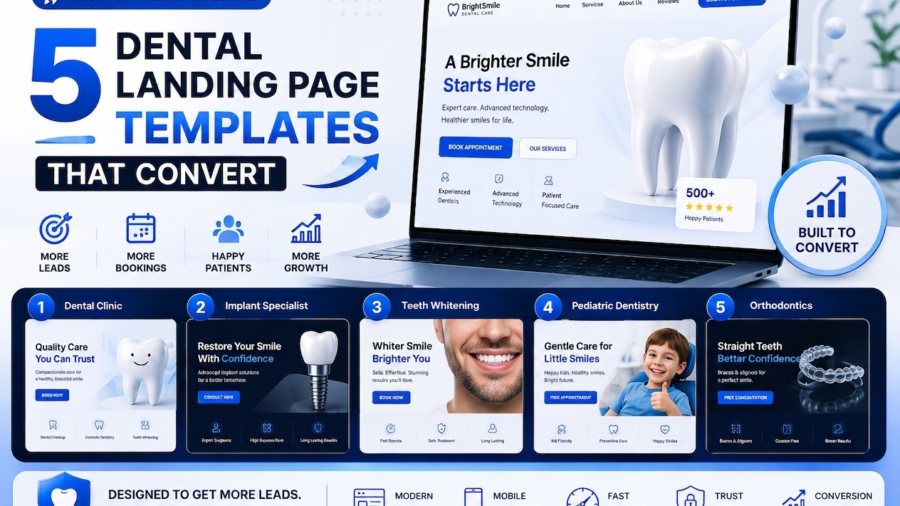
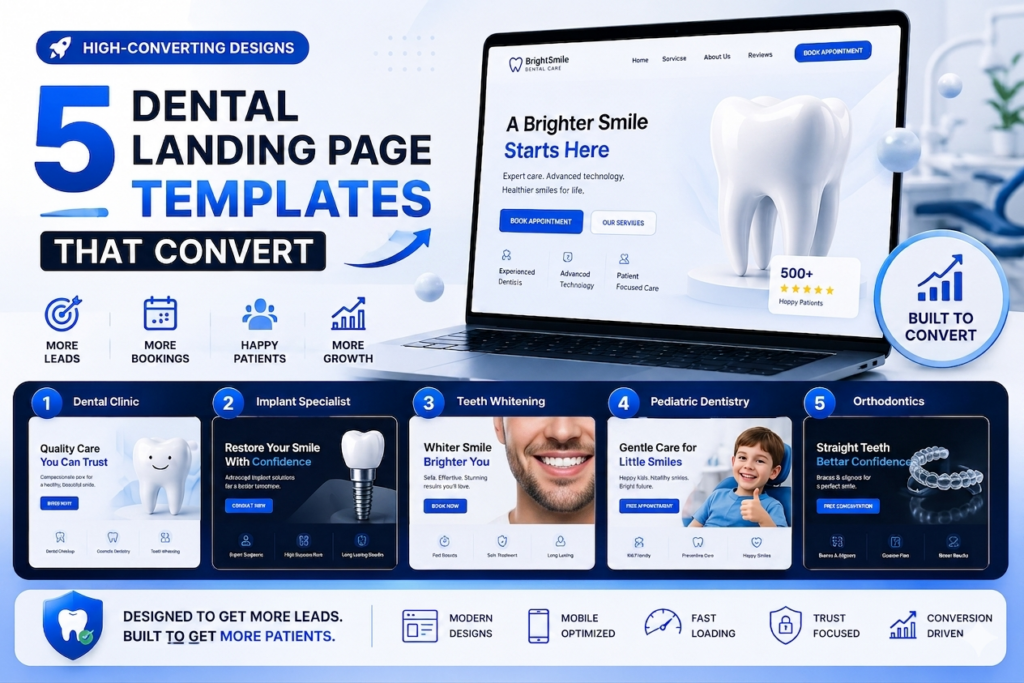
“For many clinic owners, the day ends not with a sense of clinical pride, but with operational exhaustion. You may have performed a perfect molar root canal or a flawless set of veneers, yet the ‘leaks’ in your business remain: a half-empty Friday schedule, a stack of unreturned voicemails, and the high cost of patient acquisition. Often, these leaks happen because the initial patient connection is weak; without high-converting Dental Landing Page Templates to capture and qualify leads effectively, even the best marketing efforts fail to result in long-term retention.”
The reality of modern practice management is sobering. Clinical excellence is the baseline—it’s what keeps your license. But operational intelligence is what keeps your doors open and your staff from burning out. To move from a chaotic practice to a scalable business, the shift must move away from “working harder” and toward “building better systems.”
What Intelligence Means in a Dental Clinic
In a clinical setting, intelligence is diagnostic. It’s the ability to read a 3D CBCT scan or identify a hairline fracture. In a business setting, intelligence is predictability.
An “intelligent” clinic is one where the owner knows exactly how many leads are in the pipeline, why patients are cancelling, and how much revenue is lost to missed calls every month. Most dental offices operate in a “reactive” state. They react to a cancellation by calling a few people on a manual list. They react to a slow month by asking for more marketing.
A systemic approach replaces reaction with automation. It treats the patient journey—from the first Google search to the five-year recall appointment—as a structured workflow rather than a series of disconnected events.
The Intersection of Human and System Intelligence
1. Human Intelligence: The High-Value Touch
Your front-desk team and your dental assistants are your greatest human assets. However, in many clinics, these high-value individuals are relegated to low-value tasks. When a receptionist spends four hours a day playing “phone tag” to confirm appointments, their human intelligence is being wasted.
Human intelligence should be reserved for:
- Building empathy with anxious patients.
- Explaining complex treatment plans.
- Navigating insurance nuances.
- Managing the in-office patient experience.
2. System Intelligence: The Digital Backbone
System intelligence handles everything that is repetitive, logic-based, and time-sensitive. This is where Dental Landing Page Templates, automated SMS flows, and CRM (Customer Relationship Management) systems come into play.
A system doesn’t forget to follow up. A system doesn’t get tired at 4:30 PM on a Friday. When you integrate a platform like GoHighLevel, you are essentially hiring a digital manager that works 24/7 to ensure no patient falls through the cracks.
AI and Automation: The New Infrastructure
The word “automation” often scares practitioners who fear losing the “personal touch.” In reality, automation protects the personal touch by ensuring the administrative noise is handled quietly in the background.
“System intelligence har us kaam ko sambhalti hai jo bar-bar hota hai aur waqt ka taqaza karta hai. Yeh wahi jagah hai jahan Dental Landing Page Templates, automated SMS flows, aur CRM systems apna kirdar ada karte hain. Yaad rakhein, aik behtareen landing page lead to capture kar leta hai, lekin asal kamyabi tab milti hai jab aap complete dental practice automation system implement karte hain taake follow-up ka nizam khud-kar ho jaye. Aik system kabhi follow-up karna nahi bhoolta aur na hi thakta hai.”
By utilizing structured platforms, clinics can centralize:
- Missed Call Text-Back: If a prospective patient calls and your line is busy, the system immediately sends a text: “Sorry we missed you! We’re helping another patient. How can we help you today?” This prevents them from calling the dentist down the street.
- Automated Lead Nurture: When someone downloads a guide or interacts with your Dental Landing Page Templates, the system follows up over 5 days with educational content, building trust before they even speak to a human.
- Recall Automation: Instead of manual lists, the system identifies patients who haven’t been in for 6 months and triggers a personalized re-engagement sequence.
Think of it this way—if your clinic loses even 5 missed calls per week, that’s silent revenue walking away. A structured automation system prevents that. Note: The link below is an affiliate link. I only recommend systems that align with structured clinic growth.
[Start Building a Smarter Dental System](INSERT YOUR AFFILIATE LINK HERE)
Real Clinic Scenarios: Systems vs. Chaos
Scenario A: The No-Show Trap
The System-less Clinic: A patient books a $2,000 crown prep. The office sends one manual reminder call 24 hours prior. The patient forgets, misses the call, and doesn’t show. The chair sits empty, and the fixed costs (staff, rent, utilities) for that hour result in a net loss.
The Intelligent Clinic: The booking triggers a “sequence.” The patient receives a confirmation text instantly, an email with pre-op instructions 3 days prior, and a “reply to confirm” SMS 24 hours before. If they don’t reply, the system alerts the front desk to call specifically that one person. The gap is filled, or the appointment is saved.
Scenario B: The Marketing Leak
Many dentists spend thousands on SEO and ads but have no idea why their conversion rate is low. Often, the issue is the “destination.” Using high-converting Dental Landing Page Templates ensures that when a patient clicks an ad, they land on a page designed for conversion, not just a generic homepage.
Linking these templates to an automated CRM means that the moment a lead enters their info, they are tagged, tracked, and contacted. You can see exactly which marketing dollars turned into actual chair time.
Effective systems turn your marketing from a “black hole” into a measurable investment. By centralizing your communication and lead tracking, you regain control over your clinic’s growth trajectory.
[Start Building a Smarter Dental System](INSERT YOUR AFFILIATE LINK HERE)
Common Mistakes in Dental Operations
As a strategist, I see the same three errors repeatedly:
- Buying Tools, Not Solutions: Buying a CRM but never setting up the workflows. A tool is just a hammer; the “system” is the blueprint for the house.
- Fragmented Data: Using five different softwares that don’t talk to each other. Your patient communication should happen in the same place your leads are tracked.
- Over-complicating the Patient Journey: Patients want three things: Ease of booking, clear communication, and clinical competence. If your system makes it hard to book or communicate, they will leave.
The Future of Structured Clinics
The dental industry is moving toward a “Management Services Organization” (MSO) model, even for small practices. This means operating with the efficiency of a large corporation while maintaining the heart of a local doctor.
Clinics that adopt “System Intelligence” will thrive because they have lower overhead, higher patient lifetime value, and a more stable workforce. Those who rely solely on “Better Dentistry” will find themselves working harder for shrinking margins as competition increases.
Implementing a platform like GoHighLevel isn’t about being a “tech-forward” office; it’s about being a “business-stable” office. It’s about creating a practice that provides a lifestyle for the owner, rather than becoming the owner’s entire life.
Before you invest in the next expensive clinical gadget, consider investing in the infrastructure that brings patients to that gadget. Systems are the only way to scale without adding more stress to your plate.
[Start Building a Smarter Dental System](INSERT YOUR AFFILIATE LINK HERE)
Conclusion
The bridge between where your clinic is now and where you want it to be isn’t paved with more clinical CE credits—it’s built with systems. By integrating automation, utilizing proven Dental Landing Page Templates, and centralizing your patient management, you move from being a “dentist who owns a business” to a “business owner who practices dentistry.”
The transition to an automated, intelligent clinic takes time, but the ROI is found in the hours of time recovered and the thousands of dollars in “leaked” revenue saved.
Frequently Asked Questions (FAQs)
1. Does automation make my dental practice feel “impersonal”? Quite the opposite. By automating the routine reminders and follow-ups, your staff has more time to engage in meaningful, face-to-face conversations with patients when they are actually in the office.
2. How do Dental Landing Page Templates improve my ROI? Most clinic homepages are cluttered. A dedicated landing page focuses on one specific service (like implants or Invisalign) and one specific action (booking a consult). This focus significantly increases the percentage of visitors who become patients.
3. Is it difficult to switch from manual tracking to a CRM like GoHighLevel? There is a learning curve, but the “cost” of the curve is far lower than the “cost” of continuing to lose leads and calls every day. Most clinics find the system pays for itself within the first few recovered missed appointments.
4. Can automation help with dental staff burnout? Yes. Much of staff burnout comes from “administrative friction”—the frustration of busy phone lines, last-minute cancellations, and manual data entry. Automation removes these low-level stressors.
5. How does system intelligence help with patient retention? Systems allow you to “stay top of mind” without manual effort. Automated birthday messages, 6-month check-up reminders, and post-op care texts make patients feel cared for consistently.
6. Do I need to be “tech-savvy” to implement these systems? You don’t need to be a developer, but you do need to be a strategist. You can use pre-built templates and workflows designed specifically for healthcare to get started without needing to write a single line of code.
Here is the professional English translation of Part 2, maintaining the strategic tone of a Senior Healthcare Operations Strategist.
Part 2: Revenue Optimization Through Operational Architecture
In the first part of our discussion, we established why automation is no longer optional. Now, we must focus on practical implementation—the steps required to ensure your clinic doesn’t just survive, but scales efficiently. The greatest enemy of dental growth is “Leaky Bucket Syndrome,” where new leads are constantly poured in, but revenue escapes through missed opportunities and poor patient retention.
1. The “Hidden” Revenue: Re-Activation Systems
Most clinic owners overspend on external marketing to acquire new patients, while their greatest asset—the existing database—remains dormant. An intelligent CRM system identifies “lost” patients who haven’t visited in 6 to 12 months.
Instead of demanding manual, time-consuming cold calls from your staff, an automated system triggers “Health Wellness” sequences. These are not aggressive sales pitches; they are care-driven touchpoints that remind patients of their oral health goals. By automating this re-engagement, clinics often see a 15–20% increase in chair-fill rates without spending an extra dollar on ads.
2. Digital First Impressions: Beyond the Homepage
When a prospective patient clicks your ad, they aren’t looking for a virtual tour of your entire website; they are looking for a solution to a specific problem. This is where the strategic use of Dental Landing Page Templates becomes critical.
A template designed for a specific high-value service, such as Dental Implants or Clear Aligners, provides the exact information a patient needs to make a decision. When these templates are integrated into a system like GoHighLevel, the data flows directly into a “Pipeline View.” This allows your team to track exactly where each lead stands, ensuring no inquiry is left unanswered.
3. Artificial Intelligence in Patient Triage
As we move further into 2026, AI has evolved from a novelty into a vital operational tool. Modern systems can now distinguish between a patient typing “Emergency” versus one asking about “Pricing.” AI-driven chatbots can handle basic FAQs and even schedule appointments after hours, freeing your front-desk team to focus on high-stakes treatment presentations.
This level of structure transforms your practice from a standard “dental office” into a “professional institution.” It is this perceived professionalism that attracts and retains premium, high-case-value patients.
Think of it this way — a patient’s journey begins the second they find you online. If that journey is fragmented, they won’t trust you with their surgery. A seamless, automated flow builds trust before the first consultation.