
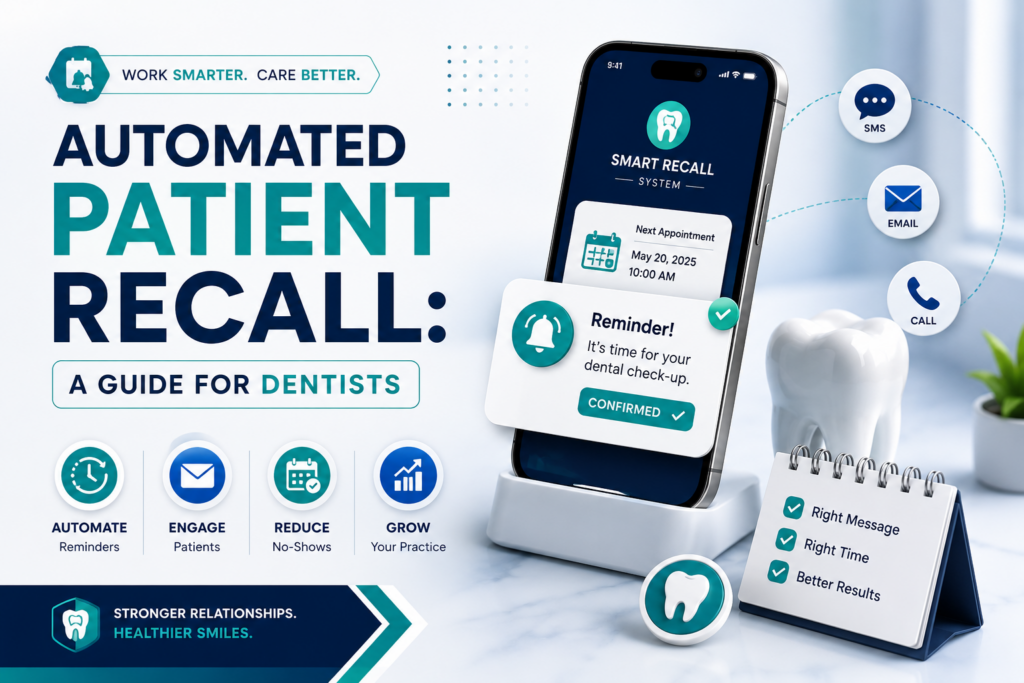
In the world of clinical dentistry, there is a common misconception that clinical excellence is the primary driver of growth. While a perfect crown or a seamless root canal is essential for patient health, it is rarely the reason a clinic scales sustainably. Most dental practices suffer not from a lack of skill, but from operational leakage.optimizing dental practice workflows
Operational leakage occurs when the “bucket” of your practice has holes. You spend thousands on marketing to acquire new patients, yet the front desk is too overwhelmed to answer the phone. You perform high-quality work, but the patient never returns for their six-month hygiene appointment because they weren’t prompted.
To build a resilient practice, we must shift the focus from clinical outcomes alone to Automated Patient Recall and intelligent systems. This article explores how structured automation stabilizes revenue, reduces burnout, and ensures that no patient falls through the cracks.
1. The Operational Pain Points of the Modern Clinic
Most dental clinic owners are exhausted. They are balancing the demands of high-stakes clinical work with the chaotic reality of small business management. When we look at the data of an average mid-sized clinic, the same bottlenecks appear repeatedly:
- The “Silent” Missed Call: A prospective patient calls during the lunch hour or while the receptionist is handling a checkout. That call goes to voicemail. Statistically, 70% of those callers will not leave a message; they will simply call the next dentist on the Google search list.
- The No-Show Epidemic: An empty chair at 2:00 PM is not just a missed appointment; it is a total loss of overhead costs (staffing, utilities, and lease) that can never be recovered.
- The “Leaky” Hygiene Pipe: Hygiene is the engine of a dental practice. When patients finish their treatment, they are often told to “call us in six months.” Without a proactive system, they don’t.
- Front-Desk Overload: Expecting a single human being to manage check-ins, insurance verification, billing, and outbound recall calls is a recipe for error.
The solution isn’t hiring more people—it’s implementing better systems.
2. What Intelligence Means in a Dental Clinic
In a strategic context, “Intelligence” is the ability of your practice to function without your constant physical presence or micro-management. We categorize this into two segments: Human Intelligence and System Intelligence.
Human Intelligence
This is the value your staff brings. It’s the empathy a receptionist shows to a nervous patient or the chairside manner of your hygienist. This is high-value labor that should not be wasted on repetitive, manual tasks like sending text reminders or dialing a list of 50 overdue patients.
System Intelligence
This is the “digital spine” of your clinic. A system-intelligent clinic uses software to handle the redundant, the predictable, and the data-driven. This is where Automated Patient Recall lives. It is the persistent, polite, and professional follow-up that happens in the background while your team focuses on the patients currently in the office.
3. The Mechanics of Automated Patient Recall
An effective recall system is more than just a calendar reminder. It is a multi-channel communication strategy that meets the patient where they are—usually on their smartphone.
The Lifecycle of an Automated Recall
- The Trigger: A patient reaches the 6-month mark since their last prophylaxis.
- The Initial Contact: An automated, personalized SMS or email is sent, inviting them to book.
- The Frictionless Booking: The message contains a direct link to your live booking calendar. No phone call required.
- The Follow-up: If the link isn’t clicked, a secondary reminder is sent 48 hours later.
- The Reactivation: If the patient remains unscheduled after 30 days, they are moved into a “Reactivation” sequence with a specific educational message about the importance of preventative care.
4. Introducing AI & Automation into the Workflow
Modern platforms, specifically CRM tools like GoHighLevel, have revolutionized how dental clinics handle these workflows. Rather than having five different softwares—one for SMS, one for email, one for landing pages, and another for lead tracking—you centralize the entire patient journey.
By using an integrated system, you can set up “if-this-then-that” logic. For example:
- If a patient misses a call, then the system immediately texts them back: “Hi, sorry we missed you! Would you like to book an appointment or ask a question?”
- If a patient cancels an appointment, then the system automatically sends a rebooking link and notifies the front desk to fill the gap.
This level of automation acts as a 24/7 virtual assistant that never sleeps, never gets tired, and never forgets to follow up.
Implementing a centralized system allows a clinic to move from reactive “firefighting” to proactive growth. By automating the mundane, your staff can regain the time needed to provide exceptional patient care.
Note: The link below is an affiliate link. I only recommend systems that align with structured clinic growth.
[Start Building a Smarter Dental System](INSERT YOUR AFFILIATE LINK HERE)
5. Real Clinic Scenarios: From Chaos to Control
To understand the power of Automated Patient Recall, let’s look at two hypothetical but realistic scenarios.
Scenario A: The Manual Practice
Dr. Smith runs a high-end cosmetic practice. His receptionist, Sarah, is excellent but overwhelmed. When a patient cancels their Tuesday afternoon appointment on Monday night, the chair stays empty. Sarah is too busy answering phones and checking in morning patients to call the “short-call list.” Dr. Smith loses $400 in potential revenue.
Scenario B: The Systemized Practice
Dr. Jones uses an automated system. When a patient cancels via the automated reminder text, the system instantly triggers an “Immediate Opening” SMS to five patients who were looking for earlier appointments. Within 12 minutes, the slot is filled. The front desk team didn’t have to lift a finger; they were busy welcoming a new patient in the lobby.
In Scenario B, the system didn’t just save time; it captured revenue that otherwise would have vanished. This is the difference between a practice that relies on luck and one that relies on infrastructure.
6. Missed Call Recovery: The “Hidden” Revenue Stream
One of the most overlooked “leaks” in dental operations is the missed call. Industry data suggests that the average dental office misses approximately 20–30% of its incoming calls. These are often high-intent leads—people in pain or looking for a new provider.
An automated system like GoHighLevel utilizes Missed Call Text-Back. When a call is missed, the system sends an immediate text. This keeps the lead “warm” and prevents them from calling the dentist down the street. It turns a lost opportunity into a digital conversation that can be picked up by the staff whenever they are free.
Think of it this way—if your clinic loses even 5 missed calls per week, that’s silent revenue walking away. A structured automation system prevents that by capturing the lead the second the phone stops ringing.
[Start Building a Smarter Dental System](INSERT YOUR AFFILIATE LINK HERE)
Learn more about the benefits of Automated Patient Recall for modern clinics.
7. Common Mistakes in Dental Automation
While the transition to Automated Patient Recall is transformative, it must be handled with nuance. Here are the most common pitfalls:
1. Over-Automating the “Human” Parts
Patients still want to feel cared for. If your automated texts feel robotic or “spammy,” patients will opt-out. The goal is to use automation to facilitate a human connection, not replace it. Your messages should sound like they come from your office, using your tone of voice.
2. Failing to Track the Data
Automation provides a wealth of data. If you aren’t looking at your “Recall Success Rate” or your “Lead Conversion Rate,” you are flying blind. Use your CRM to identify which messages get the best response and refine them over time.
3. Siloed Systems
Using one software for your dental records (PMS) and a completely separate, disconnected system for your marketing and recall often leads to data mismatches. Ensure your automation tool can sync or work in harmony with your primary clinical records to avoid double-booking or messaging the wrong patients.
8. The Economics of No-Shows
Let’s talk numbers. If your average production per hour is $300, and you have just two no-shows or late cancellations per week, that is $600 a week. Over a 50-week work year, that is $30,000 in lost revenue.
Now, consider the cost of an automated system. It is usually a fraction of that $30k. By reducing your no-show rate by even 50%, the system pays for itself ten times over. This isn’t an “expense”—it is an investment in revenue stabilization.
9. The Future of Structured Clinics
The dental industry is becoming increasingly competitive. Corporate DSO (Dental Support Organizations) are using these high-level systems to aggressively acquire and retain patients. To stay competitive, independent mid-sized clinics must adopt the same level of operational sophistication.
The future of dentistry belongs to the “Smarter Clinic.” This is a practice where the doctor can focus on surgery and aesthetics, while the “digital engine” ensures the chairs are full, the bills are paid, and the patients are returning.
True clinic freedom isn’t found in working more hours; it’s found in building a system that works while you aren’t. By centralizing your patient recall and communication, you regain control over your schedule and your life.
[Start Building a Smarter Dental System](INSERT YOUR AFFILIATE LINK HERE)
Conclusion
Automated Patient Recall is the cornerstone of a modern, efficient dental practice. By moving away from manual, labor-intensive processes and embracing intelligent CRM systems like GoHighLevel, clinic owners can eliminate revenue leaks, reduce staff burnout, and provide a more seamless experience for their patients.
Growth doesn’t have to be painful. It doesn’t have to require more caffeine or more hours at the office. It simply requires better systems. Start by looking at your current recall process: if it relies entirely on a human being picking up a phone, it’s time for an upgrade.
FAQs
1. What is Automated Patient Recall?
Automated Patient Recall is a systemized process that uses software to track when patients are due for their next appointment and automatically sends reminders via SMS, email, or voice without manual intervention from the front desk.
2. Will patients find automated messages annoying?
Not if they are structured correctly. Most patients actually prefer the convenience of a text reminder with a direct booking link over a disruptive phone call during their workday. The key is to keep the messages professional, infrequent, and helpful.
3. Can I use GoHighLevel alongside my existing Dental Practice Management Software (PMS)?
Yes. While many PMS systems have basic reminder functions, tools like GoHighLevel offer much more robust marketing, lead tracking, and missed-call recovery features. Most clinics use them in tandem to handle the “top of the funnel” and patient reactivation.
4. How much time does it take to set up an automated system?
Initial setup for a basic recall and missed-call recovery system can take a few days to a week. However, once the “logic” is built, the system runs indefinitely with minimal maintenance.
5. Does this replace my front desk staff?
No. It empowers them. By automating the 80% of tasks that are repetitive, your staff can focus on the 20% of tasks that require a human touch, such as dealing with complex insurance issues or providing high-level patient hospitality.
6. Is it expensive to implement these systems?
The cost is usually very low compared to the revenue recovered. When you factor in the “lost opportunity cost” of missed calls and no-shows, a professional automation platform typically offers a significant return on investment (ROI) within the first 90 days.