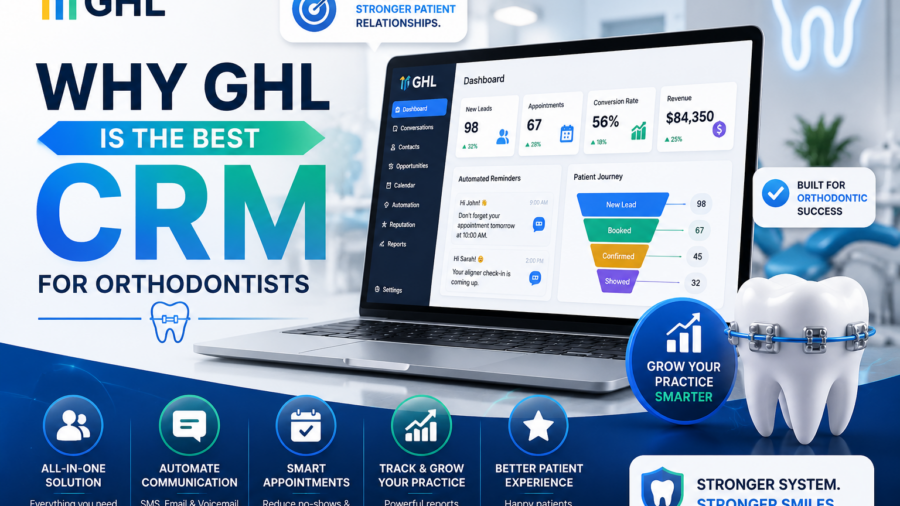
You didn’t spend years in specialized residency to become a full-time call center manager or a data entry clerk. Yet, for many orthodontic practice owners, the daily reality is far removed from the chairside excellence they envisioned.
The primary challenge in modern orthodontics isn’t the quality of the clinical work—it’s the operational friction between the initial inquiry and the bonded bracket.
Most practices suffer from “leaky bucket” syndrome. You spend thousands on marketing to generate leads, only for them to vanish into a black hole of unreturned voicemails, forgotten follow-ups, and “I need to talk to my spouse” stalls that never get revisited.
Clinical excellence attracts patients, but systematic intelligence retains them. To scale without burning out your front-desk staff, you need to transition from a manual “hustle” culture to a structured, automated environment. This is where identifying and implementing the best CRM for orthodontists becomes a strategic pivot point for your business.
What “Intelligence” Means in a Dental and Orthodontic Context
In a clinical setting, intelligence is often equated with diagnostic precision. However, from an operational standpoint, intelligence is the ability of your practice to “know” its patients without a human being having to manually check a spreadsheet.
1. Human Intelligence vs. System Intelligence
Your front-desk team is your greatest asset, but they are also a single point of failure. If your lead receptionist is on lunch and a high-value Invisalign lead calls, that call often goes to voicemail. Statistically, 67% of dental leads will not leave a message; they simply call the next clinic on Google.
Human Intelligence is reactive. It relies on memory, sticky notes, and individual effort. System Intelligence is proactive. It ensures that if a call is missed, an automated text is sent immediately to keep the lead engaged.
2. The Patient Lifecycle Management
his is where understanding [patient journey automation for dental clinics] becomes the foundation of your practice growth.”
An orthodontic patient journey is long. It starts with an inquiry, moves to a consultation, transitions to a contract, spans 18–24 months of treatment, and ends with retention. A standard Practice Management Software (PMS) is great at charting and billing, but it is often terrible at relationship management.
The best CRM for orthodontists acts as a layer that sits on top of your clinical software, handling the “human” side of the data—nurturing leads who haven’t booked yet and re-engaging patients who have gone MIA.
AI & Automation: Bridging the Gap
We are currently seeing a shift where AI is no longer a futuristic concept but a functional tool for dental operations. For an orthodontist, automation should handle the repetitive, low-value tasks, freeing your team to focus on high-value patient interactions.
Centralizing your communications is the first step. When your SMS, emails, Facebook messages, and phone calls all live in different silos, things get missed. By using a centralized platform like GoHighLevel, clinics can create a “Single Source of Truth.”
Key Automation Workflows for Orthodontists:
- Missed Call Text-Back: Automatically responding to missed calls to prevent “leakage.”
- Nurture Sequences: Sending educational content about the benefits of early interceptive treatment or the discreetness of clear aligners.
- No-Show Re-engagement: If a patient misses a consultation, the system should trigger a follow-up sequence within 10 minutes, rather than waiting for a staff member to find time to call three days later.
Note: The link below is an affiliate link. I only recommend systems that align with structured clinic growth.
Think of it this way—if your clinic loses even five missed calls per week, that’s silent revenue walking away. A structured automation system prevents that by ensuring every lead is captured and tracked through a dedicated pipeline.
[Start Building a Smarter Dental System](INSERT YOUR AFFILIATE LINK HERE)
Real Clinic Scenarios: Systems in Action
Let’s look at two common scenarios where the best CRM for orthodontists changes the financial outcome of a week.
Scenario A: The “Maybe Later” Lead
A parent calls inquiring about braces for their teenager. They find out the price and say, “We need to think about it.” In a traditional clinic, that lead is forgotten. The Systemized Result: The lead is tagged in the CRM. Over the next six months, they receive one high-quality email per month featuring a testimonial and a “Frequently Asked Questions” video from the doctor. Four months later, when the tax refund arrives, they book the consultation because your practice stayed top-of-mind.
Scenario B: The Short-Notice Cancellation
It’s Tuesday morning, and your 2:00 PM debonding appointment cancels. The Systemized Result: Instead of the front desk frantically calling a list of names, the CRM sends a broadcast SMS to a “Short-Notice List” of patients who requested earlier appointments. The slot is filled within 15 minutes without a single outbound phone call.
when evaluating the best CRM for orthodontists to handle high-volume patient inquiries.
Common Mistakes When Choosing a CRM
Many orthodontists fall into the trap of buying “all-in-one” dental software that claims to do CRM but lacks the robust automation triggers needed for modern marketing.
- Buying for Features, Not Workflows: Don’t look for a long list of buttons. Look for the ability to build a workflow that fits your specific patient intake process.
- Over-complicating the Tech Stack: If your CRM doesn’t talk to your team easily, they won’t use it. The best system is the one that actually gets implemented.
- Neglecting the “Lead to Appointment” Bridge: A CRM is useless if it’s just a database. It must be an active engine that moves people from “interested” to “in the chair.”
For many small-to-mid-sized clinics, the solution isn’t to hire more staff—it’s to give your existing staff better tools. Platforms like GoHighLevel provide the infrastructure to track every dollar of ad spend and every minute of staff time.
[Start Building a Smarter Dental System](INSERT YOUR AFFILIATE LINK HERE)
System Intelligence: Beyond the Consultation
The utility of a CRM doesn’t end once the brackets are on. Retention is the lifeblood of a stable orthodontic practice.
Automated Reviews and Reputation Management
Your Google ranking is heavily influenced by the recency and frequency of your reviews. A structured CRM will automatically trigger a review request via SMS exactly 24 hours after a positive milestone, such as a patient getting their braces off. This ensures a steady stream of 5-star reviews without your staff having to “ask” awkwardly at the front desk.
Revenue Stabilization
Orthodontics relies on predictable monthly contracts. When payments fail or patients drop off the radar, it creates a “lumpy” cash flow. A CRM can track these “lost” patients and flag them for follow-up before they become a total loss.
The Future of Structured Clinics
As the dental industry becomes more consolidated, private practices must compete on patient experience. In the next five years, the “standard” of care will include 24/7 instant communication and seamless digital scheduling.
The clinics that thrive will be those that view their practice as a series of interconnected systems. By implementing the best CRM for orthodontists, you aren’t just buying software; you are installing an operational framework that allows your business to grow while you focus on dentistry.
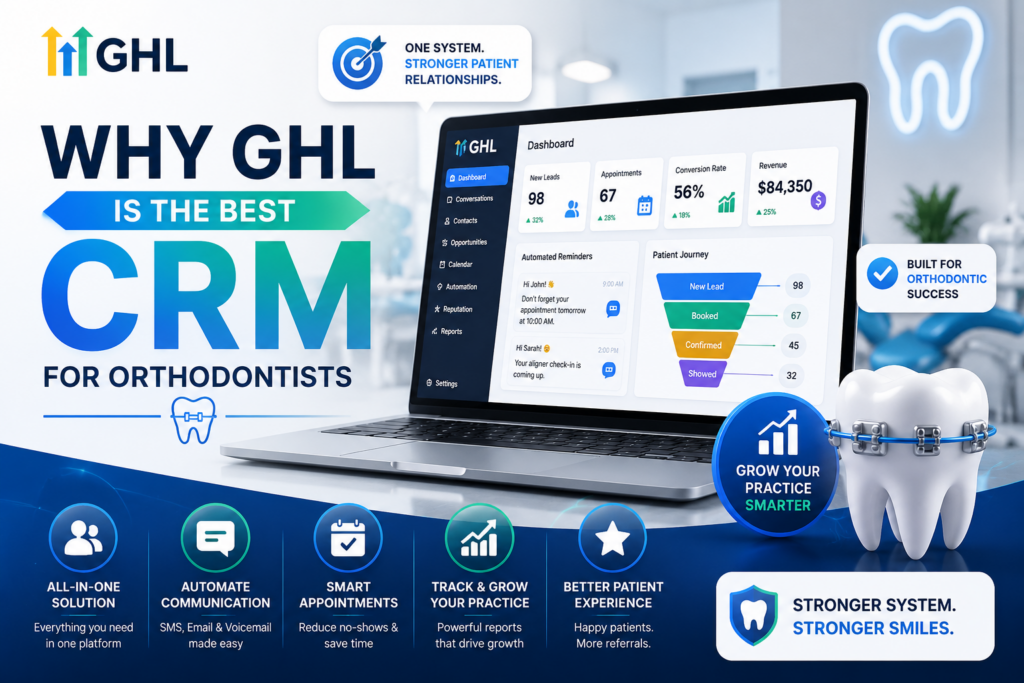
Implementing a CRM like GoHighLevel allows you to visualize your entire “Patient Pipeline.” You can see exactly how many people are in the “Inquiry” stage, how many are “Ready to Bond,” and where the bottlenecks are occurring in your staff’s follow-up process. This visibility is the difference between guessing and knowing.
[Start Building a Smarter Dental System](INSERT YOUR AFFILIATE LINK HERE)
Conclusion: Deciding on Growth
Growth is rarely the result of a single “lucky” marketing campaign. It is the cumulative effect of hundreds of small, automated touchpoints that build trust with a patient over time.
If your front desk is overwhelmed, if your no-show rate is creeping above 10%, or if you have no idea how many leads you actually received last month, it is time to move past manual processes.
The best CRM for orthodontists is one that simplifies your life, secures your revenue, and allows you to provide a higher level of care. Systemize your practice today so you can focus on the smiles of tomorrow.
FAQs
1. How is a CRM different from my practice management software (like Dolphin or OrthoTrac)? Practice Management Software is designed for clinical records, billing, and charting. A CRM is designed for communication, lead nurturing, and marketing automation. They work together to bridge the gap between a stranger seeing your ad and becoming a patient in your chair.
2. Is GoHighLevel difficult to set up for a dental clinic? While it is a powerful platform, it is designed to be user-friendly. Most clinics start with simple “snapshots”—pre-built templates for missed call text-backs and appointment reminders—and then customize them as they grow.
3. Will automation make my practice feel “cold” or “impersonal”? Actually, the opposite is true. By automating the “boring” administrative tasks, your staff has more time to engage in meaningful, personal conversations with patients when they are physically in the office.
4. Can a CRM really reduce no-shows? Yes. By using multi-channel reminders (Email + SMS + Voice Drop), you significantly increase the visibility of the appointment. Furthermore, automated “rescheduling” links make it easy for patients to move their appointment rather than simply not showing up.
5. How much time does it take to manage a CRM system? Once the initial workflows are built, the system runs in the background. Your team will spend less time on the phone and more time managing a “unified inbox” where all patient communications are centralized.
6. Is a CRM worth the investment for a single-doctor practice? Often, a single-doctor practice needs a CRM more than a large group, because resources are tighter. Automation acts as a “virtual employee” that never sleeps and never misses a follow-up, providing massive ROI for a small team.