
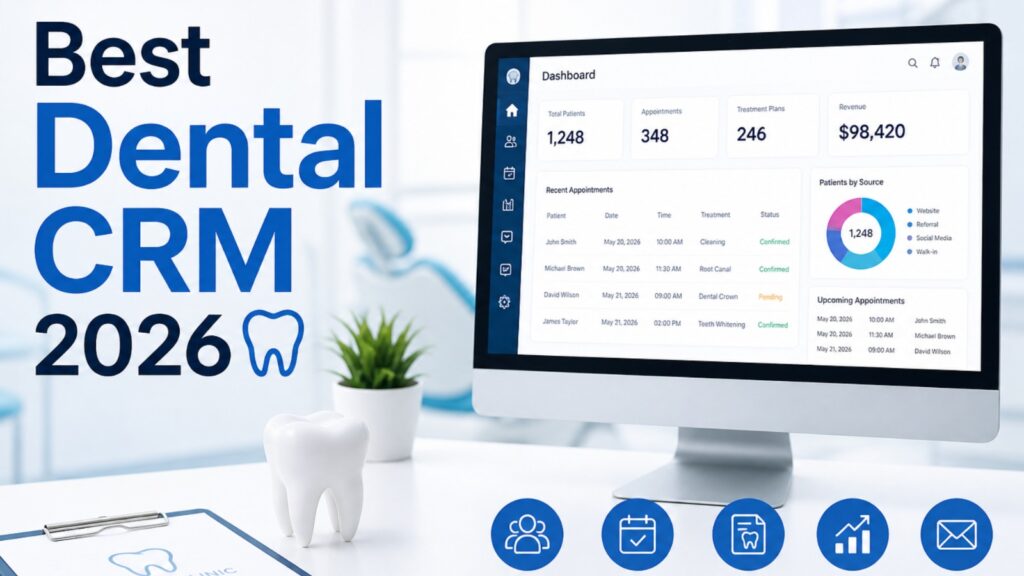
Introduction: Where Dental Clinics Quietly Lose Revenue
But here’s the operational truth:
Revenue leakage in dental clinics rarely comes from poor dentistry. It comes from broken systems.
Let’s look at common scenarios:
- Calls missed during peak hours
- Patients forgetting appointments
- Follow-ups never happening
- Treatment plans not converting
- Front desk overwhelmed with repetitive tasks
These aren’t rare issues. They’re structural inefficiencies.
And over time, they quietly erode growth.
This is where the idea of the Best Dental CRM becomes critical—not as a marketing tool, but as an operational backbone.
What Intelligence Means in a Dental Clinic
When we talk about “intelligence” in a clinic, we’re not referring to AI alone.
We’re talking about decision-support systems that reduce human dependency on memory and manual processes.
There are two types of intelligence in a dental practice:
1. Human Intelligence
Clinical expertise, diagnosis, patient communication.
2. System Intelligence
Automations, reminders, tracking, follow-ups, reporting.
Most clinics rely heavily on the first—and underinvest in the second.
That imbalance creates chaos.
Human Intelligence: Necessary, But Not Scalable
Your front desk team can only handle so much.
Even the most efficient staff will struggle with:
- Managing high call volumes
- Tracking patient histories manually
- Remembering follow-ups
- Handling cancellations in real time
This leads to:
- Inconsistent patient experience
- Missed revenue opportunities
- Staff burnout
The reality is simple:Best Dental CRM
Human effort cannot scale without structured systems.
System Intelligence: Where the Best Dental CRM Fits
System intelligence introduces consistency.
Instead of relying on memory or manual tracking, clinics operate on defined workflows.
A well-implemented Best Dental CRM allows clinics to:
- Capture every incoming lead
- Track patient journeys from inquiry to treatment
- Automate appointment confirmations
- Send reminders without manual effort
- Monitor missed calls and follow up instantly
This isn’t about replacing staff.
It’s about supporting them with structure.
AI & Automation: The Operational Shift Clinics Are Making
Modern dental clinics are gradually shifting toward automation-driven operations.
Not because it’s trendy—but because it solves real problems.
Platforms like GoHighLevel allow clinics to centralize:
- Patient communication
- Appointment reminders
- Lead tracking
- Follow-up sequences
All inside one structured system.
What This Looks Like in Practice
- A missed call triggers an automatic SMS:
“Sorry we missed you—how can we help?” - A booked appointment triggers:
Confirmation → Reminder → Follow-up - A treatment plan not accepted?
Automated check-in message after 3 days
This creates continuity without manual effort.
Think of it this way — if your clinic loses even 5 missed calls per week, that’s silent revenue walking away. A structured automation system prevents that.
[Start Building a Smarter Dental System](INSERT YOUR AFFILIATE LINK HERE)
Note: The link above is an affiliate link. I only recommend systems that align with structured clinic growth.
Real Clinic Scenarios: Where Systems Change Outcomes
Let’s move from theory to reality.
Scenario 1: Missed Call Recovery
A clinic receives 40–50 calls daily.
Even with a dedicated receptionist, 10–15% go unanswered.
Without a system → lost leads.
With a CRM → automatic follow-up within seconds.
Result:
Recovered opportunities that would otherwise disappear.
Scenario 2: No-Show Reduction
No-shows are rarely intentional.
They happen due to:
- Forgetfulness
- Scheduling conflicts
- Lack of reminders
A structured CRM introduces:
- 24-hour reminders
- Same-day confirmations
- Easy rescheduling options
This doesn’t eliminate no-shows—but it significantly reduces them.
Scenario 3: Treatment Plan Follow-Up
Many patients leave without committing to treatment.
Not because they’re not interested—but because:
- They need time
- They forget
- No one follows up
A CRM ensures:
- Timely follow-ups
- Consistent communication
- Better conversion over time
When systems handle these repetitive tasks, your team focuses on what actually matters—patient care.
[Start Building a Smarter Dental System](INSERT YOUR AFFILIATE LINK HERE)
Common Mistakes Clinics Make When Choosing the Best Dental CRM
Not all CRM implementations succeed.
Here’s where clinics often go wrong:
1. Treating CRM as Just Software
It’s not just a tool—it’s an operational framework.
2. Overcomplicating Workflows
Too many automations create confusion.
Start simple. Expand gradually.
3. Lack of Staff Training
Even the best system fails if the team doesn’t use it properly.
4. Ignoring Data Insights
CRM systems provide visibility—but only if you review the data.
5. Expecting Instant Results
Systems improve consistency—not overnight miracles.
The Future of Structured Dental Clinics
The direction is clear.
Clinics are moving toward:
- Data-driven decision making
- Automation-supported workflows
- Centralized communication systems
The Best Dental CRM will not replace your team.
But it will:
- Reduce manual workload
- Improve patient experience
- Stabilize revenue patterns
Clinics that adopt structured systems early gain a long-term advantage.
Conclusion: Growth Is Built on Systems, Not Effort Alone
Dental clinics don’t fail because of poor clinical skills.
They struggle because of operational inefficiencies.
The shift toward system intelligence is not optional anymore—it’s inevitable.
A structured CRM doesn’t just organize your clinic.
It gives you:
- Visibility
- Control
- Consistency
And most importantly—predictability.
If you’re serious about reducing no-shows, improving follow-ups, and stabilizing patient flow, the next step isn’t hiring more staff—it’s building better systems.
[Start Building a Smarter Dental System](INSERT YOUR AFFILIATE LINK HERE)
From Automation to Optimization: The Next Stage of Growth
Once a clinic has basic automation in place—such as reminders and missed-call responses—the next phase is optimization.
This is where many clinics stop progressing.
They install a system but don’t refine it.
A mature clinic, however, uses the Best Dental CRM not just to automate—but to:
- Analyze patient behavior
- Identify bottlenecks
- Improve conversion rates
- Enhance patient lifetime value
What Optimization Looks Like
Instead of asking:
“Are reminders being sent?”
You begin asking:
- Which reminder timing reduces no-shows the most?
- Which follow-up message converts treatment plans better?
- Which source brings the highest-value patients?
This shift—from execution to insight—is where real growth begins.
Patient Journey Mapping: A Missing Layer in Most Clinics
Most dental clinics operate without a clearly defined patient journey map.
They react to events instead of guiding outcomes.
With the Best Dental CRM, you can structure the patient journey into defined stages:
- Inquiry / First Contact
- Appointment Booking
- Pre-Visit Engagement
- In-Clinic Experience
- Post-Treatment Follow-Up
- Recall & Retention
Each stage can be supported with automated touchpoints.
For example:
- Before appointment → Educational message
- After visit → Care instructions
- 6 months later → Recall reminder
This creates a continuous relationship, not a one-time visit.
Data Visibility: Turning Activity into Insight
One of the most underutilized aspects of CRM systems is data visibility.
The Best Dental CRM provides clarity on:
- Number of incoming leads
- Conversion rates
- No-show percentages
- Treatment acceptance rates
But data alone isn’t useful unless interpreted correctly.
Key Metrics Every Clinic Should Track
| Metric | What It Tells You | Why It Matters |
|---|---|---|
| Call Answer Rate | % of calls handled vs missed | Indicates front-desk efficiency |
| Appointment Show Rate | % of patients who attend | Direct impact on daily revenue |
| Treatment Acceptance Rate | % of proposed treatments accepted | Measures case presentation effectiveness |
| Follow-Up Response Rate | Patient engagement with messages | Reflects communication quality |
| Patient Retention Rate | Returning patients over time | Indicates long-term clinic stability |
When clinics regularly review these metrics, decisions become evidence-based—not guesswork.
Workflow Standardization: Reducing Staff Dependency
One major challenge in dental clinics is inconsistency between staff members.
Two receptionists may handle the same situation differently.
This creates:
- Uneven patient experience
- Lost opportunities
- Operational confusion
The Best Dental CRM solves this through workflow standardization.
Examples of Standardized Workflows
- Missed call → automatic message → callback reminder
- New patient inquiry → booking link → confirmation sequence
- Treatment not accepted → 3-step follow-up over 10 days
This ensures that every patient receives the same level of attention, regardless of who is on duty.
Integration with Digital Presence
Modern patients don’t just call clinics—they interact through:
- Websites
- Social media
- Online forms
A strong CRM connects all these channels.
For example, a well-structured clinic website can capture leads directly into your system. A useful reference for understanding CRM-driven automation strategies can be found here:
https://www.gohighlevel.com
This kind of integration ensures that no inquiry is lost, whether it comes from a call, message, or form submission.
Revenue Stability Through Predictable Systems
Many clinics experience revenue fluctuations.
One week is fully booked, the next is slow.
This inconsistency is often due to:
- Lack of follow-up
- Poor recall systems
- Missed reactivation opportunities
The Best Dental CRM introduces predictability.
How It Stabilizes Revenue
- Automated recall campaigns bring back existing patients
- Reactivation messages target inactive patients
- Consistent follow-ups improve treatment conversions
Over time, this creates a steady flow of appointments, reducing dependency on new patient acquisition alone.
Common Advanced Mistakes to Avoid
As clinics grow, new challenges emerge.
Here are mistakes seen in more advanced stages:
1. Over-Automation
Too many messages can overwhelm patients. Balance is key.
2. Ignoring Personalization
Automation should still feel human. Generic messages reduce engagement.
3. Not Updating Workflows
Patient behavior changes. Systems should evolve accordingly.
4. Lack of Performance Reviews
Systems require monitoring and adjustment—not “set and forget.”
Building a Scalable Dental Operation
A scalable clinic is not defined by how busy it is—but by how efficiently it operates under pressure.
The Best Dental CRM enables:
- Controlled growth
- Reduced staff stress
- Improved patient satisfaction
- Better financial visibility
It shifts the clinic from:
Reactive → Structured → Predictable
From Activity to Outcome-Based Management
Many clinics measure effort:
- Number of patients seen
- Number of calls handled
- Number of appointments booked
But effort doesn’t always translate into results.
High-performing clinics measure outcomes:
- Revenue per patient
- Case acceptance quality
- Long-term patient value
- Reappointment cycles
The Best Dental CRM allows clinics to shift from tracking activity to monitoring outcomes in real time.
Why This Matters
Without outcome tracking:
- You stay busy but unpredictable
- Growth feels inconsistent
- Decision-making becomes reactive
With structured tracking:
- You identify what’s working
- You eliminate inefficiencies
- You improve results without increasing workload
Patient Value Segmentation: Not All Patients Are Equal
One of the most overlooked strategies in dental clinics is patient segmentation.
Every patient contributes differently to your practice:
- Some come once and never return
- Some follow long-term treatment plans
- Some refer other patients
The Best Dental CRM allows you to categorize patients based on behavior and value.
Common Segmentation Categories
- New Patients – first-time visitors
- Active Patients – regular visits
- Inactive Patients – no visit in 6–12 months
- High-Value Patients – multiple or complex treatments
- Referral Sources – patients who bring others
Strategic Advantage
Instead of sending the same message to everyone:
- High-value patients receive priority follow-ups
- Inactive patients get reactivation campaigns
- New patients receive onboarding sequences
This leads to more relevant communication—and better results.
Time Economics: Where Your Clinic Really Spends Money
Most clinic owners think in terms of revenue.
But operational control requires thinking in terms of time economics.
Hidden Time Costs in Clinics
- Manual appointment confirmations
- Repetitive patient questions
- Chasing missed follow-ups
- Handling reschedules inefficiently
Each of these consumes time—which directly impacts profitability.
The Best Dental CRM reduces time waste by:
- Automating repetitive communication
- Streamlining scheduling workflows
- Reducing dependency on manual coordination
Result
Your team spends less time on routine tasks and more time on high-value interactions.
Multi-Channel Communication Control
Patients today don’t rely on a single communication method.
They interact through:
- Phone calls
- SMS
- Online forms
- Social messaging
Without structure, this creates fragmented communication.
A well-configured Best Dental CRM brings all channels into one system.
Operational Benefits
- No missed messages
- Centralized conversation history
- Faster response times
- Consistent communication tone
This ensures that every patient interaction is tracked, managed, and followed up.
Predictive Scheduling: Reducing Last-Minute Gaps
One of the biggest inefficiencies in dental clinics is last-minute appointment gaps.
These gaps occur due to:
- Cancellations
- No-shows
- Poor scheduling distribution
The Best Dental CRM introduces predictive elements into scheduling.
How It Works
- Identifies patients likely to cancel
- Suggests overbooking buffers (within safe limits)
- Triggers short-notice appointment offers
Outcome
Instead of reacting to empty slots, clinics begin to anticipate and manage them proactively.
Team Accountability Through System Tracking
Managing staff performance can be challenging without data.
Decisions often rely on assumptions rather than facts.
The Best Dental CRM introduces transparent performance tracking.
What Can Be Measured
- Call handling efficiency
- Appointment booking rates
- Follow-up completion
- Response time to inquiries
Impact on Clinic Operations
- Clear expectations for staff
- Reduced miscommunication
- Improved accountability
- Better team alignment
This doesn’t create pressure—it creates clarity.
Scalability: Preparing for Growth Before It Happens
Many clinics attempt to scale only after they become overwhelmed.
That approach leads to:
- Staff burnout
- Operational breakdown
- Patient dissatisfaction
The smarter approach is to build systems before scaling demand increases.
The Best Dental CRM supports scalability by:
- Handling increased patient volume without proportional staff increase
- Maintaining consistent patient experience
- Standardizing workflows across locations
For Multi-Location Clinics
- Centralized reporting
- Unified communication systems
- Standardized processes across branches
This ensures growth does not compromise quality or control.
Risk Reduction Through Systemization
Every clinic faces operational risks:
- Missed follow-ups
- Lost patient data
- Communication gaps
- Inconsistent service delivery
Without systems, these risks increase over time.
The Best Dental CRM reduces risk by:
- Automating critical processes
- Maintaining records systematically
- Ensuring no step in the patient journey is skipped
Result
More control.
Less uncertainty.
Better long-term stability.
Strategic Decision-Making with Real Data
At an advanced level, the role of a clinic owner shifts.
You move from managing daily operations to making strategic decisions.
The quality of those decisions depends on the quality of your data.
The Best Dental CRM provides:
- Real-time performance insights
- Historical trends
- Patient behavior patterns
Examples of Better Decisions
- Adjusting clinic hours based on peak demand
- Identifying most profitable treatment types
- Allocating staff more efficiently
- Refining marketing efforts based on actual conversions
This transforms decision-making from guesswork into informed strategy.
Operational Maturity: The Final Stage
There are generally three levels of clinic operations:
1. Reactive Clinic
- Solves problems as they arise
- Relies heavily on staff memory
2. Structured Clinic
- Uses systems for consistency
- Implements automation
3. Optimized Clinic
- Uses data for continuous improvement
- Controls outcomes proactively
The Best Dental CRM is the bridge between levels 2 and 3.
Final Perspective: Control Is the Real Goal
Growth without control leads to stress.
Control without systems is impossible.
The real objective is not just increasing patient numbers—but creating a clinic that operates with:
- Predictability
- Efficiency
- Stability
The Best Dental CRM supports this by aligning:
- People
- Processes
- Technology
Into a single, coordinated system.
FAQs About the Best Dental CRM
1. What is the Best Dental CRM for small clinics?
The Best Dental CRM for small clinics is one that balances simplicity with automation—allowing easy setup without overwhelming staff.
2. How does a dental CRM reduce missed calls?
It automatically responds to missed calls with messages and follow-ups, ensuring no lead is ignored.
3. Can CRM systems reduce no-shows completely?
No system can eliminate no-shows entirely, but structured reminders significantly reduce them.
4. Is CRM difficult to implement in a dental clinic?
Not if introduced gradually. Start with basic workflows like reminders and missed-call responses.
5. Does a dental CRM replace front desk staff?
No. It supports staff by automating repetitive tasks, allowing them to focus on patient interaction.
6. How long does it take to see results from CRM implementation?
Most clinics begin noticing improvements in consistency and patient engagement within a few weeks.
7. Is the Best Dental CRM expensive?
Costs vary, but the focus should be on value—time saved, missed revenue recovered, and operational clarity.