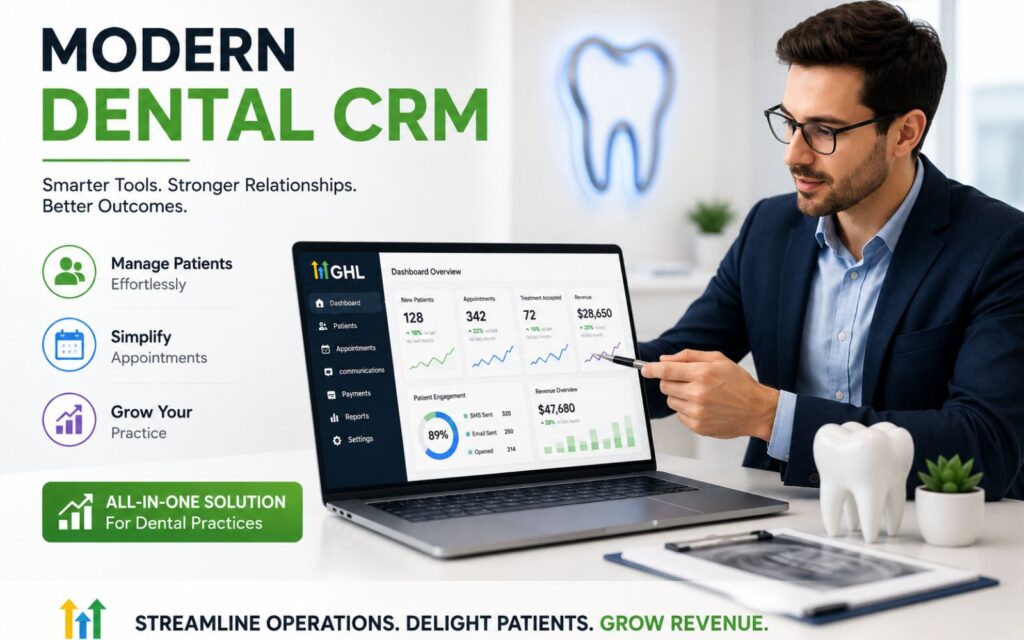
SEO Title: Modern Dental CRM: The Blueprint for Scalable, System-Driven Clinic Growth Meta Description: Explore how a Modern Dental CRM transforms clinic operations. Learn to reduce no-shows, recover missed calls, and automate patient follow-ups for a high-efficiency practice.
Modern Dental CRM: Why Systems, Not Just Skill, Define Clinic Success
The traditional model of running a dental practice is under immense pressure. For decades, the mantra for success was simple: provide excellent clinical care, and the patient base will take care of itself. While clinical excellence remains the non-negotiable foundation of any practice, the modern economic landscape has shifted the goalposts.
Today’s dental clinic owners face rising overheads, a tightening labor market for front-desk staff, and a patient base that expects instant, digital-first communication. Many practitioners find themselves on a treadmill—working harder to fill chairs, yet seeing profit margins squeezed by “leaky” operations.
The missing link isn’t usually the dentistry; it’s the infrastructure. To move from a practice that relies on the heroic efforts of a stressed-out front desk to one that scales predictably, you need a Modern Dental CRM.
What Intelligence Means in a Dental Clinic
In a clinical setting, intelligence is diagnostic. It’s the ability to read a 3D scan or identify the early stages of periodontal disease. In an operational setting, intelligence is systemic.
An intelligent clinic is one where data informs every decision. It is a practice where you know, to the dollar, your cost per acquisition for an implant patient, your exact no-show rate for hygiene appointments, and precisely how many inquiries are currently sitting in “limbo” because a staff member forgot to follow up.
Most clinics operate in a state of “unconscious leakage.” They lose money in the gaps between phone calls and appointments. A Modern Dental CRM acts as the central nervous system of the business, ensuring that no lead is dropped and no patient is forgotten.
Human Intelligence vs. System Intelligence
There is a common misconception that automation replaces the human touch. In reality, automation protects it.
The Limits of Human Intelligence
Your front-desk coordinator is likely the most overtaxed individual in your building. They are expected to:
- Greet in-person patients.
- Manage insurance verifications.
- Answer multi-line phones.
- Reschedule cancellations.
- Follow up with outstanding treatment plans.
When the office gets busy, something has to give. Usually, it’s the outgoing follow-up calls or the prompt return of a voicemail. This isn’t a performance issue; it’s a bandwidth issue.
The Power of System Intelligence
System intelligence—specifically through a Modern Dental CRM—takes the repetitive, non-clinical tasks off the human plate. While your team focuses on the patient in the chair, the system is:
- Sending automated “Missed Call Text Backs” to new inquiries.
- Nurturing leads who downloaded an Invisalign guide but haven’t booked.
- Tracking the ROI of your latest local marketing campaign.
AI & Automation: Integrating High-Level Infrastructure
The transition to a digital-first clinic requires more than just a digital calendar. It requires an integrated ecosystem. Platforms like GoHighLevel have emerged as the gold standard for this transition because they allow clinics to centralize patient communication, reminders, and tracking inside one structured system.
Rather than having a separate tool for email, another for SMS, and a spreadsheet for leads, a Modern Dental CRM consolidates these into a single dashboard. This provides the clinic owner with unprecedented visibility. You are no longer guessing if your marketing is working; you are looking at a pipeline.
Effective automation in dentistry focuses on the “In-Between Spaces”—the time between a patient seeing your ad and booking, or the time between a diagnosis and the treatment acceptance.
Operational Insight: If your clinic loses even five missed calls per week, that is silent revenue walking away. A structured automation system prevents that by engaging the patient the second they hang up.
Note: The link below is an affiliate link. I only recommend systems that align with structured clinic growth.
[Start Building a Smarter Dental System](INSERT YOUR AFFILIATE LINK HERE)
Real Clinic Scenarios: From Chaos to Control
To understand the impact of a Modern Dental CRM, we must look at the common “friction points” in a typical day.
Scenario A: The Monday Morning Missed Call
A prospective patient wakes up with tooth pain on a Sunday. They call your office, but you’re closed. They leave a voicemail. On Monday morning, your front desk is swamped with check-ins. By the time they return the call at 11:00 AM, the patient has already booked with the clinic down the street that answered their text.
The CRM Solution: The moment the call is missed, the CRM sends an automated text: “Hi! We missed your call. Need to book an appointment? Use our link here or reply with ‘Help’.” The patient is engaged instantly, and the “lead” is captured.
Scenario B: The “Ghosted” Treatment Plan
During an exam, you recommend a $4,000 crown and bridge. The patient says, “I need to talk to my spouse.” They leave, and the chart is filed. Unless a staff member manually remembers to call them two weeks later, that $4,000 is gone.
The CRM Solution: The patient is moved to a “Treatment Pending” stage in the Modern Dental CRM. A sequence of educational emails and SMS reminders is triggered, explaining the benefits of the procedure and the risks of delay. This keeps the treatment top-of-mind without the staff feeling like “salespeople.”
Scenario C: The Hygiene No-Show
No-shows are the primary killer of dental profit margins. A 15% no-show rate can cost a mid-sized clinic six figures annually.
The CRM Solution: Multi-channel reminders (Email, SMS, and Voice) are deployed at 7 days, 2 days, and 2 hours before the appointment. The system requires a “Confirm” reply, which automatically updates the status in the dashboard.
Common Mistakes When Implementing a CRM
Even the best Modern Dental CRM will fail if implemented poorly. Clinic owners often fall into these traps:
- Over-Automation: If your messages sound like a robot, patients will ignore them. The goal is “Human-to-Human” communication facilitated by “System-to-System” efficiency.
- Neglecting the Data: A CRM is a goldmine of information. If you don’t check your “Opportunity Pipeline” weekly, you are flying blind.
- Fragmented Tools: Using five different softwares that don’t talk to each other leads to data silos. A centralized platform is essential for a “Single Source of Truth.”
Implementing a structured system isn’t about working harder; it’s about creating a machine that supports your staff so they can provide better care to the patients in the room.
[Start Building a Smarter Dental System](INSERT YOUR AFFILIATE LINK HERE)
The Economics of Revenue Stabilization
The ultimate goal of a Modern Dental CRM is revenue stabilization. Most clinics experience a “yo-yo” effect: a great month followed by a slow month. This is usually because when the clinic is busy, marketing and follow-up stop. When the clinic is slow, the staff scrambles to fill the books.
Automation creates a “Consistent Baseline.” By constantly nurturing your database (your “Patient Recall” list), the system ensures a steady stream of appointments regardless of how busy the front desk is.
Lead Tracking and ROI
How much does it cost you to get one new patient? If you can’t answer that, your marketing is a gamble. A Modern Dental CRM tracks every lead source. Whether they came from a Google Ad, a Facebook post, or a referral, you can see exactly which channels are driving the highest-value patients (like implants and “All-on-4”) versus low-value leads.
Patient Retention: The Hidden Profit
It is 5x cheaper to keep an existing patient than to acquire a new one. A CRM automates the “long-term follow-up.” It sends birthday messages, six-month reminders, and “we miss you” campaigns to patients who haven’t been in for over a year. This “reactivation” is often the most profitable activity a clinic can perform.
The Future of Structured Clinics
As we move further into the decade, the divide between “analog” clinics and “systemized” clinics will widen. Patients are becoming consumers who value convenience as much as clinical skill. They want to book via text, receive reminders on their watches, and pay their bills through a secure link.
A Modern Dental CRM isn’t just a marketing tool; it is a business management necessity. It allows the clinic owner to step back from the daily “firefighting” and look at the practice from a 30,000-foot view.
If you want to reduce burnout, stabilize your income, and actually enjoy the business of dentistry, you must stop being the “engine” of the clinic and start being the “engineer” of the system.
Final Thoughts on Implementation
Transitioning to a systemized practice is a marathon, not a sprint. It begins with identifying your biggest “leak”—whether that’s missed calls or no-shows—and letting a Modern Dental CRM plug that hole first. Over time, as you layer in more automation, you will find that your staff is happier, your chairs are fuller, and your stress levels are significantly lower.
Modern dentistry is complex. Your systems shouldn’t be. By choosing a platform that centralizes your operations, you are choosing a path of sustainable growth.
[Start Building a Smarter Dental System](INSERT YOUR AFFILIATE LINK HERE)
Frequently Asked Questions (FAQs)
1. Will a Modern Dental CRM replace my current practice management software (PMS)?
No. A CRM like GoHighLevel usually sits “on top” of or alongside your PMS (like Dentrix or Eaglesoft). While your PMS handles clinical charting and billing, the CRM handles the “front-end” patient experience, marketing, and follow-up communication that most PMS systems do poorly.
2. Is automation too impersonal for a healthcare setting?
Not if done correctly. The key is to write your automated messages exactly how you would say them. Automation simply ensures the message actually gets sent. Patients actually appreciate the timely communication and the ability to confirm appointments via text.
3. How long does it take to see results from a CRM?
Some results are near-instant. Implementing a “Missed Call Text Back” feature can capture a new patient on day one. Long-term results, like improved patient retention and stabilized revenue, typically become evident within 90 days.
4. My staff is already overwhelmed. Won’t a new system just frustrate them?
A Modern Dental CRM is designed to reduce the workload, not add to it. By automating the hundreds of manual texts and calls they make every week, you are giving them hours of their day back. The initial learning curve is a small investment for a massive long-term reduction in “busy work.”
5. Can a CRM help with getting more Google reviews?
Yes. A Modern Dental CRM can trigger a review request via SMS the moment a patient checks out. This is the most effective way to build your online reputation, as patients are most likely to leave a positive review while they are still in the parking lot.
6. What is the most important feature to look for in a Dental CRM?
Centralization. You want a tool that handles SMS, Email, Lead Tracking, and Reputation Management in one place. Using multiple “niche” tools leads to a “Frankenstein” system that eventually breaks down and causes more stress than it solves.