
For the modern practice owner, the “clinical trap” is a quiet but persistent burden. We are taught that if we provide the best clinical outcomes—perfect margins, Dental Better than GoHighLevel painless extractions, and aesthetic veneers—the business will naturally flourish.
But in the reality of day-to-day operations, clinical excellence is merely the baseline. The true differentiator between a clinic that survives and one that scales is the intelligence of its systems. You can be the most talented clinician in the zip code, but if your front desk is overwhelmed, your follow-ups are inconsistent, and your missed calls remain unreturned, your revenue remains capped by operational friction.
To move from a practitioner-led business to a system-led enterprise, we must redefine what “intelligence” looks like in a dental setting.
What Intelligence Means in a Dental Clinic
Intelligence in a dental practice isn’t just about the IQ of your staff; it is about the predictability of your workflows. An intelligent clinic is one where the patient lifecycle—from the first Google search to the five-year recall—is managed by a framework that doesn’t rely on a staff member “remembering” to do it.
Most clinics operate in a reactive state. A patient calls, you book them. A patient forgets, you lose the chair time. An intelligent clinic operates proactively. It uses data to identify where patients are dropping off and employs technology to plug those holes before the revenue leaks away.
Human Intelligence vs. System Intelligence
We often over-rely on “Human Intelligence.” We hire a “superstar” office manager and pray they never quit. When they do, the practice’s institutional knowledge walks out the door with them.
- Human Intelligence is excellent for empathy, complex treatment presentation, and chairside manner.
- System Intelligence handles the repetitive, high-stakes tasks that humans are naturally prone to forget: confirming appointments at 48 and 24 hours, tracking referral sources, and following up on unaccepted treatment plans.
When you blend the two, you create a clinic that is both compassionate and profitable. You free your team from the “drudgery of the dashboard” so they can focus on the patient sitting in front of them.
The Role of AI & Automation in Modern Dentistry
The introduction of automation into the dental space isn’t about replacing the human touch; it’s about protecting it. Every minute your front desk spends playing phone tag for a hygiene appointment is a minute they aren’t discussing a $15,000 implant case with a patient in the lobby.
Platforms like GoHighLevel allow clinics to centralize patient communication, reminders, and tracking inside one structured system. Instead of having five different software subscriptions that don’t talk to each other, a unified CRM (Customer Relationship Management) tool acts as the “central nervous system” of the practice.
For many owners, the hesitation comes from a fear that automation feels “cold.” However, a well-timed, automated “Happy Birthday” or a “How are you feeling after your extraction?” text feels more personal to a patient than a manual call that never happens because the office got too busy.
Centralizing the Chaos
By utilizing an infrastructure like GoHighLevel, you gain visibility. You can see exactly how many leads came from your Facebook ads, how many were called back within 5 minutes, and what the actual ROI of your marketing spend is. It moves your decision-making from “gut feeling” to “data-driven.”
Think of it this way—if your clinic loses even five missed calls per week, that’s silent revenue walking away. A structured automation system prevents that leak and ensures every lead is accounted for.
Note: The link below is an affiliate link. I only recommend systems that align with structured clinic growth.
👉 [Start Building a Smarter Dental System](INSERT YOUR AFFILIATE LINK HERE)
Real Clinic Scenarios: The Cost of Manual Labor
Let’s look at two common scenarios that haunt the average dental practice:
Scenario A: The Missed Call Leakage
It’s 12:15 PM. The front desk is at lunch. A high-value lead—someone looking for “All-on-4” implants—calls. They get a voicemail. They don’t leave a message; they simply call the next dentist on the Google search results. The System Solution: An automated “Missed Call Text Back” immediately sends a message: “Hi! This is [Clinic Name]. Sorry we missed your call. How can we help you today?” The lead is engaged, the conversation starts on SMS, and the patient is “captured” before they move to a competitor.
Scenario B: The No-Show Economics
A patient books a $2,000 crown prep. They forget the appointment. The chair sits empty for 90 minutes. Your overhead (staff, rent, utilities) continues to burn at $300–$500 per hour. The System Solution: A 3-step automated confirmation sequence (Email 7 days out, SMS 2 days out, SMS 2 hours out) with a “Click to Confirm” feature. If they don’t confirm 24 hours out, the system alerts the staff to call them immediately, allowing you to fill that gap from a “Quick-Fill” waitlist that is also automated.
Managing a clinic without these triggers is like trying to carry water in a sieve. Transitioning to a structured CRM allows you to stop the leaks and focus on dentistry.
👉 [Start Building a Smarter Dental System](INSERT YOUR AFFILIATE LINK HERE)
Common Mistakes: Why “Dental Better than GoHighLevel” is a Misconception
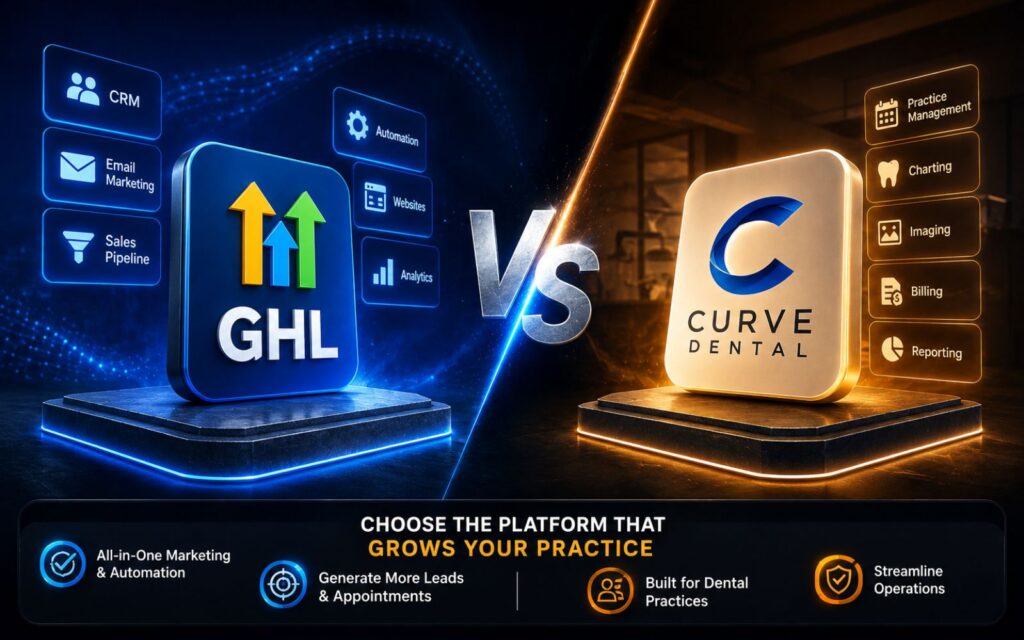
In my experience as a strategist, I often hear practitioners say they want something “specifically built for dental” that is supposedly “better” than a general-purpose powerhouse like GoHighLevel. While niche dental software exists, they often lack the sophisticated marketing automation and lead-capture capabilities of a dedicated CRM.
The “Dental Better than GoHighLevel” argument usually falls apart when you realize that most dental-specific software is great at clinical records (PMS) but terrible at modern communication. A clinic that wins in 2026 is one that uses a robust PMS (like Dentrix or Open Dental) for clinical data, but bridges it with a world-class automation engine for patient acquisition and retention. You don’t need a “dental-only” tool for marketing; you need the best tool for communication. For a deeper dive into how specialized tools compare to broader automation, you might find this external analysis on healthcare CRM trends helpful.
The Future of Structured Clinics
We are moving into an era where the “lifestyle practice” is only possible through automation. The alternative is burnout. As labor costs rise and insurance reimbursements tighten, the margin for error in dental operations is shrinking.
The future belongs to the owner who treats their practice like a sophisticated machine. This includes:
- Automated Lead Tracking: Knowing exactly where every dollar of marketing goes.
- Automated Reputation Management: Sending a review link via SMS the moment a patient checks out.
- Automated Reactivation: Identifying patients who haven’t been in for 12 months and reaching out without manual effort.
Conclusion: Systems as a Form of Care
True patient care extends beyond the clinical chair. It includes how easy it is for a patient to book, how well they are informed before their visit, and how consistently they are followed up with after a procedure.
Growth isn’t about working more hours; it’s about making the hours you work more valuable. By implementing a system like GoHighLevel, you aren’t just buying software—you are installing an infrastructure that allows your clinic to breathe, grow, and thrive without requiring you to be “on” 24/7.
Transitioning to an automated clinic is a strategic pivot that moves you from a stressed business owner to a high-performing CEO. It’s time to let the systems do the heavy lifting.
👉 [Start Building a Smarter Dental System](INSERT YOUR AFFILIATE LINK HERE)
Frequently Asked Questions (FAQs)
1. Will automation make my dental practice feel impersonal?
Actually, the opposite is true. By automating the routine “administrative” messages, your team has more time to engage in meaningful, face-to-face conversations with patients. It ensures no patient feels forgotten.
2. Is it difficult to integrate GoHighLevel with my existing Dental Software?
While it may not always sync directly with every legacy PMS, it acts as a powerful “front-end” for lead capture and communication. Many clinics use it alongside their PMS to handle the marketing and follow-up tasks that dental software usually does poorly.
3. How does “Missed Call Text Back” actually help revenue?
A high percentage of new patients will not leave a voicemail; they will simply call the next dentist. An immediate text message captures their attention and starts a dialogue, often resulting in a booked appointment before they even consider calling another clinic.
4. Can this help reduce staff burnout?
Yes. One of the primary causes of front-desk turnover is the high volume of repetitive tasks and phone calls. Automating reminders, review requests, and initial lead inquiries significantly reduces the “cognitive load” on your team.
5. What is the ROI of implementing a CRM in a dental clinic?
If the system saves just one mid-range treatment case (like a crown) or prevents two no-shows per month, it has typically paid for itself multiple times over. The long-term ROI in patient retention is even higher.
6. Is it “Dental Better than GoHighLevel” or should I use both?
It’s rarely an “either/or” situation. You need your clinical software for charting and billing, but you need a CRM like GoHighLevel for sophisticated patient acquisition and lifecycle management. The two work in tandem to create a high-growth environment.