
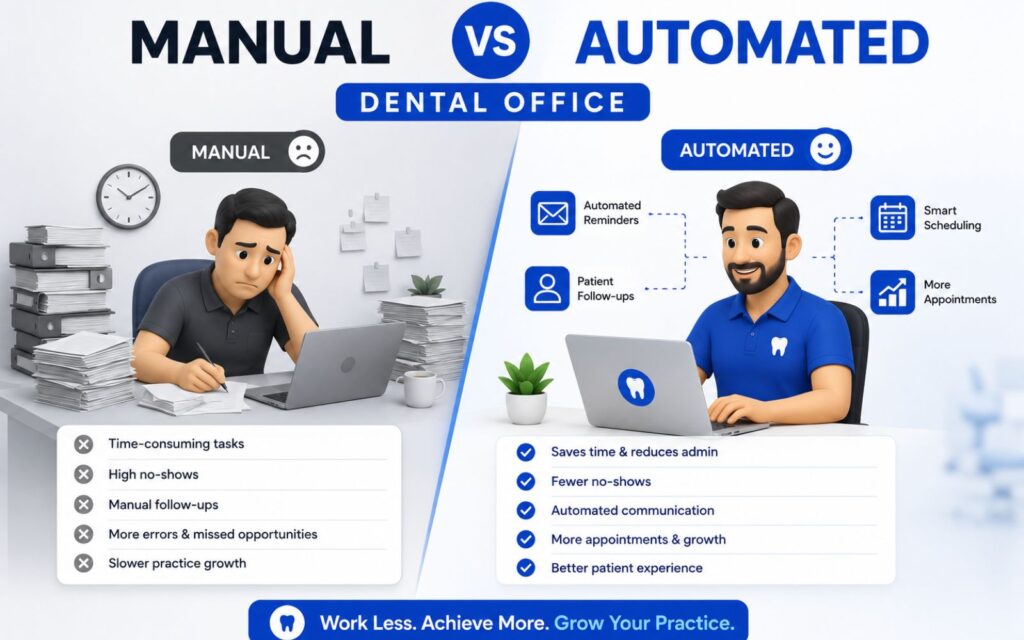
For most dental clinic owners, the day doesn’t start with a handpiece; it starts with a spreadsheet or a frantic glance at the morning huddle notes. You see the gaps immediately: three cancellations in the afternoon, a stack of patient inquiries from the weekend that haven’t been touched, and a front-desk team that looks visually exhausted before the first patient has even checked in.
The traditional response to a stagnant “production” number is often to work harder, see more patients, or invest in a new clinical certification. While clinical excellence is the bedrock of any practice, it is rarely the bottleneck for growth. The bottleneck is operational.
Automating your dental practice is no longer a luxury reserved for multi-location DSOs. It is the fundamental shift from a “labor-heavy” model to a “systems-heavy” model. In this guide, we will explore why structured systems are the only way to scale without burnout and how intelligent automation acts as the “silent associate” your clinic has been missing.
What Intelligence Means in a Dental Clinic
In a clinical setting, we define intelligence by diagnostic accuracy and surgical precision. However, in a business setting, operational intelligence is the ability of your practice to function predictably without your constant intervention.
A “smart” clinic is one where the data dictates the action. If a patient cancels, the system knows. If a lead fills out a form at 11:00 PM on a Sunday, the system responds. Operational intelligence is built on two distinct pillars:
1. Human Intelligence
This is your staff’s ability to empathize, educate, and close high-value treatment plans. This is where you want your team’s energy focused. When your front desk is spent navigating clunky software or playing phone tag for six hours a day, their “human intelligence” is being wasted on “mechanical tasks.”
2. System Intelligence
This is the digital infrastructure that handles the repetitive, the predictable, and the forgotten. System intelligence doesn’t get tired, it doesn’t forget to follow up with a “maybe” from three weeks ago, and it never fails to send a pre-op instruction.
When you begin automating your dental practice, you aren’t replacing your staff; you are elevating them. You are stripping away the administrative noise so they can focus on the patient sitting in front of them.
The Strategic Role of AI and Automation
We have moved past the era of simple “text reminders.” Modern dental automation involves a centralized CRM (Customer Relationship Management) system that acts as the brain of the practice.
Platforms like GoHighLevel allow clinics to centralize patient communication, reminders, and lead tracking inside one structured system. Instead of having your data scattered across a legacy practice management software, a separate VoIP phone system, and a standalone email tool, automation brings these into a single “command center.”
The Key Pillars of Dental Automation:
- Missed Call Text-Back: When a potential high-value patient calls during lunch or after hours, the system immediately sends a text: “Sorry we missed you! We’re currently helping another patient. How can we help you today?” This stops the “shopping” process and captures the lead instantly.
- Automated Lead Nurturing: If someone downloads a guide on dental implants from your site, the system follows up over 14 days with educational content, testimonials, and FAQ videos, moving them closer to a consultation without a single manual email from your staff.
- The No-Show Sequence: Beyond a 24-hour reminder, automation can trigger specific workflows for chronic no-showers or high-value appointments, requiring digital “confirmation clicks” that update the schedule in real-time.
Transitioning to a Managed Workflow
The transition from a reactive clinic to a proactive one requires more than just buying software; it requires a shift in how you view your front office. By implementing a central system, you ensure that no patient falls through the cracks, regardless of how busy the physical office becomes.
Note: The link below is an affiliate link. I only recommend systems that align with structured clinic growth.
Think of it this way — if your clinic loses even five missed calls per week, that’s silent revenue walking away. A structured automation system prevents that leak by capturing every interaction.
[Start Building a Smarter Dental System](INSERT YOUR AFFILIATE LINK HERE)
Real Clinic Scenarios: Automation in Action
To understand the impact of automating your dental practice, let’s look at two common scenarios that happen in every clinic.
Scenario A: The “Ghosted” Treatment Plan
A patient is diagnosed with $5,000 worth of restorative work. They say, “I need to talk to my spouse,” and walk out. In a traditional clinic, that chart is filed away, and unless a receptionist remembers to call in two weeks, that revenue is lost.
- The Automated Way: As soon as the patient leaves, the coordinator moves them to a “Pending Treatment” stage in the CRM. An automated, 3-step sequence is triggered. Day 3: A friendly “checking in” text. Day 7: A link to a video explaining the risks of delaying treatment. Day 14: A limited-time financing offer.
Scenario B: The After-Hours Emergency
It’s Friday night. A prospect has a toothache and calls three local dentists. Two go to voicemail. Your clinic, using an automated CRM, sends an immediate text back with a link to your emergency triage form and an “instant booking” option for Monday morning.
- The Result: You win the patient before your competitor even checks their voicemail on Monday morning.
Common Mistakes When Automating
While the benefits are clear, many owners stumble during the implementation phase. Automating your dental practice is a marathon, not a sprint.
- Over-complicating the Workflow: Start with the “Big Three”: Missed calls, No-shows, and New Patient leads. Don’t try to automate every single touchpoint on day one.
- Neglecting the “Human Hand-off”: Automation should get the patient to the door. Once they are there, the human element must take over. If your automated reminders are professional but your front desk is rude, the system will only help you lose patients faster.
- Ignoring the Data: If your CRM shows you are getting 50 leads a month but only 5 are booking, the problem isn’t the automation; it’s likely your offer or your pricing. Automation provides the “visibility” to see where the pipe is leaking.
The Future of the Structured Clinic
The dental industry is bifurcating. On one side, you have “Hustle Clinics” — practices that rely on constant marketing spend and a revolving door of burnt-out staff to keep the lights on. On the other side, you have “System Clinics.”
System Clinics are calmer. They have higher profit margins because their patient acquisition costs are lower (thanks to better retention and lead recovery). They are also more valuable assets when it comes time for the owner to exit. A buyer isn’t just buying your patient list; they are buying your operating system.
By automating your dental practice, you are building an asset that produces predictable outcomes. Whether you are in the operatory or on vacation, the “System Intelligence” continues to nurture leads, follow up on hygiene recalls, and request Google reviews.
Implementation Logic
Choosing a platform like GoHighLevel gives you the infrastructure to build these workflows without needing a degree in computer science. It is about creating a “set and forget” environment for the administrative tasks that currently clutter your brain.
If your goal is to stabilize revenue while reducing the mental load on your team, the next logical step is moving from manual processes to an integrated CRM.
[Start Building a Smarter Dental System](INSERT YOUR AFFILIATE LINK HERE)
Conclusion: The Path Forward
Automating your dental practice is not about removing the “care” from “healthcare.” It is about ensuring that the care is delivered consistently. Every time a call goes unanswered, or a patient isn’t followed up with after a major procedure, the quality of care drops.
Systems provide the safety net that ensures your clinical excellence is matched by your operational excellence. Start small: fix your missed call leakage, automate your appointment confirmations, and centralize your leads. You will find that as the chaos subsides, your passion for dentistry often returns.
Growth is not found in the next “miracle” marketing campaign. It is found in the quiet efficiency of a system that works while you sleep.
Frequently Asked Questions (FAQs)
1. Does automating my practice make the patient experience feel “robotic”?
Quite the opposite. By automating the routine tasks (reminders, paperwork, FAQs), your staff has more time to engage in meaningful, face-to-face conversations with patients. Personalization features in modern CRMs also allow you to use the patient’s name and specific details, often making the communication feel more attentive than a rushed manual call.
2. Is it difficult to integrate automation with my existing Practice Management Software (PMS)?
Most modern automation tools like GoHighLevel can work alongside your PMS. While some deep integrations exist, many clinics find success using the CRM as the “front-end” for communication and lead management, while the PMS remains the “back-end” for clinical charting and billing.
3. How long does it take to see results from dental automation?
You can see results almost immediately—specifically with Missed Call Text-Back. Capturing just one or two “lost” patients in the first week can often pay for the entire year’s software subscription. Full-scale “lifecycle” automation usually takes 30-90 days to fully calibrate.
4. Will my staff be resistant to these new systems?
Staff resistance usually stems from fear of technology or fear of being replaced. When you frame automating your dental practice as a way to “remove the tasks they hate” (like cold-calling overdue recalls or playing phone tag), they usually become the biggest advocates for the system.
5. What is the most important process to automate first?
If you only automate one thing, make it Lead Response. Research shows that responding to a lead within 5 minutes increases the chance of conversion by over 400%. If your team is busy with a patient, they cannot respond that fast—but an automated system can.
6. Is GoHighLevel secure for dental patient data?
While GoHighLevel offers robust security features and can be configured for HIPAA compliance (with the appropriate plan and BAA), you should always ensure your specific workflows and data storage practices meet your local regulatory requirements for patient privacy.