
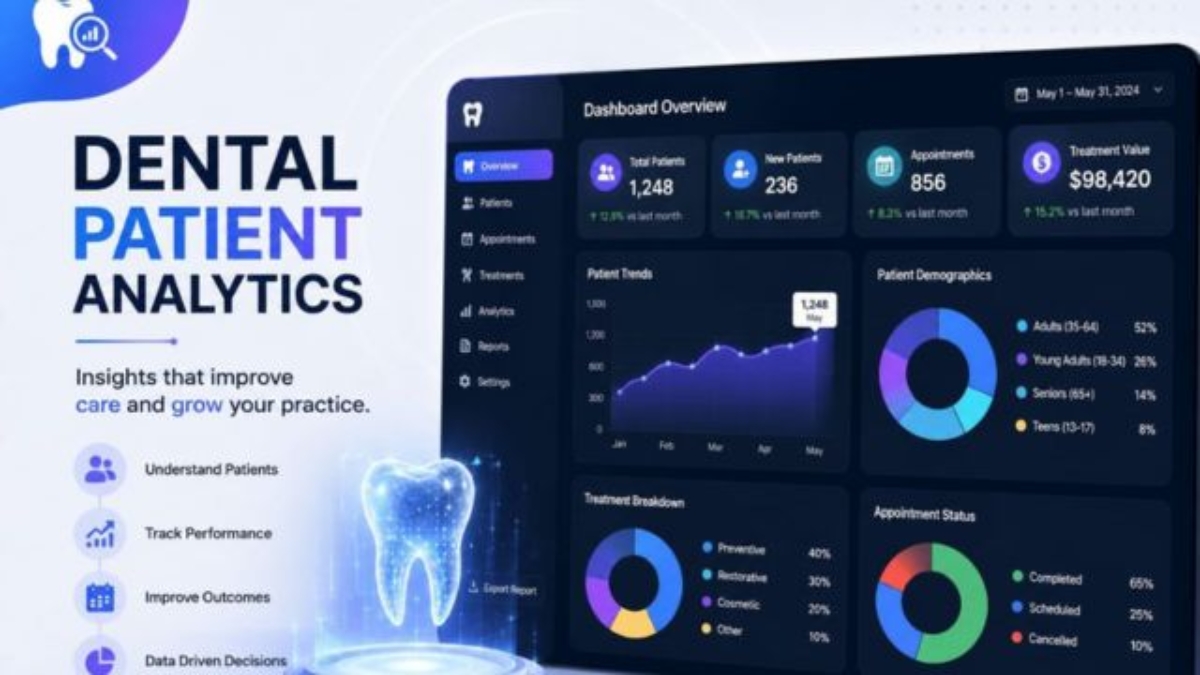
Machine Learning for Dental Patient Analytics: The Practical Growth and Implementation Guide
Machine learning for dental patient analytics allows a dental practice to turn appointment, communication, treatment, payment, and patient-engagement data into practical decisions.
Instead of looking only at historical reports, a clinic can use machine learning to identify patterns such as which patients may miss an appointment, who is overdue for recall, which inquiries are unlikely to book, and where revenue or patient-retention opportunities are being lost.
However, machine learning should not be treated as a magical decision-maker. Its value depends on data quality, responsible implementation, privacy controls, and human oversight. The goal is not to replace dentists or front-desk teams. It is to help them prioritize work, reduce repetitive analysis, and respond to patients more effectively.
What Is Machine Learning for Dental Patient Analytics?
Machine learning is a branch of artificial intelligence that identifies patterns within data and uses those patterns to generate predictions, classifications, recommendations, or forecasts.
In a dental practice, patient analytics may include data from:
- Practice management software
- Appointment calendars
- Dental CRM platforms
- Online booking forms
- Call and message records
- Treatment plans
- Payment history
- Recall records
- Patient surveys
- Marketing campaigns
- Website inquiries
- Email and SMS engagement
Traditional reporting tells a clinic what already happened. Machine learning can help estimate what is likely to happen next.
For example:
Traditional report: Twenty-seven patients missed appointments last month.
Machine-learning insight: Patients with certain booking patterns, communication gaps, or appointment histories appear more likely to miss an upcoming appointment.
The second insight gives the practice an opportunity to act before the loss occurs.
How Dental Patient Analytics Works
A machine-learning system generally follows five stages.
1. Data collection
The practice collects relevant information from approved systems. This may include appointment status, lead source, booking date, procedure type, response history, reminder delivery, payment status, and recall activity.
Only information required for a legitimate operational or clinical purpose should be collected.
2. Data preparation
Raw dental data is rarely ready for analysis. Duplicate contacts, incomplete records, inconsistent procedure names, missing appointment outcomes, and incorrect phone numbers can reduce accuracy.
Before modeling begins, the data should be:
- Cleaned
- Standardized
- Deduplicated
- Categorized
- Validated
- De-identified when appropriate
3. Pattern identification
The system analyzes historical examples and looks for relationships between variables.
For instance, a no-show model may evaluate whether missed appointments are associated with:
- Long gaps between booking and appointment
- Previous cancellations
- Failed reminder delivery
- Appointment time
- Treatment category
- Incomplete forms
- Lack of confirmation
- Low communication engagement
These variables do not automatically prove why a patient missed an appointment. They simply help the system recognize patterns that may be useful for prioritization.
4. Prediction or segmentation
The model produces an output such as:
- Low, medium, or high no-show risk
- Probability of booking
- Recall priority score
- Patient-engagement segment
- Treatment follow-up category
- Expected appointment demand
5. Human-led action
The output should trigger an appropriate workflow rather than an irreversible automated decision.
A high-risk appointment might receive:
- An earlier confirmation request
- A second reminder
- A staff follow-up call
- A simplified rescheduling option
- A request to confirm electronically
The system supports the team; the team remains responsible for patient care and judgment.
High-Value Applications of Machine Learning in Dentistry
Predicting Appointment No-Shows
No-shows create empty chair time, disrupt scheduling, and reduce productivity. Many clinics rely on the same reminder sequence for every patient, even though patient behavior differs.
Machine learning can assign each upcoming appointment a risk level based on historical patterns. The practice can then adjust the workflow.
| Risk level | Suggested action |
|---|---|
| Low | Standard confirmation and reminder |
| Medium | Additional reminder with easy confirmation |
| High | Staff call, earlier confirmation, and rescheduling option |
The purpose is not to label patients as unreliable. The purpose is to identify appointments that may need additional support.
A clinic should also allow patients to update contact preferences and opt out of nonessential communications. For broader workflow ideas, see this guide on reducing dental patient no-shows.
Identifying Patients at Risk of Leaving
A patient may quietly disengage long before formally leaving a practice.
Possible warning signals include:
- Overdue recall appointments
- Declining email or SMS engagement
- Repeated cancellations
- Unfinished treatment plans
- Long gaps since the last visit
- Negative survey feedback
- Failed payment communications
- No response to previous recall attempts
Machine learning can combine these signals into a retention-risk score. Staff can then prioritize patients who may benefit from a personal, helpful conversation.
A responsible re-engagement message should focus on continuity of care rather than pressure:
“We noticed it has been some time since your last visit. Would you like help finding an appointment that fits your schedule?”
This approach can complement a structured dental patient retention strategy.
Improving Patient Recall
Most practices have a list of overdue patients, but not every record requires the same message or priority.
Machine learning can segment recall patients according to:
- Time since last visit
- Previous appointment behavior
- Preferred contact channel
- Treatment history
- Past response timing
- Communication engagement
- Recall urgency defined by the practice
The clinic might create separate workflows for:
- Recently overdue patients
- Long-term inactive patients
- Patients who repeatedly reschedule
- Patients with incomplete treatment
- Patients who prefer phone calls
- Patients who respond better to text messages
This makes recall outreach more relevant while reducing unnecessary communication. A practical starting point is an automated dental patient recall workflow.
Supporting Treatment-Plan Follow-Up
Machine learning can help practices identify treatment plans that may require follow-up, but it should not independently decide whether a treatment is clinically necessary.
Potential operational signals include:
- Treatment presented but not scheduled
- Insurance or payment questions
- No response after consultation
- Repeated visits to financing pages
- Missed consultation follow-ups
- Long delay since treatment presentation
A model may classify cases into categories such as:
- Needs financial information
- Needs clinical clarification
- Ready to schedule
- Requires a personal conversation
- Not appropriate for further automated outreach
The final communication should remain accurate, respectful, and reviewed by qualified staff.
Forecasting Appointment Demand
Historical appointment data can help clinics estimate future demand by:
- Day of the week
- Time of day
- Procedure category
- Provider
- Location
- Season
- Lead source
- New versus existing patient status
These forecasts may support:
- Staffing decisions
- Provider scheduling
- Hygiene capacity planning
- Call coverage
- Marketing timing
- Wait-list management
- Multi-location resource allocation
Forecasts are estimates, not guarantees. Holidays, local events, changes in insurance participation, staffing changes, and economic conditions can quickly change demand.
Prioritizing New Patient Inquiries
Not every inquiry has the same intent. Some people are ready to book immediately, while others are comparing options or requesting general information.
Machine learning may analyze nonclinical engagement signals such as:
- Service requested
- Source of inquiry
- Response time
- Number of messages
- Booking-page activity
- Form completion
- Call outcome
- Availability requested
The system can prioritize urgent or high-intent inquiries while ensuring that every patient still receives an appropriate response.
This works best when connected to a centralized system such as a modern dental CRM.
Analyzing Patient Feedback
Dental practices often collect reviews and surveys but do not systematically analyze them.
Natural language processing, a related area of machine learning, can categorize written feedback into themes such as:
- Wait time
- Staff communication
- Billing confusion
- Appointment availability
- Comfort
- Cleanliness
- Post-treatment instructions
- Overall satisfaction
The practice can track whether a recurring issue is becoming more common.
Automated sentiment analysis should not be trusted without review. Sarcasm, mixed feedback, language differences, and short comments can be misclassified. Staff should validate important findings before making operational decisions.
Learn more about automating dental patient surveys.
Estimating Patient Lifetime Value
Patient lifetime value can help a practice understand the long-term contribution of different patient relationships and acquisition channels.
A model may consider:
- Length of patient relationship
- Completed visits
- Procedure mix
- Recall consistency
- Referral activity
- Cancellations
- Acquisition cost
- Revenue history
Patient lifetime value should be used for business planning, not to create unequal standards of clinical care. Every patient should receive appropriate treatment and communication regardless of projected financial value.
For an implementation framework, review tracking dental patient lifetime value.
Machine Learning Models a Dental Practice May Use
Classification models
Classification models place records into predefined categories.
Dental examples include:
- Likely to attend versus at risk of no-show
- Likely to book versus requires follow-up
- Active versus disengaging patient
- Positive, neutral, or negative feedback
Regression models
Regression models estimate a numerical value.
They may forecast:
- Monthly appointment volume
- Expected cancellations
- Chair utilization
- Patient lifetime value
- Demand for a procedure category
Clustering models
Clustering groups similar records without requiring predefined labels.
A practice might discover segments such as:
- Patients who prefer digital booking
- Patients who respond to calls but not texts
- High-engagement recall patients
- Patients who need more scheduling flexibility
- Patients who frequently request financing information
The clinic should review each segment carefully before using it in communication.
Natural language processing
Natural language processing can analyze:
- Survey comments
- Call transcripts
- Chat conversations
- Review themes
- Common patient questions
Sensitive communications should only be processed through systems that meet the practice’s privacy, security, and contractual requirements.
A Practical Machine Learning Workflow for Dental Clinics
A useful implementation does not begin with sophisticated software. It begins with a clearly defined problem.
Step 1: Select one measurable use case
Good first projects include:
- Reducing no-shows
- Improving recall conversion
- Recovering incomplete bookings
- Prioritizing treatment follow-up
- Forecasting weekly appointment demand
Avoid trying to automate every process at once.
Step 2: Define the decision the model will support
Do not begin with “We want to use AI.”
Begin with:
“We want to identify tomorrow’s appointments that may need additional confirmation.”
This clarifies the required data, output, workflow, and success metric.
Step 3: Audit the available data
Review:
- Which systems store the data?
- Is appointment status recorded consistently?
- Are cancellations separated from no-shows?
- Are duplicate patient profiles common?
- Are message outcomes available?
- Is consent recorded?
- Who is permitted to access the data?
- How long is information retained?
Automated patient forms can improve data consistency when properly designed. See automating dental patient forms.
Step 4: Create a baseline
Before implementing machine learning, record the current performance.
For a no-show project, measure:
- Total scheduled appointments
- Confirmed appointments
- Cancellations
- Rescheduled appointments
- No-shows
- Reminder delivery rate
- Staff follow-up time
- Recovered appointments
Without a baseline, the clinic cannot determine whether the new system created an improvement.
Step 5: Build the smallest useful model
The first version does not need to be highly complex.
A basic system may use:
- A simple rules-based score
- Logistic regression
- Decision trees
- A model provided by an approved software platform
A transparent model that staff understand can be more useful than a complicated model that no one can explain.
Step 6: Connect the prediction to a workflow
A prediction without action has limited value.
Example:
Appointment created
        ↓
Risk score generated
        ↓
Low risk → standard reminder
Medium risk → reminder plus confirmation request
High risk → staff review and direct contact
        ↓
Outcome recorded
        ↓
Model performance reviewed
Step 7: Test with a limited group
Run a pilot with:
- One provider
- One location
- One appointment category
- One communication channel
- A limited time period
Compare results with the baseline before expanding.
Step 8: Monitor continuously
Machine-learning performance may decline when patient behavior, staffing, software, or scheduling policies change.
Monitor:
- False positives
- False negatives
- Booking conversion
- No-show rate
- Staff workload
- Patient complaints
- Opt-out rate
- Communication delivery
- Performance across patient groups
Privacy, Security, and Ethical Considerations
Dental patient analytics can involve protected and highly sensitive information. Privacy and security must be addressed before data is transferred, analyzed, or connected to another platform.
Use approved systems and agreements
Confirm that each vendor:
- Provides appropriate privacy and security documentation
- Supports required contractual agreements
- Explains where data is stored
- Defines how data is processed
- Controls subcontractor access
- Maintains audit logs
- Offers appropriate access management
- Supports secure deletion or export
A useful comparison starting point is the guide to HIPAA-compliant dental CRM options, while the practice should still obtain professional compliance advice for its jurisdiction.
Apply the minimum-necessary principle
Do not send an entire patient record to a model when only appointment status and reminder activity are required.
Reducing unnecessary data exposure lowers risk and simplifies governance.
Keep clinical decisions under professional control
Machine learning should not:
- Provide an unsupervised diagnosis
- Determine treatment without clinician review
- Deny care based on predicted profitability
- Replace informed consent
- Automatically label a patient as difficult
- Make irreversible decisions without human oversight
Test for bias
Models can reproduce patterns found in historical data.
A practice should investigate whether model outcomes vary unfairly according to factors such as:
- Language
- Age
- Disability
- Location
- Insurance status
- Communication preference
- Access to digital tools
A prediction may reflect barriers in the practice’s process rather than behavior by the patient.
Be transparent with patients
Where required, patients should understand:
- What information is collected
- Why it is being used
- How automated communication works
- How to update preferences
- How to request human assistance
- How to opt out of nonessential messaging
Common Implementation Mistakes
Starting with poor-quality data
A sophisticated model cannot correct inconsistent appointment outcomes, duplicate contacts, or missing communication records.
Automating an already broken process
Machine learning may make a poor workflow faster rather than better. Standardize the process before automating it.
Using predictions as facts
A patient with a high no-show score may still attend. Staff should treat the score as a signal, not a judgment.
Sending too many messages
More reminders do not always create better results. Excessive messages can increase opt-outs and damage trust.
Ignoring front-desk feedback
Reception and scheduling teams understand many of the real-world exceptions hidden in the data. Their input should be included during design and testing.
Measuring only revenue
A successful system should also consider:
- Patient experience
- Staff workload
- Communication quality
- Accessibility
- Opt-out rates
- Scheduling stability
- Privacy risk
Claiming results without evidence
Every clinic has different patient behavior, procedures, systems, and local conditions. Results should be measured through real testing rather than guaranteed in advance.
Dental Systemic’s editorial framework similarly prioritizes practical implementation, balanced limitations, evidence, privacy considerations, and useful next steps over unsupported promises.
A 90-Day Implementation Roadmap
Days 1–30: Data and workflow audit
- Choose one use case
- Document the current workflow
- Identify data sources
- Clean appointment outcomes
- Review privacy requirements
- Define baseline metrics
- Assign system ownership
Days 31–60: Pilot development
- Create the first scoring model
- Define risk categories
- Build associated workflows
- Train staff
- Test message content
- Establish an escalation process
- Launch with a limited patient group
Days 61–90: Evaluation and expansion
- Compare results with the baseline
- Review false predictions
- Collect staff feedback
- Monitor patient responses
- Adjust thresholds
- Document the process
- Expand only after the pilot is stable
How to Measure Return on Investment
A basic ROI calculation can include:
Recovered appointment revenue
+ additional completed treatment
+ staff time saved
+ reduced marketing waste
− software cost
− setup cost
− training cost
− ongoing management cost
= estimated net benefit
For example, measure how many appointments were recovered after a high-risk confirmation workflow rather than assuming every contacted patient represents new revenue.
The most useful metrics include:
- No-show-rate change
- Recall booking rate
- Inquiry-to-appointment conversion
- Treatment follow-up conversion
- Average response time
- Staff hours saved
- Chair utilization
- Patient opt-out rate
- Cost per recovered appointment
Frequently Asked Questions
Can small dental clinics use machine learning?
Yes. A small practice does not need to build a custom data-science department. It can begin with analytics and prediction features built into an approved CRM, practice-management platform, or reporting system.
The clinic should still validate the workflow, privacy controls, and results.
Is machine learning the same as dental automation?
No. Machine learning produces predictions or identifies patterns. Automation executes predefined actions.
For example, machine learning may identify a high-risk appointment. Automation then sends a confirmation request or creates a staff task.
Does machine learning replace the dental team?
No. It is best used to prioritize work, identify patterns, and support staff. Patient communication and clinical decisions still require human judgment.
Existing Dental Systemic resources also emphasize automation as support for staff rather than a substitute for professional care.
How much historical data is required?
It depends on the use case, data quality, and modeling method. A practice should focus first on consistently recorded outcomes. A smaller clean dataset can be more useful than a large unreliable one.
Can machine learning predict dental disease?
Some clinical research systems analyze dental images or health records, but operational patient analytics is different from diagnosis. Any system used for clinical decision-making requires appropriate validation, regulatory consideration, and professional oversight.
What is the safest first use case?
Appointment-risk analysis, recall prioritization, and demand forecasting are usually more manageable starting points because they support administrative decisions rather than independently making clinical decisions.
How often should a model be reviewed?
Review performance regularly and whenever there is a major change in scheduling policies, patient demographics, communication systems, clinic locations, or software.
Final Takeaway
Machine learning for dental patient analytics can help a practice move from reactive reporting to proactive patient management.
The strongest use cases are not necessarily the most technically complex. They are the ones that solve a clearly defined operational problem, such as identifying no-show risk, prioritizing recall, improving follow-up, analyzing feedback, or forecasting appointment demand.
Start with one measurable problem. Use only the data you genuinely need. Keep staff involved. Protect patient information. Validate every workflow, and treat model outputs as decision-support signals rather than unquestionable facts.
When implemented responsibly, machine learning can help dental teams spend less time searching through records and more time delivering timely, organized, patient-centered care.