
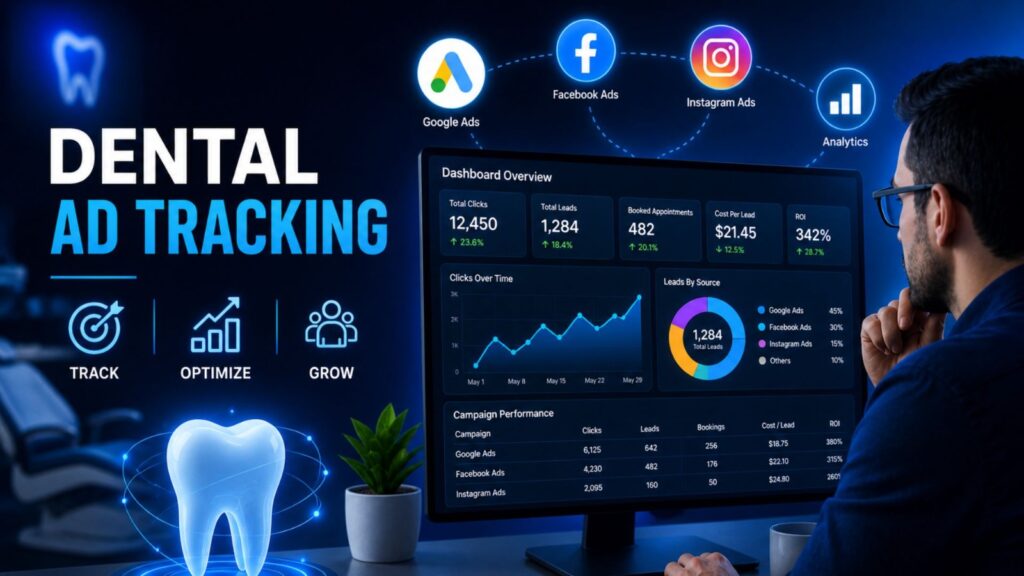
Do you ever feel like your dental marketing budget is a black hole?Track Dental Ad ROI You spend money on Google Ads, Facebook ads, maybe even local flyers, but do you really know which ones are filling your chairs with valuable patients?
Many dental clinic owners in the USA face this exact challenge. They invest heavily in advertising, hoping for the best, but struggle to connect those ad dollars directly to new patient appointments and, more importantly, actual revenue. This isn’t just about getting calls; it’s about understanding which calls turn into long-term patients and profitable treatments.
The Hidden Cost of Not Tracking Your Dental Ad ROITrack Dental Ad ROI
Imagine this: You’re running a Google Ad campaign for “dental implants” and a Facebook ad for “Invisalign specials.” Both seem to be generating interest. But if you can’t tell which platform brings in patients who actually start treatment and complete their full plan, you’re essentially guessing.
This guesswork leads to wasted money. You might be pouring thousands into an ad that brings in tire-kickers, while a smaller, more effective campaign gets overlooked. In the competitive US dental market, every dollar needs to work hard. Without clear tracking, you’re missing opportunities to optimize your spending and grow your practice more efficiently. You might even be missing out on understanding the true lifetime. value of patients coming from different sources.
Enter GoHighLevel (GHL): Your Dental Ad ROI Command Center
GoHighLevel, or GHL, is a powerful platform that can transform how you track your dental ad performance. Think of it as your clinic’s central nervous system for marketing and sales. It brings together all your lead generation, communication, and patient management tools into one place.
For dental clinics, GHL isn’t just another software; it’s a strategic asset. It helps you see exactly where your leads are coming from, how they’re engaging with your clinic, and ultimately, which ads are delivering the best return on your investment. This clarity is vital for making smart decisions about your marketing budget.
Why Traditional Tracking Fails for Dental Clinics
Let’s be honest, traditional methods often fall short for dentists. Many clinics rely on asking new patients “How did you hear about us?” This method is notoriously unreliable. Patients often forget, misremember, or simply provide a vague answer.
Another common pitfall is looking only at simple metrics like “clicks” or “impressions.” These are vanity metrics. A click doesn’t pay your bills. A booked appointment does, and a completed treatment plan with a happy patient pays them even better. You need to connect the initial click or call directly to the final outcome.
Furthermore, dental patients often have a complex journey. They might see your Facebook ad, then search for your clinic on Google, read reviews, visit your website, and then call. Tracking this multi-touch journey with disconnected systems is nearly impossible. This is where GHL steps in to bridge the gap.
Setting Up Your GHL Foundation for ROI Tracking
Before you can track anything, you need to set up GHL correctly. This isn’t just about logging in; it’s about configuring it to reflect your clinic’s specific operations and marketing goals. A solid foundation ensures accurate data collection.
First, you’ll need to integrate all your communication channels. This includes your website, all your ad platforms (Google Ads, Facebook Ads, Instagram), and even your clinic’s main phone line. GHL becomes the hub where all these signals converge.
Next, you’ll want to define your “conversion events.” For a dental clinic, a conversion isn’t just a website visit. It’s a booked appointment, a completed new patient form, or even a specific type of phone call (e.g., “new patient inquiry”). Clearly defining these helps GHL know what to measure.
Tracking Every Patient Touchpoint: The GHL Advantage
The real power of GHL for dental ad ROI lies in its ability to track every single interaction a potential patient has with your clinic, from the moment they see your ad. This comprehensive view gives you unprecedented insight.
1. Dynamic Call Tracking: Knowing Who Called and Why
Phone calls are the lifeblood of most dental practices. GHL allows you to set up dynamic call tracking numbers. This means when someone sees your ad (e.g., a Google Ad for “emergency dentist”), the phone number displayed to them is unique to that ad source.
When they call, GHL logs the call, records it (if enabled and compliant), and immediately attributes it to the specific ad campaign. You’ll know if the call came from your “New Patient Special” on Facebook, your “Invisalign” ad on Google, or even your local SEO listing. This eliminates the guesswork of “How did you hear about us?”
Real-World Example: Dr. Elena’s clinic was running ads for teeth whitening on Facebook and Google. Using GHL’s dynamic call tracking, she discovered that calls from her Google Ads campaign specifically for teeth whitening were 3x more likely to book an appointment than calls from her Facebook ad, which mostly generated general inquiries. She then shifted more budget to Google Ads for that service.
2. Website Form Submissions: Connecting Leads to Ads
Many dental clinics use website forms for appointment requests, new patient registrations, or specific service inquiries. GHL integrates directly with these forms.
When a potential patient fills out a form on your website, GHL captures their information and automatically links it back to the original ad source that brought them to your site. This could be a specific Google Ad keyword, a Facebook ad creative, or even an organic search.
This means you can see exactly which ad campaign is driving the most qualified form submissions. You can also automate follow-up messages based on the form they filled out, making your lead nurturing highly targeted.
Real-World Example: Dr. Chen wanted to know which of his local online ads were best for attracting high-value cosmetic dentistry patients. By integrating his website’s “Cosmetic Consultation Request” form with GHL, he found that patients filling out this form primarily came from his Google Display Network ads showing before-and-after photos, rather than his general Google Search ads. This insight helped him refine his ad creatives.
3. SMS and Email Campaigns: Tracking Engagement from Ad-Generated Leads
Once a lead comes in from an ad, the journey often continues with follow-up communication. GHL’s built-in SMS and email marketing tools allow you to nurture these leads and track their engagement.
You can set up automated campaigns that trigger when a lead comes from a specific ad. For example, a lead from an “Invisalign” ad could receive an automated email series about clear aligners. GHL tracks opens, clicks, and replies, giving you data on how well your follow-up is working.
By connecting these follow-ups back to the initial ad source, you can see if leads from certain ads are more responsive to your nurturing efforts, indicating higher intent. This helps you understand not just lead generation, but also lead quality.
Real-World Example: A lead from Dr. Patel’s Facebook ad for “New Patient Exam & X-rays” automatically received a welcome SMS and an email outlining what to expect at their first visit. GHL showed that leads from this specific Facebook ad had a 70% open rate on the welcome email, and those who opened were 2x more likely to confirm their appointment via SMS reminder compared to leads from other sources.
4. CRM Integration and Pipeline Management: From Lead to Lifetime Patient
This is where GHL truly shines for ROI. It’s not enough to just know where a lead came from; you need to know what happened after they became a lead. GHL’s Customer Relationship Management (CRM) system acts as the central repository for all your patient data.
Every lead generated from an ad is automatically entered into GHL’s CRM. You can then move these leads through a custom pipeline that mirrors your clinic’s patient journey:
New Lead: Came from a Google Ad.
Contacted: Initial call made.
Appointment Booked: Scheduled their first visit.
Appointment Showed: Attended their appointment.
Treatment Plan Presented: Discussed recommended treatments.
Treatment Accepted/Started: Began their dental work.
Treatment Completed: Finished their course of treatment.
Recall/Rebooked: Scheduled their next check-up.
By tracking leads through these stages, and always attributing them back to the original ad source, you can calculate the true ROI. You’re not just tracking leads; you’re tracking patients and their entire value journey.
Real-World Example: Dr. Ramirez used GHL’s pipeline to track leads from his “Dental Implant Consultation” Google Ads. He could see that out of 50 leads from this ad last month, 35 booked consultations, 28 showed up, 15 accepted a treatment plan, and 10 started treatment with an average value of $4,000 per patient. He could then easily calculate the exact revenue and profit generated by that specific ad campaign.
Calculating True Dental Ad ROI: Beyond the Basics
Most clinics calculate ROI by dividing revenue by ad spend. But for dentists, you need a deeper dive. GHL helps you move beyond simple revenue to understand the profitability and lifetime value of patients from different ad sources.
1. Cost Per Lead (CPL) and Cost Per Acquisition (CPA):
GHL automatically tracks your ad spend (when integrated) and the number of leads generated. This gives you your CPL. You can then refine this to CPA (cost per booked appointment or accepted treatment), which is far more valuable.
2. Average Patient Value (APV) by Ad Source:
This is crucial. Not all patients are created equal. A patient seeking emergency extraction might have a lower APV than a patient seeking full mouth implants or Invisalign. GHL allows you to track the actual treatment value for each patient, linking it back to their original ad source.
Actionable Step: Create custom fields in GHL for “Treatment Value” and “Procedure Type.” When a patient accepts a treatment plan, update these fields. Then, you can run reports to see which ad campaigns bring in patients with the highest APV.
3. Lifetime Value (LTV) of a Patient:
The true measure of a dental patient’s worth is their LTV. This includes their initial treatment, regular check-ups, hygiene appointments, and any future treatments over many years. GHL helps you track patient retention and rebooking rates, allowing you to estimate LTV per ad source.
Actionable Step: Use GHL’s automation to track “Last Appointment Date” and “Next Appointment Date.” Set up workflows to prompt rebooking. By comparing rebooking rates for patients from different ad campaigns, you can identify which ads bring in patients who are more likely to stay with your practice long-term.
4. Profitability Per Ad Campaign:
Ultimately, it’s about profit. By combining your ad spend, CPA, and the average profit margin on different treatments, GHL helps you calculate the net profit generated by each ad campaign. This allows you to stop spending on ads that only bring in low-profit patients and double down on those that deliver significant returns.
Real-World Example: Dr. Singh found that his “Emergency Dental” Google Ads had a very low CPA, generating many calls. However, GHL data showed that these patients rarely returned for follow-up care, and the profit margin on emergency visits was thin. In contrast, his “Invisalign Consultation” Facebook ads had a higher CPA, but patients from this source had an average treatment value of $5,000 and consistently completed their full treatment plans, leading to significantly higher overall profit. He adjusted his budget accordingly.
Actionable Steps for Implementing GHL for Dental ROI
Ready to stop guessing and start knowing? Here’s a step-by-step guide to setting up GHL for maximum ROI tracking in your dental practice:
Step 1: Integrate All Lead Sources
Connect Your Website: Ensure all website forms (appointment requests, contact forms, specific service inquiries) are integrated with GHL. This often involves embedding GHL forms or using webhooks.
Integrate Ad Platforms: Connect your Google Ads and Facebook Ads accounts to GHL. This allows GHL to track ad spend and attribute leads directly.
Set Up Unique Call Tracking Numbers: For every major ad campaign or even different ad groups, create a unique GHL call tracking number. This is non-negotiable for accurate phone lead attribution. Ensure these numbers appear dynamically on your website based on the ad source.
Step 2: Design Your Patient Pipeline
Map Your Patient Journey: Think about every stage a potential patient goes through, from initial interest to completed treatment and recall.
Create Custom Pipeline Stages in GHL: Build these stages within GHL’s Opportunities section (e.g., “New Lead,” “Consultation Booked,” “Treatment Proposed,” “Treatment Accepted,” “Treatment Completed,” “Active Patient”).
Automate Stage Movement (Where Possible): Set up GHL automations to move leads through stages based on actions (e.g., “Form Submitted” moves to “New Lead”; “Appointment Booked” moves to “Consultation Booked”).
Step 3: Customize for Dental Specifics
Create Custom Fields: Add fields to your patient contact records in GHL for critical dental data. Examples:
`Initial Treatment Interest` (e.g., “Invisalign,” “Implants,” “Emergency”)
`Estimated Treatment Value`
`Actual Treatment Value`
`Insurance Provider`
`Referring Source (Manual Override)` (for those rare cases where GHL can’t track digitally, but the patient tells you)
Tagging Leads/Patients: Use tags to categorize leads based on their ad source, type of inquiry, or even their perceived value. Example: `Source: Google Ads – Implants`, `Interest: Cosmetic`, `Status: Hot Lead`.
Step 4: Automate Follow-Up and Nurturing
Build Automated Workflows: Create sequences of emails and SMS messages that trigger when a lead enters a specific pipeline stage or comes from a particular ad source.
Appointment Confirmations & Reminders: Automate these crucial messages to reduce no-shows. Link them back to the original appointment source.
Post-Appointment Follow-Up: Send automated messages after an appointment to check in, gather feedback, or prompt for reviews. This helps with retention.
Step 5: Develop Your Reporting Dashboard
Customize Your GHL Dashboard: Focus on the metrics that matter most for your dental clinic’s ROI.
Key Metrics to Track:
Number of Leads per Ad Campaign
Cost Per Lead (CPL) per Campaign
Number of Appointments Booked per Campaign
Cost Per Booked Appointment (CPBA)
Number of Treatment Plans Accepted per Campaign
Average Treatment Value (ATV) per Campaign
Total Revenue Generated per Campaign
Estimated Profit per Campaign
Patient Lifetime Value (LTV) indicators
Review Regularly: Make it a habit to review your GHL dashboard at least weekly. This allows you to spot trends, identify underperforming ads, and double down on successful ones quickly.
Common Pitfalls Dentists Make (and How GHL Helps Avoid Them)
Even with GHL, some clinics fall into common traps. Being aware of these helps you maximize your ROI tracking.
1. Not Closing the Loop: Many clinics track leads but don’t connect them all the way to completed treatment and revenue. GHL’s pipeline management is designed to close this loop, showing you the full patient journey and its financial impact. Don’t just track calls; track income.
2. Ignoring Patient Lifetime Value (LTV): Focusing only on the initial treatment value misses the bigger picture. A patient who returns for years of hygiene and occasional restorative work is far more valuable. GHL helps you track rebooking rates and ongoing engagement, giving you insight into LTV.
3. Failing to Segment Ad Performance: Treating all “new patient ads” the same is a mistake. GHL allows you to see which ads bring in high-value cosmetic patients versus emergency patients. This segmentation helps you allocate budget more intelligently.
4. Not A/B Testing Effectively: Without clear tracking, dentists often guess which ad creatives or offers are best. GHL’s attribution allows you to run true A/B tests and see which variations lead to more booked appointments and higher-value patients. For instance, testing two different headlines for an Invisalign ad and seeing which one yields more actual consultations booked through GHL.
5. Neglecting Follow-Up: A lead is just a lead until they become a patient. Many clinics generate leads but fail at consistent, timely follow-up. GHL’s automation ensures every lead gets immediate attention, improving conversion rates and making your ad spend more effective.
Advanced Strategies for Maximizing Dental Ad ROI with GHL
Once you have the basics down, GHL offers powerful advanced features to further boost your ROI.
1. Hyper-Personalized Patient Journeys:
With GHL, you can create unique automated follow-up sequences based on the exact ad a patient clicked or the form they filled out. For example, a patient from a “Dental Implant” ad receives content specifically about implants, while a “Kids Dentistry” ad lead gets information about pediatric care. This level of personalization increases engagement and trust, leading to higher conversion rates.
Example: A lead clicks your Facebook ad for “Same-Day Crowns.” GHL tags them, and they immediately receive an SMS with a link to a short video explaining the same-day crown process and an email inviting them to a free consultation specifically for same-day crowns.
2. Smart Retargeting and Lookalike Audiences:
GHL integrates with your ad platforms, allowing you to use the data it collects to create more effective retargeting campaigns. You can retarget people who visited your website from a specific ad but didn’t book. You can also create “lookalike” audiences based on your most profitable patients.
Example: GHL identifies that patients who accepted high-value implant treatments frequently engaged with a particular blog post on your website after clicking a Google Ad. You can then create a lookalike audience on Facebook based on these high-value patient profiles and target them with similar messaging.
3. Reputation Management Tied to Ad Source:
Positive reviews are crucial for dental practices. GHL includes tools for requesting reviews from satisfied patients. By knowing which ad source brought in a particular patient, you can track the “review rate” from different campaigns. This helps you understand which ads bring in patients who are not only profitable but also likely to become advocates for your practice.
Example: Dr. Lee noticed that patients from his “Smile Makeover” Instagram ads consistently left 5-star reviews after treatment. GHL’s review request automation was set to prioritize these patients, sending them a review link immediately after their treatment was complete. This boosted his online reputation, further enhancing the effectiveness of his cosmetic ads.
4. Integrating with Practice Management Software (PMS):
While GHL is excellent for marketing and sales, your Practice Management Software (e.g., Dentrix, Open Dental, Eaglesoft) is where the core clinical and billing data resides. Many GHL users integrate with their PMS (often via third-party tools or custom APIs) to pull in actual treatment and payment data. This provides the most accurate ROI calculation.
Example: A patient generated by a “New Patient Special” Google Ad is tracked in GHL from lead to appointment. Once they become a patient in the PMS and complete their treatment, the actual payment data (after insurance adjustments) is pushed back into GHL, giving Dr. Kim a precise profit figure for that specific patient and, by extension, that ad campaign.
The USA Dental Market Advantage with GHL
For dental clinic owners in the USA, GHL offers specific benefits that address unique market challenges:
Competitive Landscape: The US dental market is highly competitive. GHL provides the data needed to outsmart competitors by optimizing ad spend for maximum profitability, not just lead volume.
Patient Shopping Behavior: US patients often shop around for dentists, especially for high-value procedures or if they’re new to an area. GHL helps you understand which ads capture and convert these discerning patients.
Insurance Complexities: By tracking the insurance providers of leads (via custom fields or form questions), you can even begin to understand which ad campaigns attract patients with insurance plans that are more favorable to your practice’s profitability.
High-Value Procedures: GHL helps pinpoint which ads drive consultations for high-profit procedures like implants, clear aligners, and cosmetic dentistry, allowing you to focus your budget where it matters most.
Conclusion: Stop Guessing, Start Growing
The days of simply “running ads” and hoping for the best are over. In today’s competitive dental landscape, knowing your return on investment is not just a luxury; it’s a necessity for sustainable growth. GoHighLevel provides the sophisticated, yet user-friendly, platform you need to connect every ad dollar to every patient and every dollar of revenue.
By setting up GHL correctly, tracking every touchpoint, and analyzing the right metrics, you can transform your marketing from a guessing game into a precise, profit-driving machine. You’ll gain the clarity to make confident decisions, eliminate wasted spending, and consistently fill your chairs with your ideal patients. This isn’t just about tracking; it’s about strategic growth for your dental practice.
Want to fix your clinic’s lead flow? Contact us for a system audit.