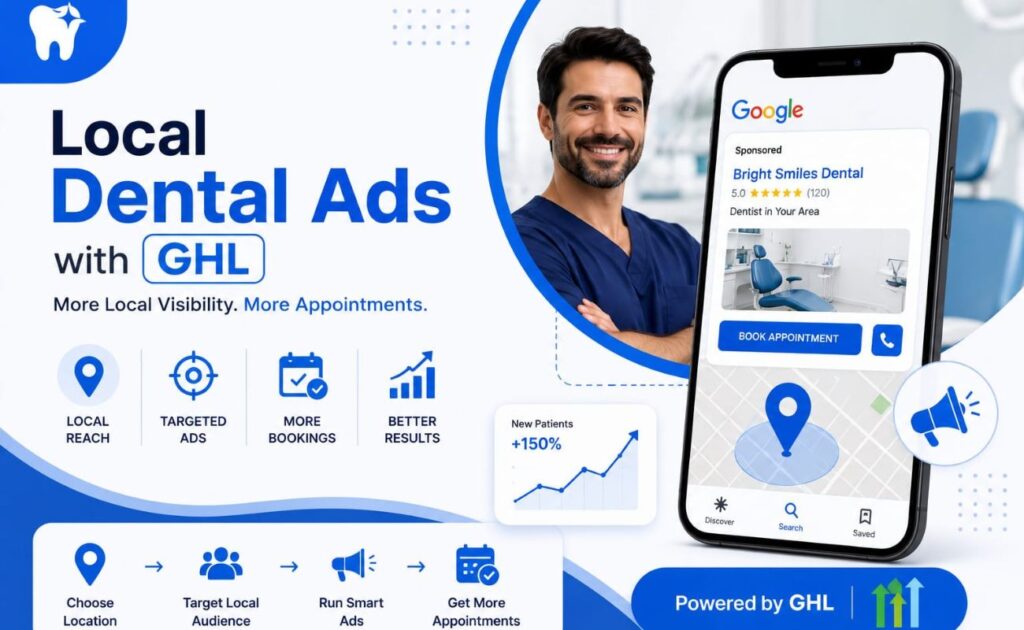
Localized Ad Campaigns for Dentists: The ROI Blueprint for Scaling Patient Acquisition and Clinical Systems
For the modern dental practice owner, patient acquisition has evolved past the point of traditional referrals and localized word-of-mouth. Today, executing highly optimized Localized Ad Campaigns for Dentists represents the boundary line between stagnant single-chair clinics and multi-location dental enterprises scaling their clinical operations predictably.
To secure these metrics, consider optimizing your dental website for high-value cases to ensure your organic traffic converts just as effectively as your paid ads
From an operational and financial perspective, digital ad spend is not an elective marketing expense—it is a measurable capital deployment strategy. When properly integrated into a clinic’s infrastructure, targeted local traffic functions as a precision tap for high-value clinical cases, including full-arch dental implants, clear aligner therapies, and cosmetic reconstructions.
However, the catastrophic mistake most practices make is treating digital advertising as an isolated marketing initiative. If your clinical front desk, patient management systems, and customer relationship management (CRM) software are not fundamentally aligned to capture, nurture, and convert this incoming demand instantly, your ad spend turns into a direct capital write-off.
To achieve a true, scalable return on investment (ROI), practices must shift from a person-dependent, celebrity-doctor framework to a system-led, automated clinical growth architecture. This comprehensive masterclass outlines the exact operational, financial, and automated frameworks required to deploy hyper-profitable Localized Ad Campaigns for Dentists while engineering an airtight conversion engine.
1. The Financial Foundations: The Economics of Reputation and Patient LTV
The survival and expansion of a dental practice depend entirely on two core financial metrics: Patient Lifetime Value (LTV) and Cost Per Acquisition (CPA). In competitive metropolitan markets, a poorly optimized customer acquisition strategy can drive CPA past sustainable thresholds. Conversely, an elite practice leverages local market positioning to maximize Patient LTV, effectively out-funding competitors on ad networks.
The Mathematical Impact of a 1-Star Review on Patient LTV
Reputation is not an abstract concept; it is a hard economic asset. To understand the true cost of a single 1-star review on your digital profiles, we must map out its mathematical impact on patient pipeline degradation and long-term asset value.
Let us define the baseline economics of a standard multi-chair dental practice:
- Average Initial Patient Value (Year 1): $1,200 (including hygiene, diagnostics, and minor restorative work).
- Average Patient Retention Lifecycle: 7 years.
- Referral Multiplier: 1.2 (every retained patient refers an average of 1.2 family members or friends over their lifecycle).
- Baseline Patient LTV:
$$\text{LTV} = (\text{Year 1 Value} \times \text{Lifecycle Years}) \times \text{Referral Multiplier}$$
$$\text{LTV} = (\$1,200 \times 7) \times 1.2 = \$10,080$$
When a practice deploys Localized Ad Campaigns for Dentists, prospective patients conduct rapid digital due diligence before scheduling. Industry data shows that a drop in a clinic’s aggregate Google Business Profile rating from 4.8 to 4.3 stars decreases landing page conversion rates by 35%.
If your localized campaigns generate 100 high-intent leads per month, and your baseline landing-page-to-booked-appointment conversion rate is 15%, you capture 15 new patients monthly. A single unaddressed, highly visible 1-star review that drops your conversion rate by 35% reduces your booking rate to 9.75%.
[100 Leads] ---> Baseline 15% Booking Rate ---> 15 New Patients  = $151,200 Gross LTV
[100 Leads] ---> Damaged 9.75% Booking Rate --> 9.75 New Patients = $98,280 Gross LTV
======================================================================================
MONTHLY CAPITAL LEAKAGE:                                           -$52,920 Gross LTV
Over a 12-month trailing period, that single unmitigated negative review costs the clinic $635,040 in unrealized gross lifetime revenue. Reputation management is fundamentally tied to ad efficiency; your ad spend can only perform as well as your public-facing trust signals allow.
The “Speed-to-Lead” Gap: Converting Digital Intent
The single greatest point of revenue leakage in modern clinical marketing is the “Speed-to-Lead” gap. When a consumer interacts with Localized Ad Campaigns for Dentists and submits a lead form for a high-value treatment like clear aligners, they are in a state of hyper-intent. This intent decays exponentially with every passing minute.
Data analyzed across thousands of healthcare digital lead funnels indicates that attempting to contact a patient lead within 5 minutes versus 30 minutes results in a 21x increase in qualification and a 100x increase in contact rates.
Lead Response Time vs. Conversion Probability
--------------------------------------------------
0-5 Minutes:   [██████████████████████████████] 100% Baseline
5-10 Minutes:  [██████████████] 45% Drop
10-15 Minutes: [███████] 70% Drop
15+ Minutes:   [███] 80%+ Drop in Conversion
Waiting longer than 15 minutes to initiate an interactive, HIPAA-compliant communication workflow results in an 80% drop in absolute conversion rates. Prospective patients do not wait for your front-desk staff to finish checking in an in-clinic patient or processing an insurance claim. If they do not receive an immediate response, they return to the search engine results or ad feeds and engage the next competitor running a localized campaign.
The operational reality is clear: Human staff cannot solve the speed-to-lead problem at scale. Expecting your dental receptionists to monitor ad dashboards, validate lead identity, and send personalized messages within 300 seconds while managing physical patient flow is a design failure. This gap can only be bridged through automated, system-driven protocols.
The “Intelligence” Concept: “Smart Clinics” vs. “Famous Doctors”
For decades, dental practice growth relied on the “Famous Doctor” model. Under this paradigm, clinical growth is tethered entirely to the personal brand, charisma, and manual clinical speed of the owner-doctor. While highly profitable at small scales, this model introduces severe operational constraints:
- The enterprise cannot scale past the physical hours the primary provider can work.
- The practice valuation is suppressed because the asset cannot operate independently of the owner’s physical presence.
- Marketing efficiency is volatile, relying on localized celebrity status rather than reproducible customer acquisition systems.
Conversely, the modern “Smart Clinic” shifts the enterprise anchor from a person to an operating system. Smart Clinics treat patient acquisition, nurture sequences, case presentation, and operational follow-ups as system-driven workflows.
When executing Localized Ad Campaigns for Dentists, a Smart Clinic does not market the individual doctor; it markets a reproducible clinical outcome delivered through standardized patient journeys.
By leveraging automated customer relationship management platforms as the central nervous system of the business, these clinics ensure that every lead is handled identically, every follow-up occurs precisely on schedule, and patient retention is completely independent of staff mood or administrative turnover. Consequently, Smart Clinics consistently out-earn, out-scale, and out-value person-led practices, operating at predictable profit margins with clear exit valuations.
2. Structural Architecture: The Automated CRM as the Central Nervous System
To eliminate revenue leakage and capitalize on localized ad traffic, a clinic must discard fragmented software solutions. Having your ad data in Facebook Ads Manager, your lead notifications in an email inbox, and your patient records isolated inside an on-premise Practice Management Software (PMS) creates structural blind spots.
Instead, a cloud-based CRM architecture—such as GoHighLevel or a comparable healthcare-focused automation platform—must function as the absolute “Central Nervous System” of the enterprise.
The Chaotic Manual Clinic vs. The Systematic Automated Clinic
To appreciate the operational variance between old-school management and automated infrastructure, consider this architectural comparison:
| Operational Variable | The Chaotic Manual Clinic | The Systematic Automated Clinic |
| Lead Capture & Ingestion | Front-desk manually checks email notifications from ad platforms twice daily. | Instantaneous webhooks ingest ad leads into an automated CRM pipeline within 500 milliseconds. |
| Initial Contact Time | 2 to 6 hours post-submission, frequently slipping to the next business day. | Less than 60 seconds via automated, conversational SMS and interactive phone-tree triggers. |
| Follow-Up Cadence | Fragmented, staff-dependent, unrecorded phone calls made only during slow clinic hours. | Multi-channel automated follow-up sequences executing across days 1, 2, 4, 7, and 14. |
| Appointment Booking | Manual back-and-forth phone calls trying to reconcile open slots on the schedule. | Direct integration with live calendars via HIPAA-compliant, two-way automated scheduling links. |
| No-Show Mitigation | Single manual confirmation call or automated text sent 24 hours prior without response verification. | Tiered automated reminder matrix sent at 72 hours, 24 hours, and 2 hours with automated cancellation/fill logic. |
| Review Generation | Front desk verbally asks satisfied patients to leave a review when checking out; low compliance. | Automated, automated review request triggers sent via SMS exactly 2 hours post-treatment completion. |
Workflow Logic: Staff-Dependent vs. System-Dependent Execution
The core principle of advanced healthcare operations is simple: Automate the administrative tasks, humanize the clinical delivery. When a dental practice struggles with high patient acquisition costs, the issue is almost never the creative quality of their ads; it is the breakdown of human execution at the front desk.
[Ad Lead Generated]
         │
         ▼
 ┌───────────────┐
 │ CRM Webhook   │
 └───────┬───────┘
         │
         ├──────────────────────────────┐
         ▼                              ▼
┌─────────────────┐            ┌─────────────────┐
│ SMS Trigger     │            │ internal Alert  │
│ (Instant User)  │            │ (Staff Notification)
└─────────────────┘            └─────────────────┘
         │
         ▼
┌──────────────────────────────┐
│ Interactive Response Filter  │
└────────┬──────────────┬──────┘
         │              │
         │ (Booked)     │ (No Response)
         ▼              ▼
┌─────────────────┐    ┌─────────────────┐
│ Stop Nurture /  │    │ Multi-Day       │
│ Move to Pre-Op  │    │ Nurture Sequence│
└─────────────────┘    └─────────────────┘
By transitioning core operations from staff-dependent tasks to system-dependent workflows, you build structural resilience into your clinic.
Automated SMS and Email Triggers
When a new patient record is created via localized lead generation networks, a dedicated workflow trigger must execute immediately. The system checks the time of day. If it is within acceptable operational hours, an automated, conversational SMS is dispatched within 60 seconds:
“Hi [Patient_First_Name], this is Sarah from Premier Dental Arts. We received your request for our Clear Aligner visual evaluation package. Do you prefer mornings or afternoons for a quick 10-minute digital diagnostic scan?”
This text cuts through inbox noise and forces a conversational interaction. If the lead responds, the automated pipeline either routes the live conversation to a dedicated treatment coordinator or guides the patient directly to a self-scheduling interface.
Dynamic Reputation Loops
The absolute volume and recency of 5-star reviews dictate how algorithms rank your local practice profile. A system-dependent clinic does not rely on staff remembering to ask for reviews.
Instead, when a provider marks a procedure as completed within the Practice Management Software, a secure webhook sends a signal to the automated CRM. Two hours later—allowing time for local anesthetics to wear off—the patient receives a localized text trigger:
“Hi [Patient_First_Name], it was a pleasure taking care of your smile today at Premier Dental Arts. Could you spare 30 seconds to share your clinical experience with our team here? [Google_Review_Link]”
If the patient interacts and leaves a review, the loop completes. If they do not, the system issues a single, gentle follow-up three days later. This structural loop ensures a constant, linear influx of fresh user-generated content, insulating the practice against negative reviews and lowering the long-term CPA of your localized ad campaigns.
Implementation Failures: The Expensive Software Trap
A common failure mode among dental practice owners is the unchecked acquisition of software licenses. Doctors routinely buy expensive CRM platforms, advanced automated systems, and analytical packages under the impression that the software itself will solve operational inefficiencies.
Software without predefined workflow triggers is nothing more than an expensive digital ledger.
When you purchase an automation platform but fail to map out the explicit logic gates, user roles, conditional outcomes, and messaging structures, your front-desk staff will default to their old manual habits. The platform becomes an underutilized, unintegrated interface that adds complexity instead of reducing friction.
To maximize the ROI of your localized ad spend, you must map your entire patient operational protocol in clear logic terms before turning on ad networks. Every possible patient action must correspond to a programmatic system reaction.
3. Step-by-Step Blueprint: Deploying Localized Ad Campaigns for Dentists
To build a high-performance patient acquisition system from scratch, you must execute a strict sequence of strategic and technical steps. The following blueprint provides the precise operational framework for designing, targeting, and automating high-converting local dental ad campaigns.
The Ad Deployment Sequence
1.Establish Advanced Conversion Tracking and Pixels:Day 1 – Prerequisites.
Deploy native tracking scripts across all landing pages and web assets. Configure custom conversions specifically for form submissions, automated schedule bookings, and inbound phone clicks. Integrate server-side APIs (such as Meta Conversions API) to bypass browser-side ad-blocking software, ensuring absolute parity between ad clicks and platform reporting.
2.Construct Hyper-Targeted Geographic and Demographic Geofences:Day 2 – Audience Architecture.
Configure ad platform geography to target individuals who reside in or are actively visiting a strict radius around your clinic (typically a 3 to 7-mile radius depending on population density). Filter out non-local commuters unless targeting corporate worker demographics. Layer secondary targeting parameters based on specific high-value clinical treatments, such as age brackets for dental implants (ages 45-65+) or parental status for pediatric and orthodontic therapies.
3.Deploy High-Intent Creative Assets and Landing Pages:Day 3-4 – Content Deployment.
Launch ad creatives featuring genuine, high-resolution imagery of the clinic interior, clinical team, and real patient outcomes. Avoid sterile, easily identifiable stock photography. Route all traffic to dedicated, conversion-optimized landing pages that focus entirely on a single clinical solution (e.g., a landing page dedicated exclusively to dental implants, completely free from general dentistry clutter).
4.Configure Webhook-Driven CRM Lead Ingestion Pipelines:Day 5 – Automation Engineering.
Build a direct programmatic connection between your ad lead forms and your central automated CRM using secure webhooks. Verify that lead fields mapping patient names, mobile numbers, email addresses, and requested clinical services transfer instantly into your system pipeline within milliseconds of user submission, with zero manual input required.
5.Map Out and Activate Conditional Response Triggers:Day 6 – Operational Launch.
Construct conditional logic gates within your automation platform. Program separate workflows for business hours versus nights and weekends. For after-hours leads, configure immediate automated responses that manage expectations and provide direct access to an integrated self-scheduling calendar, ensuring the lead is captured and locked into your system before the next business day begins.
Prior to analyzing the conversion framework, it is vital to emphasize that localized visibility is significantly driven by a clean, highly structured online profile. Your organic local visibility works in tandem with paid traffic to build ultimate consumer confidence.
Critical Operational Directive: All ad components, landing pages, and automated text templates must explicitly exclude protected health information (PHI) until a secure, encrypted patient portal connection is formally established. Never display diagnosis specific details or clinical charting data within unencrypted, public SMS or email communications.
4. The Conversion Engine: Turning Clicks Into Productive Chair Time
An ad campaign that generates thousands of impressions but fails to populate the clinical schedule with high-value cases is an operational failure. To convert cold localized digital traffic into predictable, production-grade chair time, a practice must implement a structured, multi-tier nurture and presentation framework.
[Cold Local Ad Click]
         │
         ▼
┌─────────────────────────────────┐
│ Targeted Single-Topic Page      │
└────────────────┬────────────────┘
                 │
                 ▼
┌─────────────────────────────────┐
│ Frictionless Booking Interface  │
└────────────────┬────────────────┘
                 │
                 ▼
┌─────────────────────────────────┐
│ Automated Attendance Protection │
└────────────────┬────────────────┘
                 │
                 ▼
┌─────────────────────────────────┐
│ Case Presentation & Finance     │
└─────────────────────────────────┘
1. The Single-Topic Landing Page
Never route paid ad traffic from highly specific Localized Ad Campaigns for Dentists to your website’s homepage. A standard homepage is an informational directory full of distractions: links to community blogs, generic team biographies, insurance forms, and comprehensive lists of services ranging from pediatrics to cleanings. When a prospect looking for full-arch dental implants lands on a generic homepage, they experience high cognitive load and leave.
Paid traffic requires hyper-focused, single-topic landing pages. If an ad promotes clear aligners, the destination page must feature:
- A clear, bold headline focused entirely on the cosmetic and functional outcomes of clear aligners.
- Authentic case photos displaying high-quality clinical outcomes.
- Social proof consisting exclusively of reviews from clear aligner patients.
- A singular, clear call to action (CTA), with no secondary links, headers, or footers to divert user attention.
2. The Frictionless Self-Scheduling Booking Interface
Modern dental consumers expect convenience. Forcing a digital lead to wait for a phone call to secure an appointment time creates massive drop-off points.
Your landing pages must host an embedded, responsive calendar component linked directly to your automated CRM. This allows qualified local leads to browse open consultation slots and book their own appointments instantly.
To maintain total clinical control over your calendar, you can configure your backend software to expose only specific blocks of time designated for high-value consultations. This populates your schedule with top-tier procedures while protecting open hygiene and general restorative blocks.
3. Automated Attendance Protection (No-Show Mitigation)
Once an appointment is booked via your localized campaign, the automation platform shifts to attendance preservation. High no-show rates drain practice morale and waste marketing capital. To counter this, deploy a automated confirmation matrix that requires explicit patient confirmation to preserve the appointment slot.
[Appointment Booked] ───> 72h Prior Text (Requires "CONFIRM") ───> 24h Prior Reminder ───> 2h Travel Alert
If a patient fails to reply with “CONFIRM” to the 48-hour or 24-hour automated text message, the CRM triggers an automated notification to your front desk staff: “Action Required: Patient [Last_Name] has not confirmed tomorrow’s 2 PM implant consultation. Initiate manual verification protocol.”
If confirmation is still not received within 4 hours of the appointment, the system automatically opens the slot for on-demand emergency patients or waitlist recalls, ensuring clinical chair utilization remains optimal.
4. System-Driven Case Presentation and Flexible Financing Options
The conversion chain concludes inside the consultation room. When local digital leads present for high-value treatments, their primary barrier to acceptance is almost always financial.
Your clinical consultation workflows must utilize highly visual case presentation tools, followed immediately by pre-configured, clear financial options handled by your treatment coordinator.
By integrating flexible, multi-tiered patient financing solutions directly into your presentation steps, you can break down a $5,000 clear aligner treatment or a $25,000 full-arch implant case into highly accessible monthly payments. This system-led approach turns clinical recommendations into clear financial realities, driving case acceptance rates past the 65% threshold.
To sustain consistent expansion, clinical operations must shift away from volatile, human-dependent tasks and transition into robust, predictable digital architectures. Systemization is the bedrock of enterprise value and true clinical independence.
To build an elite practice that converts local demand into reliable, automated revenue stream, enter your system details below.
👉 Start Building a Smarter Dental System
5. Real-World Scenario: The Case of “Modern Dental Group”
To understand the practical impact of deploying automated Localized Ad Campaigns for Dentists, consider the operational turnaround of Modern Dental Group, a 4-chair practice located in a competitive suburban market.
The Baseline Status (Before Systemization)
The clinic was managed via traditional, person-dependent methods. The practice owner deployed localized Facebook and Google ads targeting dental implant patients, spending a fixed $4,000 per month. The ads routed traffic directly to the main website homepage.
Leads were captured using a standard contact form, which generated an automated email notification sent to the office manager’s general inbox.
The results were financially unsustainable:
- Monthly Lead Volume: 80 raw lead submissions.
- Average Front-Desk Response Time: 4.5 hours (frequently sliding to 24 hours if leads arrived over the weekend).
- Contact Rate: Less than 28% of submitted leads ever answered a manual follow-up phone call.
- Scheduled Appointments: 6 patients per month.
- Actual Attendance (Show Rate): 60% (3.6 patients actually presented in the chair).
- Case Acceptance: 1 implant case accepted per month.
- Blended CPA (Cost Per Acquisition): $4,000 per closed case.
- Net Margin: Barely breaking even on direct ad spend when factoring in laboratory costs and clinical materials.
The practice owner was convinced that digital advertising was an expensive failure for dental clinics. The true failure, however, was not the traffic generation; it was the lack of an automated backend to capture and convert the demand.
The System-Led Transformation (After Systemization)
The clinic underwent a comprehensive operational redesign. The unintegrated homepage forms were replaced with single-topic, dedicated dental implant landing pages. The practice deployed an automated CRM platform to act as its central operations engine and established explicit workflow triggers.
Old Manual Process (4.5 Hour Delay):
[Lead Influx] ──> [Inbox Notification] ──> [Manual Staff Check] ──> [Cold Call Attempt] (28% Contact Rate)

New Automated Workflow (<60 Second Execution):
[Lead Influx] ──> [Automated Webhook] ──> [Instant SMS Nurture] ──> [Self-Schedule Lock] (82% Contact Rate)
- Instantaneous Lead Capture: Webhooks routed every lead from the localized campaigns into the CRM pipeline within milliseconds.
- Immediate Automated Interaction: The CRM executed an immediate two-way SMS script within 60 seconds of form submission. If a lead arrived after hours, the system sent a tailored night text managing expectations and offering an instant self-scheduling link.
- Automated Nurture Tracks: Leads that did not book an appointment immediately were entered into a multi-channel, 14-day automated follow-up sequence via text and email. This sequence regularly delivered educational content, patient video testimonials, and FAQs regarding implant durability.
- Automated Attendance Preservation: A 3-tiered automated confirmation matrix was launched, removing unconfirmed appointments from the live calendar if communication broke down.
The Operational Results
Within 90 days of activating the system-dependent architecture, the practice metrics experienced a fundamental shift, while maintaining the exact same $4,000 monthly ad spend:
| Metric | Before Automation | After Automation | Operational Shift |
| Monthly Lead Volume | 80 leads | 88 leads | Stable traffic input (+10%) |
| Average Response Time | 4.5 hours | 42 seconds | 99.7% reduction in delay |
| Lead Contact Rate | 28% | 82% | Near-total pipeline illumination |
| Consultations Scheduled | 6 appointments | 24 appointments | 300% increase in scheduled flow |
| Appointment Show Rate | 60% | 88% | Minimized scheduling gaps |
| Monthly Closed Implant Cases | 1 case | 7 cases | 600% expansion in high-value cases |
| Blended Acquisition Cost (CPA) | $4,000 | $571 | 85.7% reduction in acquisition cost |
| Monthly Gross Revenue Generated | $5,500 | $38,500 | Scalable financial return |
By shifting from a staff-dependent manual process to an automated, system-driven workflow, Modern Dental Group transformed an unprofitable marketing expense into a highly predictable engine for practice growth.
To scale your practice predictably, you must stop treating operational efficiency as an afterthought. High-performing customer acquisition requires an aligned digital infrastructure that operates flawlessly every hour of the week.
To eliminate lead leakage, drive case acceptance, and permanently secure your local clinical market share, provide your operational targets below.
👉 Start Building a Smarter Dental System
6. Regulatory Compliance and Advanced Operational FAQs
1. How can a clinic maintain strict HIPAA compliance when deploying automated SMS and email sequences for localized ad leads?
HIPAA compliance is an absolute legal requirement when managing automated communication pipelines. The critical legal boundary revolves around Protected Health Information (PHI). When a consumer clicks on Localized Ad Campaigns for Dentists and submits their name, phone number, and email address via a lead capture form, this data is classified as general consumer data or PII (Personally Identifiable Information). It only transforms into PHI when it is explicitly paired with health status, past medical history, individual diagnoses, or explicit clinical treatment plans.
To ensure your automated CRM infrastructure remains completely HIPAA compliant, your initial automated text and email triggers must never include specific clinical language that implies a definitive medical diagnosis. For example, your automated SMS should say, “Thank you for requesting information regarding our local clear aligner options,” rather than, “Thank you for scheduling treatment for your severe orthodontic malocclusion.” Furthermore, you must ensure that your automation platform executes a formal Business Associate Agreement (BAA) with your practice, guarantees end-to-end data encryption for all stored customer information, restricts administrative data access to authorized team members, and features instant, automated opt-out mechanisms (e.g., “Reply STOP to unsubscribe”). Never transmit specific x-ray files, digital intraoral scans, or itemized financial treatment ledger data through standard, unencrypted cellular text channels.
2. What are the specific geographic and demographic targeting settings required for local Google and Meta ad campaigns to minimize wasted ad spend?
To minimize capital waste, you must discard the default broad targeting settings provided by major ad platforms. For Meta (Facebook and Instagram) campaigns, change your geographic targeting from the default “People living in or recently in this location” to strictly “People living in this location.” This simple adjustment prevents your budget from being spent on commuters, tourists, or delivery drivers who pass through your clinic’s zip code but will never become long-term, high-value patients.
For dense urban markets, restrict your geofence radius to a tight 2 to 4-mile circle around your physical practice doors. For spread-out suburban or rural environments, expand this target to a 7 to 15-mile radius, as rural populations are accustomed to longer travel times for specialized healthcare services.
On Google Ads networks, prioritize high-intent Local Search Campaigns and utilize Location Extensions to ensure your ads appear directly within the Google Maps Local 3-Pack interface. Avoid layering excessive demographic or interest filters (such as “interests in luxury goods”) onto high-intent search terms. If an individual in your exact zip code types “Emergency dentist near me” or “Dental implants pricing,” their intent is already fully qualified. Layering additional demographic restrictions will only artificially drive up your bidding costs and suppress your overall ad delivery volume.
3. How do we accurately track our Cost Per Acquisition (CPA) when a patient lead interacts with an ad, calls the office weeks later, and then schedules treatment months down the road?
Accurately tracking long-cycle healthcare conversions requires a unified multi-touch attribution protocol that bridges the gap between digital marketing platforms and offline on-premise Practice Management Software (PMS). To achieve this tracking parity, your systematic automated CRM must employ dynamic phone tracking tools (such as CallRail or built-in CRM tracking numbers) and unique tracking parameters known as UTM parameters. When a prospective patient clicks on one of your Localized Ad Campaigns for Dentists, a dynamic javascript snippet modifies the phone number displayed on your landing page, assigning a unique tracking number to that specific web session. If the patient decides to pick up a physical phone and call your front desk, the system instantly catches that call and associates it directly with the specific ad group, keyword, and creative variant that generated the initial interest.
Furthermore, when the lead data is pushed into your automated CRM via webhooks, the system stamps the contact record with their unique digital tracking footprint. When that patient eventually moves through your physical consultation phase and accepts an implant or clear aligner treatment case months later, the financial transaction volume must be updated back into the CRM via secure api webhooks or manual pipeline resolution. This closed-loop recording allows your marketing systems to calculate your absolute Blended CPA down to the exact dollar amount, providing full visibility into your true long-term marketing ROI.
4. What is the optimal monthly budget allocation between Google Ads and Meta Ads when launching localized dental campaigns?
The optimal distribution of capital across search networks versus social discovery feeds depends entirely on the specific clinical services you want to scale. As an operational standard, your ad capital should be distributed based on the underlying intent profile of the patient:
Total Ad Budget Distribution
┌───────────────────────────────────────┐
│              Google Ads               │ ---> 60-70% Allocation
│ (High-Intent Search: Implants, Needs) │
├───────────────────────────────────────┤
│               Meta Ads                │ ---> 30-40% Allocation
│ (Visual Discovery: Aligners, Veneers) │
└───────────────────────────────────────┘
For high-intent, need-based clinical treatments—such as root canals, emergency crown replacements, broken tooth restorations, and dental implants—allocate 60% to 70% of your total budget toward Google Ads. Consumers facing severe dental pain or missing teeth do not browse social media feeds looking for inspiration; they actively type high-intent search queries into Google.
Conversely, for elective, highly visual cosmetic enhancements—such as clear aligners, porcelain veneers, professional teeth whitening, and full-face smile design transformations—allocate 60% of your marketing budget toward Meta Ads (Facebook & Instagram). These elective treatments thrive on visual disruption, transformation imagery, and educational video explainers that capture consumers during their leisure time, generating deep demand where no immediate physical pain exists.
5. Why do standard lead-generation forms provided directly inside ad platforms frequently fail, and how do dedicated external landing pages solve this issue?
Standard in-app native lead forms (such as Meta Lead Forms) frequently experience high drop-off and low patient quality due to the complete lack of consumer friction. Because these native ad forms automatically pre-fill the user’s contact data using historical profile information, a user can submit a complete lead form with just two accidental clicks while scrolling through their social feeds. This results in a massive volume of low-intent leads, many of whom have entered outdated phone numbers or old email addresses tied to their legacy social media accounts. When your front-desk staff attempts to call these contacts, they are met with disconnected numbers or confused individuals who have zero recollection of ever submitting a request.
Dedicated external landing pages solve this quality issue by introducing intentional, conversion-focused friction. By routing a prospect off the ad platform and onto a dedicated, single-topic landing page, you force them to read your clinical positioning, view your actual patient outcomes, and manually type in their current, active mobile phone number to request a consultation. This manual step filters out low-intent users, ensures the integrity of your ingestion data, and delivers highly qualified prospective patients directly into your automated follow-up sequences.
6. If our front-desk staff is highly resistant to adopting new automated CRM systems, how do we successfully drive operational compliance without causing staff turnover?
Staff resistance to automation almost always stems from a fundamental fear of replacement or a lack of clarity regarding software utility. If you introduce an advanced CRM platform as a management oversight tool designed to police their phone activity, your front desk team will view it with hostility and subtly sabotage system compliance. To eliminate this internal friction, you must reframe the software as an administrative assistant designed to automate their most repetitive tasks.
Demonstrate to your office manager and reception team how the automated CRM instantly intercepts incoming ad traffic, filters out spam, sends initial confirmation texts, and automatically handles multi-day follow-up sequences without requiring them to make cold phone calls. Show them that the software handles the tedious administrative work, allowing them to focus entirely on welcoming physical patients, managing in-clinic flow, and building high-value patient relationships.
Additionally, you must establish clear, non-negotiable operational Key Performance Indicators (KPIs) linked directly to the system’s pipeline stages. For example, mandate that every manual lead interaction must be logged within the central platform rather than on loose sticky notes or separate spreadsheets. By tying daily operational workflows directly to software execution, you turn system compliance into a standardized, friction-free habit across your entire dental organization.
Sustainable healthcare expansion requires a complete transition from manual, human-dependent management to resilient, automated digital systems. Your clinical outcomes deserve a consistent, high-performance patient pipeline that functions predictably every single day.
To implement an airtight customer acquisition system that captures local intent, automates your administrative work, and drives measurable return on investment, provide your practice parameters below.
To transform your clinical patient acquisition from an expensive guessing game into a highly scalable, automated growth asset, click here to 👉 Download the free Guide Now Clinic here