
For many dental clinics, growth does not fail because the dentist lacks clinical skill. It fails because the business side of the practice depends too much on manual follow-up, inconsistent billing, missed calls, weak retention, and overloaded front-desk staff.
That is exactly where membership plan automation for dental clinics becomes valuable.
A dental membership plan is more than a discount program. When it is built correctly, it becomes a predictable recurring revenue system. It gives uninsured patients a reason to stay with your clinic, helps stabilize monthly cash flow, and makes preventive care easier to continue.
But the plan itself is not enough.
Many clinics launch a membership plan, mention it once at the front desk, and then wonder why sign-ups remain low. The real problem is not the membership offer. The real problem is the lack of automation behind it.
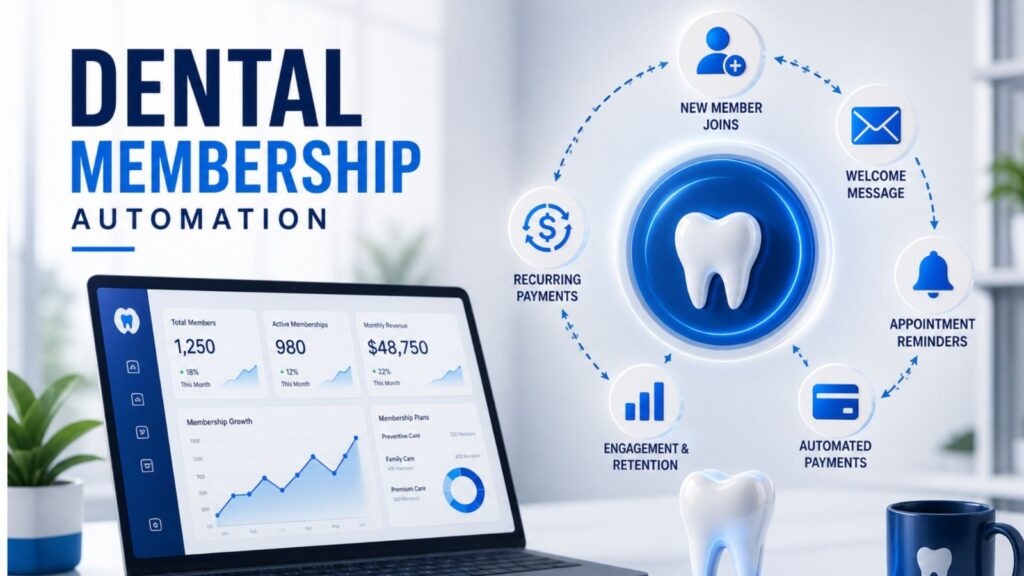
When membership enrollment, payment reminders, failed-card recovery, recall reminders, missed-call follow-up, and patient communication are automated through a CRM or workflow system, the clinic moves from reactive management to structured growth.
In simple words: the clinic stops depending on memory and starts depending on systems.
Improved Section: The Real Problem With Manual Membership Plans
Why Manual Membership Plans Fail in Dental Clinics
Many dental clinics already understand the value of in-house membership plans. The issue is that most plans are managed manually.
A patient is told about the plan once. A staff member makes a note. Someone promises to follow up. A payment card expires. A recall reminder is missed. A patient who was interested says, “I’ll think about it,” and no one contacts them again.
This is not a strategy problem. It is an execution problem.
Manual membership management creates five major problems:
1. Low enrollment rate
Patients may be interested, but if the offer is not explained at the right time and followed up properly, they never join.
2. Missed follow-ups
Front-desk teams are busy. They are handling calls, check-ins, insurance questions, payments, cancellations, and walk-ins. Membership follow-up often becomes a low-priority task.
3. Payment leakage
Expired cards, failed payments, and missed renewals can quietly reduce recurring revenue.
4. Weak patient retention
If the patient does not receive reminders, value updates, and recall communication, the membership becomes easy to forget.
5. Poor tracking
Without a CRM or automation dashboard, the owner cannot clearly see how many patients were offered the plan, how many joined, how many renewed, and how much revenue the membership program generated.
This is why membership plan automation matters. It gives the clinic a repeatable system instead of depending on staff memory.
Improved Section: What Membership Plan Automation Actually Does
What Is Membership Plan Automation for Dental Clinics?
Membership plan automation is the use of CRM workflows, automated billing, SMS reminders, email sequences, task alerts, and patient follow-up systems to manage an in-house dental membership plan with minimal manual work.
A strong automation system can help the clinic:
- Send membership plan information to uninsured patients
- Follow up with interested patients automatically
- Collect monthly or annual membership payments
- Send failed-payment reminders
- Trigger recall reminders for cleanings and exams
- Notify staff when a patient needs personal attention
- Track membership revenue, renewals, cancellations, and patient lifetime value
The goal is not to remove the human touch. The goal is to remove repetitive admin work so the team can spend more time on patient care, treatment presentation, and relationship-building.
A receptionist should not have to remember every failed payment, every unfinished sign-up, every recall date, and every patient who said, “Call me later.” The system should handle those reminders automatically.
Improved Section: Revenue Angle
How Membership Plan Automation Creates Recurring Revenue
The biggest benefit of a dental membership plan is revenue predictability.
In a traditional fee-for-service model, revenue can rise and fall sharply depending on cancellations, seasonal slowdowns, insurance delays, and patient behavior. One slow week can create pressure on payroll, rent, lab bills, and marketing spend.
A membership model changes that structure.
Instead of waiting for patients to book only when they feel pain or need treatment, the clinic creates an ongoing relationship. Patients pay a monthly or annual fee for preventive care benefits, exams, cleanings, discounts, or other clearly defined services.
When automated properly, this creates three financial advantages:
1. More predictable cash flow
Recurring membership payments can help cover fixed overhead before larger treatment revenue comes in.
2. Better patient retention
Patients who are enrolled in a plan have a stronger reason to return for regular visits instead of shopping around.
3. Lower marketing waste
If more existing patients stay active, the clinic does not need to rely only on new patient acquisition to grow.
This does not mean a membership plan will automatically turn every clinic into a high-growth practice. The result depends on pricing, offer clarity, patient communication, compliance, and consistent execution.
But when the system is built correctly, membership plan automation can become one of the most useful retention and revenue-stabilization tools for a dental clinic.
Improved Section: Implementation
How to Set Up Membership Plan Automation Step by Step
A clinic should not start by buying software first. It should start by mapping the patient journey.
Here is a practical setup process:
Step 1: Define the Membership Offer
Keep the plan simple. A confused patient does not buy.
A basic structure may include:
- Adult preventive plan
- Child preventive plan
- Perio maintenance plan
- Optional family plan
Each plan should clearly explain:
- Monthly or annual cost
- Included services
- Discount rules
- Renewal terms
- Cancellation policy
- What is not included
Step 2: Identify the Best Patients to Target
Not every patient needs the same message. Automation works best when the clinic segments patients properly.
Good membership candidates may include:
- Uninsured patients
- Emergency patients without insurance
- Patients who declined treatment because of cost
- Inactive patients
- Patients who regularly pay out of pocket
- Families looking for predictable dental costs
Step 3: Build the CRM Pipeline
The CRM should track each patient’s membership status.
Recommended pipeline stages:
- New membership lead
- Plan information sent
- Interested but not enrolled
- Payment link sent
- Active member
- Failed payment
- Renewal due
- Cancelled member
- Reactivation opportunity
This gives the clinic visibility. The owner can see where patients are dropping off and which workflow needs improvement.
Step 4: Create Automated Follow-Up Workflows
A strong workflow should not send random messages. Every message should have a clear purpose.
Example workflow:
Day 0: Patient receives plan information
Day 1: Friendly reminder with benefits
Day 3: FAQ message answering common concerns
Day 7: Final reminder with enrollment link
Day 14: Staff task created for personal follow-up
This type of workflow keeps the conversation alive without forcing the front desk to remember every lead manually.
Step 5: Automate Failed Payment Recovery
Failed payments are common. The clinic should not rely on awkward phone calls for every expired card.
A simple failed-payment workflow can send:
- First polite payment update message
- Second reminder after 2–3 days
- Staff alert if payment is not updated
- Final message before membership pause
The tone should be professional, calm, and helpful.
Step 6: Track the Right Metrics
After launch, the clinic should track:
- Number of membership leads
- Enrollment rate
- Monthly recurring revenue
- Failed payment recovery rate
- Renewal rate
- Cancellation rate
- Average value of membership patients
- Treatment acceptance from members
- Recall appointment completion
Without tracking, the clinic cannot improve the system.
Improved Section: Real Clinic Scenarios
Real-World Scenarios: How Automation Works Inside a Dental Clinic
Scenario 1: The Uninsured Emergency Patient
A patient visits the clinic for emergency pain relief but has no insurance. In a manual system, the patient pays for the visit and may never return.
With automation, the system tags the patient as uninsured and sends a helpful follow-up message:
“Hi [Patient Name], we hope you’re feeling better after your visit. Because you don’t currently have dental insurance, our in-house membership plan may help make preventive care more affordable. You can review the details here: [Link].”
This turns a one-time emergency visit into a possible long-term patient relationship.
Scenario 2: The Patient Who Says “I’ll Think About It”
Many patients do not reject the membership plan. They simply delay the decision.
Without automation, that patient is often forgotten.
With automation, the CRM sends a short educational sequence explaining the benefits, included services, payment options, and common FAQs. If the patient clicks but does not enroll, the system creates a task for the front desk to follow up personally.
Scenario 3: The Failed Payment
A patient’s card expires, and the monthly membership payment fails.
Instead of your receptionist making an uncomfortable call, the system sends a polite message:
“Hi [Patient Name], we were unable to process your membership payment. You can securely update your payment method here: [Link]. If you need help, please reply to this message.”
This keeps the process professional and reduces staff workload.
Scenario 4: The Inactive Member
A patient is paying for the plan but has not booked their included cleaning.
That is a patient experience problem.
The system should automatically send a recall reminder:
“Hi [Patient Name], your membership includes preventive care benefits, and you’re due for your next visit. You can book a convenient time here: [Booking Link].”
This helps the patient use the plan and increases perceived value.
Improved Section: Common Mistakes
Common Mistakes Dental Clinics Make With Membership Plan Automation
Mistake 1: Making the Plan Too Complicated
If your team needs five minutes to explain the plan, it is probably too complicated.
Patients should quickly understand:
- What they pay
- What they get
- How they save
- How they enroll
- How they cancel or renew
Simple plans are easier to sell, easier to automate, and easier for patients to trust.
Mistake 2: Using Automation Without Human Handoff
Automation should not trap patients.
If a patient has a complex question about treatment, billing, cancellation, or clinical concerns, the system should alert a real team member. The best systems combine automation with human support.
Mistake 3: Not Training the Front Desk
Even the best automation fails if the team does not understand the plan.
Your front desk should know:
- Who the plan is best for
- How to explain it in simple language
- When to send the enrollment link
- How to answer common objections
- When to escalate to the office manager
Mistake 4: No Tracking Dashboard
A membership plan without tracking is guesswork.
The clinic owner should be able to see enrollment rate, recurring revenue, failed payments, cancellations, and renewal performance. If these numbers are not visible, the system is incomplete.
Mistake 5: Over-Selling the Membership Plan
Patients should not feel pressured. The plan should be presented as a helpful option, especially for uninsured or self-pay patients.
The tone should be advisory, not aggressive.
Improved CTA Section
Better CTA for Conversion
Aap ke article mein current CTA “Start Building a Smarter Dental System” theek hai, lekin thora generic hai. Is ki jagah ye CTA zyada strong rahega:
Ready to turn your membership plan into a recurring revenue system?
Start with a simple workflow that enrolls patients, follows up automatically, recovers failed payments, and keeps members active.
👉 Build Your Dental Membership Automation System
Ya agar lead magnet lagana hai to:
👉 Download the Dental Membership Automation Checklist
Ye CTA zyada specific hai, is liye conversion better ho sakti hai.
Improved FAQ Section
Frequently Asked Questions About Membership Plan Automation for Dental Clinics
1. What is membership plan automation for dental clinics?
Membership plan automation is the use of software workflows to manage enrollment, payment reminders, failed-payment recovery, renewals, recall reminders, and patient follow-up for an in-house dental membership plan. It helps the clinic reduce manual admin work and create a more predictable recurring revenue system.
2. Is a dental membership plan only for uninsured patients?
Uninsured patients are often the best starting point, but they are not the only audience. Membership plans can also help self-pay patients, families, inactive patients, and patients who want more predictable dental care costs.
3. Can my existing practice management software handle this?
Some practice management systems can manage patient records and appointments, but many are not built for advanced marketing automation, failed-payment workflows, lead tracking, or multi-step patient follow-up. That is why many clinics use a CRM or automation platform alongside their PMS.
4. How does automation improve membership enrollment?
Automation improves enrollment by making follow-up consistent. Instead of relying on staff to remember every interested patient, the system sends educational messages, payment links, reminders, and staff alerts at the right time.
5. Will automated messages annoy patients?
They can annoy patients if they are too frequent, unclear, or overly promotional. But when messages are helpful, short, and relevant, patients usually appreciate the convenience. The key is to use automation for guidance, reminders, and clarity — not pressure.
6. What is the first workflow a clinic should build?
The best first workflow is usually the uninsured-patient follow-up workflow. When a patient without insurance visits the clinic, the system can automatically send membership plan details and an enrollment link. This is simple, practical, and directly connected to revenue.
7. How should a clinic measure success?
A clinic should track membership leads, enrollment rate, monthly recurring revenue, renewal rate, failed-payment recovery, cancellations, and recall completion. These numbers show whether the membership plan is actually improving business performance.
Improved Conclusion
Conclusion: Build a Membership System, Not Just a Membership Plan
A dental membership plan can be a powerful growth asset, but only when it is supported by the right system.
If your clinic depends on manual follow-up, sticky notes, staff memory, and occasional reminders, the membership plan will never reach its full potential. Patients will forget. Payments will fail. Follow-ups will be missed. Revenue will leak quietly.
But when membership plan automation is connected to your CRM, billing workflows, recall reminders, missed-call follow-up, and patient communication system, the clinic becomes more predictable.
The goal is not to automate the human side of dentistry. The goal is to automate the repetitive tasks that prevent your team from giving patients the attention they deserve.
For dental clinic owners, the future is not just better marketing. It is better systems.
A smart membership automation system can help your clinic create recurring revenue, reduce front-desk pressure, improve patient retention, and build a more stable path to growth.
👉 Build Your Dental Membership Automation System