Global Dental Marketing

Global Dental Marketing SEO Guide 2026

Global Dental Marketing

The hidden revenue leak within modern clinical operations does not stem from your clinical skill; it occurs within your digital front desk. Many clinical practice owners mistake high impressions on search engines for operational profitability. If you are deploying resources into localized campaigns without auditing your operational infrastructure, you are bleeding thousands in patient Lifetime Value (LTV) every month.Global Dental MarketingGlobal Dental Marketing

When a clinical practice treats its online footprint as a billboard rather than an interconnected digital intake system, it falls into a dangerous pitfall. High ranking positions fail to matter if your incoming traffic terminates at a broken or unmonitored communication funnel. For a dental practice seeking sustainable scalability, optimizing the modern patient acquisition journey requires a strict convergence of technical ranking strategy and highly sophisticated operational automation.Global Dental Marketing

To achieve sustainable practice growth, clinicians must transcend the paradigm of the “famous local doctor” and build an “intelligent clinical system.” Famous doctors are constrained by their personal bandwidth, manual staff tasks, and unpredictable referrals. Conversely, an intelligent clinical system relies on predictable, systemized assets that capture, qualify, and book patients autonomously. In this masterclass, we break down the execution vectors required to turn search intent into high-value case acceptance, ensuring your practice dominates search engines and operational balance sheets alike.Global Dental Marketing


The Economic Architecture of Modern Clinical SEOGlobal Dental Marketing

To dominate your market, you must understand the financial metrics governing patient acquisition. Scaling a clinic requires a hyper-focus on two critical metrics: Cost Per Acquisition (CPA) and Patient Lifetime Value (LTV). If your digital strategies fail to reduce your CPA while elevating your LTV, your practice is simply generating empty data noise.Global Dental Marketing

[Patient Organic Search Intent] 
               │
               ▼
   [Topical Authority Content] 
               │
               ▼
 [Systemized Capture & Conversion] 
               │
               ▼
[Automated HIPAA-Compliant Nurturing]

A truly effective strategy utilizes localized and intent-driven content to attract high-value cases—such as full-arch dental implants, cosmetic reconstructions, and sleep apnea therapies. By building comprehensive content structures around specialized procedures, you satisfy search engine algorithms while addressing the critical pain points of high-intent searchers. This reduces reliance on expensive paid ad channels and builds a compounding organic pipeline that continuously reduces your overall CPAGlobal Dental Marketing.


Why “Smart Clinics” Out-Earn “Famous Doctors”

The modern medical marketplace rewards operational efficiency over pure clinical fame. A practice driven solely by the charisma of a single provider inevitably hits a revenue ceiling dictated by human limitations.Global Dental Marketing

“Smart Clinics” scale by engineering system-dependent tasks that remove human error from the patient intake process. They implement advanced web assets optimized for Answer Engine Optimization (AEO) and voice search queries, ensuring their site serves as a 24/7 digital patient coordinator.

By utilizing standardized programmatic data schemas, an intelligent practice ensures its operational hours, service offerings, and real-time patient reviews are instantly scannable by search engines and AI platforms. This infrastructure guarantees that when a high-value prospect searches for a specialized provider, the clinic appears as the definitive choice.Global Dental Marketing


The Economics of Reputation: The Lifetime Value Churn Link

Many practitioners fail to grasp the structural damage a single 1-star review inflicts upon their practice financials. It is not merely an emotional blow; it is a direct attack on your systemic Patient LTV and compounding organic reach.Global Dental Marketing

         1-Star Public Unresolved Review
                        │
                        ▼
   Erosion of Trust & Core Ranking Signal Decay
                        │
                        ▼
    80% Drop in Speed-to-Lead Initial Conversions
                        │
                        ▼
Escalation of CPA & Immediate Patient Churn Rate Spike

When an unaddressed negative review sits on your public profile, it triggers a catastrophic financial chain reaction. Search engines interpret a sudden drop in click-through rates as a signal of diminishing clinical relevance, leading to lower visibility in localized map packs. Concurrently, your patient Churn Rate climbs as existing and prospective patients quietly divert their care to automated competitors.


The “Speed-to-Lead” Operational Gap

The financial losses from poor reputation management are further multiplied by the “Speed-to-Lead” operational gap. Data reveals that failing to engage a digital inquiry within 15 minutes of submission reduces your ultimate conversion probability by a staggering 80%.

High-intent patient prospects do not wait around for an over-burdened front-desk receptionist to check an email inbox. They continue scrolling through search results and contact the first clinic that provides an immediate, conversational, and helpful response. If your practice lacks automated communication mechanisms to instantly claim and nurture incoming leads, your search engine traffic is effectively subsidizing your competitors’ growth.


Systemization Blueprint: Manual vs. Automated Practices

To scale past human operational bottlenecks, practices must transition away from fragile, staff-dependent tasks and deploy automated, system-dependent infrastructure.

Operational BenchmarkThe Chaotic Manual ClinicThe Systematic Automated Clinic
Inbound Lead Response Time2 to 4 hours (Staff-dependent via manual email checking)Under 60 seconds (System-dependent via instant multi-channel Workflow Triggers)
Review Generation MechanicsAsking patients verbally during checkout (Highly inconsistent, zero tracking)Automated SMS/Email outreach fired via HIPAA-compliant triggers post-appointment
No-Show & Patient Churn MitigationReceptionist calls patients manually from a printed daily schedule sheetMulti-step automated reminder workflows featuring interactive confirmation links
Missed Call RecoveryInbound calls after hours go to a generic voicemail box (Leads are permanently lost)Instant Automated Missed-Call Text-Back workflows that immediately engage the patient
Data Synchronization & TrackingFragmented spreadsheets and disconnected local software systemsCentralized Dashboard Tracking with real-time attribution for CPA and Patient LTV

Core Engine Architecture: Implementing GoHighLevel As Your Clinical Central Nervous System

To eliminate operational fragmentation, elite clinics treat GoHighLevel (GHL) as the Central Nervous System of their practice. Rather than patching together distinct software for text messaging, funnel building, email campaigns, and review collection, GHL unifies your entire clinical intake onto a single operational dashboard.

Deploying Automated Review Generation

System-dependent consistency requires eliminating manual operational choices. Through direct integration with your existing Practice Management Software (PMS) via webhooks or secure HL7 engines, GHL can instantly identify when a patient completes an appointment. This event initiates a precise, automated review workflow:

[Patient Checkout in PMS] 
           │
           ▼ (Secure Webhook Fired)
[GHL Workflow Trigger Executed] 
           │
           ▼ (Delays 30-45 Minutes)
[Segmented SMS Review Request Sent] 
           │
           ▼
[Direct Direct Link to Google Business Profile]

This structural loop eliminates staff friction and drives a continuous volume of authentic public reviews, strengthening your core local ranking signals.

Activating the Missed-Call Text-Back Engine

An unreturned phone call represents immediate revenue loss and a spiked CPA. When an incoming clinical line goes unanswered, GHL instantly detects the dropped connection and launches a high-level automated missed-call text-back sequence:

[Inbound Call Missed / Unanswered]
               │
               ▼
[GHL Instantaneous System Trigger]
               │
               ▼
[Automated SMS Sent: "Hi, this is [Practice Name]. We missed your call while helping another patient. How can we assist you today?"]
               │
               ▼
[Patient Responds via Text -> Interactive Booking Link Delivered Autonomously]

This rapid response preserves your speed-to-lead advantage, captures patients before they bounce back to search engines, and protects your marketing investment without requiring extra staff hours.


Strategic dental practice scaling requires moving past vanity metrics like organic search impressions and focusing on automated patient acquisition systems that systematically lower your CPA while maximizing lifetime retention.

👉 Start Building a Smarter Dental System


Advanced Content Optimization Strategy

To secure a dominant market position, your content must satisfy both modern search engines and human search intent. The foundation of an effective digital framework relies on building absolute topical authority across your core clinical services.

                  [Core Topical Pillar Page]
                 (e.g., Complete Implant Care)
                               │
         ┌─────────────────────┼─────────────────────┐
         ▼                     ▼                     ▼
 [Supporting Cluster 1]  [Supporting Cluster 2]  [Supporting Cluster 3]
  (Bone Graft Guides)     (Implant Cost Math)     (Aftercare Protocol)

Instead of publishing generic content, your internal marketing team must compile extensive content clusters that cover every phase of the patient’s research journey. For instance, a dedicated dental implant campaign should include deep-dive resources on:

  • Bone grafting procedures and criteria
  • Transparent financial breakdowns and insurance navigation
  • Post-operative recovery and long-term care timelines

Each secondary article must systematically link back to your primary service landing page using precise anchor text. This architecture establishes deep topical authority, demonstrating to search platforms that your clinic provides comprehensive answers to complex clinical questions.

Maximizing Local Visibility & Schema Architecture

Local patient acquisition relies heavily on dominating proximity-based searches. To capture this high-intent local traffic, clinics must meticulously optimize their Google Business Profile (GBP) and deploy advanced technical markup.

Your digital engineering team should inject hyper-localized schema markup directly into your website’s codebase. This structured data explicitly communicates your practice’s physical coordinates, verified practitioner credentials, accepted insurance providers, and direct appointment booking links to search engine crawlers.

HTML

<script type="application/ld+json">
{
  "@context": "https://schema.org",
  "@type": "Dentist",
  "name": "Apex Dental Implant Center",
  "image": "https://www.apexdental.com/assets/clinic-front.jpg",
  "geo": {
    "@type": "GeoCoordinates",
    "latitude": 40.7128,
    "longitude": -74.0060
  },
  "url": "https://www.apexdental.com",
  "telephone": "+1-555-867-5309",
  "priceRange": "$$$",
  "address": {
    "@type": "PostalAddress",
    "streetAddress": "123 Health Science Way, Suite 400",
    "addressLocality": "New York",
    "addressRegion": "NY",
    "postalCode": "10001",
    "addressCountry": "US"
  }
}
</script>

Pairing this advanced on-page technical optimization with automated review generation ensures your clinic consistently holds the top position in localized map configurations.


Maximizing practice revenue requires implementing a unified, automated framework that transforms raw search volume into high-value, scheduled cases on your clinical calendar.

👉 Start Building a Smarter Dental System


Real-World Case Analysis: Before vs. After Implementation

To understand the practical impact of systemized automation, consider this real-world operational case study from a multi-chair practice facing stagnant patient numbers and rising acquisition costs.

The Baseline: A Fragmented Practice

Before restructuring, a prominent clinic in a competitive market relied entirely on manual staff operations to manage incoming leads and reviews. The practice generated over 45,000 monthly page impressions through standard content marketing, yet only converted 22 new patients a month.

Their front-desk staff suffered from severe alert fatigue, leading to an average inbound lead response time of 3.5 hours. Furthermore, their review collection was completely ad-hoc, yielding fewer than two new public reviews per month. As a result, their localized rankings began to slip, their cost per acquisition spiked to an unsustainable level, and their patient retention rate steadily declined.

The Transformation: An Automated System

To fix these operational leaks, the practice eliminated manual intake tasks and implemented an integrated GoHighLevel ecosystem linked directly to their primary digital channels.

[Inbound Organic Search Lead] -> [Instant GHL Workflow Trigger]
                                         │
                    ┌────────────────────┴────────────────────┐
                    ▼                                         ▼
      [Automated SMS Within 45 Sec]             [Internal Staff Notification]
                    │                                         │
                    └────────────────────┬────────────────────┘
                                         ▼
                     [Autonomous Digital Booking Completed]

The clinical team deployed instant text-back workflows to handle missed calls and web forms within 45 seconds. They also launched automated review sequences that engaged patients via text 30 minutes after checking out of their Practice Management Software.

The Operational Results

Within 90 days of activating these automated systems, the practice experienced a massive shift across all core operational metrics:

  • Inbound lead conversion rates increased by 310% due to consistent, immediate responses.
  • Their public review volume climbed from 1.8 reviews per month to a consistent average of 34 verified reviews per month, catapulting them to the top of local map searches.
  • Their Cost Per Acquisition dropped by 44%, while automated follow-ups recaptured lost treatment plans, adding significant revenue to their bottom line.

Implementation Failures: Why Out-of-the-Box Setup Fails

The primary reason most practices fail to see a return on investment from software like GoHighLevel is a failure of execution. Many practice owners buy subscription licenses assuming the software will magically solve their intake bottlenecks without customizing the underlying architecture.

Critical Strategy Note: Software without customized workflow triggers is simply an expensive, underutilized digital repository.

If your marketing agency merely embeds basic contact forms on your site without configuring specific operational automation rules, your system is fundamentally broken. To drive real practice growth, every contact point must be tied to a multi-stage automation workflow that handles:

  • Immediate confirmation routing via text and email
  • Internal notification schedules for your front-desk staff
  • Fallback re-engagement loops for prospects who stall during the booking process

Furthermore, you must ensure that all automated text and email interactions strictly comply with all relevant medical privacy and regulatory standards.


Enforcing Strict Regulatory and Communication Compliance

When deploying automated communication systems, keeping your data workflows fully secure and compliant with health regulations is non-negotiable.

[Incoming Communication Trigger]
               │
               ▼
[System Checks Active Opt-In Status]
               │
               ▼
[Encrypt Data Payloads (SSL / Database Level)]
               │
               ▼
[Deliver Secure, Content-Compliant Notifications]

To maintain an audit-proof system, your GoHighLevel instance must be configured with a strict compliance architecture:

  • Explicit Opt-In Verification: Never send automated marketing messages without capturing explicit, logged consent via your digital intake forms.
  • Compliant Data Transmission: Ensure your platform uses dedicated, encrypted communication routes. Avoid sending sensitive diagnostic details or protected health information through open, unencrypted SMS networks.
  • Data Privacy Management: Configure your workflows to honor data deletion and access requests instantly, maintaining compliance with modern consumer privacy standards.

By embedding these structural guardrails directly into your automation rules, you protect your practice from severe legal penalties while building a highly scalable patient acquisition engine.


True practice scalability is built on dependable systems, not human perfection. Protect your clinical margins by replacing fragile manual tasks with automated growth architecture.

👉 Start Building a Smarter Dental System


Strategic Operational FAQ Masterclass

1. How do we transition from manual review collection to automated review generation without violating platform guidelines or medical privacy regulations?

Transitioning to system-dependent review generation requires connecting your internal Practice Management Software to GoHighLevel using automated webhooks. When a patient checkout event occurs, it triggers an API call that schedules a review invitation to send via text 30 to 45 minutes later.

To maintain strict regulatory compliance, the text message must exclude all personal medical details and focus solely on the patient’s operational experience at your practice. Additionally, you must avoid “review gating”—the practice of filtering out unhappy patients via an internal survey before sending positive reviewers to public profiles. Platforms heavily penalize this practice. Your automated system must send an unbiased, direct invitation link to all checked-out patients, ensuring completely compliant review generation.

2. What are the exact steps to configure a missed-call text-back workflow in GoHighLevel to minimize patient churn?

To stop losing patients to missed calls, open the automation builder within GoHighLevel and create a brand-new workflow triggered by the Call Status parameter. Set the conditions to filter for Inbound calls with a status of Busy, No Answer, or Voicemail.

Your very first action step should be a system check to verify that the incoming phone number is a valid mobile line capable of receiving texts. Once confirmed, add an immediate SMS action step that sends a professional, personalized message, such as: “Hi, this is [Clinic Name]. We’re currently helping another patient and missed your call. How can our team assist you today?”

Follow this with an internal notification rule that alerts your front-desk staff on their dashboard, and insert a wait-step to monitor for the patient’s reply. If the patient responds, the system can automatically deliver your direct online booking link, securing the appointment before they contact a competitor.

3. How does establishing topical authority through content marketing directly lower our clinic’s cost per acquisition (CPA)?

When a clinic relies solely on paid advertising, its patient acquisition costs are tied to bidding markets that consistently grow more expensive over time. Building deep topical authority breaks this dependency. By creating comprehensive content clusters centered around high-value procedures, you build a library of educational assets that search engines trust as definitive answers.

As these pages rank higher for competitive search queries, your clinic earns a steady stream of high-intent organic visitors for free. Because these organic searchers are already looking for specialized care, they convert into scheduled procedures at a far higher rate than cold ad traffic. This organic pipeline consistently drives down your overall cost per acquisition while increasing your average case value.

4. Why is responding to inbound leads within 15 minutes critical for conversions, and how does automation solve this problem?

The modern healthcare consumer expects immediate answers. When a prospective patient fills out an appointment form, they are actively looking for a solution to an immediate problem. If your practice takes hours to respond, that patient’s focus shifts, and they will likely continue searching until they find a clinic that answers right away.

Data shows that delaying your response by just 15 minutes drops your chances of booking that patient by 80%. Expecting busy front-desk staff to hit this response window manually while managing in-office patients is unrealistic. Automated workflows solve this bottleneck by instantly taking over the initial intake step, triggering immediate text and email confirmations the moment a form is submitted to keep the prospect engaged.

5. What structural data markers must our website use to optimize for modern AI search engines and local search packs?

To ensure your clinic ranks well in modern AI search summaries and local map packs, your website must deploy advanced structured data using JSON-LD format. This schema code should be placed directly in the header of your site, giving search crawlers clear, verified details about your business.

Your schema files must use specific medical and local business tags to outline your exact clinic name, physical address, verified phone lines, geo-coordinates, hours of operation, and your real-time customer review ratings. Additionally, embedding specific service and FAQ schema markup into your treatment pages allows search engines to easily scan and pull your content into featured answers and voice search results.

6. How do we keep our automated text and email campaigns compliant with strict patient communication laws?

Maintaining communication compliance requires building explicit consent checks into every automated workflow. Every digital form on your website must include an un-ticked checkbox where patients explicitly agree to receive automated text and email updates from your practice. Your system must log and store this consent timestamp within the patient’s contact profile.

Furthermore, every automated text message you send must clearly include standard opt-out instructions, such as “Reply STOP to unsubscribe.” Your data systems must also use end-to-end encryption to prevent sensitive health updates or diagnostic information from being broadcast across public, unsecure messaging networks, keeping your practice safe from costly data violations.


Note: The platform and system links provided within this guide contain affiliate tracking markers. We only recommend operational infrastructure and automation software that align with structured clinic growth and have been thoroughly vetted within active medical practice environments.

GHL vs Solutionreach

GHL vs Solutionreach for Patient Engagement

GHL vs Solutionreach

Introduction — The Operational Reality Inside Dental Clinics

Most dental clinics don’t struggle because of poor clinical work.
They struggle because of operational leakage.

Appointments fall through.
Calls go unanswered.
Patients forget.
Front desks get overwhelmed.

Over time, this creates a quiet but consistent revenue problem.

You don’t notice it daily — but monthly, it compounds.

This is where the conversation around GHL vs Solutionreach becomes important. Not as a “tool comparison,” but as a decision about how your clinic operates as a system.

Because growth in modern dentistry is not driven by skill alone.
It is driven by structured systems that reduce friction across the patient journey.


What Intelligence Means in a Dental Clinic

“Intelligence” in a clinic is not about having more data.
It’s about having useful, actionable control over what happens daily.

A truly intelligent clinic can:

  • Track every patient interaction
  • Prevent missed opportunities
  • Maintain consistent communication
  • Reduce reliance on memory and manual effort

When evaluating GHL vs Solutionreach, the real question is:

Are you managing tasks — or managing a system?


Human Intelligence (And Its Limits)

Dental clinics traditionally rely heavily on people:

  • Receptionists handling calls
  • Staff sending reminders manually
  • Front desk managing schedules

This works — until volume increases.

At that point:

  • Calls are missed during peak hours
  • Follow-ups are delayed
  • Patients slip through gaps

Even experienced staff cannot maintain perfect consistency under pressure.

This is not a staffing issue.
It’s a system design issue.


System Intelligence — Where Structure Changes Everything

System intelligence replaces manual repetition with predictable workflows.

Instead of relying on memory:

  • Every missed call triggers a callback workflow
  • Every appointment has automated reminders
  • Every inquiry is tracked and followed

In a structured setup:

  • Nothing is “forgotten”
  • Nothing depends on one person
  • Everything is trackable

This is where the difference in GHL vs Solutionreach starts to show clearly.

Solutionreach primarily focuses on patient communication and reminders.

On the other hand, platforms like GoHighLevel provide a broader infrastructure that includes:

  • Lead tracking
  • Pipeline visibility
  • Automated follow-ups
  • Multi-channel communication
  • Workflow automation

This doesn’t replace your team — it supports them with consistency.


AI & Automation — Moving Beyond Basic Reminders

Automation in dentistry is often misunderstood.

Many clinics think automation = reminders.

But in reality, automation is about managing the entire patient lifecycle.

When comparing GHL vs Solutionreach, this is a critical distinction:

Solutionreach

  • Appointment reminders
  • Patient messaging
  • Review requests

GoHighLevel

  • Everything above
  • Plus full workflow automation
  • Lead capture and tracking
  • Missed call text-back systems
  • Automated nurture sequences

Think of it this way:

A patient calls your clinic at 6 PM. No one answers.

What happens next?

  • In a basic system → Nothing
  • In a structured system → Immediate text response + follow-up + tracking

That single moment can determine whether a patient books or disappears.


Think of how many opportunities quietly slip through when systems are not connected.
Even a small improvement in follow-up consistency can stabilize your bookings.

[Start Building a Smarter Dental System](INSERT YOUR AFFILIATE LINK HERE)

Note: The link above is an affiliate link. I only recommend systems that align with structured clinic growth.


Real Clinic Scenarios — Where Systems Make the Difference

Let’s move away from theory and look at practical scenarios.

Scenario 1: Missed Calls During Peak Hours

A clinic receives 20–30 calls daily.

Even missing 4–5 calls:

  • Some patients never call back
  • Some choose another clinic

With structured automation:

  • Every missed call triggers an instant response
  • Follow-up continues until engagement

This alone can recover lost opportunities.


Scenario 2: No-Shows and Last-Minute Gaps

Manual reminders are inconsistent.

Patients forget — especially for routine visits.

With structured workflows:

  • Multiple reminders are sent automatically
  • Timing is optimized
  • Patients can confirm or reschedule easily

This reduces idle chair time without increasing workload.


Scenario 3: Lead Tracking & Inquiry Management

A patient submits a form or message.

Without a system:

  • The inquiry may sit unnoticed
  • Response delays reduce conversion

With a structured CRM:

  • Every lead is logged
  • Follow-up is automated
  • Conversion becomes measurable

If your clinic experiences even one of these issues regularly, it’s not random.
It’s a pattern that can be systematized and improved.

[Start Building a Smarter Dental System](INSERT YOUR AFFILIATE LINK HERE)


GHL vs Solutionreach — Practical Comparison for Clinics

This is not about which platform is “better.”

It’s about which structure your clinic actually needs.

Use Solutionreach if:

  • You only need patient reminders
  • Your front desk handles everything else
  • You are not focused on lead tracking or automation

Use GoHighLevel if:

  • You want full visibility of patient flow
  • You want automation across the entire lifecycle
  • You want to reduce manual workload
  • You want structured follow-up systems

In simple terms:

  • Solutionreach = Communication Layer
  • GoHighLevel = Operational System

Common Mistakes Clinics Make

When evaluating systems like GHL vs Solutionreach, clinics often make predictable mistakes:

1. Thinking Tools Fix Problems Automatically

A platform does nothing without proper setup.

2. Over-Relying on Staff Memory

Even skilled staff cannot replace structured systems.

3. Ignoring Missed Calls

Missed calls are not small issues — they are lost revenue points.

4. Treating Follow-Ups as Optional

Follow-ups are not extra — they are essential.

5. Implementing Without Strategy

Tools without workflows create more confusion, not less.


The Future of Structured Dental Clinics

Dental clinics are gradually shifting from:

Manual → Automated
Reactive → Predictable
Fragmented → Centralized

The future clinic will not rely on:

  • Sticky notes
  • Manual callbacks
  • Memory-based systems

Instead, it will rely on:

  • Automated workflows
  • Centralized communication
  • Data-driven decisions

Platforms like Solutionreach and GoHighLevel are part of this shift — but they serve different levels of system maturity.

The real question is:

Do you want to improve tasks — or improve the system itself?


If your goal is to reduce chaos, increase visibility, and create consistency,
then structured automation is not optional — it becomes foundational.

[Start Building a Smarter Dental System](INSERT YOUR AFFILIATE LINK HERE)


Conclusion

The GHL vs Solutionreach decision is not about choosing software.

It’s about choosing how your clinic operates.

  • Do you rely on people alone?
  • Or do you support your team with systems?

Clinics that grow sustainably do not work harder.
They work with better structure.

And that structure comes from:

  • Consistent workflows
  • Automated follow-ups
  • Clear visibility into patient activity

Better dentistry brings patients in.
Better systems ensure they stay, return, and refer.


FAQs

1. What is the main difference in GHL vs Solutionreach?

Solutionreach focuses on patient communication, while GoHighLevel provides a full CRM and automation system for managing the entire patient journey.


2. Is GoHighLevel suitable for small dental clinics?

Yes, especially for clinics that want to implement structured workflows, reduce manual work, and improve patient tracking.


3. Can Solutionreach handle missed call follow-ups?

It offers communication tools, but it is not designed as a full automation system for missed-call recovery workflows.


4. Does automation replace front desk staff?

No. It supports staff by reducing repetitive tasks and improving consistency.


5. How does automation reduce no-shows?

By sending structured, timely reminders and allowing easy confirmation or rescheduling.


6. Which system is better for long-term clinic growth?

It depends on your needs. Clinics focused on full operational control and automation often lean toward systems like GoHighLevel.


7. Is switching systems difficult?

Implementation requires planning, but with proper setup, the transition can significantly improve efficiency.

SMS Marketing Compliance

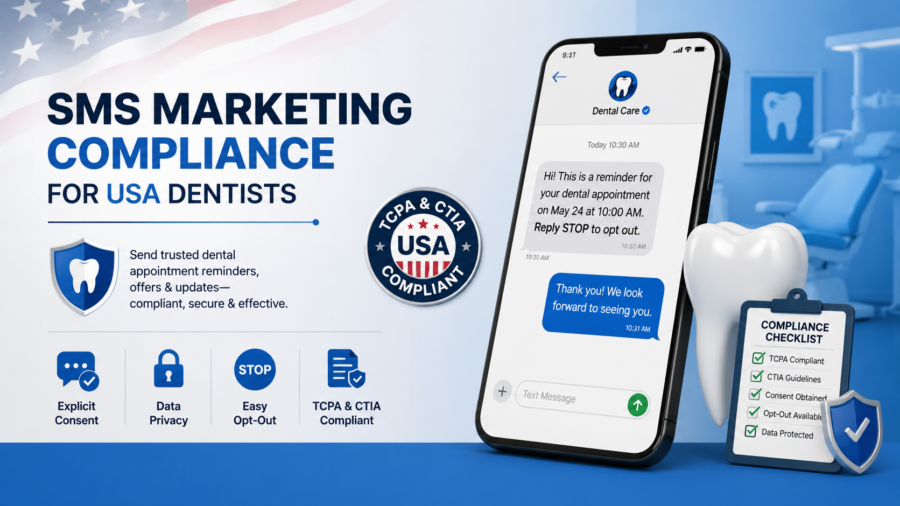
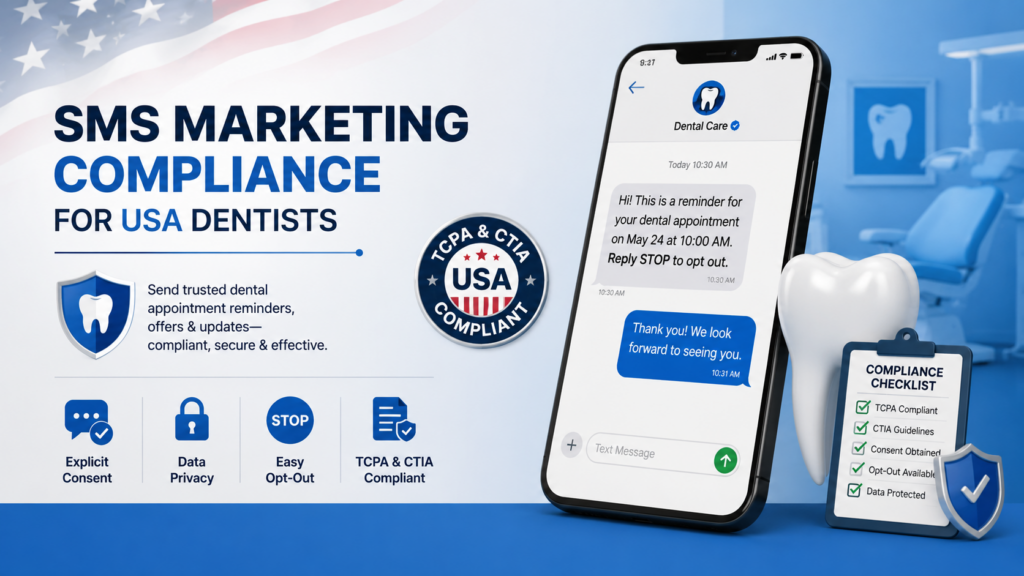
SMS Marketing Compliance for USA Dentists

SMS Marketing Compliance

In the current dental landscape, clinical excellence is the baseline, not the differentiator. You can be the most skilled clinician in your region, but if your chairs are empty because of a leaky “front desk bucket,” your expertise is effectively sidelined.

Most dental clinic owners face the same mounting pressures: rising overhead, front-desk burnout, and a patient base that increasingly ignores phone calls but responds to texts within minutes. While the shift to text-based communication is the most effective way to stabilize revenue, it introduces a significant operational hurdle: SMS marketing compliance.

Navigating the transition from manual outreach to automated systems requires more than just a software subscription; it requires a strategic understanding of how to balance patient engagement with the strict legal frameworks of the TCPA (Telephone Consumer Protection Act) and 10DLC (10-Digit Long Code) regulations.

What Intelligence Means in a Dental Clinic

In a high-performing clinic, “intelligence” is not a measure of the staff’s IQ, but rather the quality of the systems they operate. A clinic relying solely on human memory is a clinic destined for chaos.

System intelligence means that when a patient cancels an appointment, the system knows it immediately. It doesn’t wait for a receptionist to find a spare moment to call the waitlist. Instead, it triggers a sequence that offers that slot to high-priority leads.

True intelligence in dental operations involves:

  • Centralized Data: Knowing exactly where every lead came from and where they are in the treatment plan.
  • Predictable Communication: Ensuring every patient receives the same high-standard follow-up, regardless of how busy the office is.
  • Risk Mitigation: Automating SMS marketing compliance so that your practice never accidentally sends a message to a patient who hasn’t opted in.

Human Intelligence vs. System Intelligence

We often over-rely on our front-desk teams to perform tasks that are better suited for machines. We ask them to remember to follow up with “no-shows,” to manually text appointment reminders, and to “keep an eye” on missed calls.

This is an inefficient use of human intelligence.

Your staff’s intelligence should be reserved for high-value tasks: empathetic patient interaction, resolving complex insurance disputes, and presenting treatment plans in the chair. System intelligence handles the repetitive, the mundane, and the technical—like tracking opt-ins for SMS marketing compliance and ensuring that every automated text includes a clear “Stop” to unsubscribe.

The Role of AI and Automation in Modern Dentistry

The introduction of automation platforms like GoHighLevel has changed the “infrastructure” of the dental office. It serves as a digital nervous system that connects your marketing efforts to your actual chair time.

By using a centralized CRM, a clinic can automate the “Missed Call Text Back.” If a potential new patient calls and the line is busy, the system immediately sends a text: “Sorry we missed you! We’re currently helping another patient. How can we help you today?”

This single automation can prevent thousands of dollars in “leakage” every month. However, for this to work effectively and legally, your platform must be configured for SMS marketing compliance. This includes registering your brand with mobile carriers and ensuring your messaging workflows respect quiet hours and opt-out requests.


Implementing Structure Over Chaos

If your clinic is currently managing patient follow-ups via sticky notes or unorganized spreadsheets, you are operating with significant blind spots. Transitioning to a structured CRM allows you to see exactly which marketing channels are providing a return and which are simply wasting your budget.

Note: The link below is an affiliate link. I only recommend systems that align with structured clinic growth.

[Start Building a Smarter Dental System]([INSERT YOUR AFFILIATE LINK HERE])


Real-World Scenario: The High-Cost of the “No-Show”

Consider a clinic that averages two no-shows per day. If the average appointment value is $250, that is $500 a day, or $10,000 a month in lost revenue.

Most clinics try to solve this by having the receptionist call the day before. But people don’t answer their phones. A compliant, automated SMS reminder system—sending texts at 48 hours, 24 hours, and 2 hours before the appointment—can reduce no-shows by up to 80%.

The “Intelligence” here isn’t just sending the text; it’s the system’s ability to recognize a “Confirm” reply and automatically update your schedule, or flag a “Cancel” reply so the front desk can fill the spot immediately.

Common Mistakes in Dental SMS Marketing

Many dental owners jump into texting patients without a strategy, leading to two major issues:

  1. Compliance Violations: Sending “marketing” messages (like “10% off whitening”) to patients who only opted in for “operational” messages (like appointment reminders).
  2. Over-Automation: Sending too many messages, which leads to patients blocking the clinic’s number.

To maintain SMS marketing compliance, your system must distinguish between transactional and promotional content. Transactional messages have more leeway, but promotional messages require explicit, documented consent.

The Future of the Structured Clinic

The dental industry is moving toward a model where the “Back Office” is almost entirely automated. The future belongs to the “Smarter Clinic”—one that uses a CRM to track the patient lifecycle from the first Google search to the five-year recall.

In this model, SMS marketing compliance is not a hurdle; it’s a standard operating procedure. By utilizing tools like GoHighLevel, you can ensure that your clinic stays ahead of the curve, maintaining professional communication while safeguarding your practice against regulatory scrutiny.


Taking Control of Your Practice Operations

Systematizing your outreach doesn’t just increase revenue; it decreases the “noise” in your daily operations. When the system handles the follow-ups, your team can focus on the patient standing right in front of them.

[Start Building a Smarter Dental System]([INSERT YOUR AFFILIATE LINK HERE])


Many dental clinic owners operate on “gut feelings” or estimates, but an intelligent system provides real-time, actionable data. When you integrate SMS marketing compliance with a robust CRM, you aren’t just sending messages—you are harvesting valuable data that creates a roadmap for clinical growth.

Understanding Patient Behavior Through Analytics

Every automated text your system sends is a data point. If your “No-show” rate spikes on specific days or for specific procedures, an intelligent system reveals these trends immediately.

  • Conversion Tracking: You can see exactly which SMS campaign generated the most consultations, allowing you to stop wasting money on underperforming ads.
  • Patient Engagement Scores: Identify which patients respond instantly and which have become inactive, allowing for targeted re-engagement.
  • True ROI Visibility: You gain the clarity to see exactly how every dollar spent on automation translates into realized revenue at the chair.

Scaling Without Increasing Overhead

A common mistake among dentists is hiring more staff the moment revenue starts to grow. However, new staff members mean higher overhead, more management headaches, and extensive training time. Intelligent systems allow for “Vertical Scaling”—the ability to handle a higher volume of patients using your existing team and resources.

When your system handles lead nurturing according to SMS marketing compliance standards, your front-desk team is liberated from the burden of manual follow-ups and cold calling. They can shift their focus to high-value tasks, such as in-person patient experience and treatment plan acceptance.


Systems as a Practice Asset

Consider the long-term value of your practice. If you decide to sell your clinic in the future, a buyer isn’t just looking at your dental chairs and equipment; they are looking at your System. A clinic with an automated lead flow, compliant patient communication, and a predictable revenue model carries a significantly higher market valuation than a “manual” practice.

Note: The link below is an affiliate link. I only recommend systems that align with structured clinic growth.

[Start Building a Smarter Dental System]([INSERT YOUR AFFILIATE LINK HERE])


Operational Excellence: The “Silent” Growth Engine

Growth is not just about acquiring new patients; it is about plugging the holes where revenue is currently leaking. In most dental clinics, the largest source of lost income is “Treatment Ghosting”—patients who hear a treatment plan but never book the appointment.

Automated Treatment Plan Follow-ups

An intelligent system never “forgets” a patient. Within the boundaries of SMS marketing compliance, a CRM can trigger “educational” follow-ups. Instead of a high-pressure sales call, the system sends clinical insights regarding the risks of delaying treatment. These “soft touches” are documented to be 40% more effective at bringing patients back than sporadic manual phone calls.

Managing Privacy and Reputation

Reputation management is a cornerstone of modern dentistry. Immediately following an appointment, your system can automatically send a feedback request via SMS. If the feedback is positive, the system prompts a Google Review; if it is negative, it alerts the manager privately to resolve the issue before it reaches the public. This entire process is handled within a legal, compliant framework that protects the clinic’s integrity.

Strategic Conclusion: The Leap from Dentist to CEO

When you separate the clinical work of dentistry from the operational systems of the business, you transition from being a “Doctor” to a “Business Owner.” SMS marketing compliance is not merely a legal hurdle—it is a professional bridge between you and your patient. By adopting these systems, you reduce burnout, eliminate chaos, and transform your clinic into a modern, high-revenue machine.

Conclusion: Systems Over Sweat

Growth in a dental practice is often mistaken for “working harder.” But there is a ceiling to how hard you and your staff can work. There is no ceiling to how well a system can perform.

By focusing on SMS marketing compliance and integrating a robust CRM, you move from a reactive state—chasing missed calls and no-shows—to a proactive state where your practice grows predictably. Intelligent systems are the only way to achieve revenue stabilization without professional burnout.


FAQs on SMS Marketing Compliance and Dental Operations

1. What is the most important part of SMS marketing compliance for dentists? The most critical element is “Prior Express Written Consent.” You must have a record that the patient agreed to receive text messages from your practice, specifically for the type of content you are sending (marketing vs. informational).

2. Is a simple “Opt-In” box on my website enough? It’s a start, but your “Opt-In” language must be clear. It should state that message and data rates may apply, the frequency of messages, and provide a link to your privacy policy and terms of service.

3. What happens if I ignore 10DLC registration? If you use a platform like GoHighLevel without completing 10DLC registration, mobile carriers (like Verizon or AT&T) may block your messages entirely or flag them as spam, meaning your appointment reminders will never reach your patients.

4. How does automation help with missed call recovery? An automated system detects when a call to your clinic goes unanswered. It can immediately trigger a text message to the caller. This keeps the lead engaged and prevents them from calling the next dentist on the Google search results list.

5. Can I use my personal cell phone to text patients? This is highly discouraged for both HIPAA and SMS marketing compliance reasons. Personal phones do not provide the audit trail or the automated “Opt-Out” mechanisms required by law to protect your practice.

6. Does GoHighLevel integrate with my existing Dental Practice Management Software (PMS)? While many CRMs operate alongside your PMS, tools like GoHighLevel can often be synced via third-party integrators (like Zapier) or used as a powerful “front-end” to manage all lead generation and initial patient communication before they are officially entered into your clinical record.