
Introduction — The Operational Reality Inside Dental Clinics
Most dental clinics don’t struggle because of poor clinical work.
They struggle because of operational leakage.
Appointments fall through.
Calls go unanswered.
Patients forget.
Front desks get overwhelmed.
Over time, this creates a quiet but consistent revenue problem.
You don’t notice it daily — but monthly, it compounds.
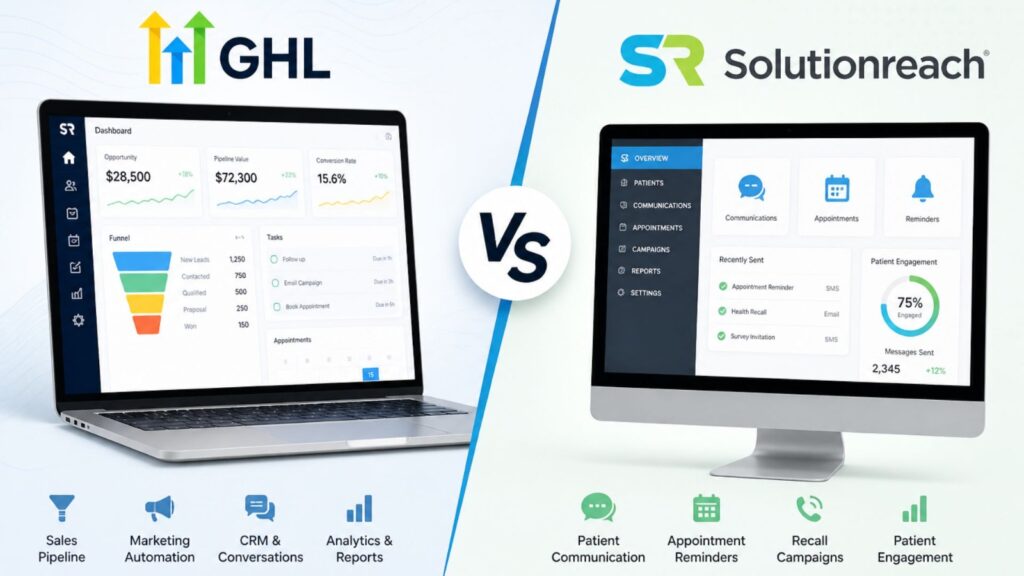
This is where the conversation around GHL vs Solutionreach becomes important. Not as a “tool comparison,” but as a decision about how your clinic operates as a system.
Because growth in modern dentistry is not driven by skill alone.
It is driven by structured systems that reduce friction across the patient journey.
What Intelligence Means in a Dental Clinic
“Intelligence” in a clinic is not about having more data.
It’s about having useful, actionable control over what happens daily.
A truly intelligent clinic can:
- Track every patient interaction
- Prevent missed opportunities
- Maintain consistent communication
- Reduce reliance on memory and manual effort
When evaluating GHL vs Solutionreach, the real question is:
Human Intelligence (And Its Limits)
Dental clinics traditionally rely heavily on people:
- Receptionists handling calls
- Staff sending reminders manually
- Front desk managing schedules
This works — until volume increases.
At that point:
- Calls are missed during peak hours
- Follow-ups are delayed
- Patients slip through gaps
Even experienced staff cannot maintain perfect consistency under pressure.
This is not a staffing issue.
It’s a system design issue.
System Intelligence — Where Structure Changes Everything
System intelligence replaces manual repetition with predictable workflows.
Instead of relying on memory:
- Every missed call triggers a callback workflow
- Every appointment has automated reminders
- Every inquiry is tracked and followed
In a structured setup:
- Nothing is “forgotten”
- Nothing depends on one person
- Everything is trackable
This is where the difference in GHL vs Solutionreach starts to show clearly.
Solutionreach primarily focuses on patient communication and reminders.
On the other hand, platforms like GoHighLevel provide a broader infrastructure that includes:
- Lead tracking
- Pipeline visibility
- Automated follow-ups
- Multi-channel communication
- Workflow automation
This doesn’t replace your team — it supports them with consistency.
AI & Automation — Moving Beyond Basic Reminders
Automation in dentistry is often misunderstood.
Many clinics think automation = reminders.
But in reality, automation is about managing the entire patient lifecycle.
When comparing GHL vs Solutionreach, this is a critical distinction:
Solutionreach
- Appointment reminders
- Patient messaging
- Review requests
GoHighLevel
- Everything above
- Plus full workflow automation
- Lead capture and tracking
- Missed call text-back systems
- Automated nurture sequences
Think of it this way:
A patient calls your clinic at 6 PM. No one answers.
What happens next?
- In a basic system → Nothing
- In a structured system → Immediate text response + follow-up + tracking
That single moment can determine whether a patient books or disappears.
Think of how many opportunities quietly slip through when systems are not connected.
Even a small improvement in follow-up consistency can stabilize your bookings.
[Start Building a Smarter Dental System](INSERT YOUR AFFILIATE LINK HERE)
Note: The link above is an affiliate link. I only recommend systems that align with structured clinic growth.
Real Clinic Scenarios — Where Systems Make the Difference
Let’s move away from theory and look at practical scenarios.
Scenario 1: Missed Calls During Peak Hours
A clinic receives 20–30 calls daily.
Even missing 4–5 calls:
- Some patients never call back
- Some choose another clinic
With structured automation:
- Every missed call triggers an instant response
- Follow-up continues until engagement
This alone can recover lost opportunities.
Scenario 2: No-Shows and Last-Minute Gaps
Manual reminders are inconsistent.
Patients forget — especially for routine visits.
With structured workflows:
- Multiple reminders are sent automatically
- Timing is optimized
- Patients can confirm or reschedule easily
This reduces idle chair time without increasing workload.
Scenario 3: Lead Tracking & Inquiry Management
A patient submits a form or message.
Without a system:
- The inquiry may sit unnoticed
- Response delays reduce conversion
With a structured CRM:
- Every lead is logged
- Follow-up is automated
- Conversion becomes measurable
If your clinic experiences even one of these issues regularly, it’s not random.
It’s a pattern that can be systematized and improved.
[Start Building a Smarter Dental System](INSERT YOUR AFFILIATE LINK HERE)
GHL vs Solutionreach — Practical Comparison for Clinics
This is not about which platform is “better.”
It’s about which structure your clinic actually needs.
Use Solutionreach if:
- You only need patient reminders
- Your front desk handles everything else
- You are not focused on lead tracking or automation
Use GoHighLevel if:
- You want full visibility of patient flow
- You want automation across the entire lifecycle
- You want to reduce manual workload
- You want structured follow-up systems
In simple terms:
- Solutionreach = Communication Layer
- GoHighLevel = Operational System
Common Mistakes Clinics Make
When evaluating systems like GHL vs Solutionreach, clinics often make predictable mistakes:
1. Thinking Tools Fix Problems Automatically
A platform does nothing without proper setup.
2. Over-Relying on Staff Memory
Even skilled staff cannot replace structured systems.
3. Ignoring Missed Calls
Missed calls are not small issues — they are lost revenue points.
4. Treating Follow-Ups as Optional
Follow-ups are not extra — they are essential.
5. Implementing Without Strategy
Tools without workflows create more confusion, not less.
The Future of Structured Dental Clinics
Dental clinics are gradually shifting from:
Manual → Automated
Reactive → Predictable
Fragmented → Centralized
The future clinic will not rely on:
- Sticky notes
- Manual callbacks
- Memory-based systems
Instead, it will rely on:
- Automated workflows
- Centralized communication
- Data-driven decisions
Platforms like Solutionreach and GoHighLevel are part of this shift — but they serve different levels of system maturity.
The real question is:
Do you want to improve tasks — or improve the system itself?
If your goal is to reduce chaos, increase visibility, and create consistency,
then structured automation is not optional — it becomes foundational.
[Start Building a Smarter Dental System](INSERT YOUR AFFILIATE LINK HERE)
Conclusion
The GHL vs Solutionreach decision is not about choosing software.
It’s about choosing how your clinic operates.
- Do you rely on people alone?
- Or do you support your team with systems?
Clinics that grow sustainably do not work harder.
They work with better structure.
And that structure comes from:
- Consistent workflows
- Automated follow-ups
- Clear visibility into patient activity
Better dentistry brings patients in.
Better systems ensure they stay, return, and refer.
FAQs
1. What is the main difference in GHL vs Solutionreach?
Solutionreach focuses on patient communication, while GoHighLevel provides a full CRM and automation system for managing the entire patient journey.
2. Is GoHighLevel suitable for small dental clinics?
Yes, especially for clinics that want to implement structured workflows, reduce manual work, and improve patient tracking.
3. Can Solutionreach handle missed call follow-ups?
It offers communication tools, but it is not designed as a full automation system for missed-call recovery workflows.
4. Does automation replace front desk staff?
No. It supports staff by reducing repetitive tasks and improving consistency.
5. How does automation reduce no-shows?
By sending structured, timely reminders and allowing easy confirmation or rescheduling.
6. Which system is better for long-term clinic growth?
It depends on your needs. Clinics focused on full operational control and automation often lean toward systems like GoHighLevel.
7. Is switching systems difficult?
Implementation requires planning, but with proper setup, the transition can significantly improve efficiency.