
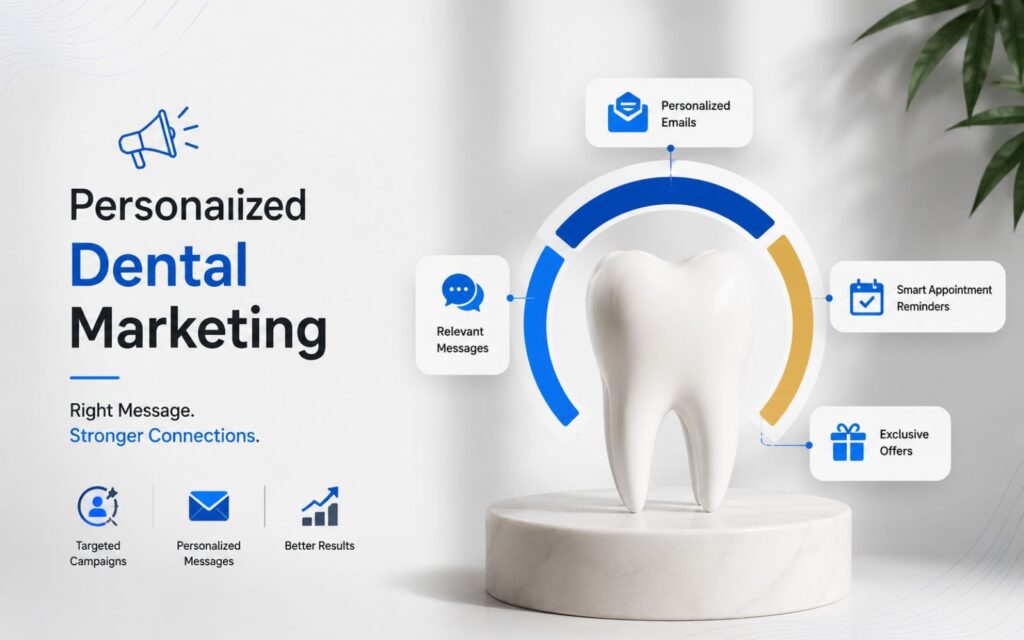
SEO Title: Personalizing Dental Care with Automated Notes: A Clinic Owner’s Guide to Systems-Driven Growth Meta Description: Discover how personalizing dental care with automated notes and intelligent CRM systems reduces front-desk burnout, eliminates missed-call leakage, and stabilizes clinic revenue.
Personalizing Dental Care with Automated Notes: Moving Beyond the Chair to Systemic Excellence
For the modern dental clinic owner, the primary challenge is rarely the quality of the clinical work. You have spent years refining your hand skills, understanding occlusion, and mastering the latest restorative techniques. However, many practitioners find that despite clinical excellence, the “business” of the clinic feels like a leaky bucket.
You see it in the frantic energy of the front desk during the 10:00 AM rush. You see it in the “no-show” gaps in the afternoon schedule that drain your overhead. Most importantly, you see it in the fading personal touch—the inability to remember the small details about a patient’s life that transform a one-time crown delivery into a lifelong referral source.
The solution isn’t working harder; it’s working with intelligence. Specifically, it involves personalizing dental care with automated notes and integrated systems that act as the “digital brain” of your practice.
What Intelligence Means in a Dental Clinic
In a clinical context, intelligence is diagnostic. In an operational context, intelligence is predictive and preservative.
An intelligent clinic is one where data doesn’t just sit in a Practice Management Software (PMS) like an archive; it moves. It informs the team of who hasn’t been seen in six months, who has an outstanding treatment plan for #14, and which patient prefers a morning appointment because they pick up their grandkids at 3:00 PM.
The Conflict of Manual Personalization
Most clinic owners try to achieve “personalization” through sheer cognitive load. They expect their office manager to remember every face and their hygienists to manually type out detailed social notes. This is a recipe for burnout. When the front desk is overwhelmed with insurance verification and ringing phones, the “personal touch” is the first thing to be sacrificed.
Human Intelligence vs. System Intelligence
To scale a practice without losing its soul, you must distinguish between two types of intelligence:
1. Human Intelligence
This is the irreplaceable value your team brings. It is the empathy a dental assistant shows a phobic patient. It is the nuanced explanation a dentist gives regarding a complex full-mouth reconstruction. Human intelligence should be reserved for high-value emotional and clinical interactions.
2. System Intelligence
This is the infrastructure that handles the repetitive, the mundane, and the easily forgotten. System intelligence handles:
- Sending a text when a call is missed.
- Prompting a patient to book their hygiene appointment 14 days before they are due.
- Categorizing leads from your website into “High Interest” or “General Inquiry.”
When you begin personalizing dental care with automated notes, you are essentially using system intelligence to “bridge the gap” between appointments, ensuring the patient feels known and valued even when they aren’t in the chair.
The Role of AI and Automation in Modern Dentistry
The transition from a “traditional” clinic to a “structured” clinic involves centralizing communication. Many clinics suffer from “platform fragmentation”—they use one tool for reminders, another for their website, and a paper notebook for follow-up calls.
This is where CRM (Customer Relationship Management) tools like GoHighLevel have become transformative for the dental industry. Instead of a passive database, these systems act as an active participant in the patient lifecycle.
Personalizing dental care with automated notes through these platforms allows for “conditional logic.” For example, if a patient cancels a high-value surgical appointment, the system doesn’t just mark it “canceled.” It can automatically trigger a personalized sequence:
- A task for the treatment coordinator to call within 2 hours.
- An automated, friendly text 24 hours later if no rebooking occurred.
- A note added to the patient’s digital file regarding their specific concerns.
By automating the “paperwork” of the relationship, your staff is freed up to actually talk to the people in front of them.
To understand how this fits your specific needs, you can check out a best dental CRM comparison guide to see how different platforms stack up
Strategic Implementation Note: Transitioning to an automated system is not about replacing your staff; it is about giving them the tools to perform at a higher level. When the “busy work” is handled by a CRM, your team can focus on case acceptance and patient experience.
Note: The link below is an affiliate link. I only recommend systems that align with structured clinic growth.
👉 [Start Building a Smarter Dental System](INSERT YOUR AFFILIATE LINK HERE)
Real Clinic Scenarios: Systems in Action
Let’s look at how personalizing dental care with automated notes and automation solves common revenue leaks.
Scenario A: The Missed Call Leakage
A prospective patient calls at 12:15 PM while the team is at lunch. In a traditional clinic, that caller leaves a voicemail (or hangs up) and calls the dentist down the street. The System Solution: The CRM detects the missed call and instantly sends a text: “Hi, this is [Clinic Name]! We’re helping another patient right now but want to make sure we take care of you. Are you looking to book an appointment or did you have a question?” The conversation starts immediately. The “automated note” records this interaction so the front desk can see the full context when they return.
Scenario B: The Post-Op Personal Touch
Following a difficult extraction, a patient receives a text at 6:00 PM asking how they are feeling, including a link to “Post-Op Care Instructions.” The System Solution: This isn’t a manual task for the doctor. It’s a triggered event based on the appointment type. It feels personal to the patient, but it required zero minutes of clinical time to execute.
Common Mistakes in Clinic Automation
While the benefits are clear, many clinic owners fail in the implementation phase.
- Over-Automation: If every single interaction is a bot, the patient feels like a number. Automation should facilitate a human connection, not replace it.
- Fragmented Data: Using a system that doesn’t talk to your lead generation sources. If your Facebook ads, website contact form, and “Missed Call Text Back” aren’t in one place, things fall through the cracks.
- Lack of Training: A system is only as good as the team’s ability to use it. You need a centralized “Command Center” that the office manager can check every morning.
Revenue Stabilization Without Burnout
The “Burnout Cycle” in dentistry usually looks like this:
- Marketing brings in a flood of new patients.
- The front desk is overwhelmed and stops following up on unscheduled treatment.
- No-shows increase because reminders weren’t personalized.
- Revenue dips.
- Owner works more hours to compensate.
By personalizing dental care with automated notes, you break this cycle. You create a “steady state” where the system handles the follow-up, ensuring the bucket stays full without requiring the owner to put in more “chair time.”
Efficiency Advice: Think of it this way—if your clinic loses even 5 missed calls per week, that’s silent revenue walking away. A structured automation system prevents that leakage while keeping your patient interactions feeling warm and professional.
👉 [Start Building a Smarter Dental System](INSERT YOUR AFFILIATE LINK HERE)
The Future of Structured Clinics
As we move further into the decade, the gap between “Digital Native” clinics and “Legacy” clinics will widen. Patients—especially Millennials and Gen Z—expect “Amazon-level” communication. They want to text for appointments, receive digital forms, and have their preferences remembered.
Implementing a system like GoHighLevel isn’t just about “marketing.” It is about clinical infrastructure. It is about ensuring that your hard work in the operatory isn’t undermined by a disorganized front office.
Implementation Logic
- Step 1: Audit your current “leaks” (Missed calls, unscheduled treatment).
- Step 2: Centralize your communication into one CRM.
- Step 3: Use automated notes to track patient sentiment and history.
- Step 4: Review the data monthly to see where patients are dropping off.
Conclusion: The Path to a Smarter Practice
Growth in dentistry is no longer just about who has the newest CBCT or the fastest mill. It is about who owns the most efficient patient relationship system.
By personalizing dental care with automated notes, you provide the high-touch experience patients crave while maintaining the high-efficiency operation your bottom line requires. You didn’t go to dental school to spend your life worrying about missed voicemails and empty chairs. It’s time to let system intelligence handle the logistics so you can focus on the dentistry.
Final Thought: Transitioning to an automated, structured clinic is the difference between owning a job and owning a business. Choose the path that leads to visibility, control, and sustainable growth.
👉 [Start Building a Smarter Dental System](INSERT YOUR AFFILIATE LINK HERE)
FAQs
1. Does personalizing dental care with automated notes feel “robotic” to patients?
Not if done correctly. The goal is to use automation to prompt human interaction or to handle administrative tasks (like “Where are you located?”) so that your team can spend more time on meaningful, personal conversations.
2. Can GoHighLevel replace my current Practice Management Software (PMS)?
No. Think of GoHighLevel as the “Growth and Communication Layer” that sits on top of your PMS (like Dentrix or EagleSoft). While your PMS handles clinical records and billing, the CRM handles the patient relationship, lead tracking, and marketing automation.
3. How much time does it take to set up these systems?
Initial setup usually takes a few weeks to map out your workflows. However, once the “logic” is built—such as an automated missed-call text back—it runs 24/7 without further input.
4. Will this help with my clinic’s no-show rate?
Significantly. Automated notes allow you to send multi-channel reminders (Email, SMS, and even Ringless Voicemail) and track which patients are “high-risk” for no-shows based on their previous behavior.
5. Is it difficult for a non-tech-savvy front desk team to learn?
Modern CRMs are designed with user-friendly dashboards. Most teams find it easier to use one centralized “inbox” for all texts, emails, and calls than to juggle multiple different platforms and paper lists.
6. What is “Missed Call Leakage” and how does automation stop it?
Missed Call Leakage is the revenue lost when a potential patient calls, gets no answer, and moves to the next listing on Google. Automation stops this by instantly engaging the caller via text the second the call is missed, capturing the lead before they move on.