
The dental industry is currently facing a paradox. While clinical technology has reached unprecedented heights—with 3D imaging, digital impressions, and laser dentistry—the “front of house” operations in many practices remain stuck in the early 2000s.Comprehensive guide on dental practice automation
Most clinic owners believe their primary growth bottleneck is a lack of new leads or a need for better clinical skills. However, as a strategist who has audited dozens of practices, the reality is often different. The bottleneck is operational leakage.
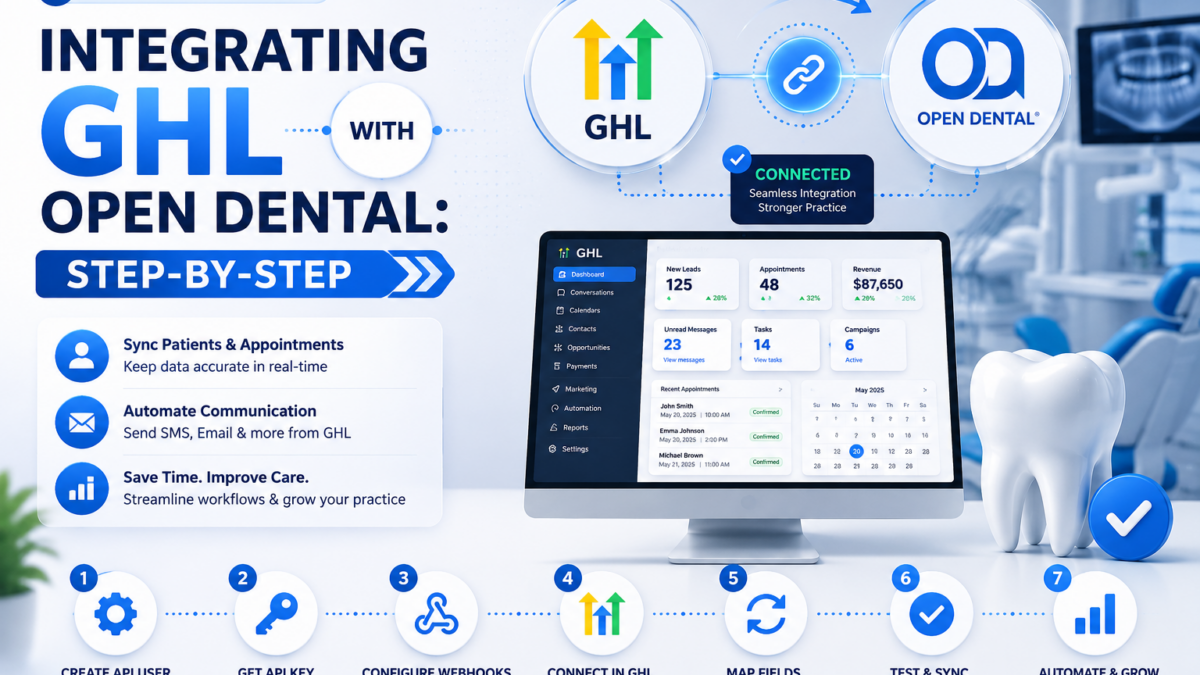
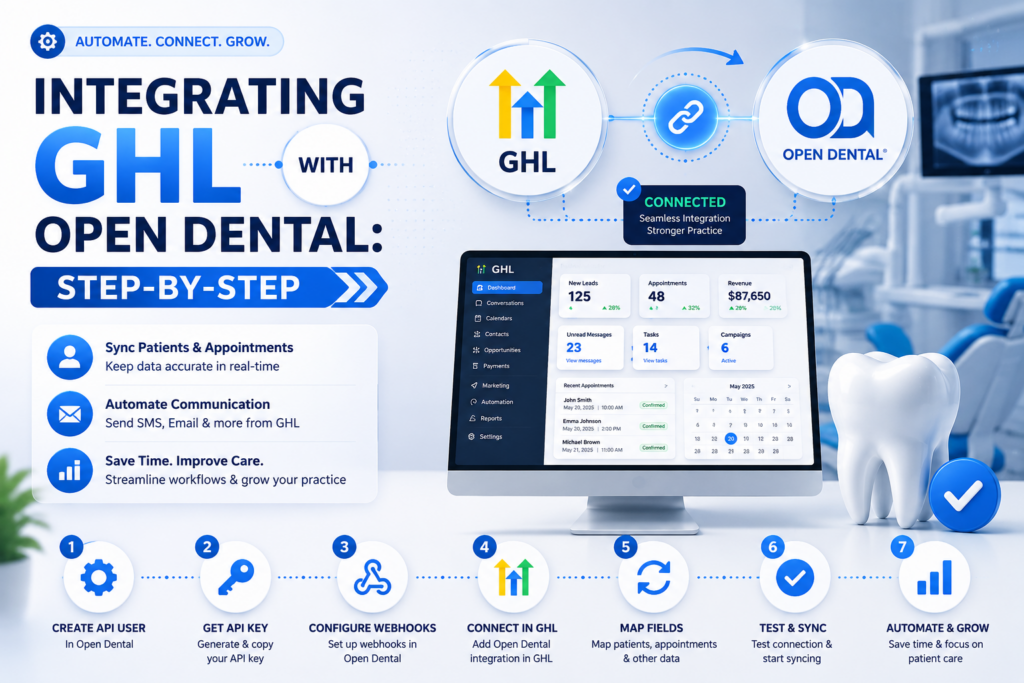
Revenue doesn’t just come from the chair; it is preserved or lost at the front desk. This is where the integration of GHL with Open Dental becomes a strategic necessity rather than a technical luxury. By marrying the robust clinical record-keeping of Open Dental with the sophisticated automation and communication layers of GoHighLevel (GHL), a clinic can transition from a reactive “chaos” model to a proactive “systematized” model.
What Intelligence Means in a Dental Clinic
In a high-performing practice, “intelligence” is not just about the IQ of the staff. It is about the ability of the clinic to respond to patient needs and internal data without manual intervention every single time.
There are two types of intelligence required for a sustainable practice:
- Human Intelligence: The empathy, clinical judgment, and chairside manner your team provides.
- System Intelligence: The digital infrastructure that ensures no patient falls through the cracks, no call goes unreturned, and no follow-up is forgotten.
When these two are out of balance—usually with too much reliance on human memory—you see high staff burnout and “leaky bucket” syndrome, where for every ten new leads, five are lost to poor follow-up.
The Human Intelligence Factor: Why Your Front Desk is Overloaded
Your front desk coordinator is likely the most overtasked person in the building. On any given Tuesday morning, they are balancing:
- Checking in arriving patients.
- Answering three ringing phone lines.
- Verifying insurance for the afternoon block.
- Attempting to call back missed leads from the weekend.
When a human is overloaded, they prioritize the person standing in front of them. This is correct for patient experience, but it means the “invisible” revenue—the person calling to book a $5,000 implant case who gets sent to voicemail—is often lost forever. Expecting a human to be 100% efficient at lead tracking and multi-channel follow-up is not a management strategy; it is a recipe for failure.
System Intelligence: The Role of GHL with Open Dental
This is where GHL with Open Dental enters the conversation. Open Dental is an exceptional tool for clinical charting, ledger management, and treatment planning. It is the “source of truth” for what happens in the op.
However, Open Dental was not built to be a modern marketing engine or a high-velocity communication CRM. By connecting it with GHL, you add a “nervous system” to your practice. GHL handles the “before” and “after” of the patient visit:
- The Before: Lead capture, instant SMS responses, and automated booking reminders.
- The After: Review requests, re-activation campaigns for unscheduled treatment, and long-term retention workflows.
AI & Automation: Moving Beyond Manual Reminders
Traditional dental marketing often stops at “getting the phone to ring.” But in a modern environment, the phone ringing is only half the battle. Automation allows you to handle the volume that humans cannot.
For example, when a patient finds your clinic via a Google search at 9:00 PM on a Sunday, they don’t want to leave a voicemail and wait until 10:00 AM Monday for a callback. An automated system can trigger an immediate SMS: “Hi, this is [Clinic Name]. We saw you reached out! Would you like to see our available openings for this week?”
This isn’t about replacing the human touch; it’s about providing an immediate response when your humans are at home sleeping. It bridges the gap between a lead’s interest and the clinic’s availability.
Strategic Insight: Implementation of automation is not a “set it and forget it” gimmick. It is the process of mapping your best staff member’s logic into a digital workflow that works 24/7.
Transitioning to a structured system means you no longer have to wonder if your team followed up on that high-value treatment plan. The system tracks it, logs it, and reminds the patient—and your team—precisely when necessary.
Note: The link below is an affiliate link. I only recommend systems that align with structured clinic growth.
Think of it this way—if your clinic loses even 5 missed calls per week, that’s silent revenue walking away. A structured automation system prevents that.
[Start Building a Smarter Dental System](INSERT YOUR AFFILIATE LINK HERE)
Real Clinic Scenarios: Bridging the Gap
To understand the power of GHL with Open Dental, let’s look at three common scenarios where clinics lose money and how a system-first approach fixes them.
Scenario 1: The “Silent” Missed Call
Find out how to achieve Seamless Integration for a Stronger Practice.
A prospective patient calls at 12:15 PM while the team is at lunch. The call goes to voicemail. The patient, needing an emergency crown, hangs up and calls the next clinic on Google.
- The Old Way: The front desk sees the missed call at 1:15 PM, calls back, and leaves a message. The patient has already booked elsewhere.
- The GHL Way: The moment the call is missed, GHL triggers a “Missed Call Text Back.” The patient receives an SMS: “Sorry we missed you! We’re on a quick break, but we’d love to help. What can we assist you with?” The patient replies, a conversation starts, and the lead is “warmed” until the staff returns.
Scenario 2: The Unscheduled Treatment Plan
A patient is diagnosed with $3,000 worth of periodontal work in Open Dental but leaves without booking because they need to “talk to their spouse.”
- The Old Way: The treatment plan sits in Open Dental. Hopefully, a staff member runs a “Treatment Plan Report” once a month and spends four hours making awkward cold calls.
- The GHL Way: The “GHL with Open Dental” integration identifies the unscheduled treatment. It adds the patient to a “Nurture Campaign” that sends educational content about the risks of untreated periodontal disease, followed by a gentle invitation to book.
Scenario 3: The No-Show Drain
No-shows are the single greatest killer of clinic profitability. A 15% no-show rate can be the difference between a thriving practice and one that is barely breaking even.
- The Old Way: One confirmation text 24 hours before.
- The GHL Way: A multi-touch “Indoctrination Sequence.”
- 7 days out: Preparation instructions.
- 3 days out: Confirmation request.
- 24 hours out: Parking instructions and a “We’re excited to see you” video.
- This builds a psychological commitment in the patient’s mind, drastically reducing the “forgetfulness” factor.
Common Mistakes When Implementing Systems
While the benefits of GHL with Open Dental are clear, many clinic owners stumble during implementation. Here are the pitfalls to avoid:
- Over-Automation: Sending too many messages can make your practice feel like a “dental factory.” The goal is to sound like a helpful neighbor, not a bot.
- Data Silos: Keeping GHL and Open Dental completely separate. Without some level of synchronization, you risk sending a “book your cleaning” text to someone who was just in the chair yesterday.
- Ignoring the “Human Bridge”: Automation gets the patient to the door; your team must still provide the excellence that keeps them there. Systems support people; they don’t replace them.
Implementing a CRM isn’t just about “sending texts.” It’s about having a dashboard that shows you exactly where your money is. When you can see that you have $50,000 in “pending leads” and $120,000 in “unscheduled treatment,” you stop guessing and start managing.
[Start Building a Smarter Dental System](INSERT YOUR AFFILIATE LINK HERE)
The Future of Structured Clinics
The dental landscape is shifting. Corporate dentistry (DSOs) is growing because they excel at systems. To compete, private and mid-sized clinics must adopt the same level of operational discipline.
Using GHL with Open Dental allows a private practitioner to have “big-box” efficiency while maintaining a “boutique” feel. The future belongs to the “Intelligent Clinic”—one that uses data to predict patient behavior and automation to handle the mundane, leaving the doctors and hygienists free to focus on what they do best: dentistry.
Revenue stabilization comes when your “New Patient” flow isn’t a roller coaster. By automating the follow-up process, you create a steady stream of appointments that don’t depend on whether your receptionist had a “busy day” or not.
Conclusion: Systems Over Sweat
Growth does not come from working more hours; it comes from making your hours more valuable. If your front desk is spent chasing missed calls and confirmation texts, they aren’t spent building relationships or presenting high-value cases.
Integrating GHL with Open Dental is the foundational step toward professional freedom. It moves the “brain” of the business out of your staff’s overwhelmed heads and into a secure, scalable system. This is how you build a practice that serves you, rather than one that you serve.
Before you invest in more Facebook ads or a new piece of clinical equipment, look at your infrastructure. Fix the leaks. Build the system. The growth will follow naturally.
The transition from a manual clinic to an automated one doesn’t happen overnight, but it does start with a single decision. Choosing to implement a centralized platform for your patient lifecycle is the most significant “non-clinical” move you can make for your practice’s health.
[Start Building a Smarter Dental System](INSERT YOUR AFFILIATE LINK HERE)
FAQs
1. Does GHL replace Open Dental?
No. Open Dental remains your clinical record (PMS). GHL acts as your marketing, communication, and automation layer. They work together to handle different stages of the patient journey.
2. Is this difficult for my staff to learn?
There is a learning curve, as with any new tool. However, once the workflows for GHL with Open Dental are set up, it actually reduces the daily workload for your front desk by automating repetitive tasks like missed call callbacks and review requests.
3. How does this help with Google Reviews?
GHL can be set to trigger a review request via SMS the moment a patient is marked as “checked out” or “completed” in your workflow. Because it happens while the patient is still in the parking lot, the conversion rate for reviews is significantly higher.
4. Is the communication HIPAA compliant?
When using GHL for healthcare, you must ensure you have the “Healthcare Component” enabled and a BAA (Business Associate Agreement) in place. This allows for secure, compliant communication with your patients.
5. Can I track exactly where my new patients are coming from?
Yes. One of the biggest advantages of using a CRM like GHL is “Attribution.” You can see exactly which patients came from Google, which came from Facebook, and which came from your website, allowing you to spend your marketing budget more wisely.
6. Will my patients think the automation is “cold” or “robotic”?
Not if you write the messages correctly. The key is to use a conversational tone. Patients today actually prefer the convenience of SMS for scheduling and reminders over receiving a phone call while they are at work.