
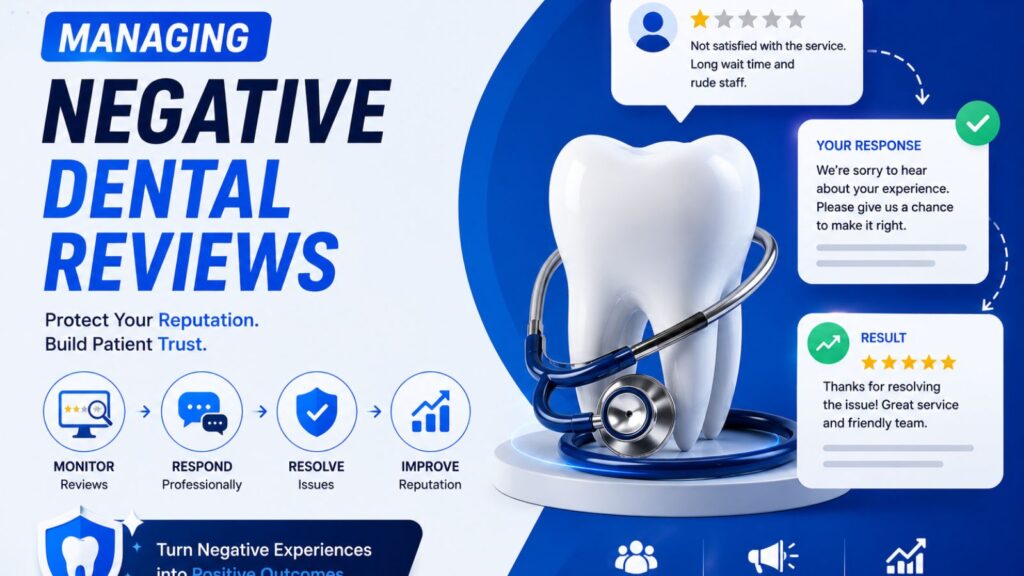
In the modern dental economy, a clinical degree is no longer a shield against operational stagnation. You can perform the most flawless $30,000 full-mouth reconstruction, but if a disgruntled patient leaves a 1-star review because of a billing dispute or a 15-minute wait time, your Customer Acquisition Cost (CAC) will inevitably spike.
For the high-growth clinic owner, a negative review is not a personal insult; it is a data point indicating a system failure. Most practitioners handle these failures with manual, emotional, and inconsistent responses. This approach is unscalable and contributes to the #1 silent killer of dental clinics: Staff Burnout.
The solution isn’t “trying harder.” It is shifting from manual management to Intelligent Systems. This guide explores how to leverage AI and infrastructure like GoHighLevel to turn reputation management into a revenue-generating asset.
The Operational Pain: Solving Negative Dental Reviews via AI to Fix “Leaky Buckets”
Most dental owners view reviews through the lens of ego. From an operational standpoint, however, a negative review is a Financial Leak.
The No-Show Economics of a Bad Reputation
When a prospective patient sees a recent, unaddressed negative review, the psychological “trust threshold” isn’t met. This leads to:
- Increased Ghosting: Patients book via your website but never show up because they did “deeper research” post-booking.
- The “Price-Shopper” Trap: When your reputation is average, you lose the ability to charge premium fees. You are forced to compete on price because you lack the “Social Proof Premium.”
The “Missed-Call Leakage” Connection
There is a direct correlation between negative reviews and front-desk inefficiency. 70% of negative dental reviews are not about clinical outcomes; they are about communication. “No one answered the phone,” “They didn’t call me back about my insurance,” or “I waited 20 minutes.”
If your staff is bogged down manually typing out defensive responses to Google reviews, they aren’t answering the phones. You are paying a high-level administrator to do a low-level task, while high-value new patient calls go to voicemail.
2. What “Intelligence” Means in Modern Dentistry
In a clinical setting, intelligence is diagnostic. In a business setting, Intelligence is the ability of a system to operate without the owner’s constant input.
Responding to negative reviews via AI is not about “faking” empathy; it’s about Standard Operating Procedure (SOP) Automation. An intelligent system:
- Monitors: Scans Google Business Profile (GBP) 24/7.
- Categorizes: Identifies if the complaint is Clinical, Administrative, or Financial.
- Drafts: Generates a HIPAA-compliant, de-escalating response based on your clinic’s specific “Voice.”
- Notifies: Alerts the Office Manager to call the patient before the response is published.
3. Human vs. System Intelligence: The Performance Gap
| Feature | Manual Front Desk Response | AI-Driven System (GoHighLevel) |
|---|---|---|
| Response Time | 2-5 Days (Average) | < 15 Minutes |
| Emotional Bias | High (Defensive/Angry) | Zero (Neutral & Professional) |
| HIPAA Compliance | Variable (Risk of naming procedures) | Strict (Hard-coded safeguards) |
| SEO Impact | Low (Random keywords) | High (Optimized for “Dental Care”) |
| Staff Labor | 20-30 Mins per review | 0-2 Mins (Review & Approve) |
Export to Sheets
4. AI & Automation: Implementing the Infrastructure
To transition from a “busy clinic” to a “structured clinic,” you need a central nervous system. GoHighLevel (GHL) has emerged as the gold standard for healthcare operations because it bridges the gap between a CRM and a Reputation Management engine.
The AI Workflow for Negative Reviews
When a negative review hits, the system should trigger a multi-step workflow:
- Sentiment Analysis: The AI reads the review. If the sentiment is below a 3-star threshold, it halts the “Auto-Post” and moves to “Human-in-the-loop” mode.
- Contextual Drafting: Instead of “We’re sorry,” the AI suggests: “We strive for punctuality and regret that your wait time exceeded our standards. Our Practice Manager would like to resolve this directly…”
- Internal Escalation: An automated SMS is sent to the owner: “Urgent: 1-star review received from John Doe. AI draft ready for approval.”
Pro-Tip: The “Golden Window” for responding to a negative review is 2 hours. Research shows that if a patient receives a professional response and a phone call within 120 minutes, they are 65% more likely to delete or upgrade the review to 4 stars.
Systemizing your patient intake and reputation management isn’t an expense; it’s a leak-plugging strategy that protects your lifetime patient value.
👉 Start Building a Smarter Dental System
(Note: The link above is an affiliate link. I only recommend systems that align with structured clinic growth.)
5. Real-World Clinic Scenarios: Before vs. After
Scenario A: The “Emotional Defense” (Before)
A patient leaves a review complaining about a “hidden fee.” The Office Manager, feeling personally attacked, waits three days, then responds: “Actually, we told you about the deductible upfront. You signed the paperwork.”
- Result: The patient doubles down. Prospective patients see a “combative” clinic. Google’s algorithm marks the interaction as low-quality.
Scenario B: The “Systematized Recovery” (After)
The same review is posted. GoHighLevel’s AI detects the “Billing” keyword. Within 10 minutes, a neutral response is drafted: “Transparency in treatment costs is our priority. We would like to review your ledger with you to clear up any confusion.” Simultaneously, a task is created in the CRM for the Billing Lead to call the patient.
- Result: The patient feels heard. The dispute is settled privately via phone. The public-facing response shows a professional, organized business.
6. Common Implementation Mistakes
- Full Autopilot (The HIPAA Risk): Never let AI post responses to clinical complaints without a human “click to approve.” AI might accidentally confirm a patient was seen for “root canal pain,” which can be interpreted as a HIPAA violation.
- Ignoring the “Positive” Reviews: AI should also be used to amplify 5-star reviews. Use AI to vary the responses so Google doesn’t flag them as “spammy” or repetitive.
- Disconnected Systems: If your review software doesn’t “talk” to your patient database, you’re flying blind. Integrated systems allow you to see the value of the patient who is complaining.
High-level dental operations require a shift from reactive firefighting to proactive system architecture. Control your reputation, or your reputation will control your growth.
👉 Start Building a Smarter Dental System
7. The Future of Structured Clinics: A Macro-Perspective
Globally, the dental market is shifting toward Consolidation (DSOs). In the US, UK, and UAE, independent clinics are being bought out by groups that use “Tech Stacks” to outperform local competitors.
To remain competitive as a private practitioner, you must adopt “Corporate-Level Infrastructure” on an “Independent Budget.” Using AI for reputation management is the first step in building a clinic that can eventually be sold for a premium—because it is a system that works without you.
Smart Localization: Texas & Beyond
In states like Texas, where the dental market is highly saturated in metros like Dallas and Austin, SEO is a “Zero-Sum Game.” Google’s “Map Pack” (the top 3 local results) is heavily influenced by Review Velocity (how fast you get reviews) and Review Sentiment. If your AI system can maintain a 4.8-star average while your competitor sits at 4.2, you will capture 70% of the local search traffic without spending an extra dollar on Google Ads.
8. Conclusion: From Clinical Skill to Intelligent Growth
Clinical excellence gets patients in the door once. Systems keep them coming back. By utilizing AI to manage negative sentiment, you aren’t just “managing reviews”—you are protecting your brand equity and freeing your staff to focus on high-value patient care.
Infrastructure creates freedom. Automation creates scale.
Before you spend another dollar on external marketing, ensure your “Reputation Engine” is automated and leak-proof.
👉 Start Building a Smarter Dental System
FAQs: Mastering Dental AI Operations
1. Is using AI to respond to reviews a HIPAA violation?
Not if done correctly. AI should never mention specific treatments, diagnoses, or personal health information (PHI). The best practice is to use AI to generate a professional, generic invitation to take the conversation “offline,” which is the gold standard for HIPAA-compliant public responses.
2. Can Google penalize me for using AI responses?
Google penalizes “spammy” or identical automated responses. Modern AI (like that integrated with GoHighLevel) generates unique, context-aware responses for every review. This actually improves SEO because it signals to Google that the business is active and responsive.
3. How does this reduce staff burnout?
The “Review Dread” is real. Front desk staff hate dealing with angry patients. By providing them with an AI-generated draft, you remove the “blank page syndrome” and the emotional labor of dealing with negativity. They shift from “Conflict Managers” to “System Administrators.”
4. What is “Review Velocity,” and why does AI help?
Review Velocity is the speed at which you gain new reviews. AI systems can automate the request process via SMS/Email immediately after an appointment. When you have a high volume of positive reviews coming in daily, a single negative review has a negligible impact on your overall rating.
5. Why GoHighLevel instead of standard review software?
Most review software (like Birdeye or Podium) are “point solutions”—they only do one thing. GoHighLevel is an All-in-One Infrastructure. It handles your reviews, your CRM, your missed-call text-back, and your appointment reminders. It eliminates “Software Fatigue” and reduces your monthly overhead.
6. What should I do if a review is fake?
AI can help identify patterns in fake reviews (e.g., lack of specific detail, accounts with 1 review). While you cannot “delete” them easily, an AI-optimized response that professionally states, “We have no record of a patient by this name in our system, but we take all feedback seriously,” alerts prospective patients and Google that the review may be fraudulent.