
For the modern dental clinic owner, the primary challenge is rarely the quality of the clinical work. You have the degrees, the specialized training, and a commitment to patient outcomes. Yet, many high-quality practices find themselves plateauing. The bottleneck isn’t the operatory; it’s the front desk.
Operational “leakage”—missed calls, unconfirmed appointments, and forgotten follow-ups—is the silent killer of dental ROI. To scale without burnout, a shift in perspective is required: Dental growth does not come from better dentistry alone—it comes from intelligent systems.
In this guide, we will analyze the infrastructure necessary to stabilize revenue, specifically comparing two major players in the space: . We will explore how these platforms handle the patient lifecycle and which one fits the strategic needs of your specific practice.
1. What “Intelligence” Means in a Dental Clinic
In a clinical setting, intelligence is often equated with diagnostic accuracy. In a business setting, intelligence is the ability of your systems to capture, process, and retain a patient without manual intervention from an already-overloaded front desk staff.
An intelligent system addresses three core phases:
- The Acquisition Phase: Capturing the lead (the missed call or the website inquiry).
- The Operational Phase: Managing the appointment (reminders and no-show recovery).
- The Retention Phase: Maintaining the relationship (re-care cycles and reviews).
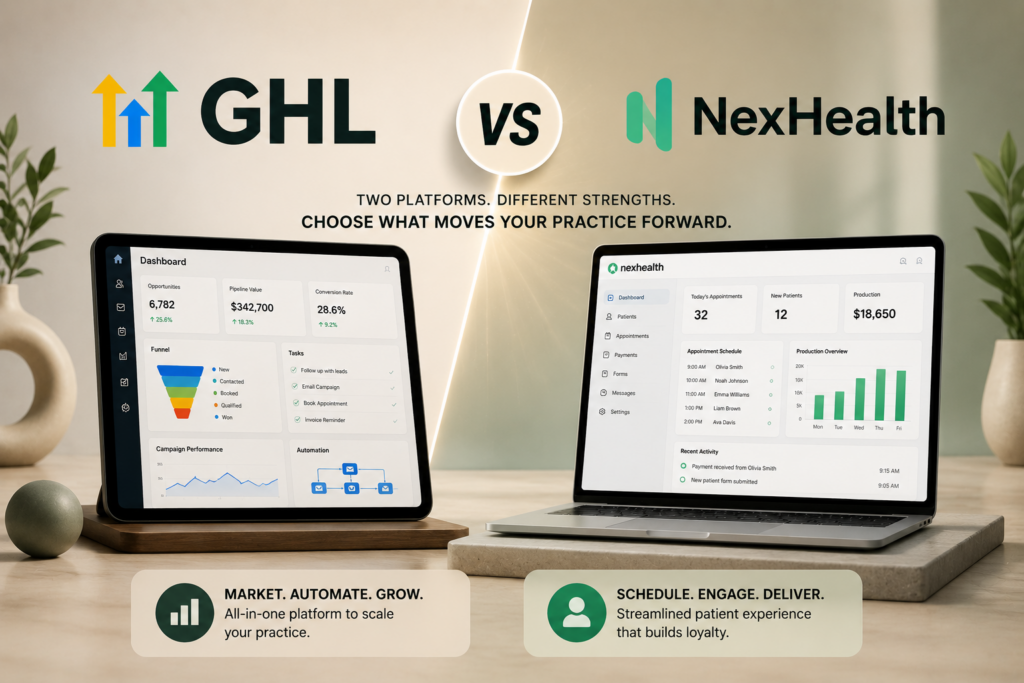
When we look at GHL vs NexHealth, we are looking at two different philosophies of intelligence. NexHealth is a “point solution” designed to sit on top of your Practice Management Software (PMS) to streamline the patient experience. GoHighLevel (GHL) is a “platform solution” designed to build custom, end-to-end automation engines that manage the entire business logic of the clinic.
2. Human Intelligence vs. System Intelligence
Your front desk team is composed of capable humans, but humans have “bandwidth limits.”
- Human Intelligence is best used for empathy, complex treatment planning, and handling nervous patients in the chair.
- System Intelligence is best used for the “grunt work”: sending a text at 8:00 PM to a patient who didn’t show up, or instantly replying to a missed call at 2:00 AM.
The “GHL vs NexHealth” debate often centers on how much of that human workload you want to offload. NexHealth excels at the synchronization of appointments with your calendar (Open Dental, Eaglesoft, etc.). GHL excels at the conversational and marketing logic—ensuring that if a patient cancels, they are nurtured back into the schedule through a series of automated, multi-channel touchpoints.
3. AI & Automation: The Core of Modern Operations
Automation is no longer a luxury; it is the “digital floor” of a profitable clinic. Without it, you are paying your staff $25–$40 an hour to perform tasks that a software script can do for pennies.
The Power of the “Missed Call Text Back”
One of the most significant revenue leaks in dentistry is the missed call. If a prospective patient calls your office while the receptionist is on the other line and they get a voicemail, they will likely call the next clinic on Google.
GHL allows for an immediate, automated SMS response: “Hi, this is [Clinic Name]. Sorry we missed your call! How can we help you today?” This simple automation captures the lead before they move on. While NexHealth offers robust two-way texting, GHL’s ability to build complex “if/then” workflows around these interactions gives the owner more control over the patient journey.
Centralizing Communication
Both platforms aim to reduce “tab fatigue.” Instead of checking a separate portal for reviews, another for SMS, and another for lead forms, these systems centralize the data. However, GHL functions more as a CRM (Customer Relationship Management) tool, allowing you to track the exact “value” of every lead in your pipeline.
Managing a clinic today requires more than just a calendar; it requires a command center that works even when your lights are off. By implementing a structured automation platform, you reclaim your time and protect your overhead.
Note: The link below is an affiliate link. I only recommend systems that align with structured clinic growth.
Transitioning from manual chaos to automated precision is the single most important step in scaling your practice. A structured system ensures no patient falls through the cracks.
👉 [Start Building a Smarter Dental System](INSERT YOUR AFFILIATE LINK HERE)
4. Real Clinic Scenarios: GHL vs NexHealth in Action
To understand which system fits your clinic, let’s look at two common operational hurdles.
Scenario A: The Chronic No-Show
A patient, “John,” misses his 2:00 PM hygiene appointment.
- NexHealth Approach: NexHealth identifies the gap in the PMS and can help fill that slot by blasting out “appointment available” texts to other patients. It is highly efficient for filling holes in a busy schedule.
- GHL Approach: GHL triggers a “No-Show Recovery Sequence.” John receives a text 15 minutes after his missed start time, followed by an email later that evening with a link to reschedule. If he doesn’t reschedule within 24 hours, a task is created for the front desk to call him. GHL tracks the behavior of the lead.
Scenario B: High-Value Lead Tracking
You spend $3,000/month on Google Ads for dental implants.
- NexHealth: NexHealth provides the booking link, but it doesn’t necessarily tell you which ad campaign the patient came from or where they are in the “buying” process.
- GHL: GHL acts as a full-funnel tracker. You can see that “Sarah” clicked an implant ad, downloaded a “Cost of Implants” guide, and has been nurtured with educational emails for three weeks before she finally booked.
5. Common Mistakes in Clinic Automation
When choosing between GHL vs NexHealth, clinic owners often fall into these traps:
- Over-complicating the Workflow: Automation should simplify, not add layers of confusion. If your staff doesn’t understand the system, they will bypass it.
- Choosing “Flashy” over “Functional”: NexHealth’s “1-click booking” is world-class for patient experience. GHL’s customization is world-class for business owners who want to control their brand and marketing. Don’t choose a tool based on a demo; choose it based on your biggest bottleneck.
- Neglecting the Human Element: Automation is the skeleton; your staff is the heart. Use the time saved by these systems to allow your staff to provide better in-person care.
6. System Intelligence: The Architecture of Scale
GHL (GoHighLevel) is often misunderstood as just a “marketing tool.” In reality, for a dental clinic, it is an Operating System. It allows you to build a custom “Patient Lifecycle Management” engine.
While NexHealth is a “set it and forget it” tool for many, GHL is for the owner who wants to own their data. With GHL, you can build:
- Custom landing pages for specific procedures (Invisalign, Implants).
- Automatic review requests triggered by “Status” changes.
- Re-activation campaigns for patients who haven’t been seen in 12+ months.
In the GHL vs NexHealth comparison, NexHealth is the specialized tool, while GHL is the entire workshop.
7. The Future of Structured Clinics
The dental industry is moving toward “Consolidation Performance.” Whether you are a solo practitioner or looking to build a DSO (Dental Support Organization), your value is tied to your systems. A clinic that relies on a “rockstar receptionist” is a risky asset. A clinic that relies on a “proven automation stack” is a scalable business.
As we move into 2026 and beyond, AI-driven voice assistants and automated scheduling will become the standard. Starting with a platform like GoHighLevel today gives you the “data rails” needed to integrate future technologies.
Think of it this way—if your clinic loses even 5 missed calls per week, that’s silent revenue walking away. A structured automation system prevents that leak and stabilizes your monthly recurring revenue.
👉 [Start Building a Smarter Dental System](INSERT YOUR AFFILIATE LINK HERE)
8. Conclusion: Choosing Your Path
In the battle of GHL vs NexHealth, there is no objective “winner”—only the right fit for your goals.
- Choose NexHealth if you want a seamless, plug-and-play integration specifically for your PMS that focuses heavily on the patient booking experience and filling the immediate schedule.
- Choose GoHighLevel (GHL) if you want a comprehensive business command center. If you want to track every dollar of ad spend, automate complex follow-up sequences, and build a “moat” around your patient database, GHL offers the flexibility and power that point-solutions cannot match.
Systematizing your practice is the only way to achieve “Revenue Stabilization without Burnout.” It’s time to stop working in the business and start building the machine that runs it.
9. Frequently Asked Questions (FAQs)
Q1: Does GHL replace my Practice Management Software (like Dentrix or Open Dental)? No. GHL is a CRM and automation layer that sits alongside your PMS. It handles the “front-end” (marketing, leads, communication) while your PMS handles the “back-end” (clinical notes, billing, charting).
Q2: Is GHL difficult to set up compared to NexHealth? NexHealth is generally faster to “plug in.” GHL requires more initial configuration because it is a “blank canvas” you can customize to your specific clinic’s needs. However, the long-term control GHL provides is significantly higher.
Q3: How does GHL handle HIPAA compliance? GHL offers a HIPAA-compliant package that includes signed BAAs (Business Associate Agreements), encrypted communication, and audit logs, making it safe for dental patient data.
Q4: Can I use GHL for missed call recovery? Yes. This is one of GHL’s strongest features. You can set up an “Auto-Missed-Call-Text-Back” so that any time a call goes unanswered, the caller receives an immediate SMS to start a conversation.
Q5: Which is better for multi-location dental practices? GHL is highly regarded for multi-location practices because of its “Snapshot” feature, which allows you to build an automation system once and deploy it across 5, 10, or 50 locations instantly.
Q6: What is the main cost difference between GHL vs NexHealth? NexHealth typically charges per location and can be more expensive on a monthly basis. GHL offers a flat-fee “Pro” plan that allows for unlimited sub-accounts (locations), often making it more cost-effective for growing practices.