
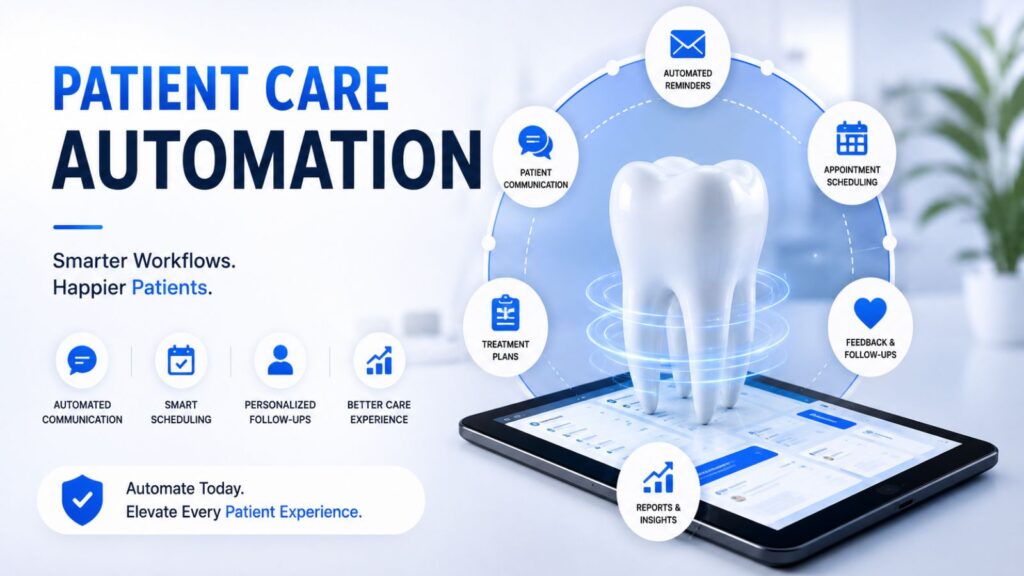
The High-Margin Clinic: Why Automating Post Treatment Care is the Ultimate Growth Lever
In the high-stakes world of clinical dentistry, we are trained to obsess over margins—specifically, the margins of a crown or the depth of a periodontal pocket. However, as a Senior Healthcare Operations Strategist, I’ve observed that the most dangerous margins in a dental practice aren’t clinical; they are operational.
The period immediately following a procedure is the most vulnerable stage of the patient lifecycle. It is where “clinical excellence” meets “operational chaos.” If your post-treatment care relies on a distracted front-desk staff member handing over a crumpled piece of paper, you aren’t just risking a patient’s healing process—you are leaking revenue, inviting litigation, and capping your clinic’s ability to scale.
The Operational Pain: Why Manual Follow-Ups are Killing Your ROI
Most dental clinic owners view post-treatment care as a courtesy. This is a fundamental strategic error. In reality, post-treatment care is Phase 1 of the next sale.
When a patient leaves your chair, they are in a state of “High Intent/High Vulnerability.” If they experience unexpected pain or confusion at 8:00 PM and cannot reach you, the relationship frays.
The Cost of “Manual” Chaos:
- The “Missed-Call Leakage”: Patients calling with post-op concerns clog phone lines, preventing new high-value leads from getting through.
- Staff Burnout: Your high-value office manager spends three hours a day playing phone tag for “wellness checks” instead of closing $10k treatment plans.
- The Review Gap: Patients who feel forgotten don’t leave 5-star reviews. They leave quietly, or worse, they leave a 1-star review when a minor, treatable complication occurs.
What “Intelligence” Means in Modern Dentistry
“Intelligence” in a dental setting is often misconstrued as simply having the latest 3D scanner. True System Intelligence is the ability of your practice to provide a “concierge experience” without human intervention.
Sustainable growth comes from shifting the burden of care from Human Capital (expensive, prone to error, limited hours) to System Infrastructure (scalable, precise, 24/7).
Human vs. System Intelligence: A Comparison
| Feature | Manual Front Desk Approach | Automated System Intelligence (GoHighLevel) |
| Delivery Speed | Depends on staff workload (Often delayed). | Instantaneous (Triggered by checkout). |
| Consistency | Varies by staff mood/memory. | 100% Uniformity. |
| Data Capture | Rarely logged in a searchable way. | Full audit trail of patient engagement. |
| Scalability | Requires hiring more staff to grow. | Handles 10 or 1,000 patients with zero extra cost. |
| Revenue Link | Disconnected from re-booking. | Automatically prompts next-phase scheduling. |
AI & Automation: Implementing the Infrastructure
To automate post-treatment care effectively, you need more than an email tool; you need Infrastructure. This is where GoHighLevel (GHL) becomes the “operating system” for your clinic.
By integrating GHL with your Practice Management Software (PMS), you can trigger “Smart Sequences” based on the ADA procedure codes entered at checkout.
The “Pro-Tip” Logic: The 3-6-24 Rule
Our data shows that patient satisfaction scores and re-booking rates spike when you follow the 3-6-24 Rule:
- 3 Minutes Post-Op: SMS arrives with a video link of the doctor explaining what to expect in the next 4 hours.
- 6 Hours Post-Op: A check-in text asking for a pain-level rating (1–10). If the score is >7, an internal alert is sent to the clinical lead immediately.
- 24 Hours Post-Op: A “How are you feeling?” message with a direct link to book their follow-up or next hygiene appointment.
Industry Secret: Clinics using automated video follow-ups see a 40% reduction in post-op emergency phone calls. Seeing the doctor’s face (even on a pre-recorded video) builds immediate psychological trust and lowers patient anxiety.
Advisory Framing:
Systemizing your patient intake and follow-up isn’t just an expense; it’s a leak-plugging strategy designed to recover lost chair time.
Building a resilient practice requires moving away from manual “to-do” lists and toward autonomous workflows.
👉 Start Building a Smarter Dental System
Note: The link above is an affiliate link. I only recommend systems that align with structured clinic growth.
Real-World Clinic Scenarios: Before vs. After
Scenario: The $5,000 Dental Implant
Before Automation:
The patient leaves with a gauze pack and a printed sheet. They lose the sheet. At 9:00 PM, they worry the bleeding is excessive. They call the emergency line (waking the doctor) or, worse, they wait until morning, frustrated, and cancel their second-stage appointment because “it was too much hassle.”
After Automation (The GHL Framework):
- Trigger: Procedure code “D6010” is marked complete.
- Action: GHL sends a specific “Implant Recovery” sequence.
- Education: The patient receives a link to a “Soft Foods” digital cookbook and a video on how to change gauze.
- Monitoring: An automated SMS asks: “Is your swelling localized? Reply YES or NO.”
- Result: The patient feels “digitally hugged.” The doctor sleeps. The second-stage conversion rate stays at 98%.
Macro-Perspective: Global Trends in Dental Automation
Whether you are operating in Texas, the UK, or the UAE, the trend is identical: Consumerization of Healthcare.
- In the US: HIPAA compliance is the ceiling. Automating via GHL requires ensuring all SMS and Email communication avoids “PHI” (Protected Health Information) while still being personal.
- In the UK (NHS/Private Mix): Efficiency is the only way to survive shrinking margins. Automation allows private clinics to justify higher fees through superior “Patient Experience” (UX).
- In the UAE: The market is driven by luxury and speed. Patients expect “instant” communication. If you don’t automate, you are perceived as “old fashioned.”
Advisory Framing:
High-growth clinics treat their operational stack with the same rigor as their clinical equipment.
True freedom for a clinic owner comes from knowing the system works even when they aren’t in the building.
👉 Start Building a Smarter Dental System
Common Implementation Mistakes
Even the best tools fail if the strategy is flawed. Avoid these “Growth Killers”:
- Over-Automation: Don’t send 15 emails. Two well-timed SMS messages are worth 100 ignored emails.
- Generic Content: If a patient had a cleaning, don’t send them wisdom tooth recovery instructions. Use Tagging in GoHighLevel to segment your care instructions.
- Ignoring the “Negative Feedback Loop”: If a patient replies to an automated text saying “I’m in a lot of pain,” and no one calls them back because the staff thinks “the system has it,” you have a major liability. Automation should alert humans, not replace them in emergencies.
The Future of Structured Clinics: Predictive Care
We are moving toward a world where AI doesn’t just send instructions; it predicts complications. By analyzing the sentiment of a patient’s reply to a post-op text, GoHighLevel’s AI can categorize responses into “Green” (All good), “Yellow” (Monitor), and “Red” (Immediate Action Required).
This isn’t “futuristic.” This is how $10M+ DSO-level clinics are currently operating. They don’t hire more people; they build better bots.
Advisory Framing:
Scaling your practice without automation is simply scaling your stress.
Investment in infrastructure is the only way to decouple your income from your time spent at the chair.
👉 Start Building a Smarter Dental System
Conclusion
Automating post-treatment care instructions is the “low-hanging fruit” of dental operations. It reduces staff friction, eliminates “No-show economics” by keeping patients engaged, and ensures that your clinical skill is supported by a world-class patient experience.
If you are still relying on human memory to care for your patients after they leave the office, you aren’t running a modern clinic; you’re running a high-stress hobby. It’s time to install the infrastructure that your clinical expertise deserves.
Frequently Asked Questions (FAQs)
1. Is automating patient communication HIPAA compliant?
Yes, provided you use a platform like GoHighLevel with a signed Business Associate Agreement (BAA) and configure it correctly. Avoid putting specific diagnoses or sensitive PHI in the body of an SMS. Use secure links for detailed medical instructions.
2. Will my older patients struggle with digital instructions?
Actually, the “Silver Tsunami” (aging Boomers) is more tech-savvy than ever. However, the system should be “omni-channel.” If a patient doesn’t open the SMS within 2 hours, the system can trigger a different task for a staff member to give them a quick call.
3. How long does it take to set up these automations?
With a structured template, a “Post-Op Sequence” for the top 5 dental procedures can be built and tested in under 4 hours. Once it’s done, it works forever.
4. Does this replace the need for a follow-up call?
For major surgeries (implants, full-mouth reconstructions), a human touch is still valuable. However, automation handles the “low-level” routine check-ins, allowing your staff to focus their energy on the patients who actually need a voice on the phone.
5. Can I automate re-booking through these instructions?
Absolutely. This is the “secret sauce.” At the end of a recovery sequence, include a direct link to your booking calendar. We’ve seen clinics increase hygiene re-appointment rates by 22% simply by asking at the right time during the recovery phase.
6. What if a patient replies to an automated text with an emergency?
The system should be configured with “Keyword Triggers.” If a patient texts “Pain,” “Bleeding,” or “Emergency,” GoHighLevel can instantly trigger a “High Priority” notification to the doctor’s mobile phone and the front desk dashboard.