
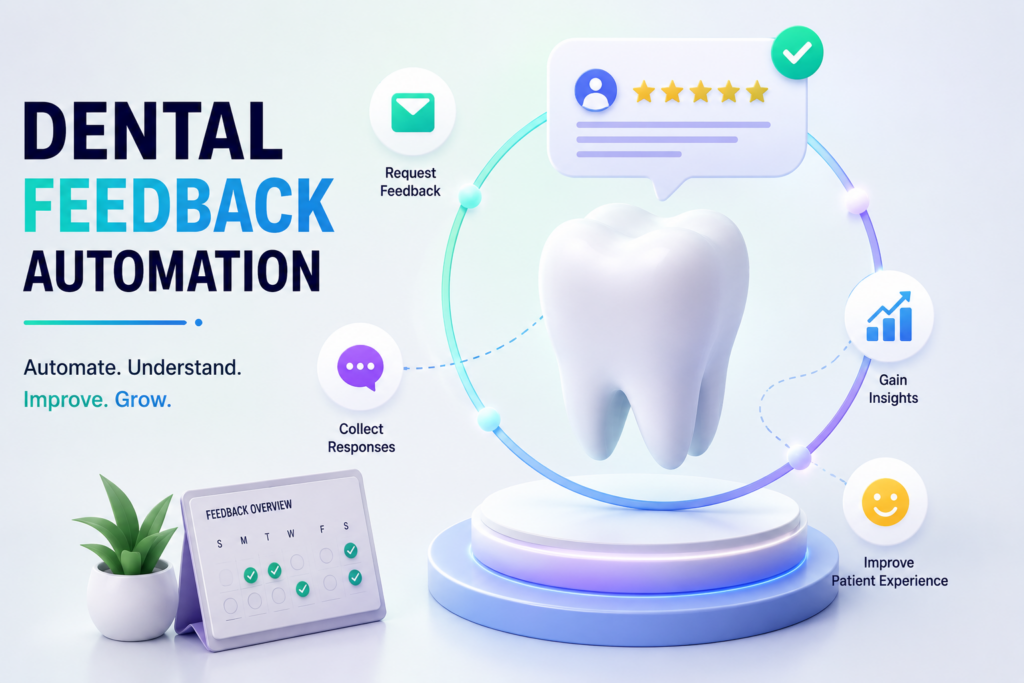
Automating Dental Patient Surveys for Feedback: The ROI Blueprint for Scaling Systems
In the modern dental landscape, the most dangerous leak in your practice isn’t a clinical error; it’s the silent churn of a dissatisfied patient who never voices their concern to you, but tells their entire digital circle. Most practice owners treat patient feedback as a “nice-to-have” manual task delegated to an overworked front desk. However, Automating Dental Patient Surveys for Feedback is the only way to capture the true sentiment of your patient base while simultaneously boosting your Google ranking and Patient Lifetime Value (LTV). Ignoring this automation is costing the average solo practitioner upwards of $50,000 annually in lost referrals and preventable churn.
The Intelligence Concept: Why “Smart Clinics” Out-Earn “Famous Doctors”
For decades, the “Famous Doctor” model relied on individual charisma and word-of-mouth. But charisma doesn’t scale. A “Smart Clinic” operates on systems where human error is removed from the equation. The difference lies in the Central Nervous System of the practice. By Automating Dental Patient Surveys for Feedback, a clinic transforms from a reactive environment into a proactive data-driven enterprise.
When you systemize feedback, you aren’t just asking “how did we do?” You are calculating your Net Promoter Score (NPS), identifying friction points in your clinical workflow, and creating a moat around your reputation. In the dental industry, your Cost Per Acquisition (CPA) is rising. If you aren’t protecting that investment with automated feedback loops, you are effectively pouring water into a leaky bucket.
The Economics of Reputation: LTV vs. The 1-Star Review
The financial impact of a single negative review is often underestimated. If the average LTV of a dental patient (including cleanings, periodic x-rays, and restorative work) is $12,000 over ten years, a single 1-star review doesn’t just cost you that one patient. Due to “social proof” dynamics, that review can deter 10–15 potential high-value cases (implants or Invisalign) from booking.
By Automating Dental Patient Surveys for Feedback, you create a “Feedback Firewall.” Automated systems can be programmed to route high-score surveys to public platforms like Google and Yelp, while low-score internal surveys trigger an immediate “High Priority” notification to the Office Manager. This allows for service recovery before the patient hits “Post” on a public rant.
The “Speed-to-Lead” Gap in Feedback
Data shows that responding to a lead or a negative review after 15 minutes reduces the chance of conversion or resolution by 80%. Manual systems cannot compete with this timeline. If a patient leaves your chair feeling overcharged, and your automated survey hits their phone 30 minutes later, you can resolve the issue by 4:00 PM. If you wait for a manual follow-up call two days later, the resentment has already calcified.
The GHL-Automated Systematic Clinic vs. The Chaotic Manual Clinic
To understand the operational shift, we must look at the data. Most clinics suffer from “Staff-Dependent Fatigue,” where tasks are forgotten the moment the phone rings.
| Feature | The Chaotic Manual Clinic | The GHL-Automated Systematic Clinic |
| Survey Delivery | Staff asks verbally (sometimes). | Automated SMS/Email triggered by “Checked Out” status. |
| Review Capture | Relies on patient “remembering.” | Direct link injection via GoHighLevel Workflows. |
| Negative Feedback | Usually found weeks later on Google. | Real-time internal alerts for service recovery. |
| Data Integrity | Anecdotal and biased. | Quantifiable NPS and Patient Satisfaction metrics. |
| Staff Labor | 5–10 hours/week spent on follow-ups. | 0 hours; staff focuses on in-office experience. |
| Compliance | Vulnerable via personal staff phones. | Fully HIPAA-compliant encrypted messaging. |
Strategy: Automating Dental Patient Surveys for Feedback via GoHighLevel
GoHighLevel (GHL) acts as the operational brain. To implement Automating Dental Patient Surveys for Feedback effectively, you must move beyond simple “Review Requests.” You need a multi-stage Workflow Trigger.
Stage 1: The Appointment Completion Trigger
The moment your Practice Management Software (PMS) marks an appointment as “Completed,” GHL should pull that data via API.
- Action: Wait 45 minutes (the “Reflection Period”).
- Action: Send a “Value-First” SMS: “Hi [Patient_Name], it was great seeing you today at [Clinic_Name]. On a scale of 1-10, how would you rate your comfort today?”
Stage 2: The Logic Gate
This is where the automation gets “smart.”
- If Score is 9-10: Trigger a second SMS with a direct Google Review link.
- If Score is 1-7: Trigger an internal notification to the “Patient Success” pipeline and send a polite follow-up: “We’re sorry to hear that. A manager will call you shortly to make this right.”
Stage 3: The Reputation Loop
By Automating Dental Patient Surveys for Feedback, you are consistently feeding the Google Algorithm fresh, keyword-rich content (as patients often mention “Best Dentist” or “Painless” in their reviews), which lowers your organic CPA.
Operational Failures: Why GHL “Out of the Box” Fails
Buying a GoHighLevel subscription is not a strategy. Many doctors fail because they don’t build the “Workflow Triggers” correctly.
- The “Dead-End” Survey: Sending a survey but having no internal workflow to handle the results.
- Over-Automation: Sending 5 texts in 2 hours. This increases Churn Rate and leads to “Stop” opt-outs.
- Lack of Personalization: If the automated message sounds like a robot, the patient ignores it. You must use “Custom Values” to mention the specific provider or procedure type.
Strategic growth requires moving away from labor-heavy models and toward software-led consistency. When your systems handle the mundane, your staff can focus on the patient in the chair.
👉 “Start Building a Smarter Dental System”
Read The More Information in:Dental Patient Surveys for Feedback
Case Study: From 3.2 Stars to 4.9 Stars in 90 Days
The Practice: Smith Family Dental (Generic Name for Privacy).
The Problem: High clinical quality but a 3.2-star rating due to a “Vocal Minority” of billing complaints. Their manual survey process was non-existent.
The Intervention: We implemented Automating Dental Patient Surveys for Feedback using a three-tier GHL workflow.
- Step 1: Integrated their OpenDental PMS with GHL.
- Step 2: Created a “Service Recovery” trigger for any survey score under 8.
- Step 3: Automated an SMS follow-up 24 hours after any major restorative procedure (Crowns/Bridges) to check on post-op pain.
The Result: Within 90 days, their public review count increased by 400%. More importantly, their internal “Hidden Leak” was discovered: patients hated the lobby music. A simple fix that would have never been surfaced without an automated, anonymous feedback loop. Their Patient LTV increased as treatment acceptance for second-phase work rose by 22%.
Detailed Implementation: How-to Automating Dental Patient Surveys for Feedback
To execute this at a Senior Strategist level, follow these H3 tactical steps:
H3: Mapping the Patient Journey for Survey Triggers
Before touching the software, map out when a patient is most likely to provide honest feedback. For a cleaning, it’s 1 hour post-op. For a complex surgery, it’s 48 hours post-op once the anesthesia and initial discomfort have subsided. Use GHL’s “Wait” steps to time these perfectly.
H3: Crafting the High-Conversion SMS Script
Avoid the word “Survey.” It sounds like homework. Instead, use “Feedback” or “Experience.”
- Correct: “We value your smile! How was your experience with Dr. Jones today?”
- Incorrect: “Please complete this 5-minute survey regarding your dental visit.”
H3: Integrating the Feedback Loop into Staff KPIs
Automating Dental Patient Surveys for Feedback provides you with a scorecard for your team. In GHL, you can tag feedback by the “Assigned User” (the Hygienist or Assistant). Use this data during quarterly reviews. If one Hygienist consistently gets 10/10 scores, study their chair-side manner and replicate it across the clinic.
To maximize your clinic’s valuation, you must demonstrate that your patient acquisition and retention are not dependent on you, but on a repeatable system.
👉 “Start Building a Smarter Dental System”
Frequently Asked Questions (FAQs)
1. Is automating dental patient surveys for feedback HIPAA compliant?
Yes, but only if implemented through a platform that signs a Business Associate Agreement (BAA) and encrypts data at rest and in transit. When using GoHighLevel for dental practices, you must ensure you are on the “Healthcare Starter” or “Pro” plans that offer HIPAA-compliant features. The automated messages should never contain Protected Health Information (PHI). For example, instead of saying “How was your Root Canal today?”, the automation should say “How was your visit today?”. This protects the patient’s privacy while still capturing the necessary sentiment data. Furthermore, ensure that your “Opt-in” protocols are strictly followed to comply with TCPA regulations regarding SMS marketing.
2. How does automated feedback impact my local SEO and Google Maps ranking?
Google’s local search algorithm prioritizes three things: Relevance, Proximity, and Prominence. Prominence is heavily weighted by the quantity, frequency, and “freshness” of your reviews. By Automating Dental Patient Surveys for Feedback, you ensure a steady stream of new reviews. This “Review Velocity” tells Google that your business is active and reliable. Additionally, when patients leave feedback via automated prompts, they often use natural language keywords (e.g., “best dentist in Dallas,” “emergency tooth extraction”) that further signal your relevance to Google’s crawlers, helping you outrank competitors who only get sporadic, manual reviews.
3. What is the ideal “Wait Time” before sending a survey request?
The “Reflection Period” is critical. If you send a survey the second a patient walks out the door, they are likely distracted by booking their next appointment or paying their bill. If you wait 24 hours, the emotional “peak” of the visit has faded. For standard hygiene appointments, a 45-to-60-minute delay is the “sweet spot.” For invasive procedures, a 24-to-48-hour delay is better, as it allows the patient to comment on the healing process and the effectiveness of your post-op instructions. Automating Dental Patient Surveys for Feedback allows you to customize these delays based on the “Appointment Category” synced from your PMS.
4. Can I use automated surveys to increase treatment acceptance for pending cases?
Absolutely. This is a high-level strategy used by “Smart Clinics.” When a patient leaves with an unscheduled treatment plan, an automated survey can ask: “What is the biggest factor holding you back from starting your treatment?” If the response is “Cost,” GHL can automatically trigger a workflow that sends information about your third-party financing options (like CareCredit or Sunbit). By Automating Dental Patient Surveys for Feedback in this way, you are using the survey as a diagnostic tool for your sales process, identifying and overcoming objections without a staff member having to make an awkward “sales” call.
5. How do I handle negative feedback generated through automation?
The goal of Automating Dental Patient Surveys for Feedback is to keep “Dirty Laundry” off the internet. Your GHL workflow should include a “Negative Feedback Loop.” If a patient rates their experience below a 3 out of 5, the automation should immediately: 1. Send an apology SMS to the patient. 2. Create a high-priority task in the GHL Pipeline for the Office Manager. 3. Tag the patient as “Detractor.” The Office Manager should then call the patient within 2 hours. This “Speed-to-Resolution” often turns an angry patient into a loyal advocate because they feel heard and valued.
6. Will patients get “Survey Fatigue” if I automate this for every visit?
Survey fatigue is a real risk if not managed with “Frequency Capping.” Within GoHighLevel, you can set “Workflow Conditions” to check when the last survey was sent. For a patient who comes in every 3 months for perio-maintenance, you might only want to trigger a survey every second or third visit. A good rule of thumb is to limit automated surveys to once every 6 months, unless they have a major restorative appointment between those dates. Automating Dental Patient Surveys for Feedback requires a balance between data collection and respecting the patient’s digital space.
Conclusion: The Path to a Self-Correcting Practice
The ultimate goal of any dental practice owner should be to create a “Self-Correcting Practice.” This is a clinic that identifies its own weaknesses and scales its own strengths without the owner needing to micromanage every interaction. Automating Dental Patient Surveys for Feedback is the foundational step in this evolution. It provides the raw data needed to reduce Churn Rate, increase Patient LTV, and dominate the local market through a bulletproof digital reputation.
When you move from staff-dependent tasks to system-dependent consistency, you don’t just grow your revenue; you buy back your time. Your GoHighLevel instance should be more than a CRM; it should be the guardian of your practice’s future.
Note: The link below is an affiliate link. I only recommend systems that align with structured clinic growth.
By implementing these automated loops, you are ensuring that every patient interaction becomes an asset for future growth. Don’t leave your reputation to chance.