
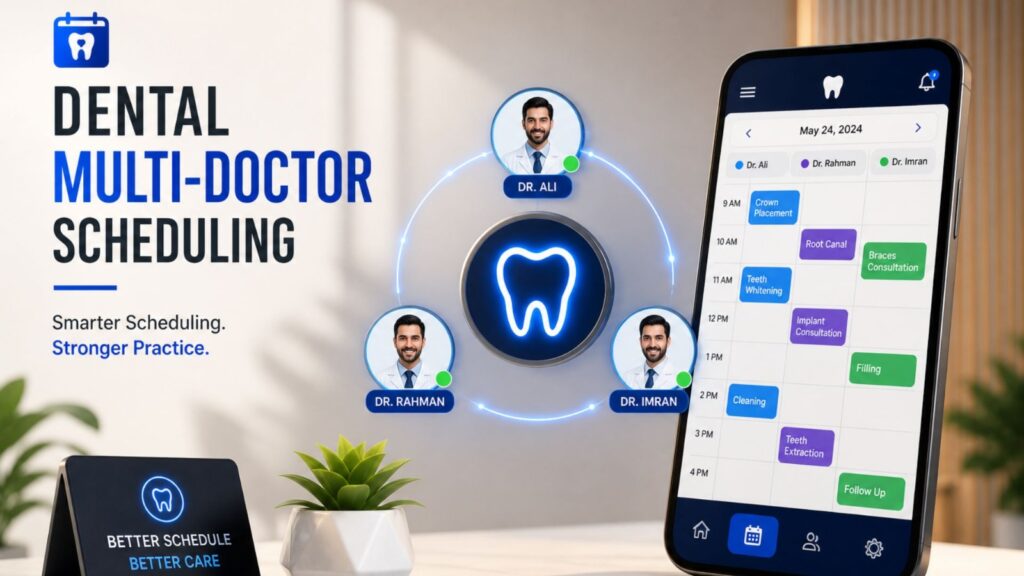
SEO Title: Managing Multi-Doctor Schedules: A Guide to Dental Clinic Operational Efficiency
Meta Description: Master the complexity of managing multi-doctor schedules in your dental practice. Learn how systems, automation, and CRM tools like GoHighLevel stabilize revenue and reduce front-desk burnout.
The Systems Behind the Science: A Strategic Approach to Managing Multi-Doctor Schedules
As a dental practice owner, you likely spent years mastering the clinical precision required for high-end restorative work or complex extractions. However, as your practice grows from a solo operation to a multi-provider facility, the primary bottleneck often shifts from clinical skill to operational logistics.
The most significant drain on a clinic’s profitability isn’t usually the cost of materials; it is “empty chair time” and the chaotic friction of managing multi-doctor schedules. When multiple providers share a limited number of operatories, assistants, and hygienists, the margin for error disappears. Without a structured system, you aren’t running a clinic; you are managing a high-stakes game of Tetris where every dropped block costs you hundreds of dollars in overhead.
The Operational Pain Points of Growth
Growth in a dental practice is a double-edged sword. On one hand, adding associates allows for higher patient volume and specialized care. On the other, it introduces a layer of complexity that can quickly overwhelm a traditional front-desk setup.
The challenges are predictable but damaging:
- The Overlap Crisis: Two doctors needing the same surgical suite or the same high-end imaging equipment at the same time.
- The “Hole” in the Day: Last-minute cancellations that go unfilled because the front desk was too busy checking in one doctor’s patient to call the waitlist for another’s.
- The Follow-up Black Hole: Patients who leave without a re-care appointment because the hand-off process broke down during a busy shift.
To stabilize revenue, we must move past the idea that a “busy” front desk is a “productive” one. True productivity is rooted in systems that manage themselves.
What Intelligence Means in a Dental Clinic
In the context of modern healthcare, “intelligence” is not just about the IQ of your staff. It is about System Intelligence. A clinic with high system intelligence functions the same way regardless of who is sitting at the front desk.
When managing multi-doctor schedules, intelligence means having a clear, digital visualization of the clinic’s capacity. It means knowing, in real-time, which doctor is ahead of schedule and which is lagging, and having an automated mechanism to adjust patient flow accordingly.
Human Intelligence vs. System Intelligence
We often rely too heavily on “Rockstar” office managers. While a great manager is an asset, relying on a single person’s memory or manual effort to keep three doctors’ schedules full is a recipe for burnout and single-point-of-failure risk.
Human Intelligence should be reserved for:
- Patient empathy and chairside manner.
- Complex treatment planning.
- Resolving unique insurance disputes.
System Intelligence (Automation and CRM) should handle:
- Appointment reminders and confirmations.
- Filling gaps caused by cancellations.
- Tracking leads from digital marketing.
- Nurturing “dormant” patients who haven’t visited in 6+ months.
AI & Automation: The Infrastructure of the Modern Clinic
This is where the transition from “manual” to “automated” occurs. For a mid-sized clinic, you need a centralized “brain” for your operations. Platforms like GoHighLevel allow clinics to centralize patient communication, reminders, and tracking inside one structured system.
When you are managing multi-doctor schedules, you cannot afford to have data scattered across sticky notes, separate spreadsheets, and siloed practice management software. You need a CRM that triggers actions based on patient behavior.
For example, if a patient cancels an appointment for Doctor A, the system should automatically:
- Tag that patient as a “Canceled/Not Rescheduled.”
- Send a text message offering two specific alternative slots.
- Notify the front desk if the patient doesn’t re-book within 24 hours.
This level of automation reduces the cognitive load on your team, allowing them to focus on the patients physically present in the building.
Operational Insight: If your clinic loses even five missed calls per week, that is silent revenue walking away. A structured automation system ensures that every missed call receives an immediate, professional text response to “save” the lead.
Note: The link below is an affiliate link. I only recommend systems that align with structured clinic growth.
[Start Building a Smarter Dental System](INSERT YOUR AFFILIATE LINK HERE)
Real Clinic Scenarios: The Cost of Manual Scheduling
Let’s look at a common scenario in a three-doctor practice.
Doctor 1 is a high-speed producer doing crowns and bridges.
Doctor 2 is an associate focused on general fillings and hygiene checks.
Doctor 3 is a specialist (Endodontist) who comes in twice a week.
Without a robust system for managing multi-doctor schedules, the following happens: Doctor 3 has a 2-hour cancellation. The front desk is currently on the phone dealing with an insurance claim for Doctor 2. By the time they realize Doctor 3 has an opening, it’s too late to call the waitlist. That 2-hour block—worth perhaps $1,500—is gone forever.
With an automated CRM, the moment that cancellation is logged, the system scans the database for patients tagged “Needs Endo” and sends a blast: “We have a priority opening this morning at 10:00 AM. Reply YES to claim.”
The slot is filled in minutes without a single phone call from your staff.
Common Mistakes in Multi-Provider Environments
- Over-scheduling the “Anchor” Doctor: Many owners try to do everything themselves while their associates sit idle. Your system should prioritize filling the associates’ books to maximize the clinic’s total ROI.
- Ignoring Missed Call Leakage: Statistics show that 35% of dental inquiries happen outside of business hours. If you don’t have an automated “Missed Call Text Back” system, those patients are calling your competitor down the street.
- Lack of Lead Tracking: If you spend $2,000 on Google Ads, you must know exactly which doctor those leads are booking with. Structured systems give you a “pipeline” view of your revenue.
The Importance of External Resources
To understand the broader impact of scheduling on provider well-being and patient safety, it is helpful to review industry standards on workforce management and scheduling protocols which highlight how staggered start times can reduce morning bottlenecks.
The Future of Structured Clinics: Revenue Stabilization
The ultimate goal of managing multi-doctor schedules through automation is to achieve revenue stabilization. This is the point where the owner can step away from the chair, knowing the system will continue to find, book, and retain patients.
By implementing a CRM like GoHighLevel, you are building an asset. A clinic that relies on the owner’s constant physical presence is a job; a clinic that runs on automated systems is a business.
Transitioning to a systematic approach requires an initial investment in setup, but the long-term reduction in “no-show” economics and front-desk turnover is immeasurable.
Moving from manual chaos to automated precision is a strategic shift. It requires moving away from “checking the calendar” to “managing the system” that fills the calendar for you.
[Start Building a Smarter Dental System](INSERT YOUR AFFILIATE LINK HERE)
Conclusion: Systems Over Sweat
Managing a multi-doctor dental practice will always be a challenge, but it does not have to be a source of constant stress. By shifting the burden of managing multi-doctor schedules from your human staff to an intelligent system, you reclaim your time and protect your profit margins.
Remember: Dental growth does not come from better dentistry alone—it comes from intelligent systems. If you want to scale your practice without burning out your team, start looking at your clinic through the lens of automation.
FAQs (Frequently Asked Questions)
1. How does automation help with managing multi-doctor schedules specifically?
Automation helps by synchronizing multiple calendars and preventing “double-booking” of shared resources like surgical suites. It also ensures that if one doctor’s schedule has a gap, the system can automatically reach out to a specific segment of patients to fill it.
2. Will my older patients be comfortable with automated text reminders?
Yes. Modern data shows that patients across all age demographics prefer the convenience of text confirmations over intrusive phone calls. It allows them to confirm or reschedule at their own pace.
3. Can a CRM like GoHighLevel replace my existing Practice Management Software (PMS)?
No, it usually works alongside your PMS. While the PMS handles clinical records and billing, a CRM like GoHighLevel handles the “Patient Relationship” side—marketing, lead tracking, and automated follow-ups—which most PMS systems do poorly.
4. What is “Missed Call Leakage” in a dental context?
This refers to the potential revenue lost when a prospective patient calls your office and no one answers. Without an automated text-back system, that patient will usually call the next dentist on their search list.
5. How do I prevent my front desk from feeling “replaced” by automation?
Frame it as a tool that removes the “robotic” parts of their job. By automating the 50+ reminder calls they make a day, they are free to provide better in-person service and handle more complex treatment coordination.
6. Is it difficult to set up a system for managing multi-doctor schedules?
It requires an initial strategic setup to define your clinic’s workflows. However, once the “logic” is built into the CRM, the system runs on autopilot, requiring only minimal oversight.