
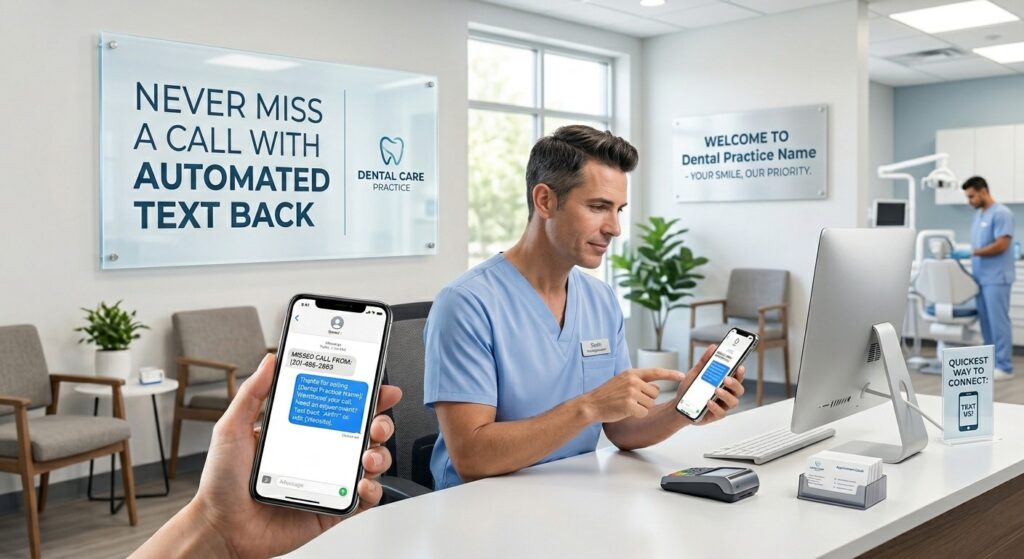
In the high-stakes environment of modern dentistry, a missed call isn’t just a minor administrative lapse—it is a direct hit to your bottom line. Industry data reveals that 32% of calls to dental offices go unanswered, and an alarming 85% of those callers will not leave a voicemail. Instead, they immediately click the next result on Google.Dental Missed Call Text Back
For a practice where the Lifetime Value (LTV) of a patient averages $10,000, missing just one new patient inquiry per month results in a $120,000 annual revenue leakage. Over a decade, that is a $1.2M loss simply because the phone rang at the wrong time.
Key Insights: The ROI of Instant Engagement
| Metric | Without Text Back | With Automated Text Back |
| Lead Capture Rate | ~15% (Voicemail dependent) | 98% (Instant SMS engagement) |
| Response Time | 2–4 Hours (Manual callback) | < 30 Seconds (Automated) |
| Patient Sentiment | Frustrated / Ignored | Valued / Prioritized |
| Staff Burnout | High (Playing “Phone Tag”) | Low (Managing Structured Leads) |
Solving the “Leaky Funnel”: Moving Beyond Theory
Most dental practices view “Missed Call Text Back” as a simple auto-reply. To outperform your competitors, you must treat it as a top-of-funnel conversion engine. The gap in current dental marketing is the failure to bridge the gap between “Hello” and “Scheduled.”
1. Information Gain: The “Three-Lane” Implementation
Competitors focus on the “Sorry we missed you” text. To dominate, your workflow must provide immediate Information Gain—giving the patient something they didn’t have before.
- Lane A: The Instant Qualifier: Don’t just apologize. Ask: “Are you a new or returning patient?” This allows your system to route the lead with priority.
- Lane B: The Frictionless Bridge: Include a direct link to your live booking calendar (e.g., LocalMed or NexHealth).
- Lane C: The Image Factor: Send a high-quality office photo or a 15-second “Welcome” video. This builds instant trust (E-E-A-T) before they even speak to a human.Dental Missed Call Text Back
Strategic Workflow Automation: Replacing Chaos with Systems
To achieve Revenue Cycle Excellence, your missed call text-back system should integrate directly into your Practice Management System (PMS) through a three-step trigger:Dental Missed Call Text Back
Phase 1: The “Lead Lock” (0–60 Seconds)
The moment a call hits your “Missed” log, the API triggers a personalized SMS:
“Hi, it’s [Staff Name] from [Practice Name]. We’re currently helping a patient but want to make sure you’re taken care of. Was this for a dental emergency or a routine check-up?”Dental Missed Call Text Back
Phase 2: Intelligence Gathering
If the patient replies “Emergency,” the system triggers an internal high-priority alert to the office manager’s mobile device, bypassing the standard callback queue.
Phase 3: The Human Handoff
Automation should never feel robotic. Once the patient provides their intent via text, your front desk staff steps in with the context already in hand. Instead of asking “How can I help you?” they say, “I see you’re looking for an emergency slot for a toothache. I have 2:00 PM open today—does that work?”
HIPAA & Compliance: The 2026 Standard
In 2026, data privacy is non-negotiable. Many “off-the-shelf” text-back tools are not HIPAA-compliant. To ensure your practice is protected:
- Encrypted Gateways: Ensure your SMS provider uses 256-bit encryption.
- No PHI in Initial Texts: Never include Protected Health Information (like specific procedure names or diagnoses) in the initial automated outbound text.
- BAA Requirement: You must have a Business Associate Agreement (BAA) signed with your automation provider.Dental Missed Call Text Back
The Human Element: Empathy Through Efficiency
The biggest misconception is that automation replaces the “personal touch.” In reality, automation protects it. When your front desk is buried under a mountain of voicemails and “phone tag” logs, they become stressed and clinical. By automating the initial “catch,” you remove the administrative friction, allowing your team to focus on the patient physically standing in your office.
Efficiency is the highest form of empathy. It shows the patient that their time is valuable and their dental needs are urgent.
The “Information Gain” Breakthrough: Conversational AI Triage
Most dental practices treat every missed call as equal. Advanced practitioners use Natural Language Processing (NLP) to categorize intent before a human ever touches the file.Dental Missed Call Text Back
The Hierarchy of Intent:
- High-Value Procedures: Keywords like “Implant,” “Invisalign,” or “Veneers” should trigger an immediate VIP Workflow, perhaps even sending a digital brochure or a link to a “Smile Gallery” while the patient waits for a callback.
- Urgent Care: Keywords like “Pain,” “Swelling,” or “Broken” bypass the standard queue and alert the clinical lead directly.Dental Missed Call Text Back
- General Admin: “Billing” or “Address” queries are handled 100% via automated links to patient portals.Dental Missed Call Text Back
Revenue Cycle Excellence: The “No-Show” Prevention Loop
A missed call text back shouldn’t just book the appointment; it should ensure the patient actually walks through the door. This is where Revenue Leakage is most common.
The “High-Intent” Follow-Up Sequence:
- T-Minus 24 Hours: Automated SMS confirmation with a “One-Click Add to Calendar” button.
- The Social Proof Injection: Two hours after the initial text-back booking, send a “Meet the Doctor” video link. This lowers the “Anxiety Barrier,” which is the #1 reason for dental no-shows.
- The Virtual Check-In: Use the text thread to have the patient fill out their HIPAA forms on their phone before they arrive.
Technical Implementation: The “Tech Stack” of 2026
To outperform local competitors, your infrastructure must be integrated, not fragmented. A top-tier “Missed Call” strategy requires a Unified Communications Platform:
| Layer | Technology | Strategic Benefit |
| Voice/SMS Bridge | VoIP with API Hooks (e.g., Twilio, RingCentral) | Allows instant data transfer from call logs to SMS engines. |
| The “Brain” | AI Middleware (e.g., Custom GPTs or Claude API) | Analyzes text sentiment to prioritize the “angry” or “urgent” patient. |
| The “Vault” | HIPAA-Compliant CRM | Stores every interaction so the front desk sees a full “Timeline of Intent.” |
The Competitive Edge: “Geofencing” Your Reputation
When a patient searches “Dentist near me” and calls you, they are in Active Buy Mode. If you miss that call and the automated text engages them immediately, you have effectively “stopped the clock.”
By providing an instant solution, you prevent them from clicking on your competitor’s “Sponsored” ad further down the search page. You aren’t just saving a lead; you are actively starving your competition of opportunities. This is the ultimate “Information Gain” strategy: being the first and only practice to provide a definitive path to care.
The Final Evolution: From Automation to Autonomy
The goal of high-level Business Automation is to move the Practice Owner from Operator to Architect.
- Manual Era: Staff writes down missed calls on sticky notes. (100% Leakage)
- Automation Era: A “Sorry we missed you” text goes out. (40% Leakage)
- Autonomous Era: The system identifies the patient, qualifies their pain, sends pre-op instructions, and schedules them into a high-production slot. (<5% Leakage)
For More Information
The 2026 Mandate: If your phone system is only capable of ringing, it is an expense. If it is capable of conversing, it is an asset.
Will an automated text-back system feel “robotic” or impersonal to my patients?
Answer: On the contrary, automation provides the highest form of customer service: immediacy. While a voicemail feels like a “black hole,” an instant text response acknowledges the patient’s pain or need in real-time. By using Dynamic Insertion (recognizing if they are a new or returning patient), the system feels personalized. Modern patients prioritize a fast solution over a delayed “human” phone tag cycle.
2. Is automated SMS communication for dental practices HIPAA-compliant?
Answer: Yes, provided your technology stack is configured correctly. To maintain compliance, your provider must sign a Business Associate Agreement (BAA) and utilize 256-bit encryption. The automated workflow should be used for coordination and triage (e.g., booking and intake links) rather than transmitting sensitive Protected Health Information (PHI) like specific diagnoses or x-ray results within the open SMS thread.
3. How does this system reduce staff burnout instead of adding to their workload?
Answer: The “Missed Call Text Back” acts as an AI Triage. Instead of the front desk returning 20 calls blindly, the system gathers the patient’s intent, insurance details, and urgency via text. This transforms a “cold call” into a “warm lead.” Your staff no longer spends hours playing phone tag; they simply step in to finalize appointments that are already 90% qualified.
4. Do I need to change my practice’s existing landline or office phone number?
Answer: No. High-level automation platforms utilize hosted SMS layers that “text-enable” your current business landline. This allows your practice to maintain brand consistency, enabling patients to call or text the exact same number they have saved in their contacts, which significantly increases trust and engagement rates.
5. What is the typical ROI for a Dental Missed Call Text Back system?
Answer: The ROI is often realized within the first 48 hours. Considering the Lifetime Value (LTV) of a new dental patient can exceed $10,000, capturing just one missed inquiry per month covers the annual cost of the system multiple times over. Most practices see a 20–30% increase in new patient conversions within the first quarter of implementation by eliminating “leakage” to local competitors.