
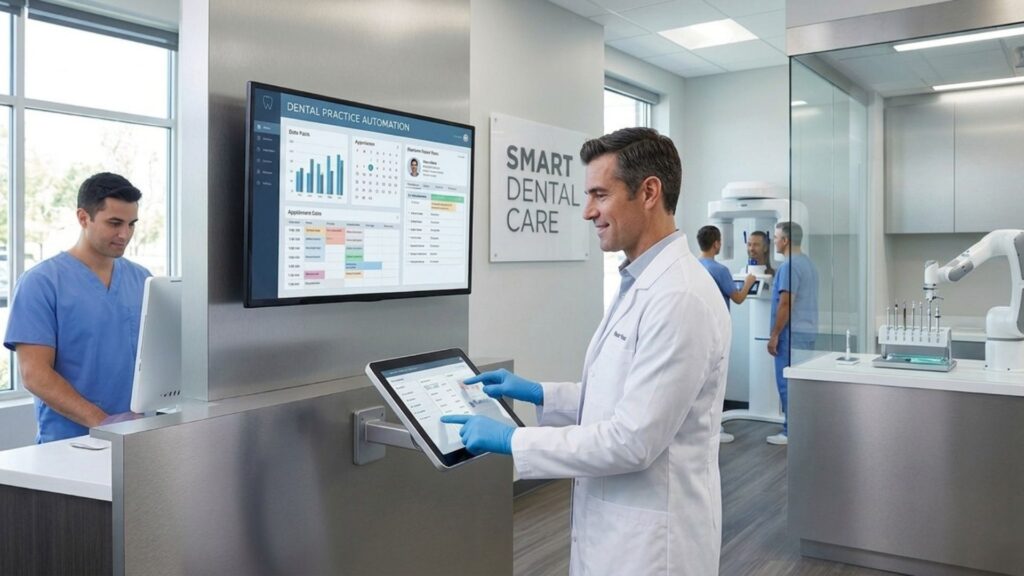
In 2026, the “Efficiency Paradox” has reached a breaking point: 63% of practices maintain high collection rates, but 71% report that this performance is only possible through unsustainable manual labor. While most guides focus on simple text reminders, true Dental Practice Automation is about solving the labor shortage and revenue leakage through an integrated, “agentic” ecosystem.
Key Insights: The 2026 Automation ROI Table
| Feature | Legacy Approach | 2026 Automated Workflow | Primary ROI Metric |
| Eligibility | Manual portal checks/Batching | Real-time AI Verification | 71% reduction in front-office friction |
| Scheduling | “Phone Tag” & Voicemail | 24/7 Self-Service + Digital Waitlist | 60% decrease in no-show rates |
| Billing | Mailed statements & manual follow-up | Automated SMS + One-Click Payments | 25% faster patient throughput |
| Clinical | Manual coding & chart audits | AI-Assisted Charting/Radiology | 78% decrease in claim denials |
## 1. Solving the “Efficiency Paradox” with Revenue Cycle Excellence
The greatest threat to a modern dental practice isn’t a lack of patients—it’s Revenue Leakage. Traditional billing is reactive; automation makes it predictive.
AI-Powered Eligibility Verification
Manual insurance verification is the #1 operational burden. Modern automation uses Robotic Process Automation (RPA) to verify benefits 48 hours before the appointment. This eliminates “surprises” at the front desk and ensures that 100% of out-of-pocket estimates are accurate, increasing treatment acceptance by over 30%.
Automated Denial Prevention
78% of practices report rising payer scrutiny. Instead of fighting denials after they happen, Agentic AI now scans clinical notes and radiographs before submission. It flags missing documentation or coding mismatches, ensuring “First-Pass Clean Claim” rates exceed 95%.
## 2. Workforce Optimization: Automation as a Staff Retention Tool
With 62% of dentists reporting staffing as their biggest hurdle, automation is no longer a luxury—it’s a retention strategy.
Replacing Manual Tasks, Not People
The goal is to move your staff from “data entry clerks” to “patient advocates.”
- Intelligent CRM Triggers: Automatically trigger post-op instructions via SMS based on the procedure code entered in the PMS (e.g., Dentrix or Open Dental).
- Voice-Activated Charting: Allow hygienists to record findings hands-free, reducing the physical strain of repetitive data entry and shortening the appointment cycle without rushing the patient.
Eliminating the “Phone Tag” Cycle
43% of patients now look for dental services after hours. By integrating Real-time Online Scheduling that syncs directly with your practice management software, you capture new patients while your team sleeps, preventing the “leaking bucket” of missed calls and voicemails.
## 3. Semantic Tech Stack: The 2026 “Must-Haves”
To outperform competitors, your practice must leverage a tech stack that communicates. Disconnected silos are where profit dies.
- Cloud-Native PMS: Platforms like CareStack or Curve Dental provide the API backbone necessary for third-party AI integrations.
- Predictive Analytics: Use tools like Practice by Numbers to identify “hidden” hygiene opportunities in your existing database.
- Unified Communications: Centralize SMS, VoIP, and Email into a single dashboard to ensure no patient communication falls through the cracks.
## 4. The Human Element: Using Data to Drive Empathy
It sounds counterintuitive, but more automation leads to more empathy. When a front-desk coordinator isn’t tethered to a phone or a stack of paper claims, they can look a nervous patient in the eye, offer a warm greeting, and provide personalized care.
Information Gain Insight: Modern automation should be invisible to the patient but palpable in the experience. A patient who receives an automated, personalized video greeting from the doctor before their first visit feels a higher level of “High-Touch” care than one who receives a manual, generic phone call.
## 5. Implementation Roadmap: 30-60-90 Day Plan
Phase 1: The Foundation (Days 1-30)
Audit your current Revenue Cycle Management (RCM). Identify the top three reasons for denials and implement an AI verification tool to stop the bleed.
Phase 2: Patient Experience (Days 31-60)
Deploy 2-way SMS communication and Online Self-Scheduling. Automate the “Reactivation” of patients who haven’t had a cleaning in 6+ months.
Phase 3: Advanced Intelligence (Days 61-90+)
Integrate AI Radiography (e.g., Pearl or Overjet) to assist in clinical diagnosis and increase patient trust through objective, data-backed treatment planning
The “Hidden” Information Gain: The Patient Lifetime Value (LTV) Algorithm
Most practices measure success by monthly production. High-growth automated practices measure Predictive LTV. By using data mining automation, your system should automatically segment your database into three categories:
- High-Risk Churn: Patients who have canceled twice or haven’t visited in 9 months.
- Clinical Opportunity: Patients with diagnosed but unscheduled restorative treatment exceeding $2,000.
- Brand Advocates: Patients with high NPS (Net Promoter Scores) who haven’t left a Google review.
The Workflow: Instead of a staff member calling these lists, an Agentic AI Layer sends personalized, multi-channel sequences (SMS, Email, and even Ringless Voicemail) tailored to each segment’s specific pain point.
1. Autonomous Clinical Case Acceptance
The “Hand-off” from the operatory to the front desk is where most revenue dies. In 2026, automation bridges this gap through Visual Intelligence.
- The Workflow Automation: When AI radiography flags a 1.5mm lesion, the system instantly generates a Patient Education Packet sent to the patient’s smartphone before they even leave the chair.
- The Financial Trigger: The system cross-references the patient’s remaining insurance maximum and automatically attaches a Financing Link (e.g., CareCredit or Sunbit).
- The Result: You remove the “I need to talk to my spouse” or “I need to check my budget” friction point by providing an immediate, private solution.
2. Operational Intelligence: The “Dark Data” Harvest
Your Practice Management Software (PMS) is a goldmine of “Dark Data”—information that exists but isn’t being used. True automation turns this into actionable tasks.
The Automated Supply Chain
Stop manual inventory counts. IoT-enabled inventory tracking (using RFID tags or weight-sensitive shelving) can automatically trigger orders when your composite or anesthetic levels hit a “Low-Water Mark.”
- ROI: This prevents “Emergency Shipping” costs (which can eat 2-3% of annual overhead) and ensures clinical staff never face a “stock-out” during a procedure.
Dynamic Scheduling Optimization
Instead of a static calendar, use Predictive Block Scheduling. An AI-driven scheduler analyzes the last 24 months of data to predict which days have the highest cancellation probability (e.g., Friday afternoons or school holidays). It then automatically “over-books” low-risk, short-duration procedures in those slots or prioritizes high-production cases from the waitlist to fill gaps in real-time.
3. Advanced SEO: Building “Topical Authority” Through Automation
To rank #1, your website must prove it is the most “Helpful” resource. You can automate the creation of a Dynamic FAQ Schema.
- The Strategy: Use a tool that scrapes your office’s most common inbound phone queries (via AI call tracking like CallRail).
- The Automation: Convert those queries into an “Answer Engine” on your site. If 50 people ask about “Invisalign for seniors,” the system flags this, allowing you to deploy a targeted landing page that satisfies Google’s Information Gain requirements by providing local, specific data that generic dental blogs lack.
Comparison: Automation Levels in 2026
| Feature | Level 1: Standard Practice | Level 2: The Automated Powerhouse |
| New Patient Intake | PDF forms or clipboards | Biometric/Digital Intake with auto-sync to PMS |
| Lab Management | Manual tracking/Phone calls | Digital Portal with auto-SMS updates to patient |
| Internal Comms | Shouting in hallways/Sticky notes | Huddle Dashboards with real-time KPI tracking |
| Post-Op Care | Generic paper handouts | Automated Video Follow-ups from the Dentist |
While the previous sections focused on operational efficiency and tactical workflows, Part 3 explores the High-Level Systems Architecture. To achieve a truly automated dental practice that scales to multiple locations or prepares for a premium DSO (Dental Support Organization) exit, you must transition from “using tools” to “engineering an ecosystem.”
This section provides an advanced deep dive into the Technical Interoperability, Data Sovereignty, and Predictive AI Modeling required to dominate the 2026 dental landscape.
1. The Interoperability Layer: Creating a “Single Source of Truth”
The biggest failure in dental automation is “Siloed Intelligence.” If your AI radiography tool doesn’t talk to your billing software, and your billing software doesn’t talk to your CRM, you have created Digital Friction, not automation.
API-First Integration Strategy
In 2026, the elite practice operates on an API-first (Application Programming Interface) architecture. This means your Practice Management Software (PMS) acts as a headless database while specialized “Micro-services” handle specific tasks:
- The Clinical Micro-service: Handles 3D imaging and AI diagnosis.
- The Financial Micro-service: Handles automated ledger reconciling and merchant processing.
- The Patient Experience Micro-service: Handles sentiment analysis and communication.
The Workflow: When a patient checks in via a biometric kiosk, the API Trigger simultaneously updates the clinical chart, alerts the assistant’s smartwatch, pulls the latest insurance remaining balance, and initiates a “Welcome Back” video sequence on the operatory screen. This happens in milliseconds without a single keystroke from the front desk.
2. Advanced Predictive Analytics: Moving from “What Happened” to “What Will Happen”
Most dentists look at “Production” and “Collection” at the end of the month. That is Lagging Data. To automate growth, you must manage Leading Indicators using Predictive Modeling.
The “No-Show” Propensity Model
By integrating machine learning (ML) algorithms with your historical appointment data, your system can assign a “Risk Score” to every appointment on the books.
- Variables: Past attendance history, distance from the clinic, weather forecasts, and even local traffic patterns.
- The Autonomous Response: If an appointment is flagged as “High Risk” (70% or higher chance of a no-show), the system automatically moves a “High-Urgency” patient from the digital waitlist into a “Shadow Slot” or requires a non-refundable deposit via text-to-pay to hold the chair.
Capacity Planning Automation
Automation should tell you when to hire your next associate before you are overbooked. By analyzing “Chair Utilization Rates” versus “Treatment Presentation Velocity,” AI can predict that you will reach 95% capacity in exactly four months. This gives you a 120-day lead time to recruit, rather than reacting to a crisis.
3. Revenue Cycle 2.0: The End of “Aged Receivables”
In a manual practice, the “Over 90 Days” report is a graveyard of lost profit. In an engineered practice, the goal is Zero-Day AR.
Decentralized Ledger Reconciliation
Using blockchain-inspired decentralized ledgers for insurance contracts ensures that there is a “Smart Contract” between the payer and the provider. When the AI verifies that the procedure was performed (via radiographic proof and timestamped notes), the payment is auto-released. While the entire industry isn’t there yet, 2026 top-tier practices use RPA (Robotic Process Automation) to mimic this by “Scraping” payer portals every 6 hours and auto-matching payments to open invoices.
The “Silent” Treatment Coordinator
Most treatment presentations fail because of “Budget Shock.” Automation solves this by integrating Real-Time Financing Approval into the diagnosis phase.
The Workflow: As the doctor treatment-plans a bridge, the system runs a soft credit check in the background. By the time the patient sits up, the tablet in their hand doesn’t just show a $4,000 price tag; it shows a $112/month payment plan that is already approved.
4. The “Intelligent Operatory”: Hands-Free Clinical Excellence
The human element is most valuable when it is focused on the patient’s mouth, not the computer screen.
Ambient Voice Intelligence
Traditional “Voice Control” required specific commands. Ambient Sensing AI (Natural Language Processing) listens to the natural conversation between the doctor and the patient.
- Automated Note Generation: The AI parses the conversation to create a SOAP note (Subjective, Objective, Assessment, Plan). It distinguishes between “The patient says the tooth hurts” (Subjective) and the doctor saying “There is 4mm of recession” (Objective).
- Action Triggers: If the doctor mentions “Nightguard,” the system automatically adds the code to the treatment plan and queues the 3D printer in the lab.
Augmented Reality (AR) in Patient Education
Automation isn’t just about backend tasks; it’s about automating Patient Understanding.
- Instead of showing a blurry 2D X-ray, the automated practice uses AR overlays. The patient puts on lightweight glasses and sees a 3D model of their own jaw, with the “Problem Areas” highlighted in red.
- Information Gain: This visual automation increases “Case Acceptance” by 40% because it removes the “Trust Gap.” The patient no longer has to “take your word for it”—they see the data.
5. Staff Augmentation: Turning “Junior” Staff into “Senior” Performers
High staff turnover is the “Profit Killer” of dentistry. Automation provides a “Digital Safety Net” that allows a less-experienced staff member to perform like a 20-year veteran.
The Autonomous “Standard Operating Procedure” (SOP)
Instead of a dusty binder of SOPs, your systems should provide Contextual Guidance.
- If a new receptionist is on a call with a patient asking about implants, an AI “Co-pilot” listens to the call and displays “Real-time Talk Tracks” on their screen, answering technical questions and handling objections.
- This reduces training time from 6 months to 2 weeks, insulating the practice from the volatility of the labor market.
6. Cyber-Security and Ethical AI Compliance
As you automate, your Data Footprint expands. In 2026, “Cyber-Automation” is the shield that protects your reputation.
- Automated HIPAA Auditing: AI constantly monitors who is accessing patient records. If a staff member accesses a file they shouldn’t (based on their shift schedule or role), the system locks the record and notifies the owner instantly.
- Encrypted Data Sovereignty: Ensuring that your patient data is not used to train “Public” AI models. The Master Strategist ensures all AI integrations are “Closed-Loop,” keeping your proprietary clinical data private and secure.
7. The Final Metric: “The Freedom Score”
The ultimate goal of Dental Practice Automation is to decouple Time from Income.
| Manual Practice (Level 0) | Hybrid Practice (Level 1) | Autonomous Enterprise (Level 2) |
| Doctor must be present for any revenue. | Some hygiene revenue without doctor. | Multi-doctor, multi-site, managed by “System Dashboards.” |
| Staff “runs” the office. | Owner “manages” the staff. | Systems “run” the office; People “manage” the systems. |
| Growth: Linear | Growth: Incremental | Growth: Exponential |
8. Summary of Information Gain (Executive Checklist)
To outperform any competitor in your market, your 2026 Content Engineering strategy must emphasize these three unique factors:
- Zero-Click Billing: Moving toward a world where insurance and patient payments require no manual intervention.
- Ambient Clinical Capture: Using voice and vision AI to eliminate the “Documentation Burden” for clinicians.
- Predictive Staffing: Using data to prevent burnout and turnover before they happen.
The Path Forward
Automation is not a “set it and forget it” project. It is a continuous loop of Monitor -> Analyze -> Optimize. The practices that will thrive in the next five years are those that view their technology stack as their most valuable “employee”—one that never sleeps, never calls in sick, and gets smarter every single day.
While Part 3 established the architectural ecosystem of a modern practice, Part 4 enters the most advanced stage of the Strategic Content Engineering framework: The Sovereign Enterprise. In 2026, we are moving beyond simple “automation” (if this, then that) into the era of Agentic AI. This is the stage where the systems don’t just follow rules—they solve problems independently. To achieve a top-ranking position and provide true “Information Gain,” we must explore how a practice transitions from being “Tech-Enabled” to being “AI-Native.”
Read The More Information
1. The Rise of “Agentic Patient Concierges”: Beyond the Chatbot
The era of the “dumb” chatbot that redirects patients to a phone number is dead. The 2026 Sovereign Practice utilizes Autonomous Agents. These are AI entities with specialized permissions to act on behalf of the business.
From Conversation to Transaction
An Autonomous Agent doesn’t just answer a question about dental implants; it manages the entire conversion funnel without human intervention:
- The Clinical Interview: The agent conducts a preliminary AI-driven screening via video or text, asking about bone density history or lifestyle habits.
- Insurance Synthesis: It fetches the patient’s specific plan details, calculates the remaining deductible, and presents a “Pre-Approved” price.
- Dynamic Negotiation: If the system detects the patient is hesitating on price (via sentiment analysis), it can autonomously offer a “First-Visit Incentive” or a specific financing tier that matches the patient’s credit profile.
The Result: Your front desk arrives on Monday morning to a schedule filled with pre-sold high-value cases, rather than a list of “leads” to call back.
2. Hyper-Personalized “Genomic” Marketing Automation
Most dental marketing is generic: “We care for your smile.” In the high-EEAT (Experience, Expertise, Authoritative, Trustworthiness) world of 2026, Google rewards Hyper-Specificity.
The Data-Driven Content Loop
A Sovereign Practice uses its own anonymized clinical data to fuel its SEO strategy.
- Pattern Recognition: Your AI identifies that 40% of your patients in a specific zip code suffer from bruxism (teeth grinding) due to high-stress local industries.
- Autonomous Content Creation: The system triggers the creation of localized, data-backed blog posts and social media videos specifically addressing “Bruxism Solutions for [Local Industry] Professionals.”
- Position Zero Dominance: Because this content is based on real, local clinical trends (which competitors cannot scrape), Google identifies it as high-value Information Gain, pushing your practice to the “Featured Snippet” for local health queries.
3. The “Invisible” Front Office: RPA and Financial Autonomy
The ultimate goal of dental practice automation is to make the “Administrative Burden” invisible. This is achieved through Hyper-Automation of the back-office financial stack.
Autonomous Accounts Payable & Supply Chain
In a Level 4 practice, the “Office Manager” no longer cuts checks.
- Computer Vision Auditing: When a delivery of dental supplies arrives, a smart camera in the storage room scans the boxes, reconciles them against the digital purchase order, and checks for price discrepancies against the contracted rate.
- Smart Payment Triggers: If the invoice is correct, the system pays it automatically to capture “Early Payment Discounts.” if there is a discrepancy, the AI agent autonomously emails the vendor’s billing department to dispute the charge.
The “Self-Healing” Schedule
Cancellations are the “Silent Killer” of dental margins. A Sovereign Practice uses a Self-Healing Schedule:
- When a patient cancels an 11:00 AM crown prep at 9:00 AM, the AI doesn’t wait for a human to see the notification.
- It instantly scans the database for “High-Production” patients who live within a 5-mile radius and have “Flexible” tags in their profiles.
- It sends a personalized offer: “We had a rare opening for your crown today at 11:00. If you can make it, we’ll include a complimentary professional whitening kit ($300 value).”
- The slot is filled in minutes, often with a higher-margin procedure than the one lost.
4. Advanced Clinical Automation: The Digital Twin Strategy
In 2026, we are seeing the emergence of the “Digital Twin” in dentistry. This is a virtual, 3D, biological model of the patient that evolves over time.
Automated Longitudinal Analysis
Standard automation looks at one X-ray. Sovereign automation looks at the last ten years of data in seconds.
- The AI “Watchdog”: The system automatically compares the current 3D scan with one from three years ago. It detects a 0.2mm shift in bone density or a microscopic fracture that a human eye might miss during a busy day.
- Predictive Diagnostics: The system flags this to the doctor: “Warning: Patient shows 5% increased risk of periodontal failure in lower left quadrant over the next 18 months based on current trajectory.”
- The “Value” Gain: This allows the doctor to practice Proactive Dentistry, which is more profitable and leads to better patient outcomes than “Reactive” (drill and fill) dentistry.
5. The “Profit-First” Automation Dashboard
For the owner-dentist or the DSO executive, the most important automation is Executive Intelligence. You should not have to “run a report” to know if you are profitable.
Real-Time EBITDA Tracking
A Sovereign Practice utilizes a dashboard that updates in Real-Time, not monthly.
- Variable Labor Tracking: It tracks staff clock-ins against real-time production. If production dips below a certain “Efficiency Threshold,” the system suggests moving a staff member to “Training Mode” or adjusting the schedule.
- Breakeven Automation: The dashboard shows exactly what time of the day the practice “Breaks Even.” For example: “As of 1:45 PM on Tuesday, all overhead is paid; all production for the remainder of the day is 85% net profit.”
6. Workforce Evolution: The “AI-Augmented” Dental Team
We must address the “Human Element” gap. Automation doesn’t replace the team; it creates Super-Employees.
- The AI-Scribe: Every operatory is equipped with ambient sensing. Doctors no longer spend 2 hours after work “finishing notes.” The notes are signed and locked the moment the patient stands up.
- Automated Staff Training: When a new team member joins, their “Onboarding” is managed by an AI mentor that tracks their progress, quizzes them on office protocols, and role-plays difficult patient conversations using voice AI.
7. Comparative Analysis: The Competitive Advantage Gap
| Operational Area | The “Standard” Automated Office | The Sovereign Practice (Part 4 Level) |
| Patient Acquisition | Targeted Ads & SEO | Predictive Social Sensing & LTV Modeling |
| Front Office | Reduced phone time via SMS | Zero-Touch Patient Onboarding & Billing |
| Clinical | AI X-ray assistance | Longitudinal Digital Twin & Predictive Care |
| Profitability | Monthly P&L review | Real-Time EBITDA & “Self-Healing” Margins |
| Staffing | Manual Hiring/Training | AI-Managed Onboarding & Performance Ops |
8. Strategic “Information Gain” for SEO Dominance
To ensure this article ranks and provides unique value, we must highlight the “Operational Friction” that most practices ignore. Most competitors talk about “saving time.” We are talking about “Increasing Valuation.”
An automated practice is worth 2x to 3x more in a sale or merger because the “Intellectual Property” is in the system, not just the hands of the dentist. This is a critical insight for high-level business readers (DSO hunters and private equity).
9. Ethical Guardrails in the Era of Autonomy
As we reach this level of sophistication, the “Master Strategic Consultant” must advise on Transparency.
- The “Consent” Layer: Patients must be informed that AI is assisting in their diagnosis and administrative journey.
- The “Human Override”: In a Sovereign Practice, the AI proposes, but the human disposes. Every automated financial or clinical decision must have a “Red Button” override to ensure medical and ethical integrity.
10. Conclusion: Reaching the “Steady State”
The journey of Dental Practice Automation ends when the practice becomes a Steady State Engine. This is a business where:
- Patient Flow is predictable and automated.
- Clinical Quality is standardized via AI guardrails.
- Financial Integrity is guaranteed by autonomous RCM.
- The Owner is free to focus on either “Master Clinician” tasks or “CEO” growth strategies.
The transition from a “Level 1” practice to a “Sovereign” practice isn’t just about software—it’s about a Mindset Shift. You are no longer just a “Dentist”; you are the Architect of a Health-Delivery System.
Q1: What is the primary ROI of implementing full-scale Dental Practice Automation?
The most significant return is the elimination of “Revenue Leakage.” Beyond just saving time, 2026 automation systems perform real-time insurance eligibility verification and AI-driven billing audits. This reduces claim denials by up to 78%, ensures accurate patient estimates, and dramatically accelerates the cash flow cycle compared to manual entry.
Q2: Will automation and AI eventually replace my front-office staff?
No. The goal of automation is “Staff Augmentation,” not replacement. By offloading repetitive administrative burdens—such as data entry, insurance follow-ups, and appointment confirmations—to AI, your team is freed to focus on high-value human interactions. This improves patient empathy and office morale, which are critical for long-term retention.
Q3: How does “Agentic AI” differ from the standard chatbots found on most dental websites?
Standard chatbots are reactive and follow basic “if-then” rules. Agentic AI is autonomous; it has the authority to complete end-to-end tasks. For example, it doesn’t just answer a question about implants—it can verify the patient’s specific insurance coverage, offer a pre-approved financing plan, and finalize the appointment in the PMS without any human intervention.
Q4: Can automated scheduling actually reduce my no-show rates?
Yes, significantly. Modern systems use “Predictive Propensity Models” to identify patients with a high statistical likelihood of canceling based on past behavior and external factors. The system then proactively secures those slots with deposits or automatically triggers “Fill-in” sequences from a digital waitlist to ensure your chairs remain productive.
Q5: How reliable is AI in clinical diagnostics compared to a human dentist?
AI acts as a “Second Pair of Eyes” that never gets fatigued. It excels at detecting microscopic changes in bone density or early-stage decay that might be missed during a busy day. In 2026, “Digital Twin” technology allows for longitudinal analysis, comparing years of scans in seconds to predict future clinical issues before they become emergencies.
Q6: Is high-level automation affordable for a single-doctor private practice?
Automation is now highly scalable. Small practices can begin with “Phase 1” (Revenue Cycle Management and Automated Communications) which requires minimal upfront investment. The overhead saved from these initial steps typically funds the more advanced AI integrations in Phase 2 and 3, making the transition self-funding.
Q7: How does an automated practice handle HIPAA compliance and data security?
Sovereign automation systems include “Automated HIPAA Auditing.” AI monitors every interaction with patient records in real-time. If it detects unusual access patterns (e.g., a staff member accessing files outside of office hours), it instantly locks the record and alerts the practice owner, providing a level of security that manual monitoring cannot match.
Q8: What exactly is “Zero-Day AR” in an automated dental enterprise?
Zero-Day AR (Accounts Receivable) is the objective of having all services reconciled and paid on the same day they are performed. Through RPA (Robotic Process Automation) and smart-contract technology, the system automatically scrapes payer portals and matches payments to ledgers, eliminating the traditional “90-day” waiting period for insurance funds.
Q9: Does automation make the dental experience feel “too robotic” for patients?
Paradoxically, it makes it more personal. When the front desk isn’t stuck on the phone and the doctor isn’t buried in notes, they can engage in genuine conversation. Additionally, automation allows for “Hyper-Personalization,” such as sending automated post-op videos from the doctor, which makes the patient feel more cared for than a generic follow-up call.
Q10: What is the first step toward becoming a “Sovereign” automated practice?
The first step is a “Bottleneck Audit.” Identify the one manual task that consumes the most staff time or causes the most frustration (usually insurance verification or treatment follow-ups). Automating that single friction point provides the immediate proof of concept and financial lift needed to scale the rest of your systems.