
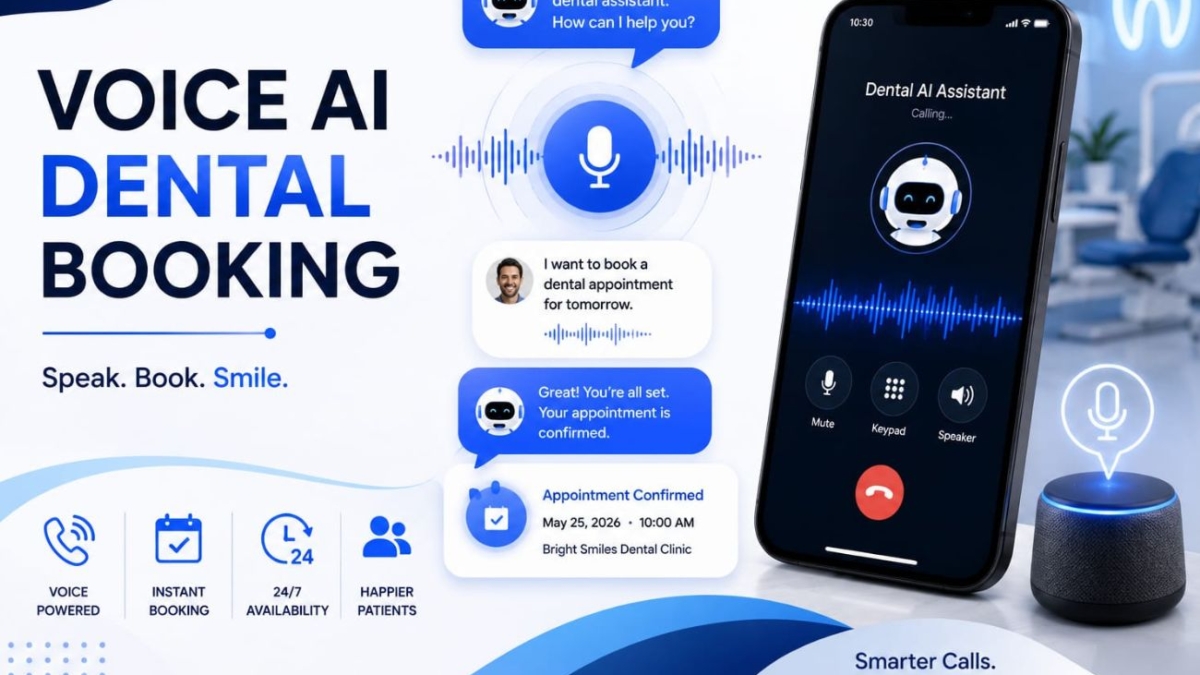
Using Voice AI for Dental Appointment Bookings is no longer a “future technology” discussion for dental practice owners. It is an operational growth system. The clinics that win today are not simply the clinics with the most famous doctor, the biggest ad budget, or the prettiest website. They are the clinics that answer faster, follow up consistently, protect patient trust, and convert demand before it leaks into a competitor’s schedule.
For a dental clinic, the real growth problem is rarely one dramatic failure. It is usually a chain of small revenue leaks: one unanswered call, one delayed voicemail, one missed recall, one review that goes unaddressed, one treatment inquiry that never receives a second follow-up. That is why using voice AI for dental appointment bookings should be treated as a revenue protection system, not just a phone feature.
A voice AI system can answer inbound calls, qualify patient intent, route emergencies, collect basic appointment preferences, trigger SMS confirmations, start follow-up sequences, and log every interaction inside a CRM. When connected correctly to GoHighLevel or a similar CRM automation platform, voice AI becomes part of the clinic’s central nervous system.
Why Using Voice AI for Dental Appointment Bookings Is an Operational Growth System
Most dental clinics do not have a demand problem. They have a response, routing, and follow-up problem. Marketing brings attention. Operations either converts that attention into booked patients or wastes it.
When a patient calls for a dental appointment, the patient is often in a high-intent state. He may have pain, a broken crown, a whitening inquiry, an implant consultation question, or a child needing urgent care. If the call is not answered, the patient does not wait patiently for the clinic to catch up. He searches again, calls another clinic, or books through a competitor that responds faster.
This is where using voice AI for dental appointment bookings changes the economics of the front desk. The goal is not to replace the receptionist. The goal is to remove the operational gap that exists when human staff are overloaded, busy with check-ins, handling billing, explaining treatment plans, or managing multiple calls at once.
A manual front desk depends on availability. A system-led front desk depends on Workflow Triggers. That difference matters because growth depends on consistency, not intention.
A staff member may intend to call back every missed inquiry. A workflow actually sends the SMS, creates the task, tags the lead, updates the pipeline, and reminds the team until the booking is resolved.
For deeper background on AI booking infrastructure, connect this article to your internal guide on 24/7 AI Receptionist for Dental Bookings.
The Speed-to-Lead Gap: Why 15 Minutes Can Destroy Conversion
Speed-to-lead is one of the most expensive blind spots in dental growth. In general sales research, fast response dramatically improves the chance of qualifying and converting a lead. The Harvard Business Review article on the short life of online sales leads is often cited because it shows how quickly lead value decays when companies delay response.
In dental operations, the decay can feel even sharper because the patient’s intent is local, urgent, and easily transferable. If one clinic does not answer, another clinic is one tap away.
A practical dental revenue model should assume that after 15 minutes, the clinic may lose up to 80% of the original conversion opportunity for urgent or high-intent appointment inquiries. This does not mean every lead disappears at exactly 15 minutes. It means the clinic’s probability of winning that patient drops aggressively because trust, urgency, and attention all decline.
Here is the operational logic:
A patient who calls now is emotionally ready to act now.
A patient who waits 15 minutes has already started comparing alternatives.
A patient who reaches another clinic first has mentally transferred trust.
A patient who books elsewhere becomes invisible revenue leakage.
Using Voice AI for Dental Appointment Bookings closes this gap by responding instantly, even when the team is busy. The voice AI can greet the caller, identify the service need, collect callback details, offer available booking windows, or trigger an immediate SMS booking link. The clinic does not need to “remember” to respond because the system responds first.
How Using Voice AI for Dental Appointment Bookings Fixes the First 60 Seconds
The first 60 seconds decide whether the clinic controls the patient journey or loses it. A strong voice AI workflow should do four things immediately: acknowledge the caller, identify intent, protect urgent cases, and create a trackable CRM record.
A simple flow looks like this:
Patient calls → voice AI answers → intent is captured → emergency rules are applied → available booking path is offered → SMS confirmation is sent → lead is logged in CRM → follow-up Workflow Triggers begin.
The clinic now has control. Instead of a missed call becoming a lost opportunity, it becomes a structured patient journey.
The Economics of Reputation: How One Star Can Damage Patient LTV
Reputation is not only a marketing asset. It is an economic multiplier. A 1-star review can reduce trust at the exact moment a new patient is deciding whether to call, book, or keep scrolling.
To understand the financial impact, a clinic owner should connect reputation to Patient LTV. Suppose a new patient has a conservative Patient LTV of $1,200 over 24 months through exams, cleanings, X-rays, basic restorative work, recall visits, and possible family referrals. If the clinic receives 200 monthly profile visitors and normally converts 8% into booked appointments, that equals 16 new bookings. At $1,200 Patient LTV, that represents $19,200 in potential long-term value.
Now imagine a visible negative review reduces conversion from 8% to 6.5%. The clinic still receives the same traffic, but now books 13 patients instead of 16. That is 3 lost patients in one month. At $1,200 Patient LTV, that is $3,600 in long-term value lost from a small conversion drop.
The damage becomes larger when you add referrals. If each satisfied patient could refer one family member or return for additional treatment, the real LTV impact is higher. One negative review is not just a comment. It can become a conversion tax on every future patient who checks your clinic before calling.
Using Voice AI for Dental Appointment Bookings supports reputation economics in two ways. First, it reduces frustration by making the clinic easier to reach. Second, it can trigger review-request workflows after successful visits, while routing complaints privately and respectfully before they turn into public damage.
This must be done ethically. Review automation should never pressure patients, filter only positive feedback, or offer rewards for positive reviews. It should simply make it easy for real patients to share honest feedback and for the clinic to respond quickly.
Smart Clinics vs Famous Doctors: Why System-Led Clinics Out-Earn Person-Led Clinics
A famous doctor can attract attention. A smart clinic converts attention into predictable revenue.
The traditional dental growth model is person-led. The owner becomes the brand. Patients ask for one doctor. Staff depend on the owner for decisions. Follow-up depends on memory. Growth depends on personal energy. This model can work for a while, but it becomes fragile as call volume, patient volume, and administrative complexity increase.
A smart clinic is system-led. It uses defined workflows, CRM stages, automation rules, scheduling logic, review management, and consistent patient communication. The clinic does not grow because one person remembers everything. It grows because the system protects every step.
Using Voice AI for Dental Appointment Bookings is a key part of this intelligence layer. The clinic becomes smarter because patient demand is captured at the point of contact. Calls do not disappear. Leads do not sit in voicemail. Appointment requests do not rely on staff remembering to call back between patients.
The result is lower CPA because the clinic converts more of the leads it already paid to generate. Patient LTV improves because communication is consistent. Churn Rate decreases because patients receive reminders, recalls, follow-ups, and care instructions without being forgotten.
The Central Nervous System: Connecting Voice AI to GoHighLevel or Similar CRM Platforms
Voice AI alone is not the full solution. The real power comes when voice AI is connected to a CRM automation platform such as GoHighLevel. The CRM becomes the central nervous system of the clinic. Voice AI becomes one sensory input. SMS, email, forms, calendars, pipelines, review requests, and follow-up sequences become the response system.
Without a CRM, voice AI may answer calls but fail to create operational control. With a CRM, every patient interaction can create a record, trigger a workflow, assign a task, update a pipeline, and measure conversion.
This is why software without Workflow Triggers is a financial mistake. Buying software does not create revenue. Building workflows creates revenue. A clinic can pay for a CRM, install a phone number, connect a calendar, and still lose money if no workflow tells the system what to do when a call is missed, when a caller asks for an implant consultation, when a patient cancels, when a new patient does not confirm, or when a lead stops responding.
For CRM planning, use your internal resource on Top 10 Features of a Modern Dental CRM.
Chaotic Manual Clinic vs GHL-Automated Systematic Clinic
| Operational Area | The Chaotic Manual Clinic | The GHL-Automated Systematic Clinic |
|---|---|---|
| Inbound calls | Staff answer when available; missed calls often disappear | Voice AI answers, tags intent, triggers SMS, and creates CRM record |
| Speed-to-lead | Response may take 15 minutes, hours, or next day | Instant response within seconds |
| Booking flow | Back-and-forth calls and manual scheduling | Booking link, calendar logic, confirmations, and reminders |
| Follow-up | Depends on staff memory | Workflow Triggers run automatically |
| CPA control | Higher CPA because paid leads leak | Lower effective CPA because more leads convert |
| Patient LTV | Reduced by poor recall and inconsistent follow-up | Improved through recall, reactivation, reviews, and retention workflows |
| Churn Rate | Patients drift away when communication stops | Patients stay connected through automated care journeys |
| Reputation | Reviews requested inconsistently | Review requests and complaint routing follow a defined process |
| Staff workload | High pressure, multitasking, more errors | Staff focus on patient care while systems handle repetitive tasks |
| Management visibility | Owner guesses what is happening | CRM dashboard shows calls, leads, bookings, no-shows, and revenue leakage |
Workflow Logic: Staff-Dependent Tasks vs System-Dependent Tasks
A dental clinic should never build growth around tasks that depend entirely on memory. Memory fails under pressure. Systems do not get tired.
Staff-dependent tasks include manually calling back missed calls, manually checking voicemail, manually sending reminders, manually asking for reviews, manually reactivating old patients, and manually tracking which leads did not book. These tasks are important, but they are also easy to miss during busy hours.
System-dependent tasks use Workflow Triggers. When a missed call occurs, the system sends an SMS. When a new patient books, the system sends confirmation. When the patient does not confirm, the system sends a reminder. When the visit is completed, the system sends a review request. When the patient has not returned for recall, the system starts a reactivation sequence.
Using Voice AI for Dental Appointment Bookings works best when every major call outcome has a workflow. A new patient inquiry should not land in the same bucket as a billing question. An emergency call should not follow the same path as a whitening inquiry. A failed booking should not be treated as a lost lead. Each intent should trigger the next best action.
How to Implement Using Voice AI for Dental Appointment Bookings Without Disrupting Reception
Start with a controlled implementation. Do not automate everything on day one. Begin with missed-call coverage and after-hours answering. These are the lowest-risk, highest-ROI use cases because they recover opportunities that would otherwise be lost.
Next, define call intent categories: new patient exam, emergency, cosmetic treatment, implants, orthodontics, hygiene recall, billing, insurance, and existing appointment change. Each category should have a routing rule. Emergency and clinical questions should be escalated to trained staff. Administrative questions can move into booking or callback workflows.
Then connect the voice AI to the CRM pipeline. Every call should create or update a contact. Every booking request should move into a stage. Every no-answer or incomplete booking should create a follow-up sequence.
All messages must respect HIPAA and GDPR. Do not include unnecessary protected health information in SMS. Avoid sensitive diagnosis details in automated messages. Use consent-based communication, role-based access, audit logs, and data retention policies aligned with the clinic’s legal region.
Mid-Article Advisory CTA
The highest ROI does not come from “adding AI.” It comes from connecting AI to patient acquisition, retention, and revenue leakage control.
When the clinic system is designed around Workflow Triggers, every inquiry becomes measurable, every missed call becomes recoverable, and every follow-up becomes consistent.
👉 “Start Building a Smarter Dental System”
Case Study: Before vs After Using Voice AI for Dental Appointment Bookings
A mid-sized dental clinic was spending heavily on local SEO, Google Business Profile optimization, and referral marketing. On paper, the clinic looked healthy. The doctor had strong clinical skills, the location was good, and the website generated inquiries.
But the schedule was inconsistent. Mondays were overloaded, Wednesdays had empty chairs, and new patient calls were not always turning into bookings. The owner initially believed the clinic needed more advertising. After a basic revenue leakage audit, the real problem became clear: the clinic was already receiving enough interest. It was failing to capture and convert that interest consistently.
Before implementation, calls during lunch often went unanswered. After-hours callers heard voicemail. Some voicemails were returned the next day. Treatment inquiries were written on sticky notes. Follow-up depended on which staff member was available. Reviews were requested only when someone remembered.
The clinic implemented using voice AI for dental appointment bookings in three phases. First, voice AI answered missed calls and after-hours calls, collected patient intent, and triggered an instant SMS. Second, the system connected to the CRM pipeline and created Workflow Triggers for new patient booking, emergency escalation, incomplete booking, and appointment confirmation. Third, the clinic added reputation workflows, recall reminders, and reactivation campaigns.
Within the first month, the clinic did not need more ad spend to see better results. It needed fewer leaks. The team saw more completed bookings from the same inquiry volume. Front desk stress decreased because staff were no longer responsible for manually rescuing every missed interaction. The owner gained visibility into call outcomes, lead sources, and conversion gaps.
The most important lesson was not that voice AI is impressive. The lesson was that system-led clinics can scale operational consistency without forcing staff to work harder.
Implementation Failures: Why Buying Software Without Workflow Triggers Wastes Money
A clinic can buy GoHighLevel, connect a phone number, add voice AI, and still fail. The reason is simple: tools do not create discipline. Workflow Triggers create discipline.
A common mistake is treating CRM software as a digital storage box. Contacts go in, but nothing meaningful happens. The owner assumes the clinic is automated because a platform is installed. In reality, automation only exists when specific events trigger specific actions.
For using voice AI for dental appointment bookings, the minimum workflow library should include:
Missed call trigger.
After-hours call trigger.
New patient inquiry trigger.
Emergency escalation trigger.
Incomplete booking trigger.
Appointment confirmation trigger.
No-show recovery trigger.
Post-visit review request trigger.
Recall reminder trigger.
Lost patient reactivation trigger.
Each workflow needs clear rules, compliance controls, and measurement. Who receives urgent alerts? What message goes to the patient? How many reminders are sent? When should the system stop? Which staff member reviews exceptions? What data is stored? How is consent recorded?
Without answers to these questions, the clinic has software expense, not operational intelligence.
Compliance Guardrails for HIPAA and GDPR
Using Voice AI for Dental Appointment Bookings must be designed with privacy in mind. Automation should never create a careless data trail. Dental clinics handle sensitive patient information, and automated systems must respect HIPAA in the United States and GDPR for patients in the European Union or other applicable privacy regions.
The safest approach is data minimization. Collect only what is necessary for booking and routing. Use neutral message language. For example, “Your appointment request has been received” is safer than including sensitive treatment details in a text message. Avoid sending diagnosis, procedure specifics, or financial details through unsecured channels unless proper safeguards and patient consent are in place.
The clinic should also define access roles. Not every staff member needs access to every automation record. Call recordings, transcripts, appointment notes, and patient identifiers should be protected with appropriate permissions. Vendors should be reviewed for security, data processing terms, and business associate responsibilities where applicable.
HIPAA and GDPR compliance are not marketing claims. They are operational responsibilities. A smart clinic designs automation to protect patient trust, not just increase bookings.
Second Advisory CTA: Education Before Automation
Before scaling automation, a clinic should understand where its revenue leaks are: missed calls, no-shows, weak follow-up, low review velocity, or poor recall.
A short guide can help the owner identify the first workflow to build instead of buying tools randomly.
👉 “Start Building a Smarter Dental System”
Revenue Metrics to Track After Launch
A voice AI project should be measured like an operational growth project. Do not judge it only by how “smart” the AI sounds. Judge it by revenue movement.
Track missed-call recovery rate. Track how many missed calls become conversations. Track how many conversations become booked appointments. Track new patient booking rate by source. Track CPA before and after automation. Track Patient LTV by campaign and appointment type. Track Churn Rate among recall patients. Track no-show rate before and after reminder workflows.
Also track exception quality. If voice AI incorrectly routes urgent calls, that is a clinical risk. If it books appointments without accurate calendar logic, that is an operational risk. If it sends too many messages, that is a patient experience risk. A smart system is not only automated. It is monitored.
FAQs About Using Voice AI for Dental Appointment Bookings
1. Is using voice AI for dental appointment bookings safe for HIPAA and GDPR compliance?
It can be safe when designed correctly, but the technology alone does not make the clinic compliant. The workflow must minimize sensitive data, use consent-based communication, protect call transcripts, restrict staff access, and avoid exposing protected health information in SMS or unsecured messages. The clinic should use neutral language such as appointment confirmation or callback request rather than including diagnosis details. For GDPR, the clinic should define lawful basis, consent rules, data retention, and patient data rights. For HIPAA, vendor relationships, access controls, and audit trails matter. The correct approach is to treat voice AI as part of the clinic’s privacy architecture, not as a casual chatbot.
2. Will voice AI replace the dental receptionist?
No. In a well-run clinic, voice AI supports the receptionist rather than replacing the role. Receptionists still handle complex patient concerns, emotional conversations, insurance questions, clinical routing, financial discussions, and in-office experience. Voice AI handles repetitive front-door tasks: answering missed calls, identifying intent, sending booking links, confirming appointments, and triggering follow-ups. This reduces pressure on staff and gives them more time for high-value patient interactions. The goal is not fewer humans. The goal is fewer dropped opportunities, fewer errors, and less stress. A smart clinic combines human empathy with system consistency.
3. What is the best first workflow to build?
The best first workflow is usually missed-call recovery. It has clear ROI because the clinic is recovering demand that already exists. A simple missed-call workflow answers or follows up instantly, sends a compliant SMS, asks how the clinic can help, offers a booking path, and alerts staff when needed. This workflow helps lower CPA because the clinic converts more leads without buying more traffic. After missed-call recovery, the next workflows should be appointment confirmations, no-show reduction, and incomplete booking follow-up. Start with one leak, measure it, improve it, then expand. Do not automate everything before proving the first workflow works.
4. How does voice AI affect patient experience?
Using Voice AI for Dental Appointment Bookings improves patient experience when it reduces waiting, confusion, and silence. Patients want quick answers, clear next steps, and easy appointment options. If the AI is scripted poorly, too robotic, or unable to escalate properly, it can harm trust. The best patient experience design includes warm greeting language, simple intent questions, emergency escalation, easy booking, and human handoff. The system should never trap a patient in an endless automated loop. It should make the clinic feel more responsive, not less human. Measure patient feedback after implementation and refine scripts regularly.
5. How should a clinic calculate ROI from voice AI?
ROI should be calculated using recovered bookings, CPA reduction, Patient LTV, and staff time saved. Start with missed calls per month. Estimate how many become conversations after voice AI. Then track how many become booked appointments. Multiply booked appointments by average Patient LTV, not only first-visit value. Subtract software, setup, and management costs. For example, if voice AI recovers 10 additional new patients per month and each has a conservative Patient LTV of $1,200, the gross long-term value is $12,000. If the system costs far less than the recovered value, ROI is strong. Always use real clinic data after launch.
6. What mistakes cause voice AI implementation to fail?
The biggest mistake is buying software without building Workflow Triggers. Other mistakes include weak call scripts, no emergency escalation, no CRM pipeline, no staff training, no compliance review, and no measurement dashboard. Some clinics also automate too aggressively and create a poor patient experience. The correct implementation should be phased. Start with missed-call and after-hours coverage. Add CRM tracking. Build appointment confirmation and reminder workflows. Train staff to handle escalations. Review transcripts for quality. Monitor booking conversion, no-show rates, and patient feedback. Voice AI succeeds when it is part of a disciplined operating system.
Final Advisory CTA
The clinics that scale profitably do not depend on luck, memory, or one overworked front desk team. They build systems that capture demand, protect trust, and make growth measurable.
Using Voice AI for Dental Appointment Bookings is valuable only when it is connected to CRM workflows, compliance rules, patient experience standards, and revenue metrics.
👉 “Start Building a Smarter Dental System”
Conclusion
Using Voice AI for Dental Appointment Bookings is not just a technology upgrade. It is a revenue leakage audit solution, a patient experience improvement system, and a clinical growth engine when implemented correctly. Dental clinics lose money when calls go unanswered, leads wait too long, reviews damage trust, and follow-ups depend on memory. Smart clinics solve those problems with Workflow Triggers, CRM visibility, instant response, ethical reputation management, and HIPAA/GDPR-conscious communication. The future belongs to clinics that become system-led, not stress-led. By using voice AI for dental appointment bookings as part of a central nervous system, dental practice owners can lower CPA, protect Patient LTV, reduce Churn Rate, and create a more predictable path to growth.
hvymegjnqmhomygjmzxrhsksegdnpo
thank you for interesting my websites