
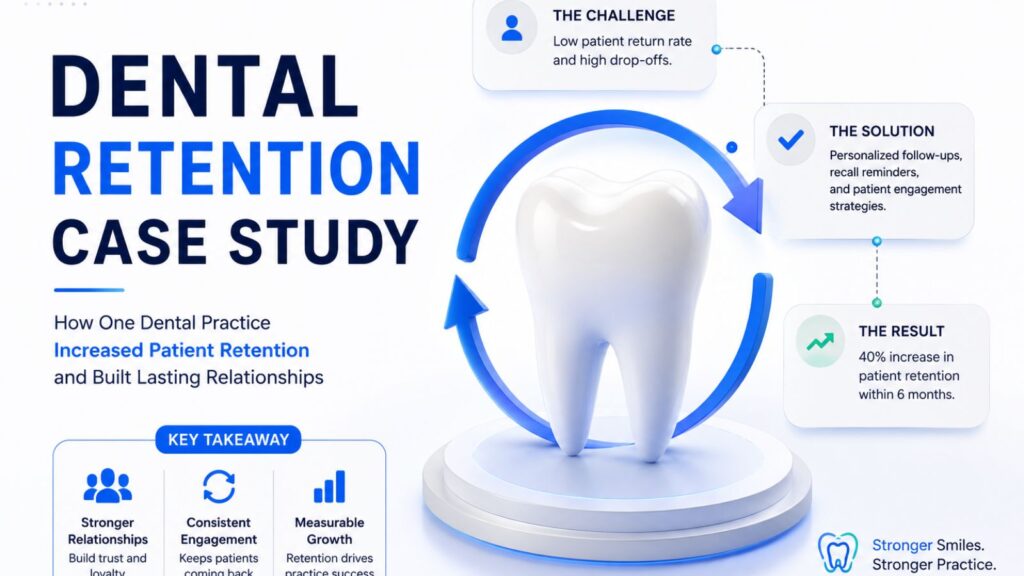
The single most expensive mistake in modern dentistry isn’t a failed implant or a billing error—it’s the “leaky bucket” syndrome. Most practice owners are obsessed with New Patient Acquisition, pouring thousands into SEO and PPC while ignoring the “Hidden Leak” in their back office. Ignoring a structured Case Study: Increasing Patient Retention by 30% is costing the average solo practitioner upwards of $150,000 in lost Lifetime Value (LTV) annually.
In this operational audit, we move beyond “good bedside manner” and treat the dental clinic as a high-precision machine. We aren’t just looking for “Famous Doctors”; we are building “Smart Clinics.” A smart clinic understands that revenue isn’t found in the first appointment, but in the systematic automation of the tenth.
The Economics of Reputation: Why Retention is the Only Metric That Matters
In the dental industry, the CPA (Cost Per Acquisition) for a new patient can range from $150 to $300 depending on your market. If that patient doesn’t return for a hygiene visit, your ROI is likely negative or at break-even. This is why our Case Study: Increasing Patient Retention by 30% focuses on the “Economics of Reputation.”
A single 1-star review on Google doesn’t just hurt your feelings; it mathematically degrades your LTV across your entire database. High-intent patients research reviews before booking; a drop in your aggregate rating from 4.8 to 4.2 can result in a 35% decrease in click-through rates on your GMB (Google My Business) profile. In a system-dependent clinic, we mitigate this risk through GoHighLevel (GHL) automation, ensuring that only satisfied patients are prompted for public reviews while dissatisfied ones are routed to a private internal feedback loop.
The “Speed-to-Lead” Gap
Data shows that responding to a lead or a patient inquiry after 15 minutes reduces conversion by a staggering 80%. This gap is where most dental practices lose their competitive edge. By implementing a Case Study: Increasing Patient Retention by 30% framework, we replace manual staff follow-ups with instant SMS triggers.
The GHL-Automated Systematic Clinic vs. The Chaotic Manual Clinic
To understand the impact of systemization, we must compare the traditional “Staff-dependent” model with the “System-dependent” model.
| Operational Metric | The Chaotic Manual Clinic | The GHL-Automated Systematic Clinic |
| Lead Response Time | 2–4 hours (Staff availability) | < 2 minutes (Automated SMS/Email) |
| Review Generation | Intermittent/Manual | 100% Automated post-appointment |
| Recall Rate | 40–50% (Requires manual calling) | 85%+ (Automated Workflow Triggers) |
| Patient LTV | Low ($800 – $1,200) | High ($3,500 – $5,000+) |
| Churn Rate | 15–20% Annually | < 5% Annually |
| Staff Stress | High (Admin heavy) | Low (Management by exception) |
To scale your practice, you must stop relying on the “perfect front desk person” who may quit tomorrow. Instead, rely on a central nervous system that never calls in sick.
Maximizing your clinic’s valuation requires moving from human-dependent tasks to digital infrastructure that guarantees consistency and patient loyalty.
👉 “Start Building a Smarter Dental System”
For More Informations in:Increasing Patient Retention
Case Study: Increasing Patient Retention by 30% — How We Did It
This Case Study: Increasing Patient Retention by 30% involves a mid-sized general practice in a competitive urban market. Before implementation, the clinic relied on “Post-it note” reminders and a staff member dedicated to “Recall Wednesdays,” where they would spend six hours cold-calling inactive patients.
Phase 1: The Reputation Management Overhaul
We integrated GHL with their existing Practice Management Software (PMS). Using HIPAA-compliant Webhooks, every time a patient’s status changed to “Checked Out,” a workflow was triggered.
- 1 Hour Post-Appt: A personalized SMS asked, “On a scale of 1-10, how was your visit today?”
- The Logic: If 9-10, send a Google Review link. If 1-8, alert the Office Manager immediately to resolve the issue privately.
Phase 2: Workflow Triggers for Hygiene Recalls
The “How-to” of this Case Study: Increasing Patient Retention by 30% strategy lies in the “Re-activation Sequence.” Instead of manual calls, we built a 4-part SMS/Email drip that triggered 5.5 months after the last cleaning.
- Day 1: Educational content on the link between oral health and systemic wellness.
- Day 7: A “Check-in” text with a direct booking link.
- Day 14: A limited-time “Loyalty Incentive” for booking within 48 hours.
Phase 3: The Results
Within six months, the clinic saw a 32% increase in hygiene re-bookings and a 45% increase in Google Reviews. The “Manual Labor” hours for the front desk were reduced by 12 hours per week, allowing them to focus on high-value case presentations rather than chasing overdue cleanings.
Implementation Failures: Why GHL Alone Isn’t Enough
Buying a GoHighLevel subscription is like buying a Ferrari and leaving it in the garage. Without “Workflow Triggers,” it is a waste of money. Most practitioners fail because they treat GHL as a glorified CRM rather than the Central Nervous System of their operations.
To succeed in Increasing Patient Retention by 30%, you must map out your patient journey before you touch the software. If your triggers aren’t aligned with your clinical protocol, you risk spamming your patients and increasing your Churn Rate. Every automated message must feel personal, timely, and medically relevant.
Strategic systemization allows the doctor to focus on clinical excellence while the software handles the psychological heavy lifting of patient retention.
👉 “Start Building a Smarter Dental System”
Detailed FAQs on Increasing Patient Retention by 30%
How does automating reputation management actually improve my retention rates?
Automated reputation management solves two critical problems. First, it ensures a constant stream of 5-star reviews, which creates a “Social Proof Loop.” When existing patients see your practice’s high rating online, it reinforces their decision to stay with you. Second, and more importantly, the automated internal feedback loop (the 1-8 scale mentioned earlier) catches dissatisfied patients before they leave a public negative review or “quietly quit” your practice. By addressing a patient’s grievance within 60 minutes of their appointment via an automated alert to your manager, you can turn a negative experience into a loyalty-building moment, directly contributing to the goal of Increasing Patient Retention by 30%.
Is using an automated SMS platform like GHL HIPAA compliant for dental use?
Yes, but only if configured correctly. To maintain compliance while Increasing Patient Retention by 30%, you must ensure that you have a Business Associate Agreement (BAA) with your software providers. Within GoHighLevel, you should use the HIPAA-compliance package which encrypts data at rest and in transit. Furthermore, your “Workflow Triggers” should never include Protected Health Information (PHI) like specific diagnoses or treatment plans in the body of an SMS. Instead, use generic but personalized language like, “It’s time for your wellness check-up.” Compliance is not an obstacle to automation; it is a framework that, when handled correctly, protects both the patient and the practice’s reputation.
What is the ideal “Re-activation” timeline for a patient who hasn’t visited in 12+ months?
Re-activating “lost” patients is a core component of this Case Study: Increasing Patient Retention by 30%. We recommend a “90-Day Win-Back” sequence. This starts with a “We Miss You” message at the 7-month mark, followed by a more urgent “Insurance Benefit Reminder” in Q4. For patients who haven’t been seen in over 12 months, the strategy shifts toward a “New Patient” offer, acknowledging the gap in care. Using GHL, we segment these patients so they don’t receive the same messaging as your regular 6-month hygiene patients. This targeted segmentation prevents “message fatigue” and ensures that your re-activation efforts remain effective and professional.
How much can a 30% increase in retention actually impact my practice’s bottom line?
The math is compelling. If your practice has 2,000 active patients and an average LTV of $1,000, your total database value is $2M. A 20% churn rate means you lose $400,000 in future revenue every year. By Increasing Patient Retention by 30% (reducing churn to 14%), you retain an additional $120,000 in annual revenue without spending a single extra dollar on marketing. This is “Found Money.” Because the overhead for these patients is already accounted for, that $120,000 is high-margin profit. Over five years, this equates to over $600,000 in additional practice value, significantly impacting your eventual exit strategy or retirement fund.
My staff is worried that automation will make our practice feel “cold” or “robotic.” How do I handle this?
This is a common misconception. In reality, automation makes a practice feel more personal. When your front desk staff isn’t bogged down by 50 manual recall calls a day, they have more time to actually look the patient in the eye, remember their kids’ names, and provide a warm office environment. The automation handles the “boring” logistics (reminders, review requests, scheduling), which frees up the humans to handle the “empathy.” In our Case Study: Increasing Patient Retention by 30%, we found that patient satisfaction scores actually increased because the communication was consistent and the staff was less stressed and more present.
How do I integrate my current Dental Practice Management Software (PMS) with GHL?
Most modern PMS systems (like Dentrix, Open Dental, or Eaglesoft) can be integrated with GHL using a middleware connector like Zapier or a dedicated API bridge. The goal is to create a “Single Source of Truth.” When a patient is marked as “Completed” in your PMS, that data should automatically push to GHL to trigger the appropriate post-care workflow. This eliminates double-entry and ensures your data is always accurate. A successful Case Study: Increasing Patient Retention by 30% relies on this seamless data flow; if the systems don’t talk to each other, the automation fails, and the “Revenue Leakage” continues.
Conclusion: The Path to a 30% Retention Increase
The evidence provided in this Case Study: Increasing Patient Retention by 30% proves that the future of dentistry is not just in clinical skill, but in operational excellence. By implementing GoHighLevel as your “Central Nervous System,” you move from a reactive, “Chaotic Manual Clinic” to a proactive, “System-dependent” powerhouse.
You cannot manage what you do not measure. By focusing on CPA, Patient LTV, and Churn Rate, and by deploying high-velocity Workflow Triggers, you ensure that no patient falls through the cracks. The 30% increase in retention isn’t just a goal—it’s the inevitable result of a well-oiled machine.
Note: The link below is an affiliate link. I only recommend systems that align with structured clinic growth.
High-level systems provide the predictable cash flow necessary to reinvest in the latest clinical technology and top-tier talent.