
As a clinic owner, you are likely intimately familiar with the “leaky bucket” phenomenon. You invest in high-end equipment, your clinical skills are top-tier, and your marketing brings people to the door. Yet, at the end of the quarter, the numbers don’t reflect the effort.
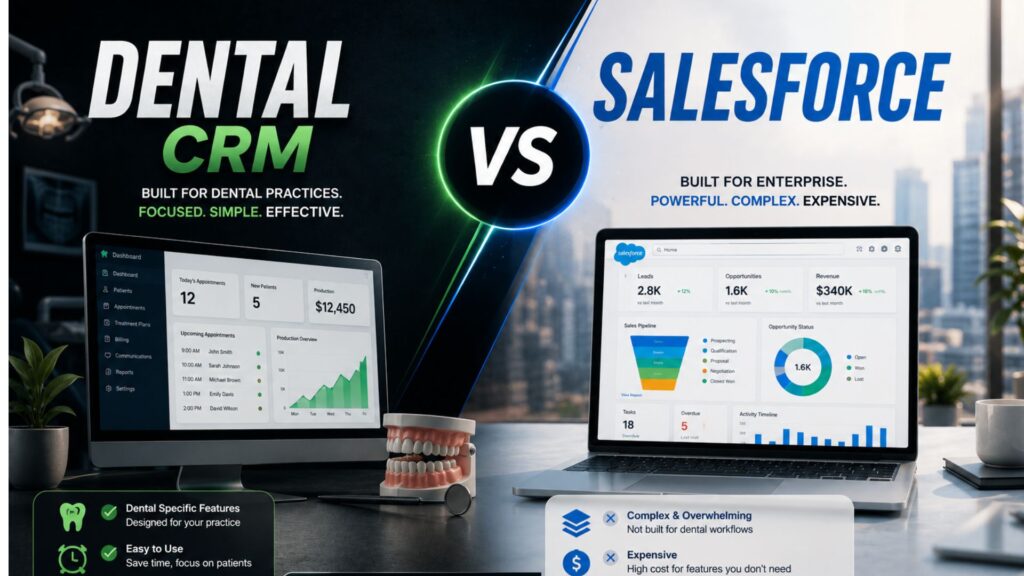
The gap isn’t in your dentistry; it’s in your operations. For years, the corporate world has pointed toward massive platforms like Salesforce as the solution for “customer relationship management.” However, for a mid-sized dental practice, a generalist Dental CRM wins over Salesforce because a clinic is not a software company—it is a high-touch, appointment-driven service environment that requires nuance, not just raw data processing.
Growth in 2026 is no longer about working more hours. It is about building an intelligent system that captures every opportunity without demanding more of your staff’s limited time.
1. What Intelligence Means in a Dental Clinic
In a clinical setting, “intelligence” is often equated with diagnostic accuracy or surgical precision. While those are vital, operational intelligence is what keeps the lights on. An intelligent clinic is one where the data speaks to the owner before a crisis occurs.
Operational intelligence means knowing:
- The exact cost of a no-show beyond just the empty chair (including staff idle time and lost opportunity).
- The percentage of missed calls that are never returned.
- The lifecycle stage of every patient, from “interested lead” to “loyal advocate.”
When we talk about a Dental CRM, we aren’t just talking about a digital Rolodex. We are talking about a central nervous system that coordinates communication, scheduling, and follow-ups.
2. Human Intelligence vs. System Intelligence
Most dental practices rely solely on Human Intelligence. This is the front-desk veteran who “just knows” which patients need a nudge. While invaluable, human intelligence is unscalable and prone to fatigue. When your front-desk manager is on lunch, or on the phone with an insurance provider, your clinic’s “intelligence” effectively drops to zero.
System Intelligence provides the safety net. It doesn’t replace your staff; it empowers them.
- Human Intelligence: Remembers to call a patient back if they have time.
- System Intelligence: Automatically sends a “Missed Call Text-Back” the moment a call goes unanswered, initiating a conversation while the lead is still “hot.”
3. Why a Dedicated Dental CRM Wins Over Salesforce
Salesforce is a powerhouse, but it is built for enterprise-level sales teams with dedicated IT departments. For a dental clinic, it often becomes a “white elephant”—expensive, over-complicated, and under-utilized.
A specialized Dental CRM wins over Salesforce because it focuses on the specific triggers of a patient’s journey. Clinics don’t need complex B2B sales pipelines; they need:
- Immediate lead response.
- Automated appointment reminders that actually reduce no-shows.
- A unified inbox for SMS, Email, and Google Business messages.
By using a platform like GoHighLevel, tailored for dental workflows, you gain the infrastructure of a Fortune 500 company without the enterprise price tag or the six-month setup time.
4. The Power of AI and Automation
The modern patient expects an immediate response. If they message your clinic on a Saturday night and don’t hear back until Monday morning, they’ve already booked with the competitor down the street.
Automation handles the “invisible” tasks that burn out your staff:
- Lead Tracking: Knowing exactly which ad or referral source brought in a patient.
- Nurture Sequences: Automatically educating a patient on the benefits of dental implants over three weeks after their initial inquiry.
- Review Management: Sending a text-back request for a Google review the moment a patient checks out.
This level of automation ensures that no patient falls through the cracks, creating a predictable revenue stream that doesn’t depend on your physical presence in the office.
Taking the First Step Toward Automation
Transitioning from manual chaos to a structured system is the single most important move a clinic owner can make this year. It moves you from “operator” to “owner.”
Note: The link below is an affiliate link. I only recommend systems that align with structured clinic growth.
Think of it this way—if your clinic loses even 5 missed calls per week, that’s silent revenue walking away. A structured automation system prevents that.
👉 [Start Building a Smarter Dental System](INSERT YOUR AFFILIATE LINK HERE)
5. Real Clinic Scenarios: The Cost of “Almost”
Let’s look at two common scenarios where a specialized Dental CRM wins over Salesforce through sheer practicality.
Scenario A: The Missed Call
A mother is looking for an emergency pediatric dentist. She calls your clinic at 12:15 PM while your staff is at lunch. In a traditional setup, that call goes to voicemail. She hangs up and calls the next clinic. With System Intelligence: The system detects the missed call and instantly texts her: “Hi, this is [Clinic Name]. Sorry we missed your call! Are you looking to book an appointment?” She replies, the bot gathers her info, and the lead is saved.
Scenario B: The “No-Show” Cascade
A high-value Invisalign patient forgets their 2:00 PM appointment. Your assistant spends 20 minutes trying to reach them, then 20 more trying to fill the slot. With System Intelligence: The patient receives a series of “Confirmation Required” texts. If they don’t confirm 24 hours prior, the system flags the front desk to fill the spot immediately, or it automatically offers the slot to a “waitlist” via SMS.
6. Common Mistakes in Clinic Scaling
Many owners believe that more “new patients” is the answer to every problem. However, if your systems are broken, more patients just lead to more stress and higher overhead.
- Mistake 1: Fragmented Tools. Using one app for reviews, another for SMS, and a spreadsheet for leads. This creates “data silos.”
- Mistake 2: Over-complicating the CRM. This is why a Dental CRM wins over Salesforce for most. If the system is too hard for the front desk to use, they will revert to post-it notes.
- Mistake 3: Ignoring the “Backdoor.” Spending thousands on SEO but ignoring the 30% of existing patients who haven’t had a cleaning in 12 months.
7. Future of Structured Clinics: Revenue Stabilization
The future of dentistry belongs to the “Smarter Clinic.” As reimbursements fluctuate and competition increases, the clinics that survive will be those with the lowest cost-per-acquisition and the highest patient lifetime value.
By centralizing your operations in a platform like GoHighLevel, you aren’t just buying software; you are buying an insurance policy against inefficiency. You gain visibility into your “Sales Pipeline,” seeing exactly how many thousands of dollars are sitting in “Pending Appointments” or “Follow-up Needed.”
Implementing a system is about more than just profit—it’s about burnout prevention. When the system handles the follow-ups, your staff can focus on the patient in the chair.
Implementing the Infrastructure
Success in dental operations is about 20% strategy and 80% implementation. You don’t need to be a tech expert to start using these tools; you just need to decide that “chaos” is no longer an acceptable business model.
A centralized CRM provides the visibility you need to make informed decisions about hiring, expansion, and marketing spend.
👉 [Start Building a Smarter Dental System](INSERT YOUR AFFILIATE LINK HERE)
8. Conclusion
We have entered an era where clinical excellence is the baseline, but operational excellence is the differentiator. While Salesforce is a massive name in the tech world, for the local dental practice, a focused Dental CRM wins over Salesforce every time by addressing the specific, high-velocity needs of patient management.
By adopting automation, missed call recovery, and lead tracking, you transform your practice from a high-stress job into a predictable, scalable business. Growth doesn’t have to be loud or frantic. Often, it’s as quiet as a text message sent automatically while you’re asleep, booking a patient for Monday morning.
FAQs
1. Is a CRM different from my Practice Management Software (PMS)?
Yes. Your PMS (like Dentrix or Open Dental) is for clinical records and billing. A Dental CRM is for growth, communication, and marketing. They work together to ensure the patient journey is seamless from the first click to the final payment.
2. How long does it take to see results from automation?
Most clinics see “Missed Call Recovery” results within the first 48 hours. Long-term results, like reduced no-show rates and increased reviews, typically stabilize over 30 to 90 days as the data accumulates.
3. Why do you say a specialized Dental CRM wins over Salesforce?
Salesforce is built for B2B cycles. Dental clinics operate on high-frequency B2C interactions. A specialized CRM (like a GoHighLevel setup for dentists) comes pre-configured with the workflows a dentist actually needs, saving months of expensive custom development.
4. Will automation make my clinic feel “cold” or “robotic”?
Actually, the opposite. By automating the “boring” administrative tasks, your staff has more time to be warm, present, and empathetic with the patients who are physically in the office.
5. Can I use GoHighLevel if I’m not a “tech person”?
Yes. The goal of using GoHighLevel in a clinic is to set it up once as infrastructure. Once the workflows are active, the front desk interacts with a simple, unified conversation inbox.
6. What is the biggest revenue leak in most clinics?
The “Unconverted Lead.” Most clinics spend money on ads, but the lead sits in an email inbox for 4 hours before anyone calls. By then, the patient has called someone else. Automation closes that gap instantly.