
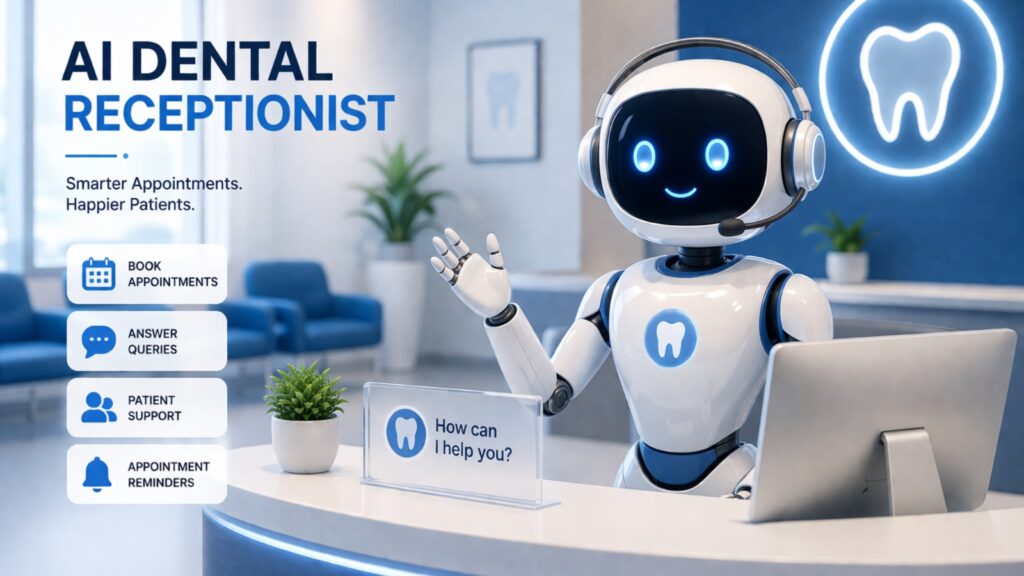
For most dental practice owners, the bottleneck isn’t the clinical work. You’ve spent years mastering the art of the perfect crown, the most efficient root canal, AI Receptionist for Dental and the nuances of patient chairside manner. Yet, despite clinical excellence, the “business” side of the practice often feels like a series of plugged leaks.
The primary point of failure is almost always the front desk. It is the most high-pressure environment in the building—a chaotic intersection of insurance verification, patient check-ins, payment processing, and a ringing phone that never seems to stop. When the phone rings while a patient is standing at the desk, something loses. Usually, it’s the caller.True practice growth does not come from working more hours, but from mastering dental practice automation to create a seamless patient journey.”
In the industry, we call this “missed-call leakage,” and for a mid-sized clinic, it can easily represent over $100,000 in lost production annually. This is where the concept of an AI receptionist for dental practices moves from a “tech luxury” to an operational necessity.
What Intelligence Means in a Dental Clinic
True practice growth does not come from working more hours or hiring more associates into a broken system. It comes from System Intelligence.
In a high-performing clinic, intelligence is split into two categories:
- Human Intelligence: Your staff’s ability to empathize with a nervous patient, handle complex billing disputes, and provide high-level clinical coordination.
- System Intelligence: The “digital infrastructure” that handles repetitive tasks—reminders, initial inquiries, missed call follow-ups, and scheduling.
The goal of implementing an AI receptionist or an automated CRM system is not to replace your front-desk person. It is to protect them. By delegating the “low-value, high-frequency” tasks to a system, you allow your human team to focus on “high-value, high-empathy” interactions.
The Economics of the Missed Call
Every missed call is a patient who is likely calling the clinic three blocks away. Data shows that 70% of new patients will not leave a voicemail; they simply hang up and click the next result on Google.
If your average new patient lifetime value is $1,500, and your front desk misses just five potential new patient calls a week, you are looking at a theoretical loss of $7,500 per week. Over a year, that is nearly $400,000 in untapped revenue.
An AI receptionist for dental clinics acts as a 24/7 safety net. Whether the line is busy, it’s after hours, or the staff is occupied with a patient in the office, the system engages the caller immediately via text or automated voice, qualifying their needs and offering a booking link.
Reducing No-Shows and Late Cancellations
Empty chairs are the silent killers of dental profitability. A no-show doesn’t just cost you the production; it costs you the overhead of the staff standing around and the missed opportunity of the patient who would have taken that slot.
Standard SMS reminders are no longer enough. Modern systems use “Conversational AI” to handle responses. If a patient texts back saying, “I can’t make it,” the system doesn’t just notify you—it can automatically offer them the next three available slots, rescheduling them without a single human intervention.
AI & Automation: Implementing GoHighLevel in Dentistry
When we talk about the technical “engine” behind this, we often look toward platforms like GoHighLevel. In the dental space, we don’t need a “marketing tool”—we need infrastructure.
Platforms like GoHighLevel allow clinics to centralize patient communication, reminders, and lead tracking inside one structured system. It bridges the gap between your practice management software (like Dentrix or EagleSoft) and the patient’s smartphone. It provides:
- Unified Inbox: Every text, Facebook message, and Google Business message in one place.
- Missed Call Text-Back: An immediate automated response to any call that goes unanswered.
- Pipeline Management: Seeing exactly where every “high-value” lead (like dental implants or Invisalign) stands in the journey.
A structured automation system ensures that no patient falls through the cracks, regardless of how busy the physical office becomes.
Note: The link below is an affiliate link. I only recommend systems that align with structured clinic growth.
“Think of it this way—if your clinic loses even 5 missed calls per week, that’s silent revenue walking away. A structured automation system prevents that.”
[Start Building a Smarter Dental System](INSERT YOUR AFFILIATE LINK HERE)
Real Clinic Scenarios: From Chaos to Control
To understand the impact of an AI receptionist for dental workflows, let’s look at a common Tuesday morning in a standard clinic:
Scenario A: The Traditional Workflow The phone rings. The receptionist is processing a $3,000 credit card payment for a crown. She lets the phone ring. The caller, a mother looking for a new family dentist, waits 4 rings and hangs up. She calls the competitor. The receptionist finishes the payment, feels stressed, and forgets to check the “missed call” log because three more patients just walked in for their 10:00 AM appointments.
Scenario B: The Automated Workflow The phone rings. The receptionist is busy. The system recognizes the call went unanswered. Within 30 seconds, the caller receives a text: “Hi, this is Riverside Dental! We’re helping another patient right now, but we’d love to help you. Are you looking to book an appointment or do you have a question?” The mother replies “Booking.” The AI sends a link to the calendar. She books her kids in for cleanings while the receptionist is still finishing the credit card transaction. Revenue captured. Stress minimized.To streamline your practice operations, implementing an AI Receptionist for Dental can significantly reduce missed call leakage.”
2. Descriptive Anchor Text (Best for Context)
Common Mistakes When Automating Your Clinic
While the “AI” buzz is loud, many owners fail in implementation. Here are the three most common pitfalls:
1. “Set it and Forget it” Fallacy
Automation is a tool, not a replacement for management. You must still review your “Lead Pipeline” weekly to see how the system is performing.
2. Over-Automating the Human Touch
Patients don’t want to talk to a robot when they are in pain or have a complex insurance question. The AI should handle the logistics (booking, confirming, following up), while the staff handles the relationships.
3. Using Multiple Disconnected Tools
If your “missed call” system doesn’t talk to your “review request” system, you’re creating more work for your team, not less. Centralizing your tech stack into a platform like GoHighLevel prevents “Data Silos.”
The Future of Structured Clinics
As we move further into the 2020s, the “lifestyle” dental practice will be defined by its systems. Owners who are burnt out are usually those who are still acting as the primary “problem solver” for every minor operational hiccup.
By implementing an AI receptionist for dental needs, you are effectively buying back your time. You are ensuring that the growth of your practice is decoupled from the limits of human endurance. Whether you are in the operatory or on vacation, the system is always “on,” always polite, and always following up.
Transitioning to a systemized clinic is a shift in mindset. It requires moving from a “manager” role to an “owner” role. Owners build systems; managers fight fires.
“True operational freedom comes when your revenue is no longer dependent on your physical presence at the front desk. Automation provides that visibility and control.”
[Start Building a Smarter Dental System](INSERT YOUR AFFILIATE LINK HERE)
Conclusion: Deciding to Systemize
The dental industry is becoming increasingly competitive. DSOs (Dental Support Organizations) are winning not because they provide better dentistry, but because they have better systems. They understand the “math” of a patient lead.
As an independent or small-group owner, you have the advantage of personal touch and community trust. When you combine that with the “System Intelligence” of an AI-driven CRM, you become unstoppable. You stop the “leaky bucket” syndrome and begin to see a stable, predictable flow of patients.
The transition doesn’t happen overnight, but it starts with a single decision: to stop letting your front desk be the single point of failure.
“Investing in your clinic’s digital infrastructure is the most direct path to reducing burnout and stabilizing your monthly production.”
[Start Building a Smarter Dental System](INSERT YOUR AFFILIATE LINK HERE)
FAQs about AI Receptionists for Dental Practices
1. Will an AI receptionist replace my front desk staff? No. It is designed to act as an assistant. It handles the repetitive “administrative” tasks like missed call follow-ups and appointment reminders, freeing your staff to handle high-value patient interactions and complex billing.
2. Is an AI receptionist HIPAA compliant? When using platforms like GoHighLevel, you must ensure you have the HIPAA compliance package activated. This ensures that all patient data, communication, and storage meet federal standards for security.
3. How does the “Missed Call Text-Back” actually work? The system monitors your office phone line. If a call is not picked up within a certain number of rings, or if the line is busy, the system triggers an immediate, personalized SMS to the caller to start a conversation.
4. Can patients actually book appointments through the AI? Yes. The system can be synced with your calendar. You can set specific “rules” (e.g., only show New Patient Exam slots) so the AI only offers the times you want to be filled.
5. Is this difficult to set up for someone who isn’t “tech-savvy”? While the backend can be complex, most clinic owners work with a strategist or use pre-built “snapshots” (templates) designed specifically for dental workflows, making the daily use very simple.
6. What is the ROI of an AI receptionist for dental clinics? If the system saves just one “High-Value” lead (like a dental implant or multiple-surface restoration) per month, it typically pays for itself 10x over. Most clinics see a significant reduction in no-shows within the first 60 days.