
“As a clinic owner, you’ve likely spent years perfecting your clinical skills. You can perform a root canal or a complex restoration with your eyes closed. However, the most painful ‘procedure’ in your practice isn’t dental—it’s operational, especially when it comes to consistently generating Dental Google Reviews to grow your online reputation.”
It’s the sound of a phone ringing at 12:15 PM while the front desk is at lunch. It’s the $4,000 treatment plan that was presented three weeks ago but never followed up on. It’s the patient who had a five-star experience but forgot to leave a review, leaving your Google profile stagnant while the aggressive corporate dental group down the street racks up dozens of new ratings.comprehensive dental practice automation
Dental growth does not come from better dentistry alone—it comes from intelligent systems.
In this guide, we will explore why Dental Google Review Automation is just one cog in a larger machine, and how transitioning from manual chaos to “System Intelligence” can stabilize your revenue without causing practitioner burnout.
1. The Hidden Leaks inDental Google Reviews Your Dental Operations
Most dental practice owners view “growth” as a marketing problem. They believe they need more leads. In reality, most clinics have a leaking bucket problem, not a lead problem.
Missed-Call Leakage
Data suggests that the average dental clinic misses up to 30% of incoming calls. These aren’t just inquiries; these are high-intent patients ready to book. When a call goes to voicemail, the patient rarely leaves a message—they simply call the next dentist on Google.
The No-Show Economics
A 15% no-show rate can cost a mid-sized clinic over $100,000 in lost production annually. If your team is still manually calling patients to confirm appointments, they are performing low-leverage work that is prone to human error and “busy-work” fatigue.
Front-Desk Overload
Your front desk is the “Director of First Impressions.” If they are buried in filing insurance claims, answering basic pricing questions, and chasing reviews, they cannot focus on the patient standing right in front of them. This friction reduces the patient experience and, ultimately, your review count.
2. What “Intelligence” Means in a Dental Clinic
To scale a practice, we must distinguish between two types of intelligence: Human Intelligence and System Intelligence.
Human Intelligence
This is what you and your team provide. It’s the empathy shown to a nervous patient, the clinical judgment during a diagnosis, and the chairside manner that builds trust. Human intelligence is expensive, finite, and prone to exhaustion.
System Intelligence
This is the infrastructure that works while you sleep. It is the automated text that goes out 10 minutes after a patient leaves the chair. It is the “Missed Call Text Back” that engages a lead when your front desk is on the other line. System intelligence is cheap, infinite, and never has a “bad day.”
Growth happens when you stop asking your humans to do what a system can do better.
3. The Power of Dental Google Review Automation
best dental patient engagement software
Why focus on Dental Google Review Automation? Because in 2026, Google is your “digital storefront.”
Reviews do two things:
- They improve your Local SEO (making you appear higher in search).
- They provide Social Proof (making patients choose you over a competitor).
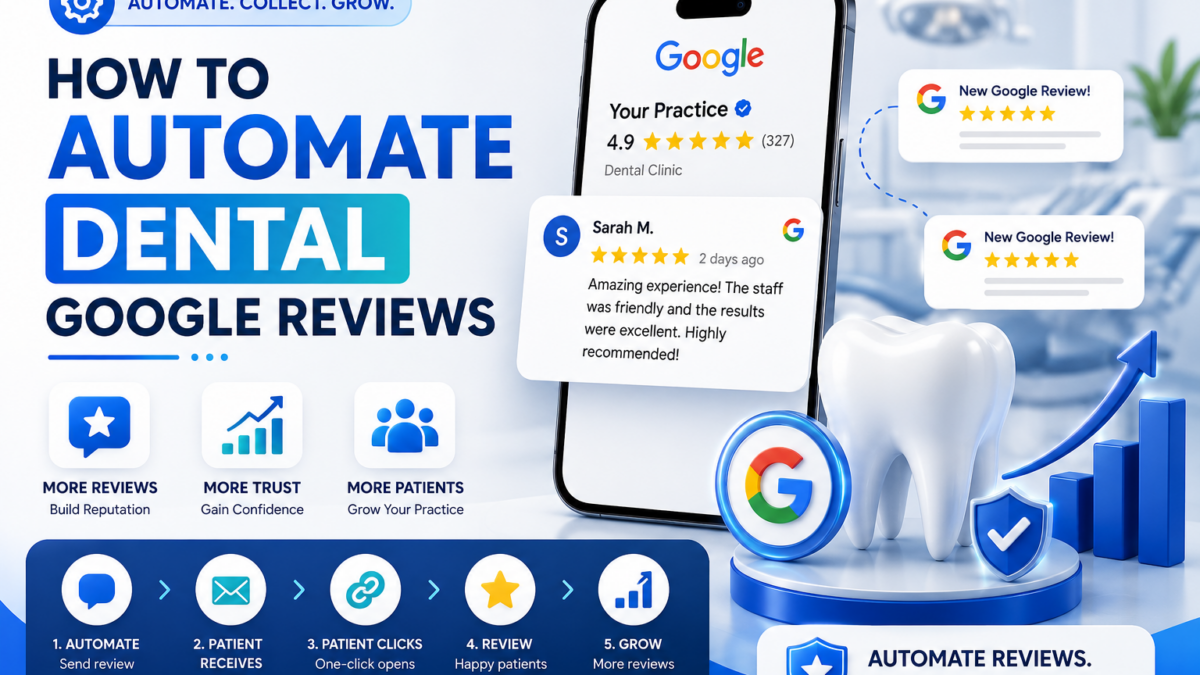
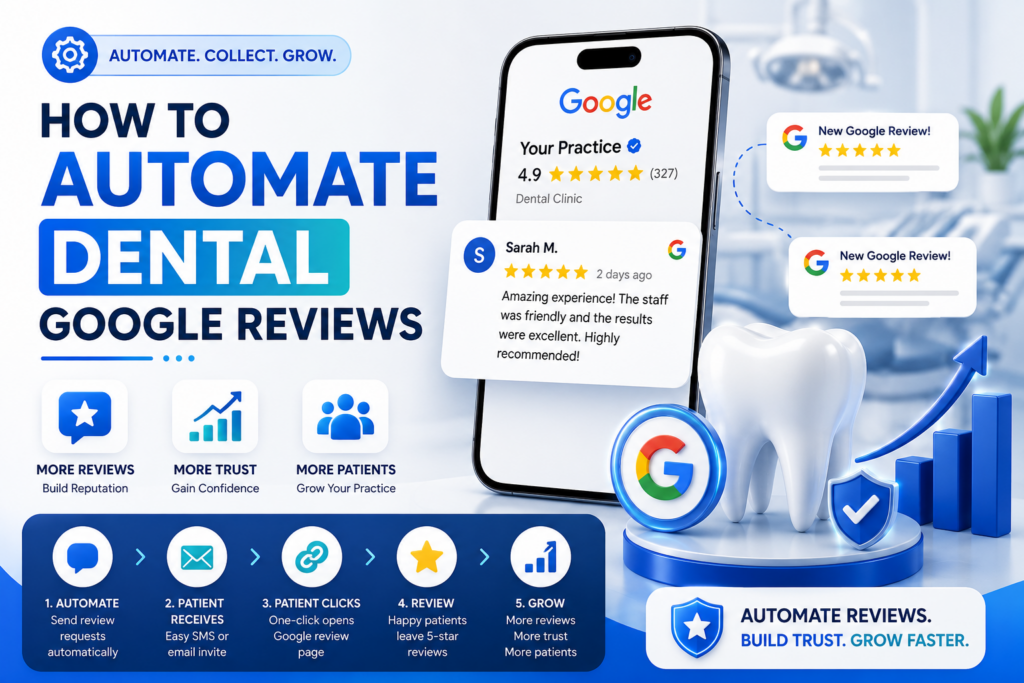
Manual review requests are inconsistent. A receptionist might ask a happy patient for a review on Monday but forget on Tuesday because the office got busy. Automation removes the “mood” of the office from the equation. By integrating your practice management software with a CRM, a review link is sent automatically via SMS the moment a patient is checked out.
The result? A consistent, compounding stream of feedback that builds your reputation without a single manual effort.
4. Moving Beyond Reviews: AI and Automation (The Infrastructure)
While reviews are vital, they are a byproduct of a well-run office. To truly modernize, clinic owners are moving toward centralized platforms.
Platforms like GoHighLevel allow clinics to centralize patient communication, reminders, and lead tracking inside one structured system. Instead of having five different softwares for email, SMS, reviews, and landing pages, a unified system creates a “Single Source of Truth.”
Real-World Scenario: The “After-Hours” Patient
Imagine a prospective patient finds your clinic on Google at 9:00 PM. They see your automated reviews and decide to call. No one answers.
- Without Automation: The lead is lost.
- With System Intelligence: The system immediately sends a text: “Hi, this is [Clinic Name]. Sorry we missed your call! Would you like to book an exam or ask a question?” The patient engages, a lead is captured in the CRM, and your team follows up the next morning to confirm the booking.
If your clinic is struggling to keep up with patient follow-ups or your reputation isn’t reflecting the quality of your work, it’s time to move from manual checklists to an integrated operations platform. A structured system doesn’t just save time—it secures your future revenue.
[Start Building a Smarter Dental System](INSERT YOUR AFFILIATE LINK HERE) Note: The link above is an affiliate link. I only recommend systems that align with structured clinic growth.
5. Case Studies: Systems in Action
Scenario A: The Hygiene Recall Gap
A patient is due for a six-month cleaning. Usually, the front desk spends three hours on a Friday afternoon calling a list of 40 people. Most don’t pick up. The System Solution: An automated “Reactivation Campaign” sends a series of personalized texts over 48 hours. Patients can click a link to book directly. The front desk only handles the final 5% who have complex questions.
Scenario B: High-Value Treatment Follow-Up
A patient is presented with a $5,000 implant plan. They say, “I need to talk to my spouse.” The System Solution: The moment the treatment plan is marked “Pending” in the CRM, an automated sequence begins. Day 3: An educational video about the benefits of implants. Day 7: A testimonial from a previous implant patient. Day 14: A gentle nudge to schedule. This happens without the dentist ever having to remind the staff to “call that guy back.”
6. Common Mistakes Clinic Owners Make
When attempting to implement Dental Google Review Automation and other systems, many owners fall into these traps:
- Fragmented Tech Stacks: Using one tool for reviews, another for reminders, and a third for the website. These tools don’t “talk” to each other, creating data silos.
- Over-Automation: Removing the human touch entirely. Automation should facilitate a human connection, not replace it. The goal is to automate the mundane so your staff can be more human.
- Ignoring the Lead Source: Not knowing exactly where your patients are coming from. A proper CRM tracks whether a patient came from a Google Review, a Facebook ad, or a referral.
7. Revenue Stabilization Without Burnout
Burnout in dentistry rarely comes from the clinical work; it comes from the friction of running a business. When you don’t have a system for Dental Google Review Automation, you worry about your reputation. When you don’t have lead tracking, you worry about the schedule.
System intelligence provides visibility. You can open a dashboard and see exactly how many reviews were requested, how many missed calls were recovered, and how much “pending revenue” is sitting in your pipeline.
This level of control allows you to step back from the “daily grind” and focus on being a clinician and a CEO.
Think of it this way—if your clinic loses even 5 missed calls per week, that’s silent revenue walking away. A structured automation system prevents that leak while simultaneously building your online authority through consistent patient feedback.
[Start Building a Smarter Dental System](INSERT YOUR AFFILIATE LINK HERE)
8. The Future of Structured Clinics
As we move further into 2026, AI-driven scheduling and automated patient communication will become the industry standard. The clinics that thrive will be those that treat their “Operational Infrastructure” with the same respect they treat their “Clinical Equipment.”
You wouldn’t use an outdated X-ray machine; why are you using an outdated, manual follow-up system?
9. Conclusion
Implementing Dental Google Review Automation is the “gateway drug” to full practice automation. It is a simple, high-ROI win that proves the power of systems. Once you see the reviews rolling in without effort, you will begin to see other areas—like missed call recovery and hygiene recalls—where system intelligence can replace human labor.
Stop being the engine of your practice and start being the pilot. Build a system that supports your growth, protects your time, and serves your patients at a level that manual processes simply cannot match.
Investing in a centralized platform isn’t about buying a new tool; it’s about installing the central nervous system for your business. By automating the routine, you empower your team to excel at the exceptional.
[Start Building a Smarter Dental System](INSERT YOUR AFFILIATE LINK HERE)
FAQs (Frequently Asked Questions)
1. Will automated reviews look “spammy” to my patients?
No. When done correctly, Dental Google Review Automation sends personalized, timed messages that feel like a natural extension of the patient’s visit. The key is to send the request while the positive experience is still fresh—typically within 1–2 hours of their appointment.
2. Can GoHighLevel replace my current Practice Management Software (PMS)?
Generally, no. Most clinics use GoHighLevel alongside their PMS (like Dentrix or Open Dental). The PMS handles clinical records and billing, while the CRM handles marketing, lead tracking, and automated patient communication.
3. How much time does it take to set up these systems?
While a full system build-out can take a few weeks, basic Dental Google Review Automation and “Missed Call Text Back” features can often be implemented in a few days. The time saved for your front desk usually pays for the setup time within the first month.
4. Is this compliant with healthcare privacy regulations?
Yes, provided you use the system correctly. Platforms like GoHighLevel offer HIPAA-compliant settings. Always ensure your automation triggers only use the necessary contact information to facilitate the communication.
5. What happens if a patient leaves a negative review through an automated system?
Automation allows you to set up “internal feedback loops.” You can ask the patient for a rating first; if the rating is low, the system can direct them to a private feedback form instead of Google, allowing you to resolve the issue privately.
6. Do I need to be “tech-savvy” to manage this?
You don’t need to be a coder. Modern systems are designed with user-friendly dashboards. However, many clinic owners choose to have a dedicated staff member or a fractional “Operations Manager” oversee the system to ensure it’s optimized.