
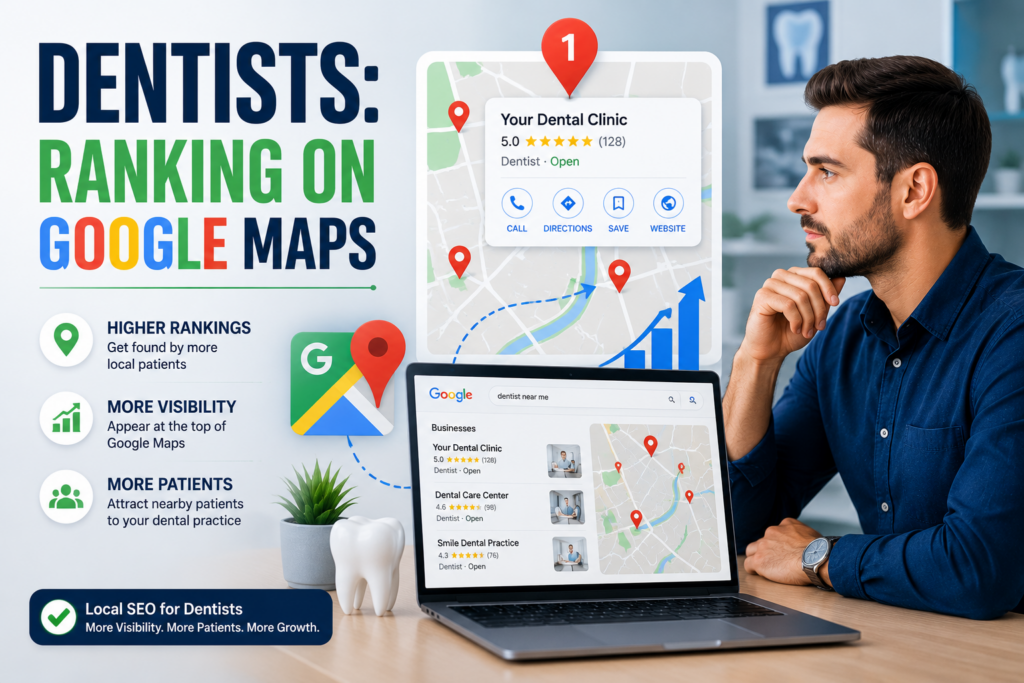
Dentists Ranking on Google Maps: The ROI Blueprint for Operational Dominance
In the high-stakes arena of modern dentistry, the “Hidden Leak” isn’t found in your supply closet or your PPO write-offs—it’s found in your digital proximity. For most practice owners, Dentists Ranking on Google Maps is viewed as a vanity metric or a marketing “extra.” In reality, failing to secure a top-three position in the Local Pack is a systemic operational failure that hemorrhages Patient Lifetime Value (LTV).
When a high-intent patient searches for a local provider, they are looking for the path of least resistance. If your clinic isn’t visible, you aren’t just losing a cleaning; you are losing the $15,000 to $30,000 LTV associated with a loyal family unit. We are moving beyond the era of “Famous Doctors” and entering the era of “Smart Clinics.” A smart clinic understands that search visibility is the first step in a high-conversion workflow.
The Economics of Reputation: Why Dentists Ranking on Google Maps Dictates Your CPA
The Cost Per Acquisition (CPA) for a dental patient has skyrocketed. Relying solely on fragmented PPC campaigns without a foundation in local search visibility is like pouring water into a cracked basin. Dentists Ranking on Google Maps serves as the ultimate trust signal.
The LTV Impact of a Single 1-Star Review
One negative review, left unaddressed, acts as a permanent tax on your marketing budget. Statistically, a single 1-star review can deter up to 11% of potential patients. In dental terms, if your average LTV is $5,000, and that review turns away 10 people a month, that “minor” digital blemish is costing your practice $50,000 in projected revenue.
The “Speed-to-Lead” Gap
The modern patient operates on a dopamine-driven timeline. If a lead finds you through your Google Business Profile and submits an inquiry, the clock starts. Responding after 15 minutes reduces your conversion probability by a staggering 80%. This is where manual clinics fail; they rely on a distracted front-desk person to “check the emails.” A systematic clinic uses automation to bridge this gap instantly.
The Strategic Architecture: Manual vs. GHL-Automated Clinics
To understand how to dominate the local rankings, we must compare the traditional, staff-dependent model with a system-dependent architecture.
| Operational Feature | The Chaotic Manual Clinic | The GHL-Automated Systematic Clinic |
| Review Generation | Staff “remembers” to ask patients verbally. | Automated SMS/Email triggers post-checkout. |
| Google Maps Updates | Occasional photo uploads when someone thinks of it. | Scheduled API posts and geo-tagged image updates. |
| Lead Response | Call-backs happen between appointments. | AI-driven “Missed Call Text Back” & Instant SMS. |
| Data Integrity | Inconsistent NAP (Name, Address, Phone) data. | Automated citation syncing and locked data. |
| Patient Retention | Manual recall lists that are often ignored. | Automated re-activation workflows for dormant leads. |
Leveraging GoHighLevel (GHL) for Dentists Ranking on Google Maps
GoHighLevel isn’t just a CRM; it is the Central Nervous System of a high-performance dental practice. If you want to sustain Dentists Ranking on Google Maps, you cannot rely on human effort. You need a machine.
1. Automated Reputation Management
Google’s algorithm prioritizes “Recency, Frequency, and Sentiment.” GHL’s reputation management module allows you to build a Workflow Trigger that fires the moment a patient is marked as “Checked Out” in your Practice Management Software (PMS). By sending a personalized SMS request while the patient is still in the parking lot, you capture high-sentiment reviews that boost your map rankings.
2. The Power of GHL Workflow Triggers
Ranking is only half the battle; the other half is conversion. When your GHL system is tuned for Dentists Ranking on Google Maps, every click on your “Call” button or “Message” button triggers a sequence.
- Trigger: Inbound Message via Google.
- Action: Immediate SMS response: “Hi! This is [Name] from [Clinic]. We saw your message. Would you like to see our available times for this week?”
3. Maintaining NAP Consistency via API
One of the primary reasons for ranking drops is “Data Drift”—where your clinic’s info varies across the web. GHL acts as a single source of truth, pushing your correct NAP data to hundreds of directories, ensuring Google’s spiders see a clean, authoritative footprint.
Implementation Failures: Why “Buying the Software” Isn’t Enough
Many doctors buy GHL and expect it to magically improve Dentists Ranking on Google Maps. This is a fallacy. Software is an engine; workflows are the fuel.
The most common failure is the “Silent System.” This happens when a clinic sets up the software but fails to integrate it with their daily clinical flow. If your staff isn’t moving “Opportunities” through the pipeline, the automation doesn’t know when to fire. A system-dependent clinic trains its staff on the dashboard, not the task.
If you aren’t auditing your workflow triggers weekly, you are leaving your ROI to chance. High-level operations require a shift from “doing dental work” to “overseeing a dental system.”
Strategic growth requires moving from a technician mindset to a CEO mindset, where every patient interaction is tracked and every lead is guarded.
👉 “Start Building a Smarter Dental System”
Case Study: From Page 4 to the Top 3
The Scenario
A mid-sized practice in a competitive urban area was struggling with a high Churn Rate and stagnant growth. Despite having a “famous” head surgeon, they were nowhere to be found in local searches. Their primary keyword, Dentists Ranking on Google Maps, was dominated by corporate dental groups with inferior clinical outcomes but superior digital systems.
The Intervention
We implemented a GHL-driven “Visibility Engine”:
- Review Blitz: We triggered an SMS blast to their top 500 patients from the last 12 months, resulting in 85 new 5-star reviews in 14 days.
- Optimized Posting: We utilized GHL’s social planner to post daily updates to their Google Business Profile, highlighting “Before and Afters” with geo-coded metadata.
- The Result: Within 45 days, the clinic jumped from the 12th position to the 2nd position. Their monthly lead volume increased by 210%, and their CPA dropped by 40% because they were no longer paying for “top-of-page” ads; they were winning the “organic” map war.
Detailed FAQs: Solving Complex Operational Hurdles
How does the Google Maps algorithm weigh “Review Velocity” vs. “Review Volume”?
When it comes to Dentists Ranking on Google Maps, velocity (how fast you get reviews) is often more important than volume (total number). Google’s algorithm is designed to surface “active and relevant” businesses. A clinic with 500 reviews from three years ago will often be outranked by a clinic with 150 reviews that gets 5 new ones every week. Using GHL’s automated SMS triggers ensures a steady pulse of feedback. This “velocity” signals to Google that your practice is thriving and currently trusted by the community, which directly influences your local search placement and keeps you ahead of competitors who only “bulk request” reviews once a year.
Is using automated AI responses to Google reviews HIPAA compliant?
Compliance is a non-negotiable pillar of healthcare operations. While GHL offers AI-driven response tools, they must be configured with a “Privacy First” logic. You must never acknowledge specific clinical details or confirm that a person is a patient in a public forum. The “Smart Clinic” approach uses GHL templates that are pre-vetted for compliance: “Thank you for your kind words! We strive to provide excellent service to all our visitors.” This allows you to maintain the “activity” required for Dentists Ranking on Google Maps without violating PHI (Protected Health Information) regulations. Automation should handle the timing, while your templates handle the safety.
Why does my clinic’s ranking fluctuate when I’m only 5 miles away from the searcher?
Google Maps uses a “Proximity Grid.” Your ranking for Dentists Ranking on Google Maps is not a single number; it’s a heatmap. You might be #1 when someone is standing in your lobby, but #8 when they are three miles North. To combat this, your GHL system must focus on “Local Authority.” This involves creating location-specific landing pages and ensuring your Google Business Profile is packed with “Local Signals”—mentions of nearby landmarks, local community events, and neighborhood-specific keywords. This expands your “Ranking Radius,” allowing you to capture high-value patients from a wider geographic area.
Can GHL help reduce my patient Churn Rate through Google Maps integration?
Absolutely. A common cause of churn is a “friction-filled” re-booking process. By integrating GHL’s booking widget directly with your Google Maps profile, you allow patients to book appointments without ever leaving the search interface. When you make it easier for a patient to stay than to leave, your Churn Rate plummets. Furthermore, GHL’s automated “Re-activation” workflows can target patients who haven’t visited in 6 months, sending them an SMS with a direct link to your Google-integrated calendar. This turns your Google Maps presence into a “Loyalty Loop” rather than just a discovery tool.
What is the relationship between website load speed and Google Maps ranking?
Google evaluates your “Entity” as a whole. If your website is slow, clunky, or not mobile-optimized, it negatively impacts your authority for Dentists Ranking on Google Maps. Google’s “Mobile-First Indexing” means that if a patient clicks from your Map listing to your site and it takes more than 3 seconds to load, they will bounce. High bounce rates signal to Google that you are a poor recommendation. Using GHL’s high-speed funnel builder ensures that your “Map-to-Appointment” path is lightning-fast, maintaining the high dwell times and low bounce rates that Google rewards with higher rankings.
How do “Missed Call Text Back” features influence my local SEO?
Google tracks “User Success Metrics.” If someone calls your clinic from a Maps listing and the call goes unanswered (and no follow-up occurs), Google interprets this as a failed user experience. If this happens repeatedly, your ranking for Dentists Ranking on Google Maps will suffer. GHL’s “Missed Call Text Back” immediately sends an SMS to the caller: “Sorry we missed you! How can we help?” This transitions a “failed” interaction into an “engaged” one. This doesn’t just save the lead; it protects your ranking by ensuring that the searcher stops their search with you rather than clicking the next dentist on the list.
Mastering the Workflow Triggers
The transition from a “Chaotic Clinic” to a “Systematic Powerhouse” requires a commitment to the “Central Nervous System” model. Every time a staff member performs a manual task that could be automated, your ROI is leaking.
- Audit your “Speed-to-Lead”: If it’s over 5 minutes, you are losing money.
- Audit your Review Velocity: If you aren’t getting 2+ reviews a week, your ranking will decay.
- Audit your Data: If your NAP is inconsistent, your authority is compromised.
The true cost of being invisible is the missed opportunity to serve your community. Ranking isn’t about ego; it’s about being the most accessible solution for a patient in pain.
Operational excellence is the only way to ensure that your marketing spend translates into actual chairs filled.
👉 “Start Building a Smarter Dental System”
Conclusion: Dominating the Local Landscape
Achieving #1 for Dentists Ranking on Google Maps is not a one-time event; it is a continuous operational discipline. By moving away from staff-dependent tasks and leaning into GHL-driven systems, you create a clinic that grows predictably and profitably.
Remember, the “Smart Clinic” doesn’t work harder; it works with better logic. It uses the “Economics of Reputation” to lower CPA and the “Speed-to-Lead” to maximize LTV. When these elements are synchronized through GoHighLevel, your clinic becomes an unstoppable force in the local market.
Note: The link below is an affiliate link. I only recommend systems that align with structured clinic growth.
The difference between a struggling practice and a market leader is the system they choose to build today.