
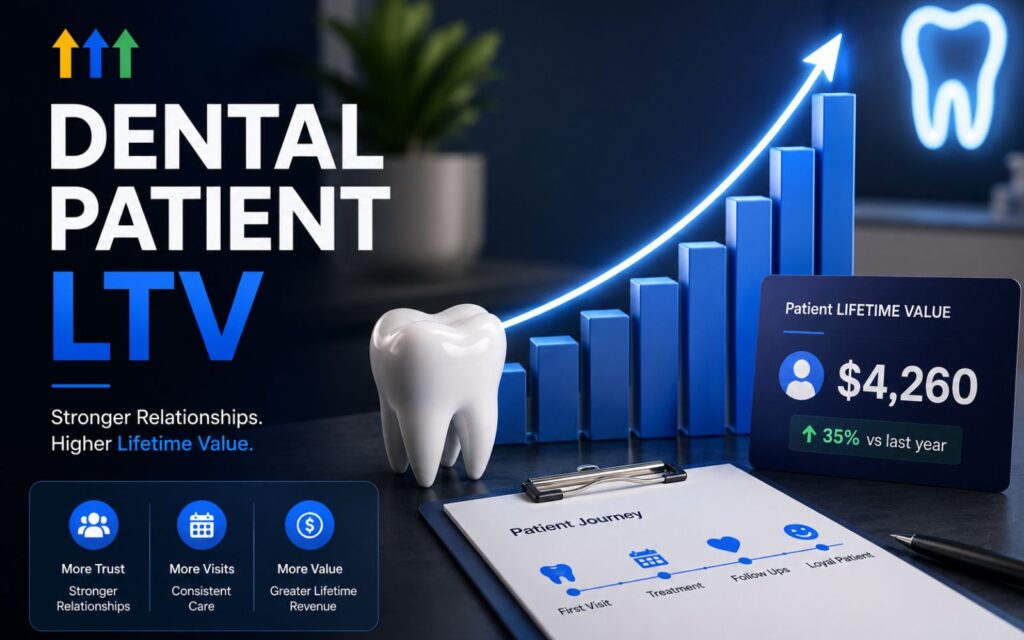
In the dental industry, there is a common misconception that growth is a byproduct of clinical excellence alone. While a perfect crown or a seamless implant procedure is essential for patient health, it is rarely the primary driver of a scalable business. Many practice owners find themselves on a treadmill: producing high-quality dentistry while simultaneously battling high overhead, fluctuating schedules, and a front-desk team that is perpetually overwhelmed.
The reality of modern practice management is that profitability isn’t found in the “one-off” procedure; it is found in the long-term relationship. This is why Tracking Patient Lifetime Value is the most critical metric for any clinic owner who wishes to move from a state of reactive chaos to proactive growth.
1. The Operational Pain Points of the Modern Clinic
Most dental clinics operate in a state of “leaky bucket” economics. The owner spends thousands on marketing to acquire new patients, only to lose them through the gaps in their operational systems.
Consider these common scenarios:
- The Missed Call Leakage: A prospective patient calls during the lunch hour or while the receptionist is handling a checkout. That call goes to voicemail and is never returned. To the clinic, that’s just a missed call. To the business, that’s the loss of the entire potential lifetime value of a family.
- The No-Show Tax: Empty chairs are the most expensive part of a dental office. When a patient fails to show, the fixed costs of staff and facility remain, but the revenue vanishes.
- The Follow-Up Fatigue: Recare lists are often hundreds of names deep. Manual calling is tedious, and as a result, it often doesn’t happen consistently.
When you focus on Tracking Patient Lifetime Value, you stop looking at a patient as a single $200 cleaning or a $1,200 crown. You start seeing them as a decade-long relationship worth $10,000 to $15,000. When the stakes are that high, “forgetting” to follow up is no longer an option.
2. What Intelligence Means in a Dental Clinic
Intelligence in a clinical setting is often associated with diagnostic skill. However, operational intelligence is different. It is the ability of a practice to collect data, interpret it, and use it to automate repetitive tasks.
An “intelligent” clinic doesn’t rely on the memory of a front-desk coordinator. Instead, it relies on a framework where:
- Data is Centralized: Every interaction—SMS, email, phone call—is recorded.
- Responses are Standardized: Every lead is treated with the same level of urgency.
- Metrics are Visible: The owner can see exactly where a patient is in their lifecycle.
3. Human Intelligence vs. System Intelligence
We often over-rely on “Human Intelligence.” We hire a “rockstar” office manager and hope they stay forever. But humans get tired, they get distracted, and they have bad days.
System Intelligence acts as the guardrail for human error.
- Human Intelligence: Remembers to call a patient who missed an appointment when they have a free moment.
- System Intelligence: Automatically triggers a text message the moment a “No-Show” status is checked in the software, offering a one-click rescheduling link.
By Tracking Patient Lifetime Value through systems, you protect the clinic from the inevitable fluctuations in human performance.
4. AI & Automation: Integrating Modern Infrastructure
To bridge the gap between human effort and clinical growth, many practices are turning to centralized CRM (Customer Relationship Management) platforms. Tools like GoHighLevel have become the infrastructure of choice for clinics looking to move away from fragmented software.
Instead of having one tool for two-way texting, another for your website, and a third for “missed call text back,” a unified system allows you to manage the entire patient journey in one place. Automation doesn’t replace the human touch; it scales it. For example, when a new lead comes in through your website, the system can instantly send a personalized “Welcome” text. This immediate engagement significantly increases the likelihood of a booking, directly impacting the long-term health of your patient base.
Think of it this way—if your clinic loses even 5 missed calls per week, that’s silent revenue walking away. A structured automation system prevents that by capturing every lead and ensuring no patient falls through the cracks. Note: The link below is an affiliate link. I only recommend systems that align with structured clinic growth.
[👉 Start Building a Smarter Dental System](INSERT YOUR AFFILIATE LINK HERE)
5. Real Clinic Scenarios: The Impact of Tracking Patient Lifetime Value
Let’s look at two different clinics to see how system intelligence changes the math.
Scenario A: The Manual Clinic
Clinic A relies on manual entry. When a patient finishes an appointment but doesn’t book their next six-month cleaning, the receptionist makes a note to “call them later.” Life happens, the phone rings, and that patient is forgotten. Six months later, the patient realizes they are due, but they see an ad for the dentist down the street and go there instead. The Loss: Not just the $200 cleaning, but the next 10 years of referrals and restorative work.
Scenario B: The Systematized Clinic
Clinic B utilizes Tracking Patient Lifetime Value as a philosophy. When the patient leaves without an appointment, a “Lost Recare” workflow is triggered in their CRM.
- Day 1: A polite text thanking them for their visit.
- Month 4: An automated reminder that they are due soon.
- Month 6: A direct booking link sent via SMS. The patient books without the front desk ever picking up the phone. The Gain: A retained patient with a predictable lifetime value.
6. Common Mistakes in Dental Growth
The biggest mistake clinic owners make is “The Marketing Trap.”
They believe that if they just get more new patients, their problems will be solved. But if your internal systems are broken, adding more leads is like pouring water into a sieve.
- Mistake 1: Ignoring Missed Calls. Over 30% of dental office calls go unanswered or to voicemail during busy hours.
- Mistake 2: Lack of Lead Tracking. Not knowing which marketing channel (Google, Facebook, Referrals) produced the patient with the highest lifetime value.
- Mistake 3: Overcomplicating the Tech Stack. Using five different softwares that don’t talk to each other, creating “data silos.”
7. Future of Structured Clinics: Revenue Stabilization Without Burnout
The future of dentistry isn’t just about better lasers or 3D printers; it’s about revenue stabilization.
When you implement a system like GoHighLevel to handle your “Missed Call Text Back” and “Automated Follow-ups,” you are building an asset that works while you are in the operatory. This reduces the “Front-Desk Overload” that leads to staff turnover. When your team isn’t bogged down by the “busy work” of chasing patients, they can focus on providing an exceptional in-office experience.
By consistently Tracking Patient Lifetime Value, you can shift your focus from “How many new patients did we get?” to “How well are we keeping the patients we have?” This shift is what allows a clinic to grow its bottom line without the owner needing to work more hours.
Implementing a structured system is about more than just software—it’s about gaining visibility into your practice’s future. By centralizing your communication and tracking every lead, you ensure that your clinical excellence is backed by operational precision.
[👉 Start Building a Smarter Dental System](INSERT YOUR AFFILIATE LINK HERE)
8. Conclusion
Tracking Patient Lifetime Value is the difference between a job and a business. A job requires your constant physical presence and manual intervention to generate income. A business is a system that produces value predictably.
By integrating automation and CRM tools into your workflow, you aren’t “dehumanizing” your practice. On the contrary, you are freeing your staff to be more human, while the “intelligent systems” handle the relentless task of tracking, reminding, and recovering lost opportunities. Growth is not an accident; it is the result of a system designed to sustain it.
9. FAQs
What is Patient Lifetime Value (LTV) in dentistry?
Patient Lifetime Value is the total projected revenue a single patient will generate for your clinic over the entire duration of their relationship with you. This includes hygiene visits, restorative work, and any referrals they bring to the practice.
Why is tracking LTV more important than tracking new patients?
Acquiring a new patient is 5 to 25 times more expensive than retaining an existing one. By focusing on LTV, you maximize the return on your initial marketing investment and build a more stable, predictable revenue stream.
How does automation help reduce no-shows?
Automation provides a multi-touchpoint reminder system (SMS, Email, Voice) that doesn’t rely on staff memory. By sending timely, interactive reminders that allow patients to confirm or reschedule with one click, you significantly lower the barriers to attendance.
Can GoHighLevel replace my existing Dental Practice Management Software (PMS)?
No. GoHighLevel is designed to sit alongside your PMS (like Dentrix or Open Dental). While the PMS handles clinical records and billing, the CRM handles the “front-end” communication, lead tracking, and marketing automation that most PMS systems do poorly.
What is “Missed Call Text Back” and why do I need it?
This is a feature where the system detects an unanswered call and immediately sends a text to the caller saying, “Sorry we missed you! How can we help?” This stops the patient from calling the next dentist on the Google search list and keeps the lead “warm.”
How do I start tracking these metrics without adding more work for my staff?
The key is integration. By using a centralized platform, the data is collected automatically as patients interact with your marketing and communication channels. You can then review a single dashboard rather than manually compiling spreadsheets.
Modernizing your clinic’s infrastructure is the most direct path to reducing stress and increasing profitability. If you are ready to move away from manual follow-ups and start seeing the true value of your patient base, now is the time to implement a structured system.
[👉 Start Building a Smarter Dental System](INSERT YOUR AFFILIATE LINK HERE)