
SEO Title: Sending Birthday Wishes to Dental Patients: A Strategic Guide to Retention and Automation Meta Description: Discover how sending birthday wishes to dental patients, combined with smart automation and CRM systems, reduces no-shows and builds long-term practice loyalty.
Sending Birthday Wishes to Dental Patients: The Strategic Intersection of Care and Automation
For the modern dental clinic owner, the day-to-day reality is often a balancing act between clinical excellence and operational survival. You didn’t go to dental school to become a logistics expert or a software engineer, yet the success of your practice hinges increasingly on how well you manage the spaces between appointments.
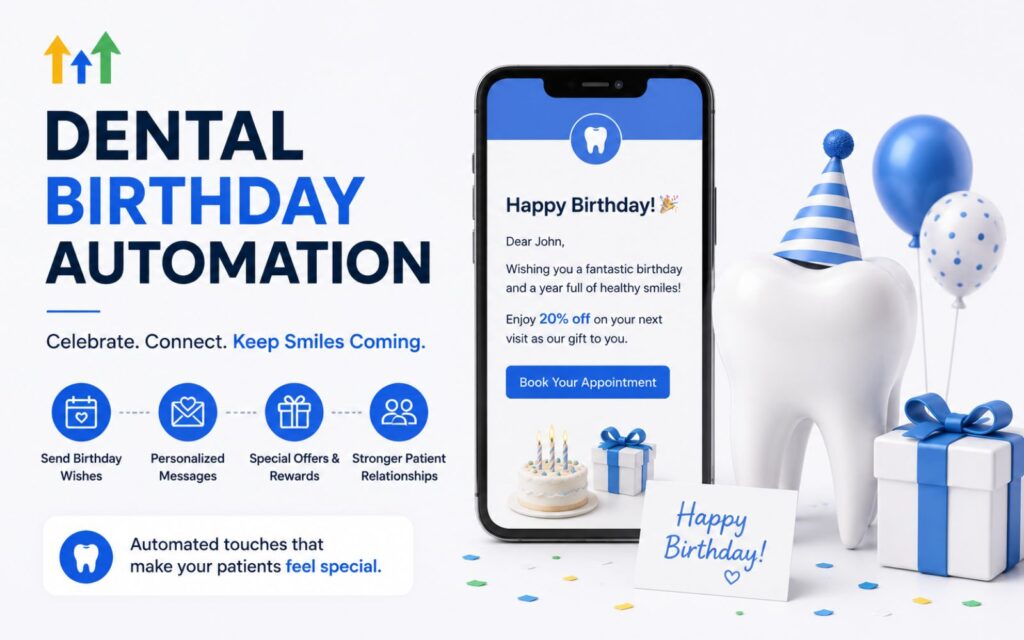
One of the most overlooked opportunities for stabilizing revenue and deepening patient loyalty is the simple act of sending birthday wishes to dental patients.
On the surface, a birthday greeting seems like a “nice-to-have” marketing flourish. However, from an operational standpoint, it is a high-leverage touchpoint. When executed through a structured system, it moves beyond a mere gesture and becomes a tool for patient lifecycle management, recall consistency, and brand recall.
What “Intelligence” Means in a Dental Clinic
Growth in dentistry is rarely the result of a single “breakthrough” marketing campaign. Instead, it is the cumulative effect of closing small operational gaps. We call this System Intelligence.
In a traditional clinic, the staff is the primary engine of intelligence. They remember faces, they manually call patients who missed appointments, and they try their best to keep the schedule full. But humans are prone to fatigue and distraction. When the front desk is busy handling an emergency walk-in and a complex insurance claim, sending birthday wishes to dental patients—along with follow-up recalls—is the first thing to fall off the priority list.
An intelligent clinic doesn’t rely solely on the memory of the front-desk coordinator. It relies on a “Digital Nervous System” that automates routine tasks, ensuring no patient feels forgotten and no revenue opportunity is ignored.
Human Intelligence vs. System Intelligence
To build a sustainable practice, you must distinguish between what humans do best and what systems do best.
The Role of Human Intelligence
- Clinical Diagnosis: Assessing oral health and performing complex procedures.
- Empathy: Comforting a nervous patient before a root canal.
- Complex Problem Solving: Navigating intricate insurance disputes or treatment plan adjustments.
The Role of System Intelligence
- Consistency: Sending a birthday text or email exactly on the patient’s special day, every single year.
- Reliability: Following up on a missed call within 2 minutes, even if the office is closed.
- Data Integrity: Tracking exactly how many leads from a social media ad actually sat in the chair.
When you bridge these two, you create a clinic that feels deeply personal to the patient but operates with industrial efficiency.
AI & Automation: Integrating the “Digital Nervous System”
The modern solution for dental operations isn’t more staff—it’s better infrastructure. This is where platforms like GoHighLevel have changed the landscape for small-to-mid-sized clinics. Instead of having five different subscriptions for email marketing, SMS reminders, lead tracking, and reputation management, a centralized CRM allows you to house everything under one roof.
Automation allows for “set-and-forget” workflows. For example, sending birthday wishes to dental patients can be programmed once. The system pulls the date of birth from your records and triggers a personalized message. But the intelligence doesn’t stop there. You can link that birthday wish to a “Self-Care Gift” (like a professional whitening discount) that includes a direct booking link, effectively turning a greeting into a scheduled appointment without a single staff member picking up the phone.
Integrating these tools isn’t about replacing the “human touch”; it’s about freeing your staff from the “robotic tasks” so they can focus on the people in the waiting room.
Operational Insight: If your staff spends 2 hours a week manually checking the calendar to send messages, that is time taken away from treatment plan presentations. Automation buys that time back.
While GoHighLevel offers robust infrastructure, choosing the right platform depends on your specific needs; you can explore our best dental CRM comparison guide to see how different systems stack up in 2026.
Think of it this way—if your clinic loses even 5 missed calls per week, that’s silent revenue walking away. A structured automation system prevents that by capturing every lead and nurturing every relationship.
[Start Building a Smarter Dental System](INSERT YOUR AFFILIATE LINK HERE) Note: The link above is an affiliate link. I only recommend systems that align with structured clinic growth.
Real Clinic Scenarios: The Impact of Automation
Let’s look at how sending birthday wishes to dental patients and broader automation systems function in real-world dental environments.
Scenario A: The “Ghost” Patient
A patient hasn’t been in for a cleaning in 9 months. They aren’t “lost,” they are just busy. On their birthday, they receive an automated text: “Happy Birthday from Dr. Smith’s Team! We have a special gift waiting for you. Click here to claim your birthday cleaning credit.” The patient clicks, sees the available slots, and books. Total staff effort: Zero.
Scenario B: The After-Hours Inquiry
It’s 8:00 PM on a Tuesday. A prospective patient finds your clinic online and calls. Usually, this is a missed-call leakage. With a system like GoHighLevel, the missed call triggers an immediate “Auto-Reply” text: “Hi, this is [Clinic Name]. We missed your call! How can we help you tonight?” The patient responds, the system sends a booking link, and by Wednesday morning, your front desk arrives to a new appointment already on the books.
Scenario C: The No-Show Prevention
Standard reminders are often ignored. An intelligent system uses “Logic-Based Reminders.” If a patient hasn’t confirmed their appointment 24 hours prior, the system automatically escalates the communication or notifies the front desk to prioritize a phone call to that specific person.
Common Mistakes in Dental Practice Management
In my experience as a strategist, I see clinic owners make three recurring errors when trying to scale:
- Over-Hiring Instead of Automating: When the front desk feels overwhelmed, the knee-jerk reaction is to hire another receptionist. Often, the problem isn’t a lack of people; it’s a lack of a system. A CRM can handle the workload of 1.5 full-time employees regarding follow-ups and scheduling.
- Fragmented Data: Using one tool for birthday emails, another for SMS, and a spreadsheet for leads. This creates “data silos” where you have no clear picture of your patient’s journey.
- Passive Patient Retention: Assuming patients will return just because you did a good job. In a competitive market, out-of-sight is out-of-mind. Sending birthday wishes to dental patients is a low-cost way to remain the “Top of Mind” provider in your community.
The Future of Structured Clinics
The dental industry is moving toward a model of “High-Tech, High-Touch.” Patients now expect the same digital convenience from their dentist that they get from Amazon or Uber. They want to book online, receive text updates, and feel recognized as individuals.
By implementing a centralized platform, you gain visibility into your “Leaky Bucket.” You can see exactly where patients are dropping off—is it at the first phone call? After the treatment plan presentation? Or during the 6-month recall? Once you see the data, you can build an automated bridge to fix it.
Infrastructure is the only way to achieve revenue stabilization without burnout. When the systems are doing the heavy lifting of lead recovery and retention, the owner-doctor can return to being a clinician rather than a stressed-out administrator.
The transition from a chaotic manual office to a streamlined, automated practice doesn’t happen overnight, but it starts with choosing the right foundation.
[Start Building a Smarter Dental System](INSERT YOUR AFFILIATE LINK HERE)
Conclusion: Beyond the Birthday Wish
While sending birthday wishes to dental patients is a small tactical move, it represents a larger shift in philosophy. It is the move from “Reactive Dentistry” (waiting for the phone to ring) to “Proactive Practice Management” (creating reasons for the phone to ring).
The most successful clinics I’ve worked with aren’t always the ones with the newest 3D scanners; they are the ones with the tightest systems. They understand that every missed call, every unconfirmed appointment, and every forgotten birthday is a micro-fracture in the business’s foundation.
Invest in your systems, and your clinical skills will finally have the platform they deserve to shine.
FAQs
1. Does sending birthday wishes to dental patients actually increase revenue?
Directly, it can drive “gift-claim” appointments. Indirectly, it significantly boosts patient retention. It costs 5x more to acquire a new patient than to retain an existing one. Birthday greetings keep your practice in the patient’s “mental circle,” reducing the likelihood they will switch to a competitor.
2. Is it better to send birthday wishes via email or SMS?
SMS has a 98% open rate, whereas email often hovers around 20%. For a personal touch like a birthday wish, SMS feels more immediate and sincere. However, using a CRM that can do both ensures you reach the patient on their preferred channel.
3. Will automation make my dental practice feel “cold” or “robotic”?
On the contrary, automation makes you more human. By automating the “logistics,” your staff has more time to have meaningful, unhurried conversations with the patients physically in the office. You are using technology to ensure no one is ignored.
4. How long does it take to set up an automated system like GoHighLevel?
A basic setup—including missed-call text-back and automated birthday workflows—can be implemented in a few days. More complex integrations with your Practice Management Software (PMS) may take a few weeks to fine-tune, but the ROI is typically seen within the first month.
5. Can I personalize automated birthday messages?
Yes. Modern CRMs use “merge tags” to pull the patient’s first name, their specific doctor’s name, and even reference the clinic location. The patient receives a message that looks like it was typed manually by your front-desk coordinator.
6. What should I offer as a “Birthday Gift” in the message?
Many clinics offer a discount on professional whitening, a free upgraded electric toothbrush with their next cleaning, or a small credit toward any out-of-pocket treatment. The goal is to provide value that encourages them to book an appointment.