
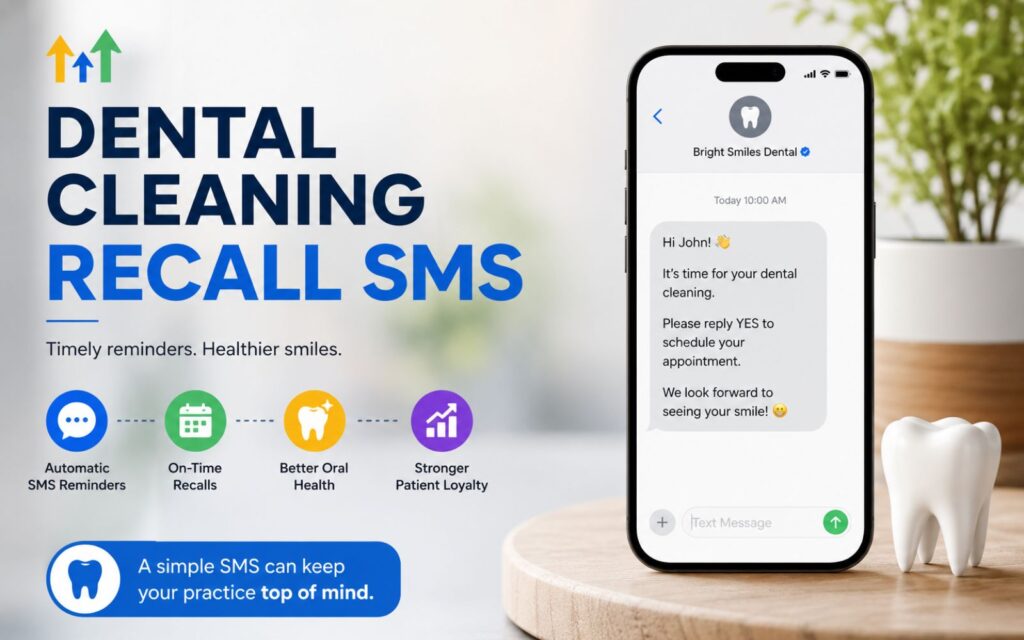
SEO Title: 6-Month Dental Cleaning Reminders: Building a System for Patient Retention and Clinic Stability Meta Description: Discover how automated 6-month dental cleaning reminders and intelligent CRM systems reduce no-shows, recover missed revenue, and stabilize dental clinic growth.
6-Month Dental Cleaning Reminders: The Engine of Clinical Stability
As a dental clinic owner, you are likely intimately familiar with the “production roller coaster.” One month, the chairs are full, the team is high-energy, and the revenue justifies the overhead. The next month, the schedule looks like Swiss cheese—riddled with holes, last-minute cancellations, and unconfirmed hygiene appointments.
Most practice owners attempt to solve this by spending more on patient acquisition. They pour money into Google Ads or social media, hoping a fresh influx of new patients will fix the “leaky bucket.” However, operational experience suggests that dental growth does not come from better dentistry or more ads alone—it comes from intelligent systems.
The most undervalued asset in your practice isn’t your high-end imaging equipment; it’s your recall list. Specifically, how you manage 6-month dental cleaning reminders determines whether your practice operates in a state of reactive chaos or proactive stability.
What Intelligence Means in a Dental Clinic
In a clinical setting, “intelligence” is often associated with diagnostic accuracy or surgical skill. In an operational setting, intelligence refers to the predictability of outcomes.
An intelligent clinic is one where the front desk isn’t “hoping” the afternoon stays full. Instead, they are managing a system that has already verified those appointments 72 hours in advance. Intelligence means knowing exactly how many patients are due for their 6-month dental cleaning reminders and having a multi-channel sequence in place to ensure they book without a staff member needing to manually dial fifty phone numbers a day.
When we shift the focus from “working harder” to “building systems,” we move away from burnout. A system doesn’t get tired, it doesn’t forget to follow up because a patient walked in with a billing question, and it doesn’t feel awkward asking a patient to reschedule.
Human Intelligence vs. System Intelligence
There is a common friction point in dental offices: the reliance on “rockstar” front-desk staff. While a skilled Office Manager is invaluable, relying solely on Human Intelligence for repetitive tasks like 6-month dental cleaning reminders is a strategic error.
The Limits of Human Intelligence
- Cognitive Load: Your staff is managing check-ins, insurance verification, co-pays, and chair-side assistance coordination. Expecting them to also perfectly track lead leakage is unrealistic.
- Inconsistency: If your lead receptionist is out sick, do the 6-month dental cleaning reminders go out? Usually, they don’t.
- The “Hustle” Trap: Humans are not meant to be high-volume outbound dialers. When staff spend all day on the phone chasing recalls, their face-to-face patient interaction suffers.
The Power of System Intelligence
System Intelligence acts as the digital infrastructure of your clinic. It handles the “low-value, high-frequency” tasks. By automating the outreach for 6-month dental cleaning reminders, you free your human staff to focus on “high-value, low-frequency” tasks—like complex treatment plan presentations and building genuine patient rapport.
AI & Automation: Centralizing the Patient Lifecycle
This is where modern CRM (Customer Relationship Management) tools, such as GoHighLevel, change the math of a dental practice. Instead of using five different softwares that don’t talk to each other, a centralized system allows you to track a patient from the moment they click an ad to the moment they show up for their third-year hygiene visit.To understand how different platforms stack up against each other, you should review this best dental CRM comparison guide for 2026, which breaks down the top tools for clinical efficiency.
Automation in a dental context should never feel “robotic.” It should feel like attentive service.
Imagine a system where:
- Missed Call Recovery: A prospective patient calls after hours. Instead of a dead-end voicemail, the system triggers an immediate “Sorry we missed you!” text with an online booking link.
- The Hygiene Loop: The system identifies patients who haven’t been in for 5 months and starts a “soft” nudge for their 6-month dental cleaning reminders via SMS and Email.
- No-Show Economics: If a patient cancels, the system automatically pulls from a “short-call list” to fill the gap, minimizing the impact on daily production.
By implementing these structures, you aren’t just “sending texts.” You are building a barrier against revenue leakage.
Note: The link below is an affiliate link. I only recommend systems that align with structured clinic growth.
Think of it this way—if your clinic loses even five missed calls per week, that’s silent revenue walking away. A structured automation system prevents that by capturing every interaction.
👉 [Start Building a Smarter Dental System](INSERT YOUR AFFILIATE LINK HERE)
Real Clinic Scenarios: The Cost of the “Manual” Approach
To understand the value of automated 6-month dental cleaning reminders, let’s look at two hypothetical but realistic scenarios.
Scenario A: The Manual Clinic
Dr. Miller has a thriving practice but no automation. His receptionist, Sarah, tries to call patients for their 6-month dental cleaning reminders every Tuesday. However, Tuesday is also the day the oral surgeon is in, and the office is slammed. Sarah manages to call 10 people. Six don’t answer. She leaves voicemails. Only one calls back.
The result? The hygiene schedule for next month has 15 open slots. Dr. Miller feels the “pinch” and decides to run a discount special on whitening to attract new patients, further devaluing his time.
Scenario B: The Automated Clinic
Dr. Zhao uses a CRM-driven system. 180 days after a patient’s last cleaning, the system automatically sends a personalized text: “Hi [Name], it’s time for your routine check-up at Zhao Dental. Click here to pick a time that works for you.”
If they don’t book, the system waits three days and sends a friendly email. If they still haven’t booked by day seven, it alerts the front desk to make a personal “concierge” call.
The result? 70% of the hygiene schedule fills itself without Sarah ever picking up the phone. Sarah now spends her time calling the high-value cases (dental implants and veneers) to move them toward acceptance.
The difference between Scenario A and Scenario B isn’t the quality of the dentistry—it’s the predictability of the pipeline. When 6-month dental cleaning reminders are automated, the “base” of your revenue is secured, allowing you to focus on growth.
[Start Building a Smarter Dental System](INSERT YOUR AFFILIATE LINK HERE)
Common Mistakes in Dental Patient Retention
Even well-meaning owners fall into traps when trying to manage their patient lists. Here are the most common “leaks” I see in dental operations:
1. Relying on Postcards Alone
While some demographics still enjoy mailers, the ROI on physical postcards for 6-month dental cleaning reminders is plummeting. They are easily lost, ignored, or thrown away. Digital reminders offer an “instant action” path (a link to book) that mail cannot match.
2. Lack of Multi-Channel Follow-up
Some clinics only use email. Others only use phone calls. An intelligent system uses a multi-channel approach. Some patients live in their text inbox; others check email once a week. Your system should meet the patient where they are.
3. Ignoring “The Lost Patient”
Many clinics stop reaching out if a patient misses their 6-month dental cleaning reminders. A true CRM system continues a “long-term nurture” sequence. If someone hasn’t been in for 12 or 18 months, the messaging changes from “time for a cleaning” to “we miss you—here’s a re-activation offer.”
Revenue Stabilization Without Burnout
The “burnout” in dentistry rarely comes from the actual procedures; it comes from the stress of the unknown.
- Will we hit our numbers this month?
- Why is the schedule so empty next week?
- Why is my staff always overwhelmed?
When you implement 6-month dental cleaning reminders through an automated platform like GoHighLevel, you are buying back your peace of mind. You are creating a “Set and Forget” engine that ensures your chairs stay warm. This allows you, the doctor, to step out of the “Manager” role and back into the “Visionary” or “Clinician” role.
The Future of Structured Clinics
The dental industry is moving toward a “consolidation” phase. Large DSOs (Dental Service Organizations) succeed because they have massive budgets for systems and operations. For the independent or mid-sized clinic owner to compete, they must adopt the same level of operational sophistication.
The future belongs to the “Smarter Clinic.” These are practices that treat their data with the same respect they treat their patients. They track lead sources, they know their “No-Show” percentage to the decimal point, and they never let a 6-month dental cleaning reminder slip through the cracks.
As we move further into an era of AI and instant communication, patient expectations are changing. They don’t want to wait on hold to book a cleaning. They want a text, a link, and a calendar. Providing that isn’t just “good marketing”—it’s modern healthcare.
Investing in your clinic’s infrastructure is the only way to decouple your income from your personal hours spent at the chair. Transitioning to an automated system is the first step toward a practice that grows while you sleep.
[Start Building a Smarter Dental System](INSERT YOUR AFFILIATE LINK HERE)
Conclusion
The 6-month dental cleaning reminder is the heartbeat of a healthy dental practice. It represents more than just a $150–$200 hygiene appointment; it represents the gateway to restorative work, the maintenance of patient trust, and the steady cash flow that keeps the lights on.
By moving away from manual, “hope-based” recall and moving toward an automated, CRM-driven system, you stabilize your revenue and reduce the mental load on your team. Growth is not an accident; it is the natural byproduct of a system that works when you don’t.
FAQs
1. How often should we send 6-month dental cleaning reminders?
A best-practice cadence is a “3-2-1” approach: 3 weeks before the due date, 1 week before, and 2 days before. If they still haven’t booked, a “past due” reminder should be sent 1 week after their 6-month mark.
2. Does automation make the clinic feel impersonal?
Actually, the opposite is true. When automation handles the “boring” reminders, your staff has more time to have meaningful, unhurried conversations with patients when they are in the office. You can also customize automated messages to include the patient’s name and specific details, making them feel seen.
3. What is the biggest cause of no-shows for cleanings?
Forgetfulness is number one, followed by “scheduling friction.” If a patient has to call during work hours to book, they often won’t do it. Providing a 24/7 booking link in your 6-month dental cleaning reminders removes this barrier.
4. Can GoHighLevel replace my current Practice Management Software (PMS)?
Usually, GoHighLevel works alongside your PMS (like Dentrix or EagleSoft). While the PMS handles the clinical records and billing, the CRM handles the advanced communication, lead tracking, and automated marketing that most PMS systems do poorly.
5. How long does it take to see results from automated reminders?
Most clinics see a “filling of the gaps” in their hygiene schedule within the first 30 to 60 days of implementing a structured recall system.
6. Is it difficult to set up 6-month dental cleaning reminders in a CRM?
While there is an initial learning curve, the “infrastructure” approach means you build the workflow once and it runs forever. Many clinic owners find that the time saved in the first month alone pays for the entire setup process.