For many dental practice owners, the primary focus is clinical excellence. You invest in the latest imaging technology, master the newest restorative techniques, and ensure your chairside manner is impeccable. However, even the most skilled clinician can find their practice plateauing.
The bottleneck is rarely the quality of the dentistry; it is almost always the operational infrastructure.
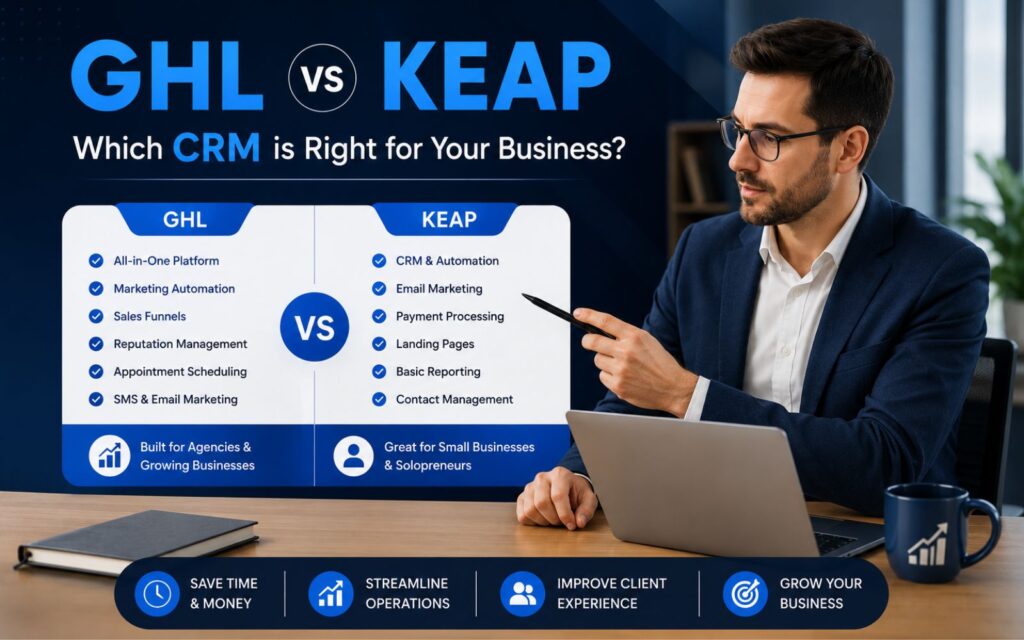
In a modern clinic, growth is a byproduct of systems. When a prospective patient calls and no one answers, that is a system failure. When a hygiene patient disappears for 18 months because no one followed up, that is a system failure. To fix these leaks, owners are increasingly looking at CRM (Customer Relationship Management) and automation platforms. In the current landscape, the debate often settles on two heavyweights: GHL vs Keap for dental marketing.
What Intelligence Means in a Dental Clinic
In a clinical setting, intelligence is diagnostic. In a business setting, intelligence is visibility and predictability.
An “intelligent” clinic is one where the owner doesn’t have to wonder why the schedule is light next Tuesday. They can look at a dashboard and see exactly how many leads are in the pipeline, how many treatment plans are pending signatures, and how many “lost” patients were successfully re-engaged by automation.
Intelligence means moving away from “heroics”—where the practice only functions because a veteran office manager works 50 hours a week—and moving toward “systems,” where the software handles the repetitive heavy lifting.
Human Intelligence vs. System Intelligence
Human Intelligence: The Front Desk Reality
Your front desk team is the heartbeat of the practice, but they are human. They get overwhelmed during the 8:00 AM rush. They forget to follow up on a $5,000 dental implant lead because the phone rang three times while they were checking in a patient.
System Intelligence: The Safety Net
System intelligence doesn’t replace your staff; it protects them. It acts as a 24/7 digital assistant. While your team focuses on the patient in front of them, the system handles:
- Missed Call Text-Back: Instantly texting a patient who called while the lines were busy.
- Automated Nurture: Sending educational content about Invisalign or implants to someone who expressed interest but didn’t book.
- Precision Reminders: Using multi-channel logic (SMS, Email, Voice) to ensure no-shows drop to near zero.
AI & Automation: Comparing GHL vs Keap for Dental Marketing
When evaluating GHL vs Keap for dental marketing, it’s important to understand the DNA of each platform.
Keap (formerly Infusionsoft)
Keap is a pioneer in the automation space. It is famous for its “Campaign Builder,” which allows for incredibly complex, branched logic. For a dental clinic, Keap is a powerful engine for long-term email nurturing. However, Keap can often feel like a “blank slate.” It requires significant time—or an expensive consultant—to build out dental-specific workflows from scratch.
GHL (GoHighLevel)
GoHighLevel was built specifically for agencies and small businesses that need “all-in-one” functionality. Unlike Keap, which focuses primarily on CRM and email, GHL integrates:
- Two-way SMS (crucial for dental patients).
- Reputation management (Google Review automation).
- Unified conversation hubs (Instagram, Facebook, SMS, and Email in one place).
- Funnel builders and landing pages.
For most dental clinics, GHL’s ability to consolidate five different subscriptions into one makes it the more pragmatic choice for operational stabilization.
Note: The link below is an affiliate link. I only recommend systems that align with structured clinic growth.
Think of it this way: if your clinic loses even five missed calls per week, that’s silent revenue walking away. A structured automation system prevents that leak by capturing every interaction instantly.
👉 [Start Building a Smarter Dental System](INSERT YOUR AFFILIATE LINK HERE)
Real Clinic Scenarios: Where Systems Win
To understand the impact of choosing between GHL vs Keap for dental marketing, let’s look at two common clinic scenarios.
Scenario A: The High-Value Lead
A patient clicks a Facebook ad for “All-on-4” implants at 9:00 PM on a Sunday.
- Without a system: The lead sits in an email inbox until Monday morning. By then, the patient has already messaged two other clinics.
- With GHL: An automated text goes out in 2 minutes: “Hi [Name], thanks for your interest in our implant seminar! Would you like to see our success gallery or book a quick 10-minute discovery call?” The patient is engaged while their intent is highest.
Scenario B: The “No-Show” Epidemic
A patient books a $2,000 crown prep but forgets the appointment.
- The Manual Way: Your receptionist calls them 15 minutes after the missed start time. The patient is embarrassed and makes an excuse. The chair stays empty.
- The Automated Way: The system sends a 48-hour text (confirmation required), a 24-hour email, and a 2-hour “parking instructions” text. If they haven’t confirmed by the 24-hour mark, the system alerts the front desk to call. This proactive approach treats the schedule as a sacred asset.
Implementing these workflows is what separates a chaotic office from a profitable, calm one.
[Start Building a Smarter Dental System](INSERT YOUR AFFILIATE LINK HERE)
Common Mistakes in Dental Marketing Automation
Even with the best tools, many clinic owners fail during implementation. When navigating GHL vs Keap for dental marketing, avoid these three pitfalls:
- Over-complicating the Logic: You don’t need a 50-step sequence. You need a “Missed Call Text-Back” and a “New Lead Follow-up.” Start simple.
- Ignoring the “Human” Element: Automation should make your team more available for high-value conversations, not replace them entirely. The goal is to get the patient on the phone or in the chair.
- Data Fragmentation: Using one tool for reviews, another for SMS, and another for lead tracking. This is where GHL usually wins over Keap—it keeps all patient data in a single “source of truth.”
For more insights on optimizing your digital presence, you can explore dental SEO best practices to drive more traffic into your chosen CRM.
The Future of Structured Clinics
We are moving into an era where “Dental AI” is becoming the norm. This includes AI that can read X-rays and AI that can handle front-desk phone calls. However, AI is only as good as the CRM it feeds into.
Whether you choose GHL vs Keap for dental marketing, the objective is the same: Revenue Stabilization. A system-driven clinic doesn’t suffer from the “rollercoaster” months. It has a steady stream of reviews coming in, a consistent follow-up process for unconverted treatment plans, and a rock-solid method for recapturing lost patients.
Conclusion: Systematize or Burn Out
The choice between GHL vs Keap for dental marketing ultimately depends on your technical comfort and your desire for an “all-in-one” solution. Keap offers deep, complex automation for those who want to build custom engines. GHL offers a comprehensive “Business-in-a-Box” that addresses the specific communication needs of a local clinic—reviews, SMS, and lead management.
As a clinic owner, your time is best spent on clinical strategy and leadership. By delegating the repetitive tasks of patient acquisition and retention to a structured system, you reclaim your time and ensure your practice’s growth is no longer left to chance.
Before you invest in more equipment, invest in your infrastructure. It is the highest-ROI decision you can make for your practice.
👉 [Start Building a Smarter Dental System](INSERT YOUR AFFILIATE LINK HERE)
FAQs
1. Is GHL or Keap easier for my dental staff to learn?
Generally, GHL is considered more user-friendly for dental teams because the interface mimics a modern social media/messaging app. Keap’s “Campaign Builder” has a steeper learning curve that often requires a dedicated specialist.
2. Can I integrate these CRMs with my Practice Management Software (PMS)?
Direct integrations with software like Dentrix or Open Dental can be complex. Most clinics use “Zapier” as a bridge, or they use the CRM as a “Front-End” to capture and nurture leads before manually entering them into the clinical PMS once they become patients.
3. How does GHL help with Google Reviews?
GHL has a native “Reputation Management” feature. You can trigger a text message to a patient immediately after their appointment, asking for a review. This is often more effective than Keap, which requires third-party integrations for similar SMS functionality.
4. Does “Missed Call Text-Back” really work?
Yes. Data shows that 60-70% of dental leads will hang up if they reach a voicemail and immediately call the next clinic on Google. An instant text saying, “Sorry we missed you, how can we help?” stops that “search behavior” and keeps the patient engaged with your clinic.
5. Is Keap better for long-term patient newsletters?
Keap’s email deliverability and sophisticated tagging make it excellent for complex newsletter strategies. However, for most dental practices, the simplified email builder in GHL is more than sufficient for monthly updates.
6. What is the cost difference between GHL vs Keap for dental marketing?
GHL typically offers a flat monthly fee for unlimited features, which is highly cost-effective for growing clinics. Keap’s pricing often scales based on the number of contacts in your database, which can become expensive as your patient list grows over the years.