
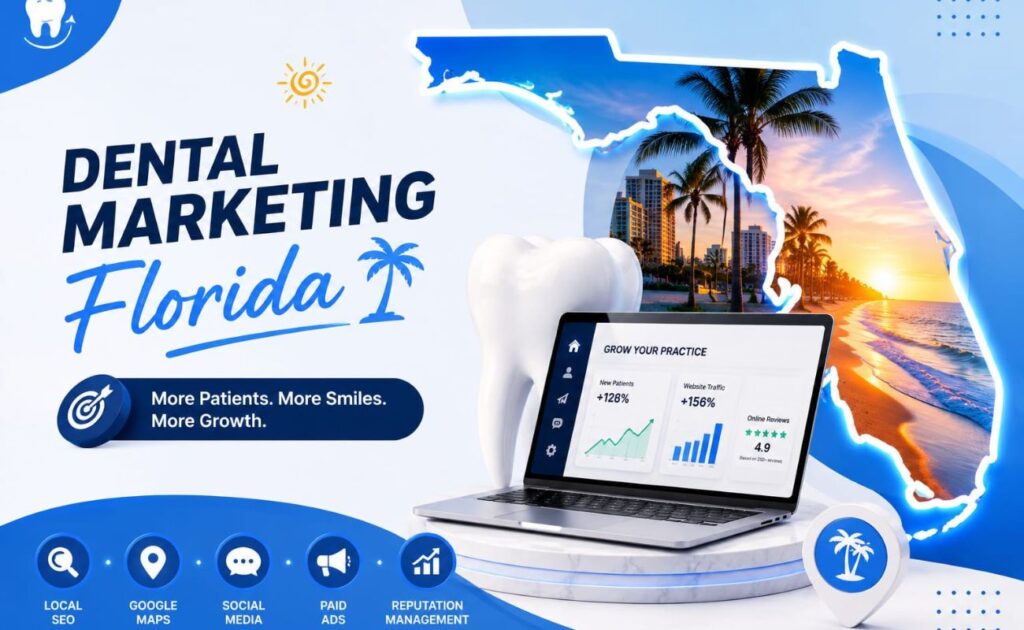
In the hyper-competitive landscape of modern dentistry, the traditional “patient-comes-to-me” model is officially obsolete. Especially in a market as saturated as Florida, dental practice owners are facing a choice: evolve into a data-driven, systematic powerhouse or watch their profit margins erode under the weight of rising acquisition costs and stagnant patient retention. Florida Dental Marketing is no longer just about running ads; it is about building a scalable ecosystem that converts curiosity into high-LTV (Lifetime Value) clinical relationships.
If you are looking to grow your dental practice in 2025, understanding Florida Dental Marketing automation trends is the first step toward getting more patients and dominating local search.
If your practice is still relying on manual follow-ups, inconsistent social posting, and “gut-feeling” growth strategies, you are losing money every hour. This guide provides the operational framework to transition from a chaotic manual practice to a high-performance “Smart Clinic.”
The Economics of Reputation: Why Your 1-Star Review is Costing You Thousands
In the digital age, your reputation is your most liquid asset. Many dentists view a negative review as a personal grievance; as a strategist, I view it as a mathematical failure of your patient experience systems.
A single 1-star review does not just hurt your ego; it creates a “reputational drag” that compounds over time. When a prospective patient in Florida searches for local care, their decision-making process is filtered through the lens of social proof. Research indicates that patients who report positive experiences are significantly more likely to engage in their own care, adhere to long-term treatment plans, and become vocal advocates for the practice (Milani & Boissy, 2023).
The Math of Erosion
If your average patient LTV is $5,000, and a negative review drops your lead conversion rate by even 5% due to decreased trust, you aren’t just losing one patient—you are losing the compounding effect of the referrals they would have generated. A “Smart Clinic” mitigates this through automated, compliant reputation management, ensuring that satisfied patients are nudged to leave reviews immediately post-treatment, burying the occasional negative outlier under a mountain of verified excellence.
The “Smart Clinic” Concept: System-Led vs. Person-Led Growth
The most dangerous phrase in a dental practice is “we’ve always done it this way.” We often see “Famous Doctors”—clinicians who are excellent at their craft but whose practices collapse the moment they step out of the office. They are the “bottle-neck” of their own growth.
In contrast, the “Smart Clinic” is built on the philosophy of system-led operations. By leveraging a centralized CRM like GoHighLevel, you shift the burden of growth from fragile human memory to robust, automated Workflow Triggers.
| Feature | The Chaotic Manual Clinic | The GHL-Automated Systematic Clinic |
| Lead Response | Manual call-back (1–24 hours) | Instant SMS/Email trigger (< 5 minutes) |
| Review Strategy | Passive/Reactive | Automated post-op satisfaction loops |
| Patient Follow-up | “Did we call them?” (Reliance on staff) | System-driven sequences (100% adherence) |
| Growth Predictability | Variable (Hope-based) | High (Data-based) |
| Staff Focus | Administrative drudgery | High-touch clinical care |
Systems don’t get tired, they don’t forget to follow up, and they don’t let leads “slip through the cracks” while the front desk is busy answering the phone.
FOR MORE INFORMATION OUR READ THIS GUIDE:Florida Dental Marketing
Operational Excellence: Solving the “Speed-to-Lead” Gap
Data from across the healthcare sector confirms that the “Speed-to-Lead” is the single greatest predictor of conversion. In dentistry, a lead that isn’t contacted within the first 15 minutes is a lead that is already looking at your competitor. Conversion rates plummet by up to 80% if the lead is not engaged immediately.
Implementing Workflow Triggers
To capture your market, your Florida Dental Marketing must include automated response sequences that fire the moment a form is submitted on your website.
- Instant SMS: “Hi [Name], this is [Clinic Name]. We received your request for a [Procedure] consultation. Do you have a moment to chat?”
- Automated Nurture: If no reply, the system initiates a secondary touchpoint via email, providing value-add content like a “First Visit Guide.”
- Internal Notification: Your front desk is pinged via Slack or text to pick up the conversation, turning a “digital lead” into a “human conversation” in under 3 minutes.
Strategic Note: Scalability is only possible when the systems manage the “routine” so your human staff can master the “extraordinary.” By automating the initial handshake, you protect your team from burnout and ensure every prospect is treated with VIP efficiency.
👉 Start Building a Smarter Dental System
Clinical Growth: Overcoming Implementation Failures
The biggest mistake practice owners make is purchasing software without building the “workflow logic” to support it. Buying a Ferrari doesn’t make you a racecar driver; buying a CRM doesn’t make you a marketer.
Why Software Alone Fails
If you automate a broken process, you simply scale the chaos. You must map your patient journey before you touch the technology:
- Audit your touchpoints: Where are patients currently dropping off? (e.g., initial inquiry, pre-op instructions, or post-op follow-up).
- Build the “Triggers”: Define the condition (e.g., Lead fills out form) and the action (e.g., Send SMS + Create Opportunity in CRM).
- Compliance First: Ensure every automated communication is HIPAA/GDPR compliant. Use secure, encrypted portals for PHI (Protected Health Information) and never include sensitive medical data in standard SMS triggers.
Real-World Case Study: Resolving Growth Stagnation
The Situation: A multi-specialty practice in Miami was struggling with a high CPA (Cost Per Acquisition) and poor conversion. They were spending $10,000/month on ads but manually handling leads, resulting in an average 4-hour response time.
The Strategy: We implemented a “Smart Clinic” architecture. We audited their revenue leakage points, identified that 60% of leads never received a second call, and automated their entire lead-to-booking journey.
The Result: Within 90 days, their response time dropped to under 3 minutes. Conversion increased by 35% without increasing their ad spend. By fixing the operational backend, we essentially gave them a 35% raise on their existing marketing budget.
Frequently Asked Questions
1. How can I ensure my automated marketing remains HIPAA compliant?
HIPAA compliance requires that you never transmit Protected Health Information (PHI) over unencrypted channels like standard SMS. Use your automation platform to send “Secure Portal Links” or simple appointment reminders that do not reveal sensitive clinical details. Always ensure your CRM provider signs a Business Associate Agreement (BAA).
2. Why does Florida Dental Marketing require a different approach than other states?
Florida is a hyper-competitive, transient, and price-sensitive market. High-volume advertising is expensive. You must differentiate through “experience-based marketing.” By leveraging automated reputation management and hyper-local SEO, you move the conversation from “price-shopping” to “trust-building.”
3. Does automation hurt the “personal touch” of my practice?
Quite the contrary. By automating the logistical, repetitive tasks—like booking reminders, appointment confirmations, and follow-up sequences—you actually free your staff to focus on the human element. Automation provides the structure; your staff provides the soul.
4. What is the most common reason dental marketing campaigns fail?
The “Implementation Gap.” Most practices focus on the “Traffic” (getting leads) but ignore the “System” (converting leads). If you spend $5,000 on ads but lack the automated follow-up sequences to close those leads, you are effectively setting your money on fire.
5. How long does it take to see an ROI on a system-led approach?
If your backend systems (CRM, lead routing, follow-up) are built correctly, you should see an increase in conversion efficiency within 30 to 60 days. This isn’t just about getting more patients; it’s about maximizing the value of the patients you are already paying to attract.
6. Can a “Smart Clinic” model work for a small, solo practitioner?
Absolutely. In fact, it is more critical for solo practitioners. Larger DSOs (Dental Support Organizations) have teams to do the manual heavy lifting; you don’t. Automation is the “force multiplier” that allows a small, lean team to compete with (and out-earn) the massive, less-personalized groups.
Strategic Note: Growth is not an accident; it is the inevitable byproduct of a well-engineered system. When you stop relying on “hustle” and start relying on “workflow,” you build an asset that grows in value every single month.
👉 Start Building a Smarter Dental System
Ready to grow your dental practice in Florida? Get your FREE Marketing Consultation today and start attracting more patients tomorrow! 👉 Book My Free Consultation Now