
For the modern dental clinic owner, the primary challenge is rarely the quality of clinical care. You have spent years mastering your craft; your crowns are precise, and your patient outcomes are excellent. Yet, many high-performing clinicians find themselves hitting a “revenue ceiling.” Despite a full schedule, the practice feels chaotic, overhead is climbing, and the front desk is perpetually overwhelmed.
The reality of modern healthcare is that dental growth does not come from better dentistry alone—it comes from intelligent systems.
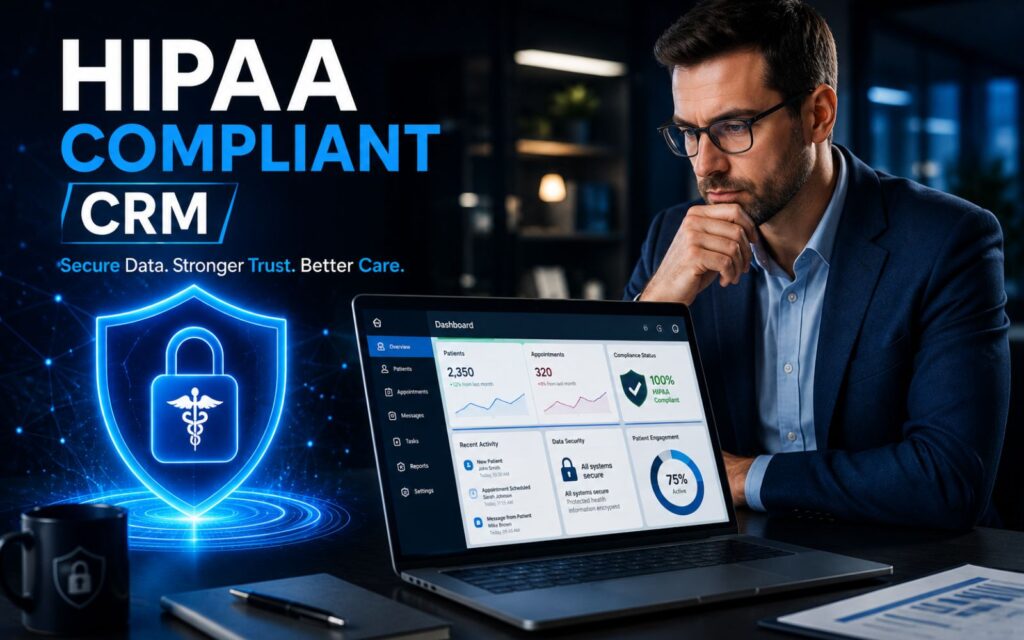
When we look at a HIPAA compliant CRM comparison, we aren’t just looking for a digital Rolodex. We are looking for an operational engine that plugs the “leaks” in your practice: the missed calls, the unconfirmed appointments, and the patients who disappear after a single hygiene visit.
1. The Operational Pain Points of the Modern Clinic
Most dental practices operate in a state of reactive management. The phone rings, the front desk answers (if they aren’t checking out a patient), and the appointment is booked. But what happens to the 30% of callers who hang up during a hold? What happens to the lead who inquired via your website form at 9:00 PM on a Sunday?
Without a structured system, these opportunities vanish. This is “leakage,” and for a mid-sized clinic, it can easily account for $10,000 to $30,000 in lost production every month. The burden then falls on the staff to manually “catch up,” leading to burnout and high turnover.
2. What “Intelligence” Means in a Dental Clinic
In a clinical setting, intelligence is diagnostic. In a business setting, intelligence is visibility.
An intelligent clinic knows its numbers beyond just total production and collection. It understands its Patient Acquisition Cost (PAC) and its Lead-to-Patient Conversion Rate. A HIPAA compliant CRM comparison reveals that the best tools don’t just store data; they provide a dashboard for these critical metrics.
Intelligence means moving from “I think we’re doing okay” to “I know exactly why our schedule is light next Tuesday, and the system is already fixing it.”
3. Human Intelligence vs. System Intelligence
Your front desk team is your most valuable human asset. However, asking a human to manually follow up with 50 “unscheduled treatment” leads while managing in-office patients is an inefficient use of human intelligence.
- Human Intelligence should be reserved for empathy, complex treatment coordination, and building chairside rapport.
- System Intelligence should handle the “grunt work”: SMS reminders, missed call auto-replies, and reactivation campaigns.
By offloading repetitive tasks to a CRM, you empower your staff to focus on the patient sitting in front of them, improving the overall patient experience.
4. The Role of AI and Automation in Dentistry
The word “AI” is often overhyped, but in a dental CRM context, it serves a very practical purpose. Imagine a scenario where a potential patient calls your office while the lines are busy. Instead of a cold voicemail, the system immediately sends a text:
“Hi, this is [Clinic Name]. We’re helping another patient right now, but we want to help you too. Are you looking to book an appointment or do you have a question?”
This is Missed Call Recovery. It keeps the lead off your competitor’s website and starts a conversation immediately.
Platforms like GoHighLevel have become central to this movement. While many CRMs are just databases, GoHighLevel functions as an all-in-one infrastructure. It allows clinics to centralize patient communication, reminders, and lead tracking inside one structured system. When performing a HIPAA compliant CRM comparison, the focus must be on how well these tools integrate with your existing workflow to ensure data security without sacrificing functionality.
Implementing a system is not about replacing your staff; it’s about providing them with a high-performance vehicle so they don’t have to run the marathon on foot. A structured automation system ensures that no patient falls through the cracks.
Note: The link below is an affiliate link. I only recommend systems that align with structured clinic growth.
[Start Building a Smarter Dental System](INSERT YOUR AFFILIATE LINK HERE)
5. Real-World Clinic Scenarios: Systems in Action
Scenario A: The “Ghost” Lead
A patient clicks a Facebook ad for dental implants at 11:00 PM. In a traditional clinic, that lead sits in an email inbox until 9:00 AM. By then, the patient has lost interest or contacted another office. The Systemized Approach: The CRM triggers an immediate automated reply with a link to book a consultation or a “Value Guide” on implants. The lead is “warmed up” before your staff even clocks in.
Scenario B: The No-Show Epidemic
No-shows are the silent killers of dental profitability. A manual phone call reminder is easy to ignore. The Systemized Approach: A multi-channel sequence (Email at 48 hours, SMS at 24 hours, and a final “I’m heading to the office” text 2 hours before) significantly reduces no-shows. If they must cancel, the system can automatically offer that slot to someone on your “ASAP” list.
Scenario C: The “One-and-Done” Patient
Many clinics struggle with retention. A patient gets a filling and is never heard from again. The Systemized Approach: The CRM tracks the “Last Visit” date. If 6 months pass without a booking, a personalized “We miss you” reactivation sequence begins, offering a small incentive to return for hygiene.
Think of it this way: if your clinic loses even five missed calls per week, that’s silent revenue walking away. A structured automation system prevents that by capturing intent the moment it happens.
[Start Building a Smarter Dental System](INSERT YOUR AFFILIATE LINK HERE)
6. Common Mistakes in Clinic Management
When clinic owners decide to upgrade their systems, they often fall into three traps:
- Fragmented Tech Stacks: Using one tool for SMS, another for email, and a third for lead tracking. This creates data silos and HIPAA risks.
- Over-Automation: Removing the human touch entirely. Automation should start the conversation, but a human should finish it.
- Ignoring HIPAA Compliance: Using non-secure platforms to discuss patient details. Any HIPAA compliant CRM comparison must verify that the provider offers a Business Associate Agreement (BAA). For more information on maintaining standards, you can refer to the official HIPAA Journal guidelines.
7. The Future of Structured Clinics: Revenue Stabilization
The ultimate goal of dental operations strategy is Revenue Stabilization. This is the point where your income is no longer a roller coaster based on how many new patients the front desk managed to book this week.
When you have a “Smarter Dental System,” your revenue becomes predictable. You know that for every X dollars spent on marketing, the system will capture Y leads, and the automation will convert Z% of them. This predictability allows you to scale, hire associates, or eventually exit your practice with a much higher valuation.
Before you make a decision, consider that the gap between a struggling practice and a thriving one is rarely the clinical skill—it is the infrastructure supporting the clinician.
[Start Building a Smarter Dental System](INSERT YOUR AFFILIATE LINK HERE)
8. Conclusion
Better dentistry is your passion, but intelligent systems are your leverage. By conducting a thorough HIPAA compliant CRM comparison and implementing a tool like GoHighLevel, you aren’t just buying software; you are installing a 24/7 operations manager. You are reducing “leakage,” ending the no-show cycle, and finally giving your front desk the breathing room they need to provide elite patient care.
Stop being the “everything person” in your practice. Let the system hold the weight so you can focus on the chair.
FAQs
1. Is GoHighLevel actually HIPAA compliant? Yes, but it requires the “Healthcare/HIPAA” upgrade. You must also sign a Business Associate Agreement (BAA) with the platform and configure your settings to ensure Protected Health Information (PHI) is handled correctly.
2. How does a CRM help with missed call leakage? Most advanced CRMs feature “Missed Call Text Back.” When a call goes unanswered, the system immediately texts the caller. This initiates a text-based conversation, preventing the lead from calling the next dentist on Google.
3. Will automation make my practice feel “cold” or robotic? Quite the opposite. By automating the mundane “confirming” and “reminding” tasks, your staff has more time for meaningful, warm interactions with patients in the office. You can also customize the language to match your specific “voice.”
4. Can I replace my Dental Practice Management Software (PMS) with a CRM? No. A CRM like GoHighLevel is meant to work alongside your PMS (like Dentrix or Open Dental). The PMS handles clinical records and billing, while the CRM handles marketing, lead acquisition, and patient communication.
5. How long does it take to see results from a new system? Most clinics see a reduction in “missed call loss” within the first 48 hours of activation. Patient reactivation and no-show reductions typically show a measurable impact on the bottom line within 30 to 60 days.
6. Do I need a full-time IT person to manage this? No. While there is a setup phase, these systems are designed for clinic managers and owners. Once the “snapshots” (pre-built dental workflows) are installed, the system runs largely on autopilot with minimal weekly oversight.